American cooking Recipes & regional stories

Skillet & Sage

A culinary journey through the fifty states

The regional table / Georgia

Savannah Red Rice
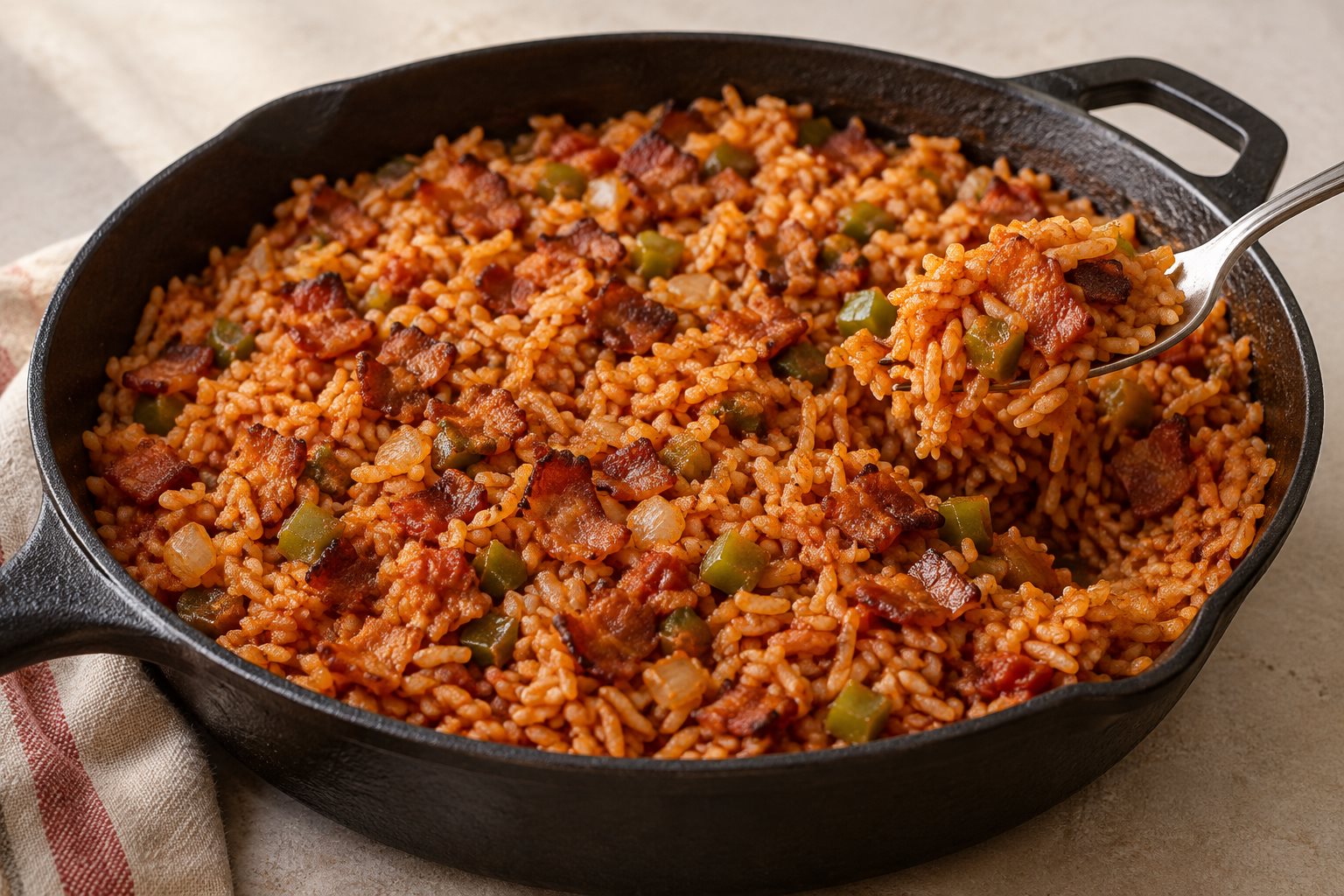
A cast iron skillet of brick-red long-grain rice, separate grains flecked with browned bacon and green pepper, a fork lifting one corner
The color comes from tomato cooked down in fat before the rice goes in, not from tomato stirred into finished rice. The grains stay whole and dry. AI-generated illustration.

Fry the tomato first. Everything else about this dish is ordinary, and that one step is the difference between red rice and rice with tomato in it.

Red rice is rice-kitchen food, and the rice kitchens of the Georgia coast were African. The National Park Service says it plainly on the page for Fort Frederica National Monument, on St. Simons Island: the Gullah Geechee are "descendants of enslaved Africans from various ethnic groups of west and central Africa," and people taken from what the traders called the Rice Coast "were considered very valuable" because "they were skilled workers who possessed detailed knowledge of large-scale rice production," knowledge they "were forced to utilize" to produce immense profits for the men who owned them. The same NPS page notes that the sweetgrass baskets still woven on that coast "were commonly used on plantations to harvest rice," and that the ring shout "evolved from Africans enslaved on rice and cotton plantations." The tidal rice fields below Savannah were built, diked and worked by those people; the way rice is cooked in that city — grain separate, dry, steamed rather than boiled and drained — came from them, and so did this dish.

The printed trail runs through two Georgia cookbooks. Mrs. A. P. Hill of Georgia, whose New Cook-Book carried her receipts from the 1860s into an 1898 edition, gives No. 135, "Tomato Pilau": fry a cut-up fowl and an onion in lard, add a pint of peeled tomatoes seasoned with pepper, salt and a teaspoonful of sugar, pour boiling water over, stir in a pint of washed rice, simmer gently — "This should not have gravy." Then The Savannah Cook Book, sold in 1909 for the building fund of Westminster Presbyterian Church and printed by the Morning News, gives the dish almost exactly as Savannah still makes it, under the name "Tomato Pillau a la South Carolina": one quart of tomatoes, one dozen small slices of bacon, three cups of rice, the bacon fried crisp, the tomatoes drained and chopped fine and their pulp fried in the hot drippings before the juice and bacon go back, salt, pepper and a little sugar if the tomatoes are acid, then the rice and boiling water an inch over the top, set at the back of the stove and stirred only now and then with a fork. Note what that book does not say: it does not call the dish red rice, and it credits South Carolina. The name Savannah made its own later — when the Savannah Tribune ran a notice for the Rib Hut on West Bay Street on 5 August 1981, the plate was ribs, red rice, collard greens and muffins for $2.50.

Why this version works

A covered steam and no stirring. Once the rice is in, the pot is a steamer. Stirring breaks grains and releases starch, which is precisely the gluey result Savannah cooking avoids. The old direction — set it at the back of the stove, lift a fork through it only occasionally — is a low even heat and a closed lid, which today means the oven.

The tomato is fried, not stirred in. Draining the tomatoes and cooking the pulp in bacon fat until it darkens and catches is the whole technique of the 1909 recipe and the reason the finished rice is brick red rather than pink. Raw tomato added with the liquid stays sour and thin; fried pulp turns sweet, concentrated and fatty, and fat is what carries that color onto every grain.

Liquid measured by depth, not by ratio. The old book says water to the depth of one inch over the rice, which sounds careless and is smarter than a ratio. Tomatoes vary wildly in how much juice they give up, so a fixed cup count either drowns the rice or leaves it hard. Level the rice, pour until a knuckle's depth stands over it, and the pot corrects itself.

Bacon fat, then the bacon back at the end. The fat does the cooking and the meat does the eating. Frying the bacon crisp first, then returning it late, keeps it in pieces you can find; bacon left in the pot the whole time goes soft and disappears into the rice, leaving salt behind but nothing to bite.
Ingredient notes

Rice: long-grain white, and rinsed until the water runs clear. Carolina Gold, milled from the old Lowcountry seed, is the historically right grain and behaves the same way. Do not use parboiled rice, which will not take on color, or short-grain, which goes sticky.

Bacon: eight ounces of thick-cut, which is about the dozen small slices the church book specifies. Smoked slab bacon or a piece of smoked ham hock meat is closer to the old coastal pantry and gives a deeper flavor.

Tomatoes: a 28-ounce can of whole tomatoes is the modern stand-in for the quart the 1909 book calls for. Drain them over a bowl and keep every drop of the juice — it is part of your inch of liquid. Fresh summer tomatoes work if you peel and seed them first.

Onion and pepper: one onion and one green bell pepper. Mrs. Hill's tomato pilau has the onion; the 1909 Savannah version has neither. Savannah kitchens today nearly always include both, so they are here, but the dish is honest without them.

Step by step

  1. Fry the bacon. Cook the chopped bacon in a wide ovenproof pot or 12-inch skillet over medium heat until crisp, 8 to 10 minutes. Lift it out to a plate and leave about 3 tablespoons of fat behind.
  2. Soften the vegetables. Cook the onion and bell pepper in the fat with a pinch of salt over medium heat, 6 to 8 minutes, until soft and just beginning to color. Heat the oven to 350°F.
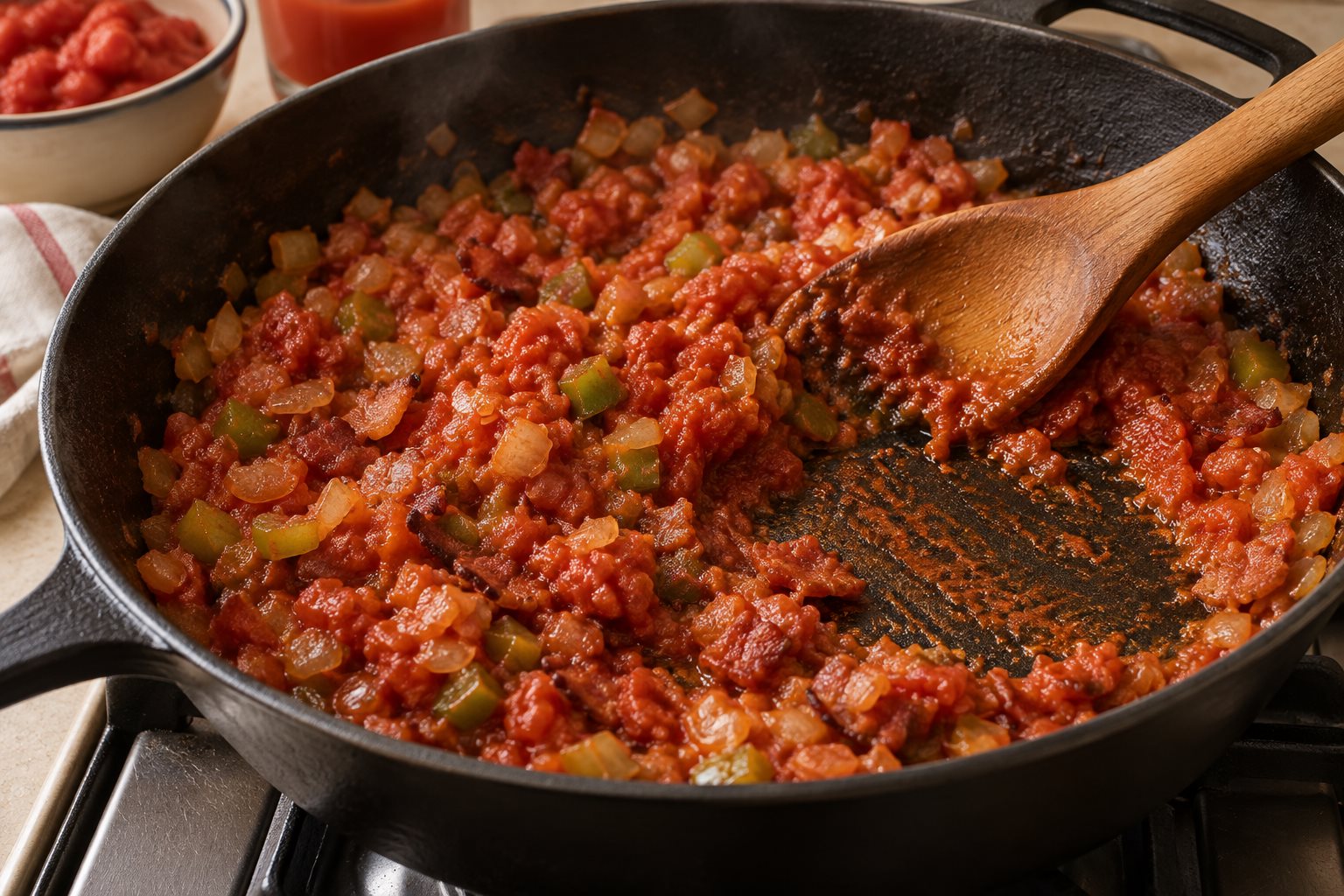
  3. Fry the tomato pulp. Drain the tomatoes, keeping the juice. Chop them fine, pulling out the hard cores, and add the pulp to the pot. Cook 8 to 10 minutes, stirring, until it darkens to brick red, smells sweet and leaves a film on the bottom of the pan.
    Tomato pulp with onion and green pepper cooked down to a brick-red film in a skillet.
    Cook the tomato pulp until it darkens to brick red before adding the liquid and rice. AI-generated illustration.
  4. Season and measure the liquid. Add the reserved tomato juice, the salt, black pepper, cayenne and the sugar if the tomatoes taste sharp. Pour in enough broth to bring the liquid to 2¾ cups in total, and bring it to a boil.
  5. Rice in, lid on. Stir in the rinsed rice and half the bacon, level the surface with a spoon and check that the liquid stands about an inch above it. Cover tightly and move the pot to the oven for 25 minutes.
  6. Steam and fork. Take it out without lifting the lid and let it sit 10 minutes. Then uncover, run a fork through from the edges inward to separate the grains, and scatter the rest of the bacon over the top.
Wet, clumped rice means too much liquid or an early peek under the lid. Leave the pot uncovered on the lowest burner for five to eight minutes and the surplus steams off; drag a fork through once, not twice. Rice still hard at the 25-minute mark has the opposite problem: sprinkle two tablespoons of hot broth over the surface, cover, and give it another eight minutes off the heat rather than on it. Neither fault can be stirred away, and stirring is what turns a recoverable pot into porridge.

Storage and make-ahead

Keeps 4 days refrigerated. Reheat covered with a tablespoon of water per portion, in a low oven or a covered skillet over low heat, until steam comes through — the microwave dries the edges and leaves the middle cold.

It freezes better than most rice because the fat protects the grains: 3 months in a sealed container, thawed overnight and reheated the same way. Leftovers fried hard in a skillet with an egg on top are worth planning for.

What to serve with it

On the Georgia coast this sits next to something from the water or the smoker — shrimp, crab, barbecued ribs, smoked sausage — with collard or mustard greens and their pot likker alongside. A bowl of red rice with a fried egg is also a complete supper and nobody in Savannah would think it strange.

A cast iron skillet of brick-red long-grain rice, separate grains flecked with browned bacon and green pepper, a fork lifting one corner

From the recipe box / Georgia

Savannah Red Rice

Long-grain rice cooked in tomato fried down in bacon fat until it darkens, then steamed until every grain is separate and stained through.

Prep
20 min
Cook
45 min
Total
1 hr 5 min
Serves
6
Calories
410 per serving

Ingredients

Scale

Instructions

  1. Fry the bacon crisp in a wide ovenproof pot, lift it out and leave 3 tablespoons of fat.
  2. Soften the onion and bell pepper in the fat for 6–8 minutes. Heat the oven to 350°F.
  3. Chop the drained tomatoes fine and fry the pulp 8–10 minutes until it darkens to brick red.
  4. Add the reserved juice, salt, black pepper, cayenne and sugar, then broth to make 2¾ cups of liquid, and bring to a boil.
  5. Stir in the rice and half the bacon, level it, cover tightly and bake 25 minutes.
  6. Rest 10 minutes with the lid on, fork the grains apart and top with the remaining bacon.

Nutrition

Fat14 g (5 g saturated)
Sodium760 mg
Protein12 g
Servingabout 1 cup
Calories410
Cholesterol30 mg
Carbohydrates58 g (5 g sugar, 3 g fiber)

Nutrition is an estimate calculated from the listed ingredients and is provided as a courtesy, not as dietary advice.

Questions readers ask

Can I add shrimp or sausage?

Sliced smoked sausage browned with the bacon is common in Savannah and needs no adjustment. Shrimp should go in raw and peeled on top of the finished rice for the 10-minute rest with the lid on — that is enough to cook them and they stay tender, while shrimp baked the full 25 minutes turn to rubber.

Can I make it on the stovetop?

Yes, and that is how the 1909 book does it: cover the pot and set it over the lowest possible heat for 25 minutes, then rest it off the heat for 10. Use a heavy pot with a tight lid, because a thin pan scorches the tomato sugars on the bottom long before the rice is done. The oven is simply the modern version of the back of the stove.

Why is my rice pink instead of red?

The tomato was not cooked down far enough. The pulp has to lose most of its water in the fat and go several shades darker before any liquid joins it; if it still looks like tomato sauce when the rice goes in, the color will be pale and the flavor thin. Give that step the full ten minutes and let it stick a little.

Is red rice the same as jambalaya or Spanish rice?

They are cousins in method, not the same dish. All three cook raw rice in a seasoned liquid so the grain absorbs its color, which is a West African way of cooking rice that travelled wherever the people who knew it were taken. Savannah red rice keeps a short ingredient list — tomato, pork fat, rice — where jambalaya carries a larger cast of meats and Spanish rice takes a different seasoning entirely.