The regional table / New Hampshire
New England Boiled Dinner
The cooking is an afternoon of doing nothing. The part worth understanding happened weeks earlier, in a barrel, and the government wrote it down.
The dish is corned beef and root vegetables boiled in one pot, and there is not much to it once the beef is corned. That is where the documents are. Farmers' Bulletin 1415, Beef on the Farm: Slaughtering, Cutting, Curing, published by the United States Department of Agriculture in 1924, gives the whole of it under the heading Curing Beef. Salt, sugar and saltpeter are the three, and it says what each one does: salt "cures the meat and extracts water from the tissues, tending to make it hard and dry"; the action of saltpeter "is similar to that of salt, but in addition gives the meat a reddish or pink color"; sugar "softens the harshness of the salt and improves the flavor of the meat". The numbers are as plain. Cut the beef in pieces five or six inches square, weigh it, allow 8 pounds of salt to every 100 pounds of meat, pack it in alternate layers with the salt in a scoured barrel or stone jar, let it stand overnight, then pour over a solution of 4 pounds of sugar, 2 ounces of baking soda and 4 ounces of saltpeter dissolved in a gallon of lukewarm water, add three gallons more water, and weight the meat under the brine, because any piece that projects spoils the whole. Twenty-eight to forty days. If the brine goes ropy in the spring, scrub every piece with hot water and a stiff brush and start again with new brine. The revision of that literature still in print forty years later, Farmers' Bulletin 2209, Slaughtering, Cutting, and Processing Beef on the Farm, 1966, changes almost nothing: 8 to 10 pounds of salt, the same 4 pounds of sugar and 4 ounces of saltpeter in four gallons of water, thirty to forty days, and a warning that the brine turns ropy if the temperature rises much above 38°F.
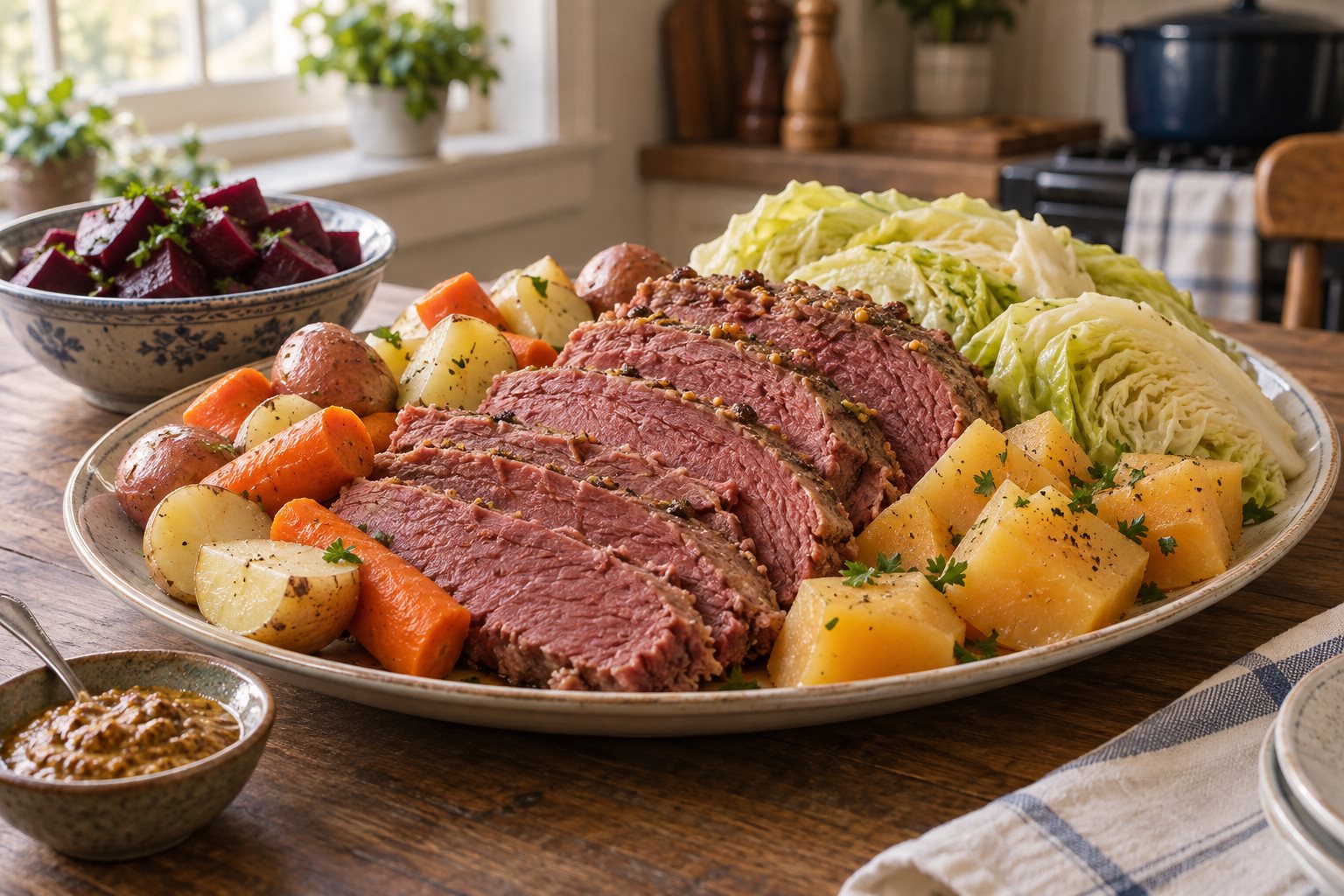
The colour that saltpeter fixes is still the legal point of the stuff. The federal table of permitted curing agents at 9 CFR 424.21 lists sodium or potassium nitrate as a "source of nitrite" and sodium or potassium nitrite with its purpose given in three words — "To fix color" — capped so that the use of nitrites, nitrates or a combination "shall not result in more than 200 ppm of nitrite, calculated as sodium nitrite in finished product". A barrel in a shed had no way of measuring that, which is why the modern home cure uses a measured curing salt instead of a scoop of saltpetre. For the cooking, the clearest old instruction is Fannie Merritt Farmer's, page 184 of The Boston Cooking-School Cook Book of 1896, under the heading Boiled Dinner, and it is four sentences long: warm unpressed corned beef served with cabbage, beets, turnips, carrots and potatoes; skim the fat off the meat water and cook the vegetables in it, "with exception of beets, which require a long time for cooking"; carrots take longer than cabbage or turnips; cabbage and beets are served in separate dishes. She is short about the meat itself — "Corned beef has but little nutritive value", she writes, and it "is eaten by the workingman to give bulk to his food" — which tells you what the dish was for.
Why this version works
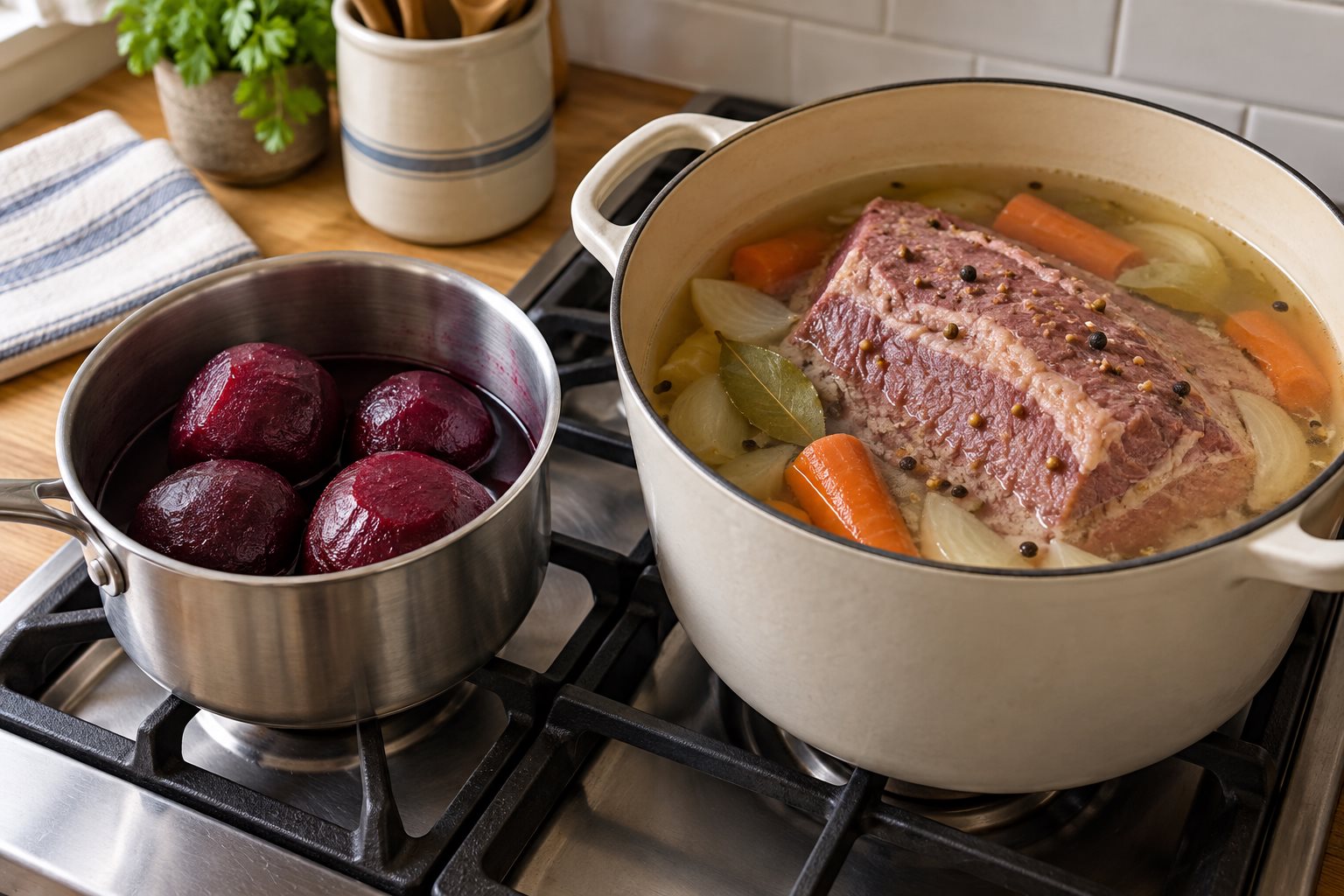
The beets cook apart. This is the one rule in Farmer's four sentences that people break, and the pot goes uniformly pink when they do. Beets also want an hour where cabbage wants twelve minutes, so keeping them out solves two problems with one saucepan. They come back to the table in their own dish, and what is left of them becomes tomorrow's hash.
Below a boil, the whole way. Farmer puts the meat in cold water, brings it slowly to the boiling point, boils five minutes, skims, and then cooks it "at a lower temperature until tender". A hard boil squeezes a brisket into strings; the fibres tighten and push out the water the brine spent a month putting in. Hold the surface at a shiver, around 185°F, and three hours gets you meat you can cut with the side of a fork.
The vegetables go in backwards. Everything cooks in the beef broth, which is the point of the dish, but nothing survives three hours in it. Add by the clock rather than all at once: carrots and turnip first because they are dense, potatoes next, cabbage last and barely. Farmer says the same in her own order, and it is the difference between a boiled dinner and a pot of mush.
Salt is the risk, not the seasoning. A supermarket brisket has been in a pumped brine, not a barrel, and it carries more salt than a cure of the old kind ever left. Rinse it, start it in plenty of fresh cold water, throw away nothing but the scum, and taste the broth before the vegetables go in. If it is already too salty to drink, pour half of it off and top up with water — the vegetables are about to take up everything that is in there.