American cooking Recipes & regional stories

Skillet & Sage

A culinary journey through the fifty states

The regional table / Iowa

Iowa Chop
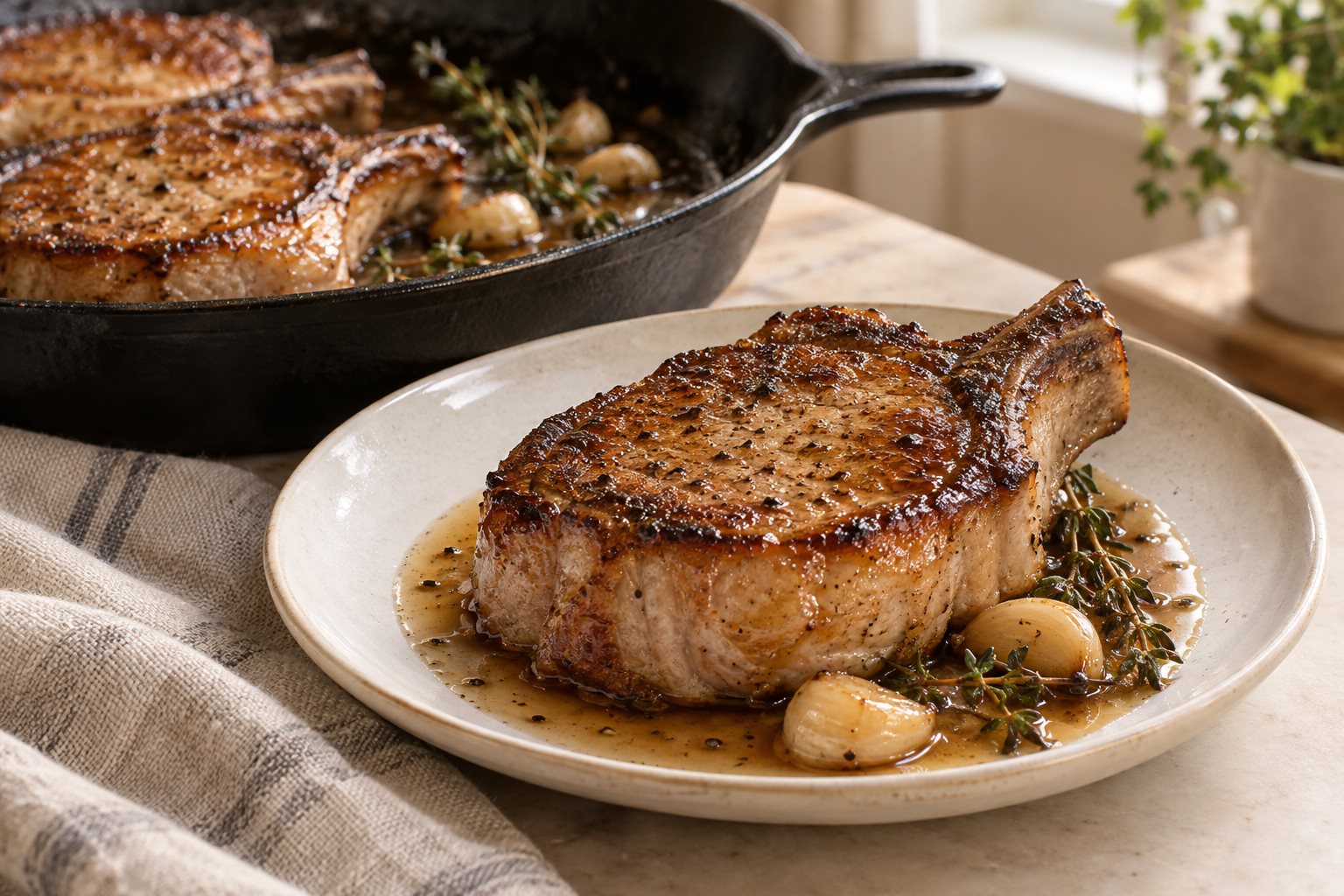
A thick browned bone-in pork loin chop with garlic cloves, thyme and glossy pan sauce.
An inch and a half is not a suggestion. At an inch you are cooking a different dish. AI-generated illustration.

This is the one American regional dish whose origin is not folklore at all: a state agency named it, described it, and registered it, and a reporter wrote the whole thing down.

Most regional dishes come to a writer as a story somebody's grandmother told. This one comes as a news item. The Carroll Daily Times Herald of 22 April 1976 ran a piece by Paul Holley of the Iowa Daily Press Association, datelined Des Moines, under the headline "Iowa Chop Promoted by IDC". The Iowa Development Commission, it reports, "is hoping to make a pork cut — dubbed the Iowa Chop — as well known as its beef counterpart, the New York Strip". Doug Snyder, deputy director of the commission's agriculture division, "described the Iowa Chop as a fresh one-inch to one-and-a-half-inch center cut pork loin". Snyder said the title had originated with the Iowa Pork Producers' Association three years earlier, and that the commission was helping the producers promote the cut by registering the name with the Iowa secretary of state: registration "will give the commission control of the Iowa Chop name". His own gloss on what that control was for is the best line in the story — "The name may be used by any retailer or restaurateur who wants to promote the cut; we will only use control if someone tries to mislabel the chop." The commission expected to rely on word of mouth, Snyder said, "because regional names cannot be registered in wholesale meat suppliers' order books", and it was building an Iowa Chop display for the National Hotel, Motel and Restaurant Association convention in Chicago that May. A dish, in other words, with a campaign plan.

The federal record confirms his point about the order books by simply not containing the thing. 9 CFR 317.344 lists the major cuts of single-ingredient raw meat that a label must use, and the pork entries run: pork loin chop, pork loin country style ribs, pork loin top loin chop boneless, pork loin rib chop, pork spareribs, pork loin tenderloin, pork loin sirloin roast, pork shoulder blade steak, pork loin top roast boneless. There is no Iowa chop on that list and there never has been. Legally the thing in this recipe is a pork loin chop; "Iowa chop" is a promotional name for a thickness, and the 1976 story says so in the plainest terms. Two further notes on dates, because they are easy to get backwards. The campaign is a state one — the Iowa Development Commission and the state's own producers' association — and it predates the national pork checkoff by a decade: the Pork Promotion, Research, and Consumer Information Act is of 1985 and its order, 7 CFR part 1230, is what put a mandatory assessment on every hog sold and created the national board. And the name really does begin in the 1970s. The handful of earlier hits the Iowa archives offer are optical-character mirages: a 1936 crop report in which "Iowa corn crop" has collapsed into "Iowa chop" at 185,000,000 bushels, and a 1954 notice of the Iowa CHOP Committee, which was a relief charity shipping butter and cheese overseas. No printed recipe attaches to the 1976 announcement, so the quantities below were worked out for this page.

Why this version works

A short wet brine. Ninety minutes in salt water takes a modern lean loin chop from unforgiving to forgiving. Salt loosens the muscle proteins so they hold water through cooking, which buys you roughly ten degrees of margin on either side of where you meant to stop.

The thickness is the dish. At an inch and a half the centre is still climbing to temperature long after the surface has browned, which is the only way to get a hard crust on pork without drying the middle. Thin chops give you a choice between pale and overcooked; there is no third option.

Pulled at 140°F and rested. Carry-over takes a chop that thick another five degrees off the heat, which lands it at about 145°F — pink at the centre, firm, and still full of juice. The grey chop most of us were raised on is a chop taken fifteen degrees further, and that is the whole of pork's bad reputation.

Sear on the stove, finish in the oven. The crust wants fierce direct heat for four minutes; the middle wants gentle surrounding heat for fifteen. Trying to do both on the burner scorches the outside before the inside moves, and doing both in the oven leaves a grey chop with no colour on it at all.
Ingredient notes

Salt: kosher salt for the brine, at a quarter cup to two quarts. If you use fine table salt cut it to two and a half tablespoons, or the chops come out inedible.

Aromatics: thyme, garlic and a spoonful of cider vinegar. Iowa pork is sweet and the vinegar at the end is what keeps the pan sauce from cloying — apple in any form does the same job, which is why so many pork chops arrive with it.

The chops: bone-in centre-cut loin chops, 1½ inches thick, 12 to 14 ounces each. That is a butcher order, not a supermarket tray — ask for a centre-cut loin cut two to the inch and a half. The bone is worth having; it slows the side nearest it and gives you something to hold.

Fat for the pan: a neutral oil for the sear and butter added only at the end. Butter in a 450°F pan for four minutes is black butter, and the pan sauce tastes of it.

Step by step

  1. Brine. Dissolve the salt and sugar in 2 quarts of cold water and submerge the chops for 90 minutes in the fridge, no longer. Lift them out, rinse briefly and dry them thoroughly on both sides and along the fat edge.
  2. Temper and heat. Leave the dried chops on a rack at room temperature for 30 minutes while the oven comes to 400°F. Cold chops from the fridge need a further five minutes in the oven and colour unevenly.
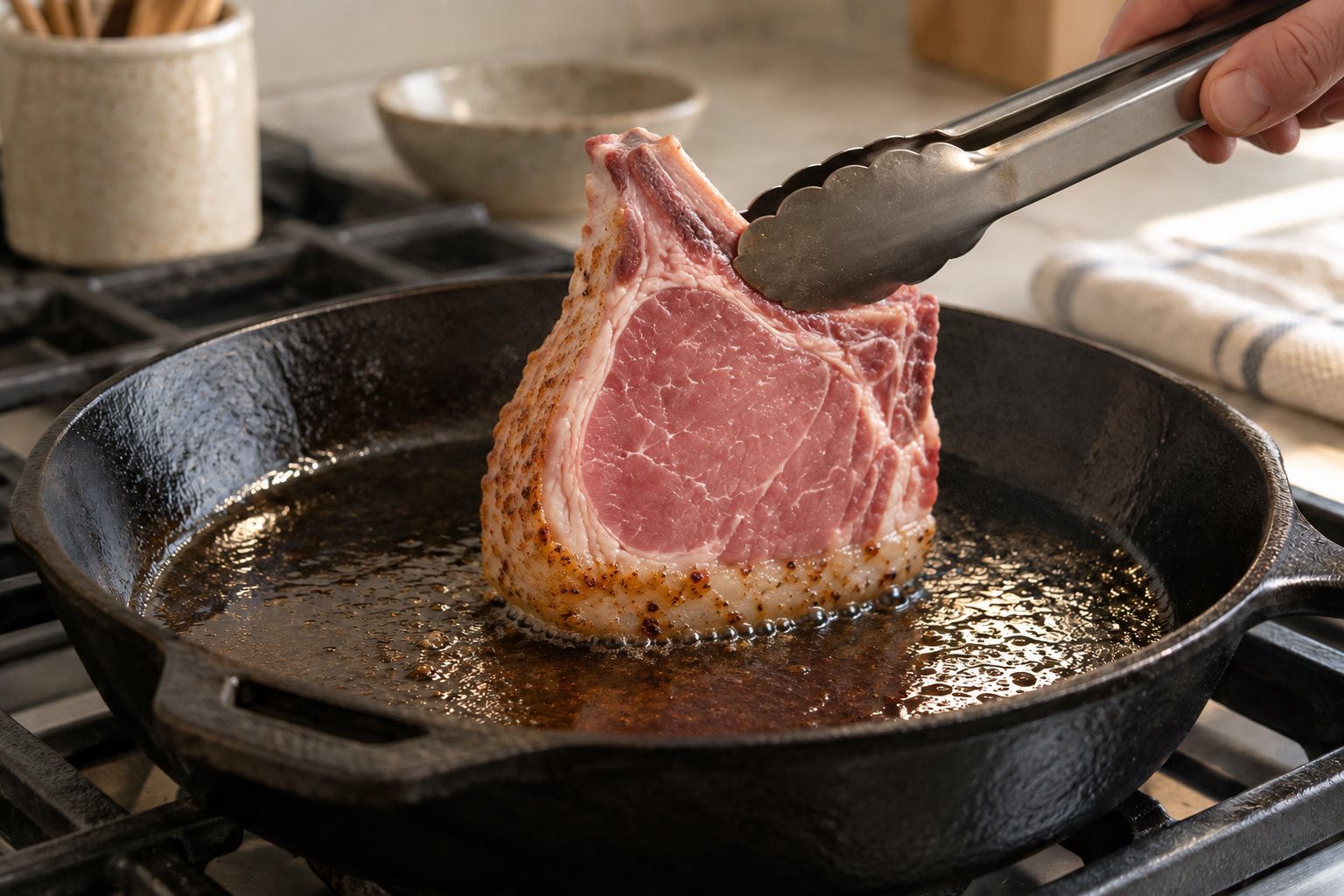
  3. Sear the fat edge first. Heat the oil in a heavy oven-safe 12-inch skillet over medium-high. Stand the chops on their fat edge, holding them with tongs, for 2 minutes until the fat is browned and has given up a slick into the pan.
    Tongs holding a thick pork chop upright on its browned fat edge in a skillet.
    Brown the fat edge first, holding the thick chop upright with tongs. AI-generated illustration.
  4. Sear the faces. Lay them flat and cook 3 to 4 minutes a side without moving them, until each face is a solid deep brown rather than a patchwork. Season with the pepper.
  5. Into the oven. Scatter in the garlic cloves and thyme and move the whole pan to the oven. Roast 10 to 14 minutes, until the thickest part away from the bone reads 140°F.
  6. Rest, then build the pan sauce. Move the chops to a board and rest 8 minutes; they will climb to about 145°F. Set the pan over medium heat, pour in the stock and vinegar, scrape up everything stuck to the bottom, reduce by half and swirl in the butter off the heat. Pour it over the rested chops with the garlic.
If a chop reads 155°F or more, do not try to save it with sauce — slice it off the bone against the grain into quarter-inch slices, lay them overlapping in the pan sauce, and let them sit in it for two minutes off the heat. Sliced thin and wetted, an overcooked chop eats far better than it does whole, and nobody at the table need know.

Storage and make-ahead

Cooked chops keep 3 days refrigerated. Store them whole and unsliced with any pan sauce in a separate container; a chop sitting in liquid overnight goes soft on the outside.

Reheat gently: 300°F for 10 minutes, covered, or sliced into a warm pan with a spoonful of stock. High heat finishes the job the oven started and there is no recovering from that twice.

What to serve with it

The state answer is applesauce, and it is the right one — its acid does what the vinegar in the pan sauce does. Otherwise: sweetcorn off the cob, a vinegary cucumber and onion salad, and something starchy enough to take the pan sauce, which means mashed potatoes or plain white bread.

A thick browned bone-in pork loin chop with garlic cloves, thyme and glossy pan sauce.

From the recipe box / Iowa

Iowa Chop

A centre-cut pork loin chop an inch and a half thick, brined, seared hard and finished in the oven in the same pan it browned in.

Prep
15 min
Cook
25 min
Total
2 hr 30 min
Serves
4
Calories
520 per serving

Ingredients

Scale

Instructions

  1. Brine the chops 90 minutes in 2 quarts of cold water with the salt and brown sugar, then rinse and dry thoroughly.
  2. Rest them on a rack at room temperature 30 minutes while the oven heats to 400°F.
  3. Heat the oil in an oven-safe 12-inch skillet over medium-high and brown the chops on their fat edge for 2 minutes.
  4. Lay them flat and sear 3–4 minutes a side until deeply browned, then season with the pepper.
  5. Add the garlic and thyme and roast in the oven 10–14 minutes, to 140°F away from the bone.
  6. Rest the chops 8 minutes; reduce the stock and vinegar in the pan by half, swirl in the cold butter off the heat and spoon it over.

Nutrition

Fat28 g (11 g saturated)
Sodium820 mg
Protein55 g
Serving1 chop with pan sauce
Calories520
Cholesterol160 mg
Carbohydrates3 g (2 g sugar, 0 g fiber)

Nutrition is an estimate calculated from the listed ingredients and is provided as a courtesy, not as dietary advice.

Questions readers ask

Do I have to brine?

For a chop this thick, yes, or accept a much narrower window. Ninety minutes is enough; several hours makes the meat spongy and faintly hammy, which is a different and worse dish.

Why stop at 140°F?

Because the chop keeps cooking on the board. Out of the oven at 140°F and rested eight minutes, a chop this thick settles at about 145°F, which is where it is still pink and still juicy. Take it to 160°F in the pan and it will be 165°F by the time you cut it.

Can I use boneless chops?

You can, and the method is unchanged, but buy them the same thickness and pull them two or three minutes earlier. Without the bone the chop cooks more evenly and dries faster, which is a fair trade in one direction only.

Is "Iowa chop" a legal name for a cut?

No. The federal list of major meat cuts at 9 CFR 317.344 names pork loin chop and pork loin rib chop and contains no Iowa chop at all. The 1976 news story is candid about this: the state registered the name with the Iowa secretary of state precisely because regional names cannot be put into wholesale meat suppliers' order books.