The regional table / Nevada
Sheepherder's Bread
A sheep camp had no oven, so the oven went into the ground — and the ground is harder to read than a thermostat.
The method is the recipe here, and it is documented in the herders' own families rather than in any cookbook. Janet C. Inda, born at Fallon in 1945 and the daughter of a Basque sheepherder, was interviewed for the University of Nevada Oral History Program in 1981; the transcript was published as Basque Sheepherder's Daughter in 1982. She remembers her father as the camp baker, and remembers watching "them put the bread in the big pits and cover them up with dirt". The family still owned the kit when she was interviewed — "we still have our bedrolls and our camp pots and our sheepherder tents and the big dutch ovens that we cooked in" — and she kept two at home, one of which she used for nothing but bread.
The same transcript contains the honest part, which no romantic account of buried bread will tell you. When the family moved to Wadsworth and got two wood stoves, they moved the baking indoors, "because we never quite got the knack of cooking the bread underground without either undercooking or overcooking it". The mechanism behind the buried oven is in the camp-cookery literature: Horace Kephart's Camp Cookery, published in New York in 1910 and long out of copyright, describes the Dutch oven as "a cast-iron pot with flaring sides and short legs, fitted with a thick iron cover, the rim of which is turned up to hold a layer of coals on top", and gives the rule that still governs this loaf — "Get the bottom moderately hot, and the lid very hot (but not red, lest it warp)." One note on the name: the phrase sheepherder's bread returns no hits at all in the digitised run of the Ely Daily Times, which covers White Pine County from 1907 to the present, and none in the Georgia Historic Newspapers archive, which indexes reprints from all over the country down to 2024. The loaf is older than whatever anybody decided to call it.
Why this version works
Lid on, then lid off. The first twelve minutes under the lid trap the dough's own steam, which is what lets the loaf keep expanding after the crust would otherwise have set. Take the lid off for the rest and the top browns and dries. Bake it covered throughout and you get a pale, damp-topped loaf; bake it open throughout and it stops growing far too early.
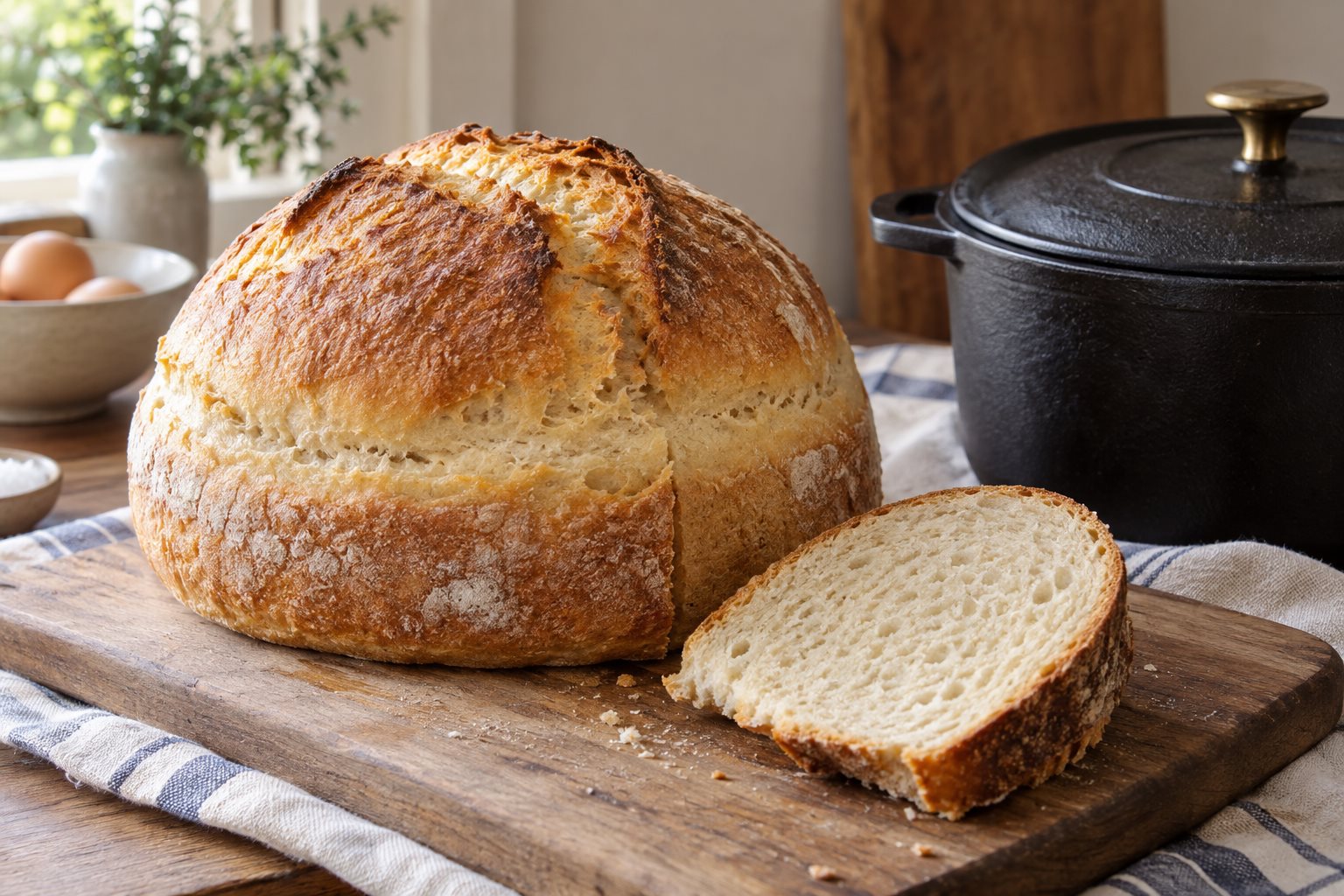
The pot is the loaf shape. There is no tin and no proving basket in this bread. The dough is dropped into a greased five-quart Dutch oven, and it rises into the walls, up the sides and against the lid. That is where the straight sides, the flat pale waist and the domed split top come from, and no other vessel gives them to you.
Butter and sugar, not a lean dough. Half a cup of butter and a third of a cup of sugar put this a long way from a rustic hearth loaf. The fat shortens the crumb so it tears rather than shatters, and it keeps for days in dry air, which is the whole point of a bread baked once for a camp.
Hot water and butter melted together. The butter is melted into hot water and the mixture is left to fall to about 110°F before the yeast goes near it. That one step both softens the dough and gets the liquid to yeast temperature without a thermometer standing idle at the back of the worktop.