American cooking Recipes & regional stories

Skillet & Sage

A culinary journey through the fifty states

The regional table / Iowa

Scotcheroos
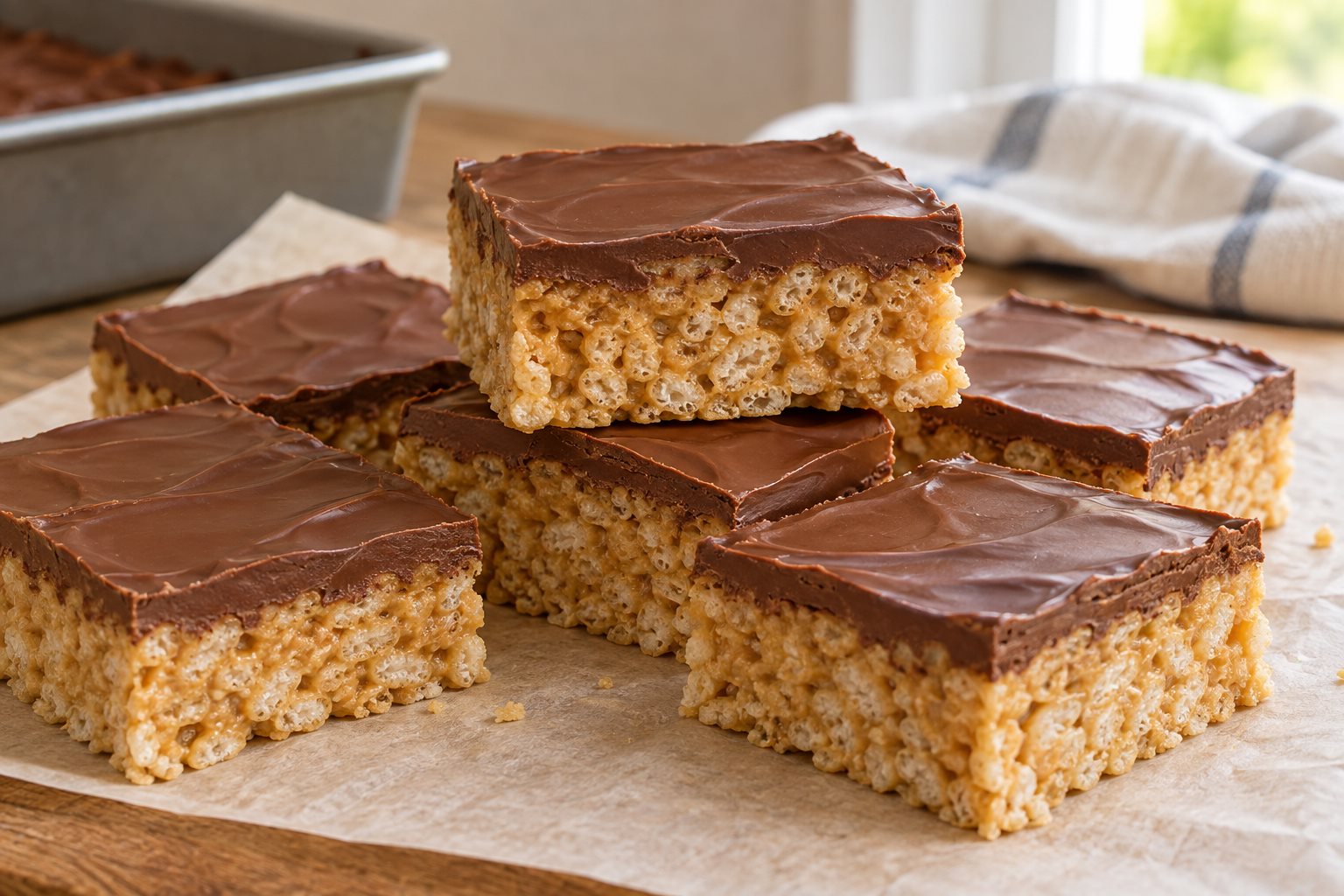
Scotcheroos bars with airy puffed rice bases and smooth chocolate-butterscotch topping.
Cut while the topping is barely set. Fully cold, it shatters off the bar in sheets. AI-generated illustration.

There is exactly one instruction in the original that matters, and it is three words long: do not overcook.

This bar is younger than any public-domain cookbook, so there is no old edition to go to and this page does not pretend otherwise. What there is instead is better suited to the dish: the recipe comes down through reader-contributed newspaper pages and church and 4-H collections, signed by the women who cooked it. The Boone News-Republican of 3 September 1970 gave a whole page to recipes sent in by its readers, and in among Fanci-Filled Cookies from Mrs Selma Estrem of Kelley, Gumdrop Bar Cookies from Mrs Sidney Stumbo of Boone, Crispies from Mrs Kenneth Carlson of Stratford and Wacky Cake from Mrs Mildred Blair of Dayton, it printed this, under the heading SCOTCHEROOS and the name of Mrs Mike Lynch of Boone: one cup sugar, one cup white syrup, one cup peanut butter, six cups rice krispies. "In heavy saucepan cook sugar and syrup until it comes to a full boil. Do not overcook. Remove from heat and blend in peanut butter. Then add rice Krispies; mix until well coated. Press into a buttered 9x13 inch pan. Then cover with topping." The topping is a six-ounce package of chocolate chips and a six-ounce package of butterscotch chips, melted over a double boiler — "Do not let water boil" — and spread over the top. That is the whole architecture, and the ratios below are hers.

Two things are worth saying about what the archives do not contain. The cereal is the base of the bar, and the cereal is a branded product, but no printing by any cereal company could be opened from here — the dated Iowa printings that can be read treat the cereal as an ingredient rather than as a sponsor. The 1970 page writes it in lower case, as a kitchen noun. When the Ames Daily Tribune reprinted a version on 4 May 1988, in a page of microwave recipes for children, it called them Chocolate Scotcheroos and specified "6 cups dry cereal (Rice Krispies, Crispex or other cereal)", with no company credited anywhere on the page. And the name itself is late in the Iowa press: across the whole of the Boone, Carroll, Cedar Rapids, Ames and Ottumwa archives the 1970 Boone page is the only occurrence before the mid-1980s, after which it turns up everywhere at once. So the bar travelled the way this kind of recipe always travels — hand to hand, on cards, in a church cookbook, in a 4-H record book — and reached print late because print was never how it moved.

Why this version works

Peanut butter goes in off the heat. Away from the burner the residual heat is enough to loosen it into the syrup without cooking the fat out. Stirred into a boiling pan it seizes, splits and leaves an oily film on top of the bars a day later.

Corn syrup, not all granulated sugar. Corn syrup is largely glucose and it physically gets in the way of sucrose crystals lining up. That is why the bar stays chewy for days instead of turning to sugar sand — and it is why substituting honey or maple syrup changes the texture as much as the flavour.

Chocolate and butterscotch in equal weight. Butterscotch chips alone are sweet enough to be tiring and set soft; chocolate alone sets hard and hides the peanut. Half and half melts to a topping that firms without shattering and tastes of both — the name is in that half.

The syrup is brought to a boil and taken straight off. The three words in the 1970 printing carry the whole recipe. A full boil dissolves the sugar and thickens the syrup just enough to coat; thirty seconds more and it climbs into soft-crack, and the bars set into something that cracks a tooth. Watch the pan, not the clock.
Ingredient notes

Chips: a 6-ounce package of each, which is about a cup of each by volume. Melt them together, not separately, and keep every drop of water away from them — a splash from the double boiler will seize the whole bowl into a grainy paste.

Cereal: six cups of plain puffed rice cereal, and check it is fresh — stale cereal has already taken up moisture from the air and goes soft the moment the syrup hits it. Any toasted rice puff works; the 1988 Ames printing named two and said "or other cereal".

Corn syrup: light corn syrup, measured in a cup lightly greased first so it all comes out. The 1970 recipe just says "1 cup syrup (white)", which is the same thing in an Iowa kitchen of that year.

Peanut butter: ordinary smooth commercial peanut butter, the stabilised kind. Natural peanut butter separates and its oil pools on the cereal, and the bars never firm up properly. This is one of the places where the supermarket jar is the right answer.

Step by step

  1. Line the pan. Butter a 9x13-inch pan, or line it with parchment with an overhang if you want to lift the slab out whole to cut it. Measure the cereal into a very large bowl before you start the syrup — there is no time to do it later.
  2. Boil the syrup and stop. Combine the sugar and corn syrup in a heavy saucepan over medium heat, stirring until the sugar dissolves. Bring it to a full rolling boil and take it off the heat immediately. This is the step the recipe warns about; it takes 3 to 5 minutes and no more.
  3. Peanut butter off the heat. Stir in the peanut butter and the vanilla off the burner until the mixture is smooth and glossy, about 30 seconds.
  4. Coat the cereal. Pour it over the cereal and fold with a silicone spatula until every piece is coated and no dry cereal is left at the bottom of the bowl. Work fast; it stiffens as it cools.
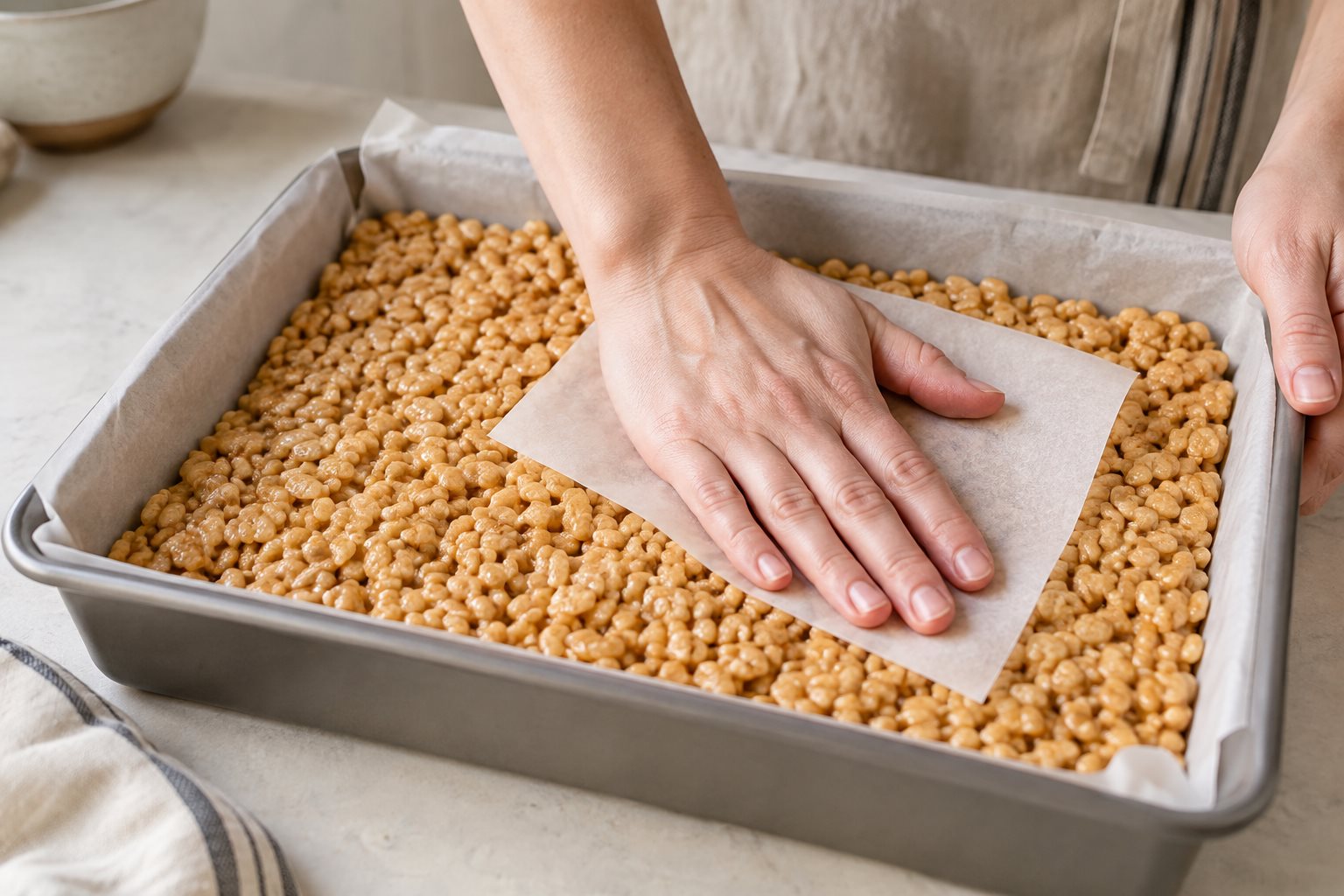
  5. Press, do not pack. Scrape it into the pan and press it level with buttered hands or a sheet of parchment under your palm. Press firmly enough that it holds together and no harder — crushed cereal makes a dense, hard bar.
    A hand gently pressing peanut-butter-coated puffed rice level through parchment in a rectangular pan.
    Press just enough to hold the cereal together; keep the puffed grains intact. AI-generated illustration.
  6. Top and set. Melt the chocolate and butterscotch chips together over barely simmering water, stirring until smooth, and spread over the base in an even layer. Leave at room temperature 45 to 60 minutes, until the top has lost its shine but still yields to a fingernail, then cut into 24 bars.
If the bars set rock hard, the syrup went past a boil and there is no undoing it in the pan — but they are not lost. Warm the whole tray at 250°F for eight minutes until the base softens, press it level again and let it cool; you get most of the chew back. If the topping seized into a grainy paste instead of melting, water got in: stir in a teaspoon of neutral oil off the heat and it will usually come back smooth enough to spread.

Storage and make-ahead

Covered at room temperature they keep 5 days and stay chewy. The fridge is the enemy here — cold makes the base brittle and the topping bloom grey, and neither recovers on the counter.

They freeze for 2 months, cut and layered between parchment. Thaw them in the wrapping so condensation forms on the outside of the packet rather than on the chocolate.

What to serve with it

They are a church-supper and bake-sale bar and they belong beside coffee, or on a plate with other bars where they are the one nobody has to explain. For children, cold milk, which is what the cereal wants anyway.

Scotcheroos bars with airy puffed rice bases and smooth chocolate-butterscotch topping.

From the recipe box / Iowa

Scotcheroos

Peanut butter and boiled sugar syrup stirred through puffed rice cereal, pressed flat and covered with melted chocolate and butterscotch chips.

Prep
15 min
Cook
10 min
Total
1 hr 25 min
Serves
24
Calories
240 per bar

Ingredients

Scale

Instructions

  1. Butter a 9x13-inch pan and measure the cereal into a very large bowl.
  2. Heat the sugar and corn syrup in a heavy saucepan over medium, stirring, and take it off the heat the moment it reaches a full rolling boil.
  3. Off the heat, stir in the peanut butter and vanilla until smooth.
  4. Pour over the cereal and fold until every piece is coated.
  5. Press into the pan with buttered hands, firmly but without crushing the cereal.
  6. Melt the chocolate and butterscotch chips together over barely simmering water, spread over the base, and set 45–60 minutes before cutting into 24 bars.

Nutrition

Fat10 g (4 g saturated)
Sodium105 mg
Protein4 g
Serving1 bar
Calories240
Cholesterol2 mg
Carbohydrates34 g (24 g sugar, 1 g fiber)

Nutrition is an estimate calculated from the listed ingredients and is provided as a courtesy, not as dietary advice.

Questions readers ask

Why did mine turn out hard?

The syrup boiled too long. The 1970 Boone printing says "cook sugar and syrup until it comes to a full boil. Do not overcook", and that is not a stylistic flourish — another half minute takes the sugar to a stage that sets glassy instead of chewy.

Can I use natural peanut butter?

It works on the day and disappoints by the next: the oil separates out and pools under the topping. If it is all you have, stir the jar thoroughly and eat them the same day.

Can I leave out the butterscotch chips?

You can, and you will have made a decent peanut butter cereal bar. You will not have made scotcheroos — the butterscotch is the half of the topping the name refers to.

Why do they go soft in the fridge or hard on the counter?

Neither, if the syrup was right and the tin is covered. Brittleness comes from cold or from an overcooked syrup; sogginess comes from stale cereal or from a humid kitchen. Keep them covered at room temperature and they hold for five days.