American cooking Recipes & regional stories

Skillet & Sage

A culinary journey through the fifty states

The regional table / Nebraska

Runza
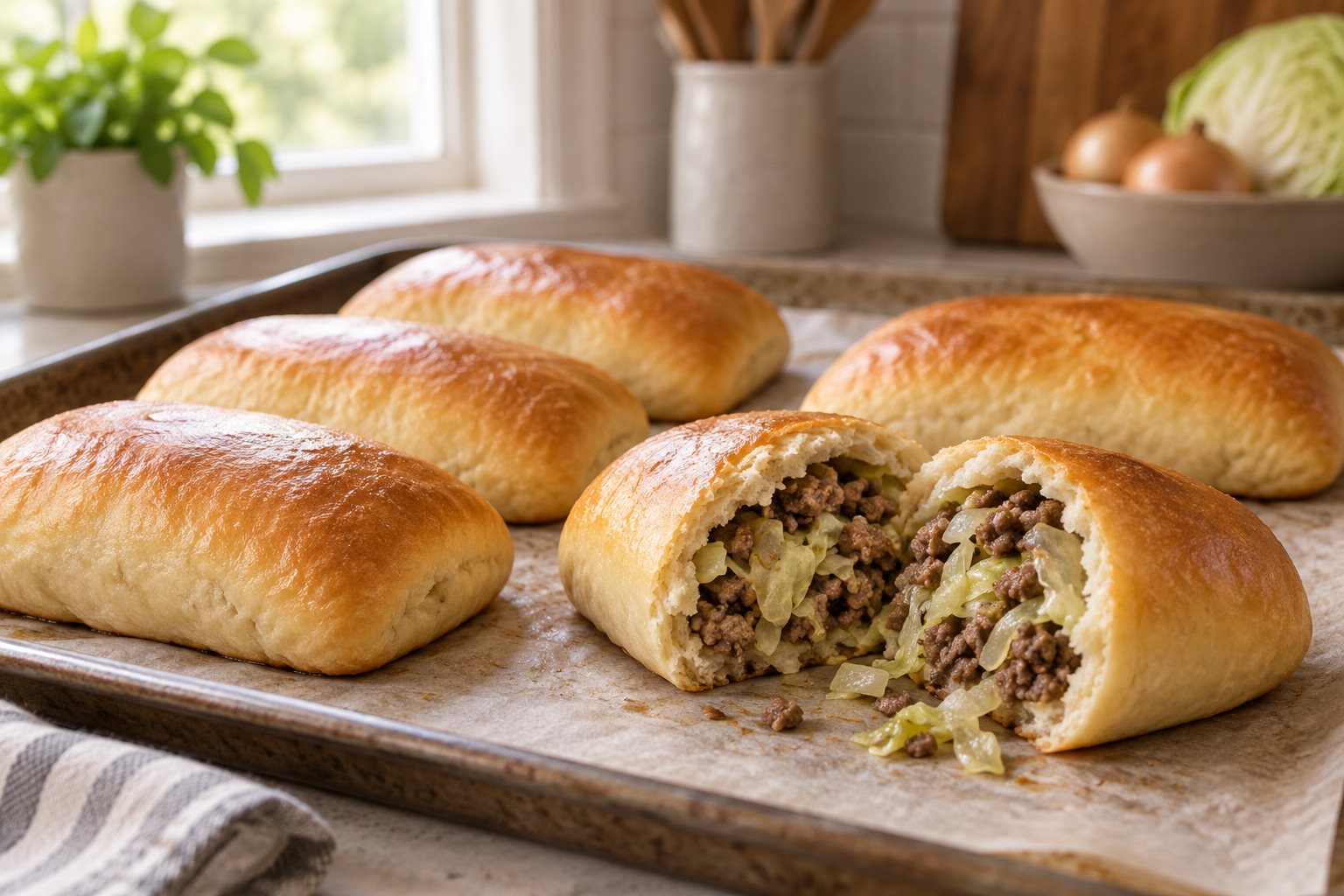
golden baked bread pockets on a sheet pan, one torn open to show a filling of ground beef, cabbage and onion
The torn one is the test: the filling should hold its shape against the bread, not run out of it. AI-generated illustration.

Everything that goes wrong with this dish goes wrong for one reason, which is water, and the fix happens twenty minutes before the dough ever sees the filling.

Two things about this food sit at different ends of the record, and it is worth being straight about both. The word is a registered trade mark of a Nebraska restaurant company as well as the ordinary name people here use for a thing they bake at home; this page makes the food, not any company's product, and no company's recipe is published or reproduced below. And the word itself is young in print. Nebraska runs its own open archive of its digitised newspapers at nebnewspapers.unl.edu, and searching the whole of it turns up no occurrence of the word before 9 July 1963, when The Daily Nebraskan carried a small advertisement for a Runza Drive-In selling "A COMPLETE MEAL in SANDWICH". Every earlier hit the search offers is an optical-character mirage: papers from 1915 through 1919 break the name of the Mexican president across a line as "Car-" and "runza", and one 1919 letter-writer splits Sancho Panza the same way. The cousin name does no better. "Bierock", which the same people carried into Kansas, returns nothing at all in the entire Nebraska corpus — not one page, in any year.

The people, by contrast, are documented to the decimal point, and they are the reason the dish exists. Hattie Plum Williams, working at the University of Nebraska, published A Social Study of the Russian German in the university's studies series in 1916. She was writing about Lincoln, "a city of some 48,000 inhabitants, of whom one seventh are Russian Germans" — about 6,500 people, "the largest group of these people to be found in any one city in the United States", and in 1914 one third of all the births in the city were of Russian German parentage. They came from the Volga provinces of Saratow and Samara; their ancestors had gone to Russia from the German states in response, as Williams puts it, "to the manifesto of Katherine the Great in 1763", and emigration to America "began in the seventies" once the reforms following the freeing of the serfs took away the self-government, the schools and the exemption from military service they had been promised. Lincoln was the distributing centre for the whole state, and many families were "ticketed direct from Saratow to Lincoln via New York, knowing nothing of any other places in America than these two". Williams also notes, in a chapter about infant health, that the mothers kept their houses cool in summer "because she has been accustomed to cooking outside" in a summer kitchen. A filled bread baked in quantity, eaten in the hand, good cold, is what that kitchen produces. No document anywhere in that record prints quantities, so the ones below were worked out for this page.

Why this version works

Sealed seam down. The weight of the filling holds the seam shut while the dough sets, and the twenty minutes of bench rest after shaping lets the gluten relax so the seal does not pull open in the oven. Seam up is how most split runzas were made.

An enriched dough, not a bread dough. Milk, egg, butter and a quarter cup of sugar give a soft close crumb that stretches around a heavy filling without tearing and stays tender the next day. A lean water-and-flour dough bakes into a crust that shatters at the fold and goes stale by evening.

Onion and pepper carry it, not spice. There is nothing in this filling but beef, cabbage, onion, salt and a lot of black pepper, and that is the point: the sweetness of the bread against the pepper is the whole flavour. Anything you add — garlic, paprika, cheese — moves it somewhere else, and the somewhere else is usually worse.

The filling is cooked dry before it goes in. A pound of cabbage is mostly water and it all comes out. Cook it out in the pan, uncovered, until the bottom of the skillet stays clear for a second after you drag a spoon through it, and the dough seals onto a solid. Put wet filling into raw dough and the steam has nowhere to go but into the crumb, which is how you get a pale, soggy base and a seam that bursts.
Ingredient notes

Beef: eighty-twenty ground chuck, browned and then drained. Leaner beef gives you a dry, crumbly filling with no body to it; fattier beef leaves grease that softens the seam from the inside. Drain it, but do not blot it dry.

Yeast: active dry, and the milk should feel barely warm on the inside of your wrist. Enriched doughs rise slowly because the fat and sugar slow the yeast down, so give the first rise the full time and judge it by size rather than by the clock.

Pepper: a full teaspoon of coarsely ground black pepper for a pound of beef, which looks like a mistake and is not. This is a bland dish by design and the pepper is the only sharp thing in it.

Cabbage: plain green cabbage, cored and shredded fine on a knife or a mandoline. Savoy is too tender and disappears; red bleeds. Shred it thinner than you think — long coarse strips hold water and make the filling hard to fold around.

Step by step

  1. Start the dough. Warm the milk to about 110°F and stir in the yeast and a tablespoon of the sugar. Leave it 10 minutes until it foams. Mix in the rest of the sugar, the egg, the melted butter and the salt, then work in the flour until you have a soft dough. Knead 8 minutes by hand or 5 in a mixer, until it is smooth and only just tacky.
  2. First rise. Cover and leave in a warm place 60 to 90 minutes, until doubled. It will take the long end of that; enriched dough is slow.
  3. Cook the filling dry. Brown the beef in a wide skillet over medium-high heat, breaking it up, 6 to 8 minutes. Drain off the fat. Return it to the pan with the onion and cook 4 minutes, then add the cabbage, salt and pepper and cook 12 to 15 minutes more, uncovered, stirring often, until the cabbage has collapsed and no liquid pools when you pull a spoon across the pan. Cool it to room temperature.
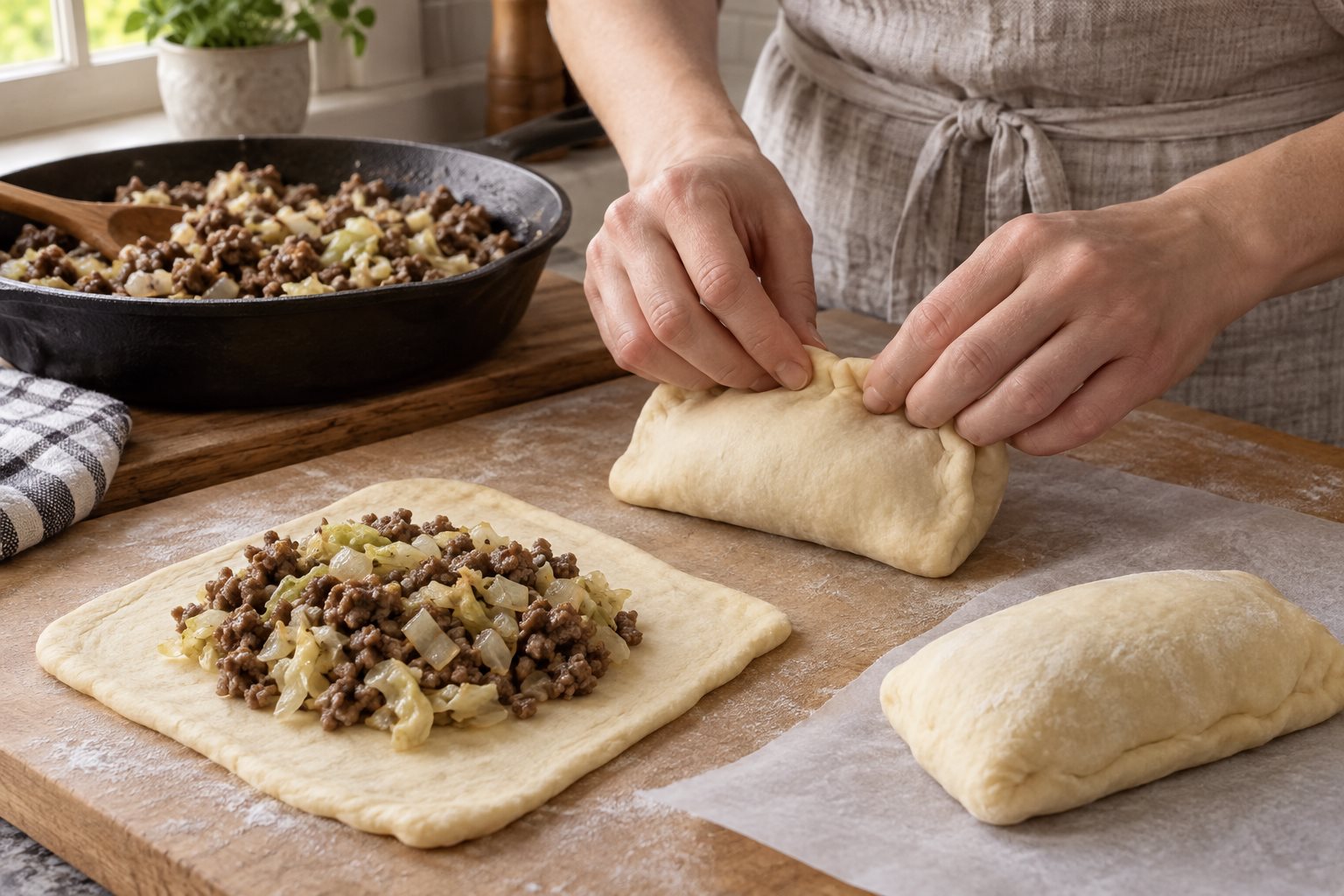
  4. Shape. Heat the oven to 375°F. Divide the dough into 8 pieces and roll each into a 7-inch square about an eighth of an inch thick. Put a heaped half cup of cold filling in the middle, fold the dough over into a rectangle, press the air out from the centre towards the edges, and pinch the seam hard. Set them seam down on two parchment-lined sheets.
    Rectangular bread pockets sealed around beef and cabbage filling
    Press out the air, pinch the seam firmly and place each pocket seam down. AI-generated illustration.
  5. Bench rest. Leave the shaped runzas uncovered 20 minutes. They will puff slightly and the seams will settle.
  6. Bake. Bake 22 to 26 minutes, until deep gold on top and firm and dry underneath when you lift one. Brush the tops with the last of the melted butter as they come out and let them sit 10 minutes before eating — the filling is much hotter than the bread.
If a seam opens in the oven, take the pan out at once, push the filling back in with a spoon and pinch the dough over it with a wet finger, then finish baking — it will heal enough to hold. If several burst, the filling was warm or wet when it went in. Cool the rest, mop the pan of the last of the liquid, and shape again.

Storage and make-ahead

Cooled completely, they keep 4 days in the fridge and 3 months frozen, wrapped singly. Reheat from cold in a 350°F oven for 15 minutes, or 25 from frozen. A microwave will heat the filling faster than the bread and leave you with a wet crust.

They are meant to be eaten cold as much as hot; a runza taken out of the fridge and eaten in the hand is the point of the shape. Do not wrap them warm, though — the trapped steam softens the base.

What to serve with it

Something sour and cold against the sweetness of the bread: dill pickles, beet pickles, or a plain vinegar slaw. A bowl of tomato soup makes it a meal in the way Nebraska actually eats it, and cold beer is the other half.

golden baked bread pockets on a sheet pan, one torn open to show a filling of ground beef, cabbage and onion

From the recipe box / Nebraska

Runza

A sweet yeast dough folded around beef, cabbage and onion cooked down until dry, then baked shut so the filling steams inside its own bread.

Prep
40 min
Cook
30 min
Total
2 hr 45 min
Serves
8
Calories
425 per runza

Ingredients

Scale

Instructions

  1. Proof the yeast in the warm milk with 1 tablespoon of the sugar for 10 minutes, then mix in the remaining sugar, the egg, 4 tablespoons of the melted butter, 1½ teaspoons salt and the flour. Knead 8 minutes to a soft, smooth dough.
  2. Cover and rise 60–90 minutes, until doubled.
  3. Brown and drain the beef, cook it 4 minutes with the onion, then add the cabbage, the remaining 1½ teaspoons salt and the pepper and cook 12–15 minutes uncovered until no liquid pools in the pan. Cool completely.
  4. Heat the oven to 375°F. Divide the dough into 8, roll each to a 7-inch square, fill with a heaped ½ cup of cold filling, fold, press out the air and pinch the seam. Set seam down on lined sheets.
  5. Rest the shaped runzas uncovered 20 minutes.
  6. Bake 22–26 minutes until deep gold and dry underneath, brush with the last tablespoon of butter and rest 10 minutes before eating.

Nutrition

Fat16 g (7 g saturated)
Sodium680 mg
Protein18 g
Serving1 runza
Calories425
Cholesterol85 mg
Carbohydrates52 g (7 g sugar, 3 g fiber)

Nutrition is an estimate calculated from the listed ingredients and is provided as a courtesy, not as dietary advice.

Questions readers ask

What about cheese in them?

A slice laid on the filling before folding is common now and it is not a fault, but it changes the dish: the cheese melts into the cabbage and mutes the pepper, which was carrying the whole thing. Try one plain before you decide.

Can I use frozen bread dough?

It works and plenty of people do it, but the crumb comes out leaner and chewier, and the dough fights you when you roll it thin. If you go that way, let it thaw fully and rest 20 minutes before rolling.

Can I make the filling the day before?

You should. Cold filling is easier to fold, seals better and cannot steam the dough from the inside. It keeps 3 days in the fridge and is the one part of this worth doing ahead.

Is this a copy of the restaurant version?

No, and it is not trying to be. The name on the sign belongs to a Nebraska company and that company's recipe is not published anywhere. What is below is the home version of the same food, worked out for this page.