The regional table / Florida
Key Lime Pie
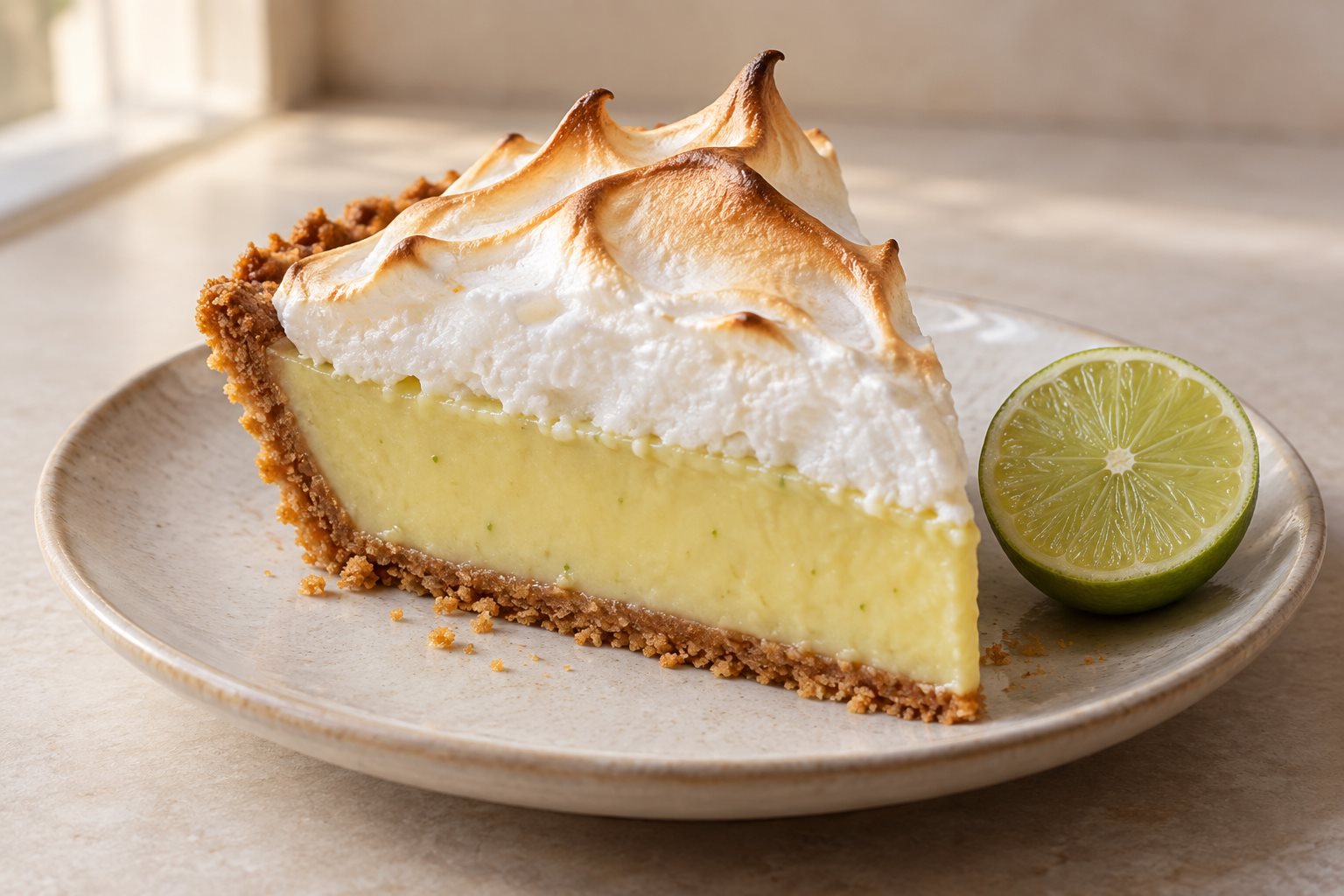
This is a pie built around a can, and the can is not a shortcut — on an island with no pasture, no wells and no ice, it was the only milk there was.
Start with what the island could not do. Jefferson B. Browne's Key West: The Old and the New, published in 1912 and readable in full on Internet Archive, records the town's search for fresh water: "In 1895 the city undertook to secure a supply of fresh water, and an artesian well was sunk in Jackson Square to a depth of two thousand feet," with borings sampled every twenty-five feet and examined for the zoological society of Harvard College. Browne's verdict on the result is five words long: "No traces of fresh water were found." The same book dates the arrival of cold: "Prior to 1890 Key West used natural ice, brought here in sailing vessels from Maine." Browne also notes that for years the mail contractors from Tampa combined carrying the post with "supplying this and the Havana market with beef cattle," which is to say that even the cattle arrived by boat. A place with no groundwater, no pasture and no manufactured ice until 1890 has no dairy herd and no way to keep milk if it had one. That is the condition a pie has to be built for, and it explains the one ingredient people find suspicious: the milk comes out of a tin because for most of Key West's history there was no other kind. What has not been shown here is the date that tin reached the island — the earliest canned-milk advertising found in the Key West Citizen runs on 18 September 1935, under the line "MORE LIKE FRESH MILK THAN ANY OTHER IN CANS," and that is later than the argument needs. Treat the condensed milk as the answer to the island's conditions, not as a dated event.
The lime is documented better than the pie. Florida's Lime and Lemon Industry, a bulletin of the Florida Department of Agriculture published in 1938, gives the Key lime a chapter of its own: "The trees are bush-like in growth and very thorny. The term 'Key' is not a varietal name, but a name given to all limes having identical characteristics, regardless of where they are grown, although in Florida the bulk of them is produced on the Keys." It notes the crop was "restored since the storms of 1926" and that the variety "seems to grow better in that locality than any of the other citrus fruits, the roots readily penetrating the alkaline rock." In a whole bulletin on the state's lime crop the word pie never once appears. The pie is in the newspapers instead, and always under a shorter name. The Key West Citizen of 30 March 1933 reports that "The Busy Bee Bakery is giving away this week either a 9-inch lime pie or a two in one Jig-Saw puzzle with every Betty Crocker Milk Chocolate Cake sold." On 23 December 1938 Fred Auerbach's Restaurant on Fleming Street advertised a $1.50 Christmas dinner ending "LIME PIE PUMPKIN PIE MINCE PIE." And on 15 February 1940 Berlin A. Sawyer wrote in his Island City column that on the keys "lime pie originates off a thorny, green, green tree in your back yard." Not one of them says key lime pie. Nor do they say what was in it: the only dated Florida recipe the search turned up, a "St. Patrick's Lime Pie" in the Clewiston News of 8 March 1940, is a different pie altogether — egg yolks, sugar, a tablespoon of flour, lime juice, grated rind and green vegetable colouring, cooked over very low heat and poured into a baked shell, with no condensed milk anywhere in it. The version below is the island one, and its quantities were worked out for this page.
Why this version works
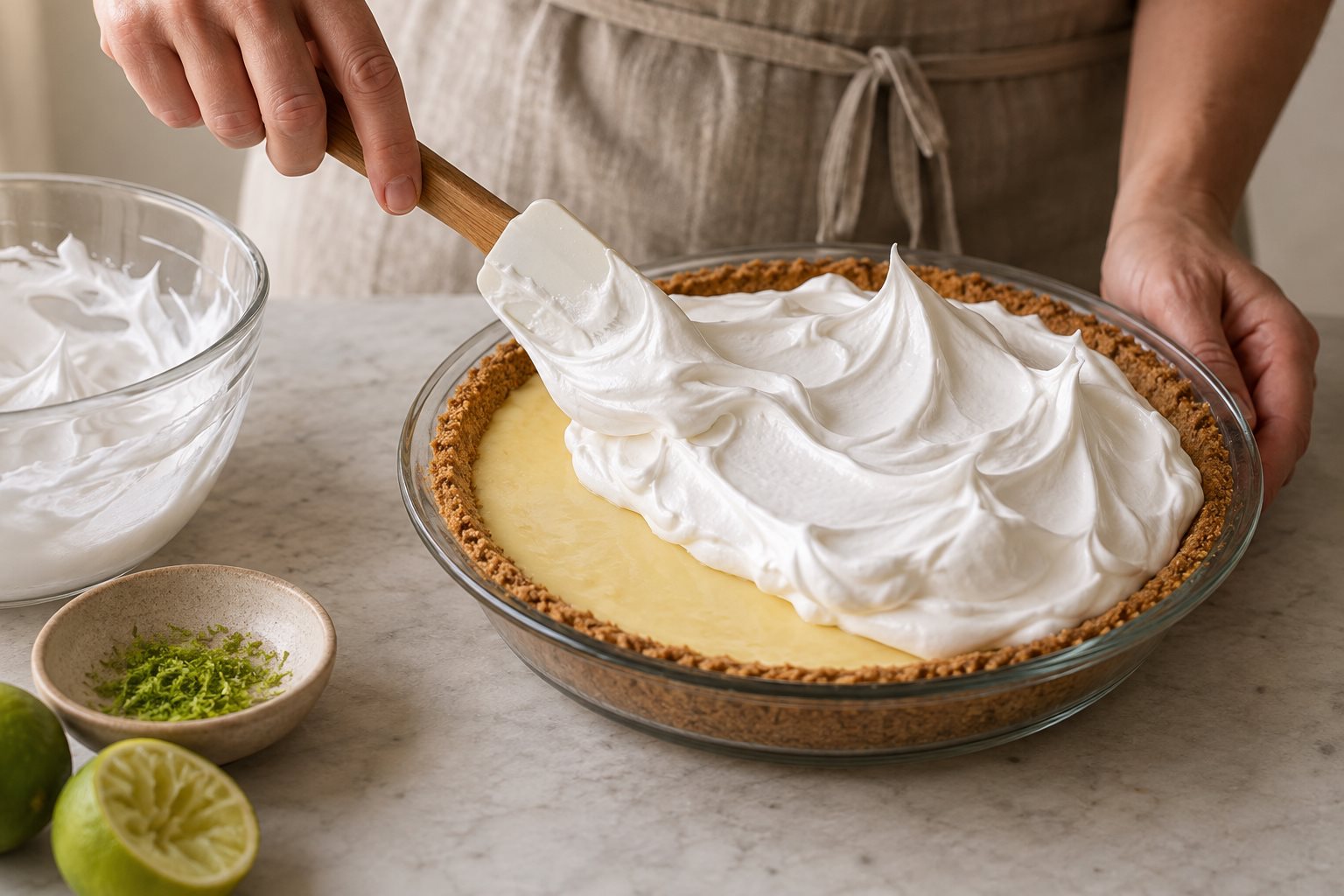
Yolks in the filling, whites on top. Four yolks give the filling body and a custard's mouthfeel where condensed milk alone is merely thick, and they leave you exactly the four whites a meringue wants. Nothing is bought for the topping and nothing is thrown away, which is how the pie was designed by people who could not run to the shop.
A cooled crust before a cold filling. The graham crust is baked and cooled before the filling goes in. Pour acid-set filling into a warm crust and the butter in the crumbs softens, the base absorbs moisture from below, and the first slice comes out as sand. Ten minutes on a rack is enough.
Acid sets the filling, heat only finishes it. Lime juice thickens sweetened condensed milk on contact, without a crumb of starch or gelatin and without cooking. That is the chemistry the whole pie rests on and the reason it belongs to a hot island: whisk the juice in and you can watch the mixture stiffen in the bowl. The short bake is there to set the yolks and make the filling safe, not to thicken it.
Key limes, not Persians, and not from a bottle. Key limes are small, seedy, thin-skinned and markedly more floral and bitter than the big Persian limes sold everywhere; their juice is paler and their aroma is the whole point. Bottled key lime juice is pasteurised and tastes cooked. If only Persian limes are to be had, use them and accept a rounder, greener, less interesting pie rather than reaching for the bottle.