American cooking Recipes & regional stories

Skillet & Sage

A culinary journey through the fifty states

The regional table / Nebraska

Czech Kolache
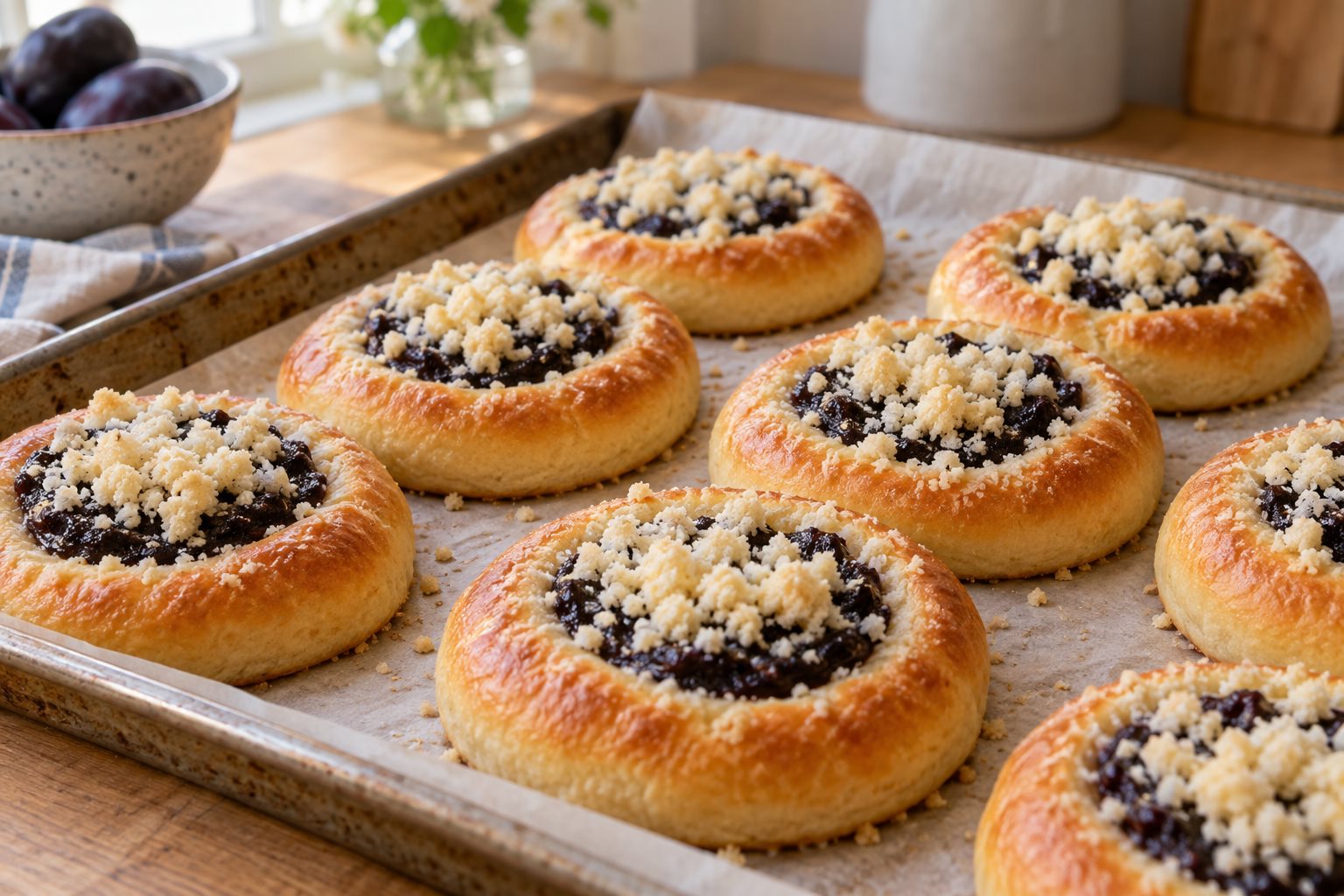
round golden pastries on a baking sheet, each with a dark prune centre under a pale scattering of crumb topping
The rim should be the colour of good bread and the crumb on top should still be pale. If the posypka has browned, the fruit underneath has gone leathery. AI-generated illustration.

The dough is the easy half. The fruit and the crumb on top are the dish, and both are made before the dough is touched.

Czech Nebraska is one of the best-documented immigrant settlements in the country, and the books are open. Thomas Capek's The Čechs (Bohemians) in America, published in 1920, records that Czech home-builders "began arriving in Nebraska in noticeable numbers after 1863, following the passage of the Homestead Law", and that Saline County, "especially the stretch of land lying between the towns of Crete and Wilber, welcomed the vanguard". The density that followed shows up in an odd place in the same book: by 1920 the Czech language was being taught in the high schools at Wilber, Prague, Crete, Clarkson, Brainard, Fremont, Verdigre and Milligan. Rose Rosicky's A History of Czechs (Bohemians) in Nebraska, printed in 1929 and out of copyright, quotes F. J. Sadilek of Wilber, "a pioneer and competent authority", estimating that up to 1880 fully three quarters of all Czech immigrants to the United States came to this one state. Rosicky also prints what arriving meant. A nineteen-year-old woman, coming through Niobrara in September 1873 with a baby on her arm, tried to buy provisions and "could not find anything except very poor white bread. Not even potatoes, which I wanted to bake." They ate the sour bread and slept on the river bank. Bread was the first grievance and the first thing built.

The pastry itself crosses into English in Nebraska earlier than you would expect. The Omaha Daily Bee of 18 March 1906 prints a full week's programme for a cooking school, session by session, and the Tuesday afternoon bread class is "Bread Sticks; Cleft Rolls. Kolache; Zwieback" — sitting between a savarin and a Boston brown bread, taught to an English-speaking Omaha in the middle of a domestic-science course. Forty years later The Frontier of O'Neill, on 27 May 1948, was still circling it in a reader-recipe column: "I know Bohemians are famous for their light breads and sweet breads and such. Some Kolaches are so delicious — they're almost out of this world." Two things the archive would not give, and they are worth saying rather than writing around. The Czech-language papers of Wilber and Omaha are digitised, but their optical character recognition is useless for this word: a search returns page after page of "na kolách", meaning on wheels, and not one printed koláč. And the word posypka — the crumb topping that is half the argument of this pastry — returns zero hits in the entire Nebraska newspaper archive, in any language, in any year. The name for it lives in kitchens and not in print, and the quantities below were worked out for this page.

Why this version works

Yolks, no whites. Three yolks give colour and a short, tender crumb that tears rather than pulls. Whole eggs bring extra water and albumen, and they bake into a springier, more bread-like round — good enough, but not the texture this pastry is known for.

The well is pressed, not cut. Pressing the centre down with two fingers or the base of a glass compresses the crumb and leaves a raised rim, so the filling has a wall to sit against. Cutting or rolling a hollow tears the gluten and the whole thing flattens in the oven.

Posypka is a lid, not a decoration. Flour, sugar and cold butter rubbed to crumb and heaped over the fruit shields it from the direct heat of the oven. Underneath it the filling stays glossy and soft; uncovered, the same filling forms a skin in twelve minutes and turns to leather by the time the dough is done.

The fruit is cooked down to a paste first. Prunes stewed and then reduced until a spoon dragged through the pan leaves a track will sit in the well and stay there. Fruit that is merely soft weeps into the dough as it bakes, undermines the base and boils over the rim. This is the single step that separates a kolache from a jam-topped bun.
Ingredient notes

Flour: plain all-purpose. Bread flour makes a chewier round that fights the filling. The dough should finish soft and slightly tacky — resist adding flour to make it comfortable to handle, and flour your hands instead.

Butter: half a cup melted into the dough and three tablespoons cold for the posypka, and the difference matters. The dough butter wants to be warm enough to blend; the topping butter wants to be cold enough to stay in pieces, which is what gives crumb rather than paste.

Prunes: ordinary pitted dried plums, twelve ounces of them. Stew them with water and a strip of lemon zest until they fall apart, then reduce hard. Apricot works the same way with a little more sugar, and poppy seed and sweetened farmer cheese are the other two fillings this dough was built for.

Milk and yeast: whole milk, warmed to about 110°F. This is a heavy, sweet, fatty dough and it rises slowly; allow the full time and judge by volume. Instant yeast can go straight into the flour and will shave twenty minutes off.

Step by step

  1. Make the filling. Simmer the prunes with the water, 2 tablespoons of the sugar and the lemon juice over medium-low heat, covered, 15 minutes, until they collapse. Uncover, mash with a fork and cook 5 to 8 minutes more until it is thick enough that a spoon leaves a clean track. Cool completely; it firms further as it cools.
  2. Start the dough. Stir the yeast and a tablespoon of the remaining sugar into the warm milk and leave 10 minutes until foamy. Beat in the rest of the sugar, the yolks, the melted butter and the salt, then work in the flour to a soft, tacky dough. Knead 8 minutes.
  3. First rise. Cover and leave 75 to 90 minutes in a warm place, until doubled.
  4. Rub the posypka. Rub the flour, sugar and cold butter together with your fingertips until it looks like coarse gravel with some pea-sized lumps. Keep it in the fridge until the moment it is needed.
  5. Shape and prove. Divide the dough into 16 pieces, roll each into a ball and set them well apart on two lined sheets. Cover and prove 30 minutes, then press a deep well in each with two floured fingers, leaving a clear rim.
  6. Fill and bake. Heat the oven to 375°F. Drop a heaped tablespoon of cold filling into each well, brush the rims with egg wash and heap the posypka over the fruit. Bake 13 to 16 minutes, until the rims are gold and the crumb on top is still pale. Cool on a rack.
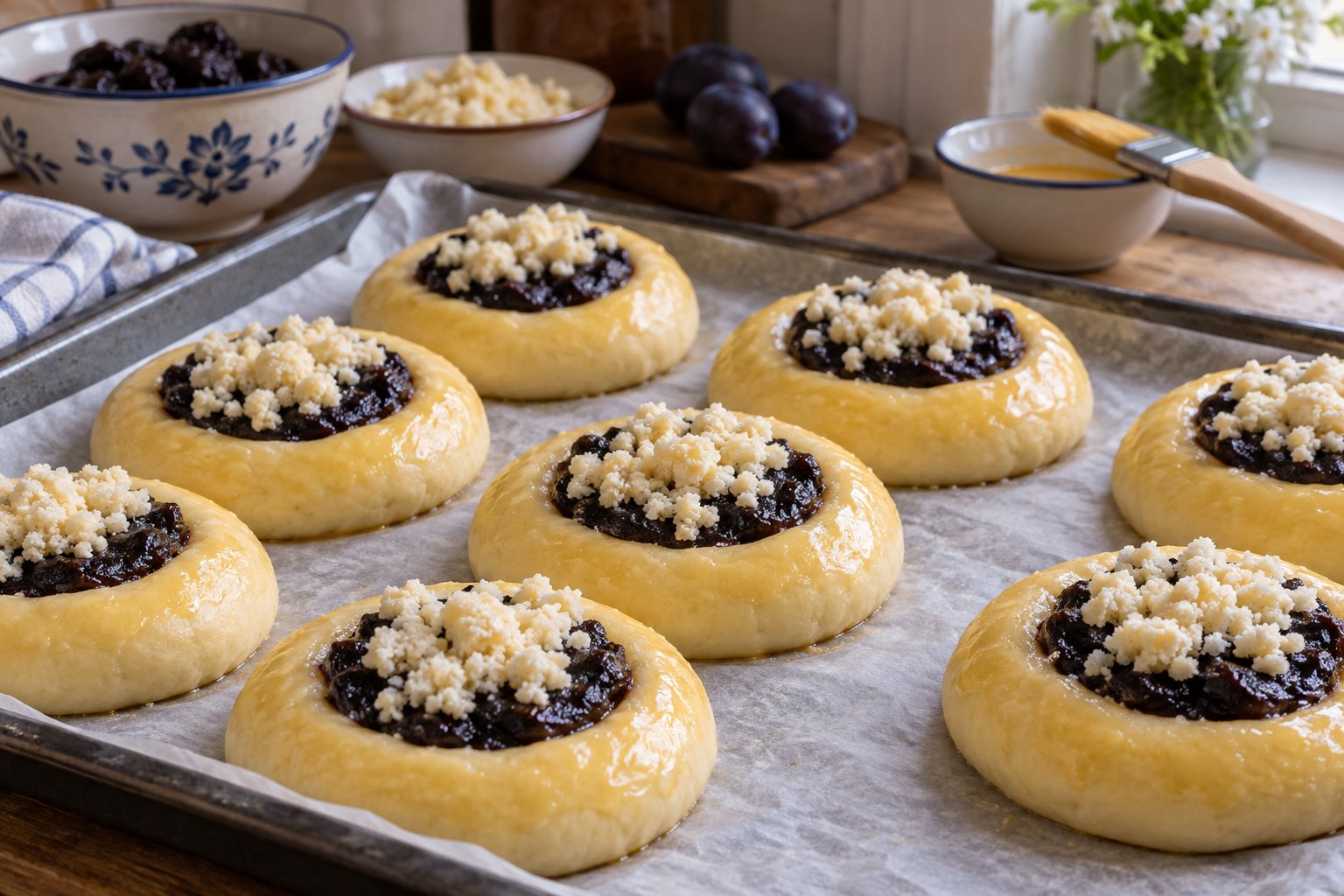
    Prune filling and pale crumb topping added to round kolache buns
    Fill the deep wells with cold prune paste and keep the crumb topping over the fruit. AI-generated illustration.
If the filling has run out over the rim, it went in too loose. Let them cool, lift the escaped fruit off with a knife, and thicken what is left of the batch by returning it to the pan for three minutes. If the wells have risen shut in the oven, press them again the moment the tray comes out — the dough is still soft enough to take it, and a second spoon of filling can go in then.

Storage and make-ahead

Best the day they are baked, good the next, stale on the third. Keep them loosely covered at room temperature, never in the fridge, which stales enriched dough faster than a counter does.

They freeze well unfilled: shape, prove, and freeze the rounds baked and plain, then thaw, press a well, fill and give them 6 minutes in a hot oven. Filled and frozen, the fruit weeps as it thaws.

What to serve with it

Coffee, and not much else. These are a morning and a mid-afternoon food, and at a Czech table in Saline County they arrive with the pot and a plate of three kinds side by side — prune, poppy seed and cheese — so that nobody has to choose.

round golden pastries on a baking sheet, each with a dark prune centre under a pale scattering of crumb topping

From the recipe box / Nebraska

Czech Kolache

A soft egg-yolk dough pressed into wells, filled with thick stewed prune and buried under posypka, the crumb topping that keeps the fruit from drying out.

Prep
40 min
Cook
15 min
Total
3 hr
Serves
16
Calories
295 per kolache

Ingredients

Scale

Instructions

  1. Simmer the prunes with the water, 2 tablespoons sugar and the lemon juice, covered, 15 minutes, then mash and reduce uncovered 5–8 minutes until a spoon leaves a track. Cool completely.
  2. Proof the yeast in the warm milk with 1 tablespoon sugar, then beat in ½ cup sugar, the yolks, 8 tablespoons melted butter and the salt, and work in 4 cups flour. Knead 8 minutes to a soft, tacky dough.
  3. Cover and rise 75–90 minutes, until doubled.
  4. Rub the ⅓ cup flour, the remaining 2 tablespoons sugar and the 3 tablespoons cold butter to coarse crumbs and chill.
  5. Divide into 16 balls, set well apart on lined sheets, prove 30 minutes, then press a deep well in each.
  6. Heat the oven to 375°F. Fill each well with a heaped tablespoon of cold filling, brush the rims with beaten egg, heap posypka over the fruit and bake 13–16 minutes until the rims are gold and the crumb still pale.

Nutrition

Fat9 g (5 g saturated)
Sodium100 mg
Protein4 g
Serving1 kolache
Calories295
Cholesterol60 mg
Carbohydrates49 g (22 g sugar, 3 g fiber)

Nutrition is an estimate calculated from the listed ingredients and is provided as a courtesy, not as dietary advice.

Questions readers ask

What exactly is posypka?

The crumb scattered over the filling: flour, sugar and cold butter rubbed together, nothing else. It is closer to a streusel than to a glaze, and its job is insulation as much as flavour. Skip it and the fruit dries out in the oven.

Why yolks and not whole eggs?

Yolks give the colour and the short, tender crumb. Whole eggs add water and white, which makes a springier, breadier round. It is still a good pastry, just not this one.

Are these the same as Texas kolaches?

The sweet fruit round is the same family. The sausage-filled thing sold under the name in Texas is a different food with a different history, and it is not what the Nebraska settlements around Wilber and Prague mean by the word.

Can I use jam instead of cooking the fruit?

Only if you cook the jam down first. Jam out of the jar is too loose, and it will boil out of the well and weld the pastry to the tray. Reduce it in a pan until it mounds on a cold saucer.