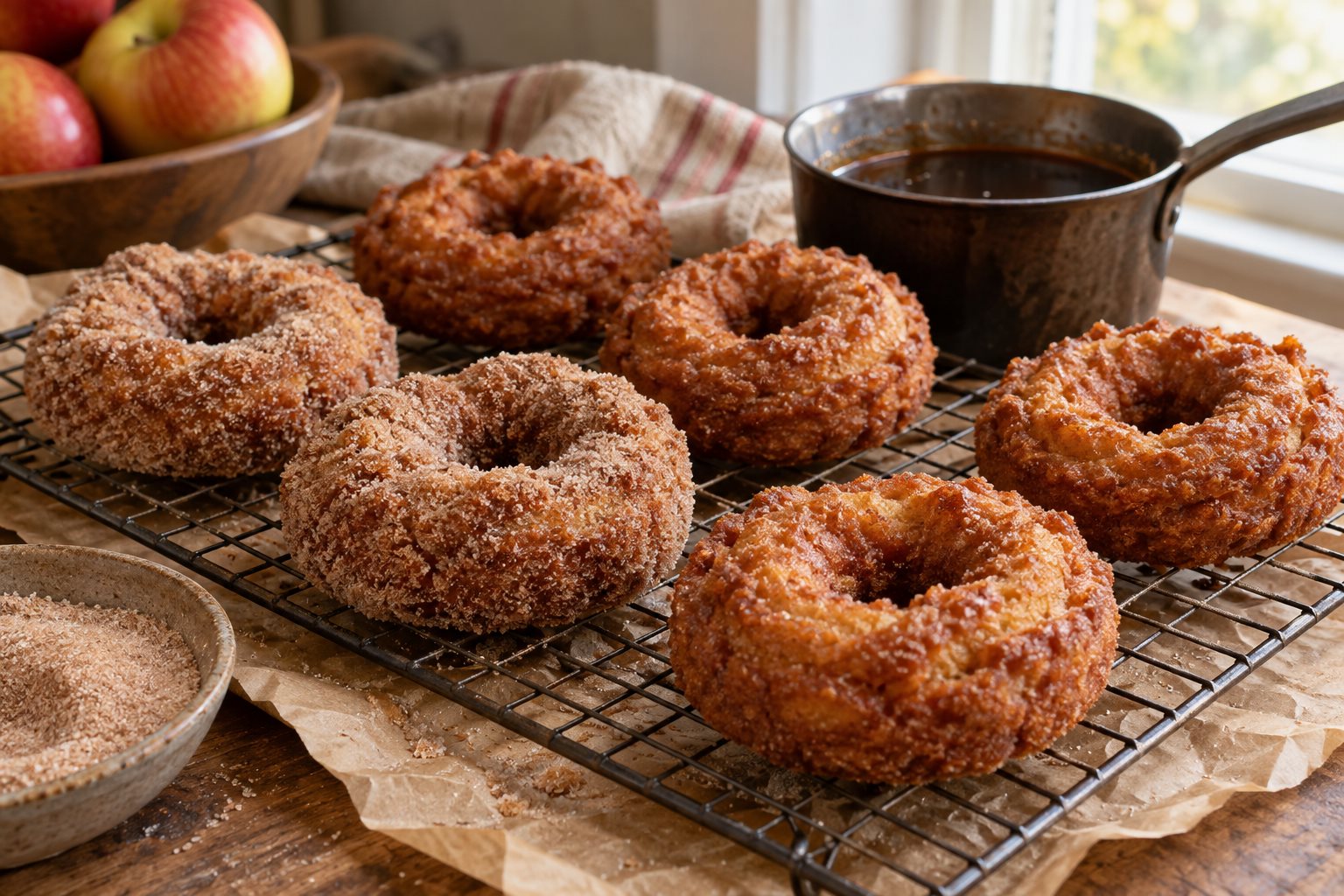
The colour comes from the boiled cider, not from the frying. A doughnut made with plain cider comes out the same pale tan as any other. AI-generated illustration.
Two cups of sweet cider carry about twenty-three grams of apple sugar and roughly two grams of acid, and the rest is water. Put that cup of water into a doughnut and you have made a doughnut with water in it. Boil it down first and you have made something else.
New Hampshire has almost no newspaper record of this dish, and it is worth saying so before anything else. The searchable run of the Keene Evening Sentinel and the New Hampshire Sentinel, on the Advantage Preservation archive, returns fifty-one pages for the exact phrase "cider doughnuts" between 1896 and 1970 — and every one read on the page turns out to be a list of two separate things served at a hall. The Sentinel of 29 October 1931 is typical: a Hallowe'en party at a private house where "Cider, doughnuts, and popped corn, will be served." The 1896 hit is coffee, cider, doughnuts, crackers and cheese at a society supper. Even the run of "cider donuts" that starts in 1958 is a hardware store on Main Street giving away cider and donuts at a sale. In that whole paper, the cider doughnut as one object — a doughnut with cider in it — does not clearly appear.
What that same paper is full of is boiled cider. The exact phrase returns three hundred and seventy-five pages, from 1849 to the 1970s, with heavy autumn runs in the 1890s and again in the 1920s. In November 1849 a Keene grocer advertised BOILED CIDER in capitals beside the new raisins, figs, dates and nuts, and kept the advertisement running into February. In November 1895 another sold boiled cider apple sauce next to the seeded raisins and the chopping trays, under a line telling readers they needed the lot to make the mince pies come out right, and in 1896 a third was pushing "that fine Boiled Cider and Shaker Apple Sauce" — a product whose printed label survives in the Shaker collection at Hamilton College, catalogued to Canterbury, New Hampshire, and reading simply SHAKER BOILED CIDER Apple Sauce. So the New Hampshire pantry staple is not the cider doughnut. It is the boiled cider. This recipe puts the two together and takes the chemistry from two federal documents: USDA Circular No. 138 of November 1930, L. K. Bailey on baking powder and baking chemicals, and a Bureau of Home Economics radio script of 1933 titled Doughnuts and Deep-Fat Frying.
Why this version works
Plain cider is water with a little sugar in it. USDA FoodData Central puts unsweetened apple juice at 88.2 grams of water and 9.62 grams of sugar per hundred grams, and the Bureau of Chemistry reached the same place in 1904: whole apples at 80 to 85 per cent moisture and 7 to 10 grams of total sugar. A cup of that in a doughnut batch is a cup of buttermilk you did not use, minus the tang. Boiling two cups down to half a cup removes about three-quarters of the water and leaves everything else where it is, so the half cup that goes into the bowl carries the sugar, the acid and the cooked-apple flavour of four times its volume.
The acid pays for the soda, and it is measurable. Circular 138 states the problem exactly as a cook meets it: "Because all sour milk does not possess the same degree of acidity, there has always been uncertainty as to how much soda should be used to neutralize the acid. If too much soda is used, undesirable products result." Cider runs around half a gram of acid per hundred millilitres. Two cups holds roughly two and a half grams of malic acid, which is diprotic, and that is enough to react with about three grams of bicarbonate — two-thirds of a teaspoon. Half a teaspoon of soda is therefore inside the cider's budget with room to spare, and the baking powder in the same bowl does the rest of the lift on its own acid.
Temperature, not batter, decides how greasy it is. The 1933 script is blunt about it: "Grease-soaked foods, cooked in fat that is not hot enough, are unattractive and unpleasant to eat," and against that, "when you fry properly in deep fat, you immerse the food in hot fat of just the right temperature and keep it at that temperature until the food cooks to a turn. Then the fat doesn't soak in." Its number is 365°F, or hot enough to brown a cube of bread in sixty seconds, for a doughnut rolled a quarter inch thick and cooked about three minutes. Fry three at a time and let the fat climb back before the next three; six doughnuts at once drops it fifty degrees and every one of them drinks.
Boiling the cider does not create acid. It removes water. This matters because it is the one place people talk themselves into nonsense. Malic acid is not volatile; it stays in the pan while the water leaves. So the reduced half cup has the same total acid the two cups had, concentrated into a quarter of the volume. Flavour per spoonful goes up fourfold. Soda-neutralising power stays exactly the same. Use the concentration for taste and colour, and size the soda against the original two cups.
Ingredient notes
Cider: two cups of fresh sweet cider, unfiltered and unpasteurised if you can get it, to be boiled down to half a cup. The 1931 USDA script on making cider at home describes the trade honestly — a product "made only during the period immediately following the apple harvest and consumed within a few days" — which is why a mill in October gives you something a supermarket jug in March does not. Filtered apple juice works and tastes flatter. Do not buy bottled boiled cider and skip the step unless you want to; half a cup of it is the same thing and costs more.
Frying fat: two quarts of a neutral oil or of shortening, which the 1933 script wants deep enough to float the doughnuts in a kettle two-thirds full when melted, and heavy iron or thick metal so the heat holds. It also tells you what to do afterwards: cool the fat, cook a few slices of raw potato in it for ten minutes, strain it through muslin, keep it covered and cold, and it will fry several more times.
Flour and fat: 3½ cups of plain all-purpose flour, about 440 grams. Bread flour makes a doughnut that chews instead of breaking. Four tablespoons of melted butter is all the fat in the dough, because the doughnut picks up ten to fifteen grams more in the kettle and a richer dough turns heavy once it has.
Soda and powder: half a teaspoon of soda for the cider acid and two teaspoons of baking powder for everything else. Circular 138 sets out what a powder is doing in the bowl: in its cream-of-tartar formula, 26.73 per cent sodium bicarbonate against 44.90 per cent cream of tartar and 5.97 per cent tartaric acid, the ratio fixed so that 100 pounds of cream of tartar neutralises 44 pounds of soda. That is a self-contained acid-and-alkali pair that does not care what else is in your batter.
Step by step
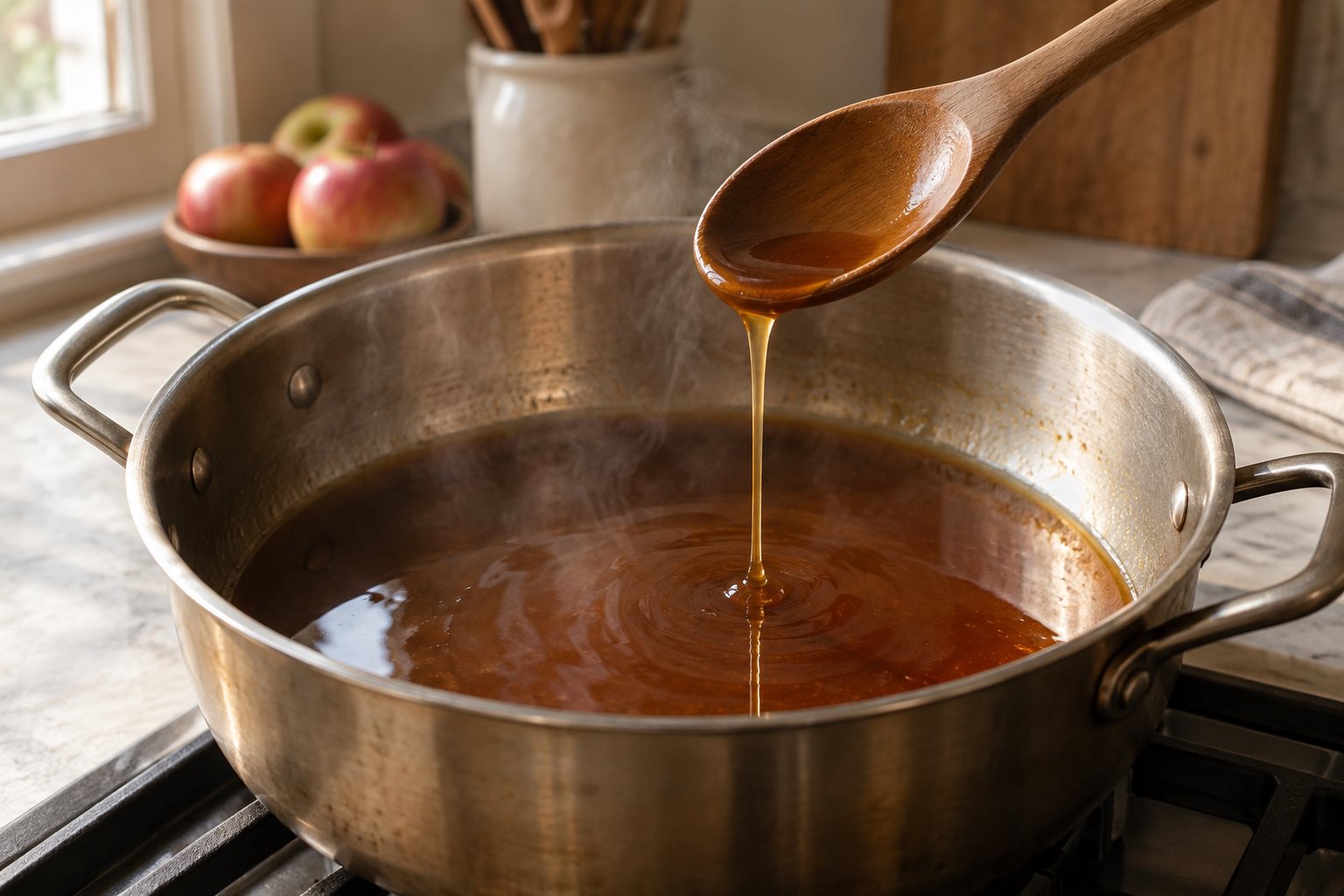
Boil the cider down. Put 2 cups of cider in a wide saucepan over medium heat and simmer 20 to 30 minutes, uncovered, until ½ cup is left. It will be the colour of strong tea and just syrupy. Wide pan, not tall — surface area is the whole job. Cool it completely; warm cider melts the butter back out of the dough.
Reduce the cider to a quarter of its original volume, then cool completely. AI-generated illustration.
Dry in one bowl, wet in another. Whisk the flour, sugar, baking powder, baking soda, salt, cinnamon and nutmeg together. In a second bowl beat the eggs, then the cooled boiled cider, the buttermilk and the melted butter.
Combine, and stop early. Pour the wet into the dry and fold with a spatula just until no dry flour shows. The dough is soft and sticky and should stay that way. Every extra turn builds gluten you will taste as toughness.
Chill it an hour. Scrape the dough onto a floured sheet of parchment, pat it out to about ¾ inch, cover and refrigerate at least 1 hour. Cold dough rolls and cuts without needing more flour, and flour added at the bench is the commonest reason a cider doughnut comes out dry.
Roll and cut a quarter inch thick. Roll the chilled dough ¼ inch thick on a floured surface and cut with a 3-inch doughnut cutter, keeping the holes. Re-roll the scraps once only. Let the cut rings sit while the fat comes up.
Hold 365°F and fry three at a time. Heat the fat in a heavy pot to 365°F on a thermometer, or until a cube of bread browns in 60 seconds. Fry 3 rings for about 90 seconds a side, turning once, until deep gold — roughly 3 minutes in all. Lift onto a rack over absorbent paper. Let the fat return to 365°F before the next batch. The holes take about half as long.
Sugar them warm. Mix the remaining sugar with the cinnamon in a bowl. Toss each doughnut while it is still hot enough to hold the sugar but cool enough to handle, about a minute out of the fat. Cold doughnuts will not take it and damp ones turn to paste.
If the first doughnut comes out pale, heavy and slick with fat, the kettle was under temperature — the exact fault the 1933 script names. Stop, let the fat climb back to a full 365°F, and test with a scrap of dough rather than a whole ring. If instead the outside is dark and the middle is raw batter, the fat was too hot and the dough too thick: pull the pot off the heat for two minutes and roll the rest a genuine quarter inch. And if the doughnuts taste faintly of soap or turn oddly brown inside, you used more soda than the acid could take, which Circular 138 warns of in one line — scale back to half a teaspoon next time and let the baking powder carry the rise.
Storage and make-ahead
Eat them the day they are fried; this is not a keeping cake. They hold about 8 hours at room temperature under a loose cloth, and go stale rather than mouldy. Refrigeration makes them worse, faster.
What does keep is the boiled cider. Reduce a quart at a time, cool it and refrigerate it in a sealed jar for up to a month — it is a New England pantry item, and it was sold as one in Keene for a century. Cut dough freezes badly, but the mixed dry ingredients can be measured into a jar weeks ahead.
What to serve with it
Sweet cider, unheated, from the same jug that made the reduction. If the doughnuts are the whole point, black coffee is the New Hampshire answer and it appears in the newspaper notices right alongside them.
Sharp cheddar, cut in slabs. The pairing of cider, doughnuts and cheese runs through the Sentinel's supper notices for fifty years and it is better than it sounds.
From the recipe box / New Hampshire
Cider Doughnuts
A cake doughnut leavened with soda and powder, where two cups of sweet cider are boiled down to half a cup before they go anywhere near the flour.
Prep
40 min
Cook
45 min
Total
2 hr 25 min
Serves
12
Calories
375 per doughnut
Ingredients
Scale
Instructions
Simmer 2 cups of cider in a wide saucepan over medium heat 20–30 minutes until ½ cup remains, then cool it completely.
Whisk the flour, ¾ cup sugar, baking powder, baking soda, salt, 1½ teaspoons cinnamon and the nutmeg together in a large bowl.
Beat the eggs in a second bowl, then whisk in the cooled boiled cider, the buttermilk and the melted butter.
Fold the wet into the dry just until no dry flour shows, then pat the dough ¾ inch thick on floured parchment, cover and chill 1 hour.
Roll the chilled dough ¼ inch thick, cut 3-inch rings and keep the holes, re-rolling the scraps once.
Heat the fat to 365°F and fry 3 rings at a time about 90 seconds a side, letting the fat return to temperature between batches.
Drain on a rack over paper, then toss each doughnut in the cinnamon sugar while still warm.
Nutrition
Fat
17 g (4 g saturated)
Sodium
295 mg
Protein
5 g
Serving
1 doughnut
Calories
375
Cholesterol
45 mg
Carbohydrates
50 g (21 g sugar, 1 g fiber)
Nutrition is an estimate calculated from the listed ingredients and is provided as
a courtesy, not as dietary advice.
Questions readers ask
Can I bake them instead?
You can bake the batter in a doughnut pan at 350°F for about 12 minutes and you will get a small ring cake, which is a perfectly good thing and not this. A cake doughnut is defined by what happens in the kettle: a crust set in three minutes at 365°F while the inside steams. The 1933 script spends most of its length on that point, and the difference between a properly fried doughnut and a greasy one is entirely a question of holding the temperature.
Are these a New Hampshire dish?
Cider and doughnuts are, together, and the papers prove it: fifty years of Grange and church notices in the Keene Sentinel serving cider, doughnuts and cheese every October. The cider doughnut as a single fried object is not something that paper records, and no honest search of it produces an origin story. What New Hampshire genuinely owned was boiled cider, advertised by Keene grocers from 1849 onward and bottled by the Canterbury Shakers as boiled cider apple sauce.
Why both baking soda and baking powder?
They do different jobs. The soda is there to meet the acid the cider brought, and half a teaspoon is roughly what two cups of cider can neutralise. The powder carries its own acid with it — Circular 138 gives a cream-of-tartar formula of 26.73 per cent bicarbonate to 44.90 per cent cream of tartar — so it lifts regardless of what the cider did. Drop the powder and you get a flat, dense ring; drop the soda and the cider acid has nothing to react with.
Can I just use cider straight instead of boiling it down?
You can, and the doughnut will taste of doughnut. Swap half a cup of plain cider for the reduction and you are adding about five grams of sugar and half a gram of acid to a batch built on 440 grams of flour, then frying it at 365°F, which takes most of the apple aroma with it. Nothing goes wrong. Nothing tastes of apple either. The reduction is the whole argument of the recipe.