American cooking Recipes & regional stories

Skillet & Sage

A culinary journey through the fifty states

The regional table / Georgia

Brunswick Stew
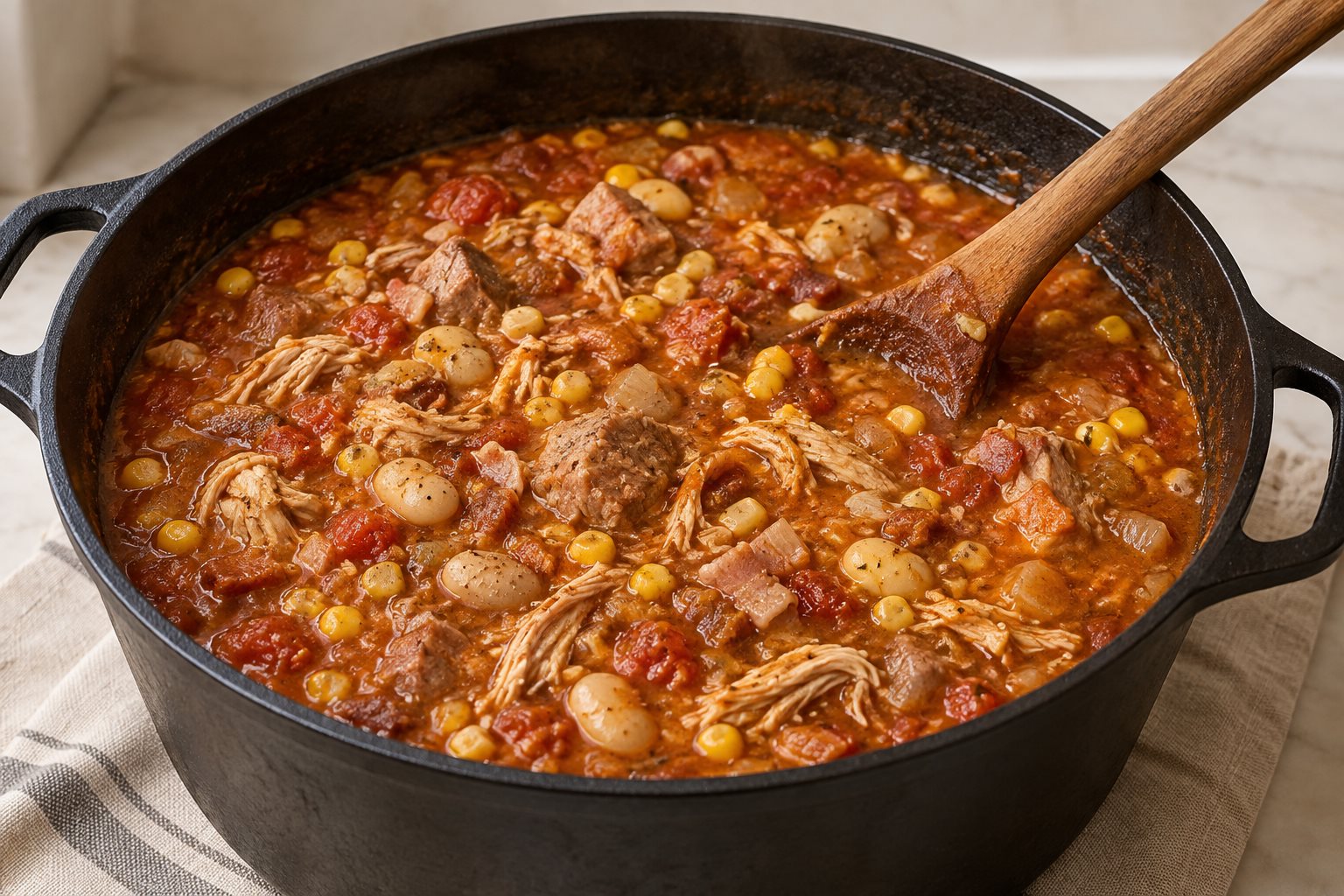
A wide cast iron pot of thick red-brown stew crowded with shredded chicken, pork, corn kernels and butter beans, a long wooden paddle resting in it
The paddle is not decoration. After the second hour nothing but a flat stirrer reaches the bottom, and the bottom is where this stew scorches. AI-generated illustration.

Two towns named Brunswick have spent well over a century claiming this pot, and the only way to write it honestly is to cook what both of them printed.

The fight is real, it is old, and it is in the newspapers. Through June and July of 1906 the Americus Times-Recorder, a Georgia paper, ran and reran a column headed "Brunswick Stew. A Gastronomic Triumph With a National Reputation," credited at the foot to the Richmond Times. It opens flatly: the stew "originated in Brunswick county, Va., from which it takes its name," and the originator "was either Mr. Haskins or Mr. Stith, each claiming during a long life the distinction of having made the first stew and dying without a proper adjustment of the controversy." Georgia papers kept printing the Virginia line for another half century — the Brantley Enterprise of Nahunta, in southeast Georgia, told its readers on 26 May 1955 that the stew "had its origin up in Brunswick County, Virginia" — and a Blakely grocer advertised canned Brunswick stew in the Early County News of 15 March 1928 as "the stew that made Old Virginia famous."

Georgia answers with the legislature and with volume. The Summerville News of 19 May 1988 printed House Resolution 906 in full: the "Battle of the Brunswicks" has "stewed in every cauldron of controversy," and the City of Brunswick "possesses the very pot in which the first batch of Brunswick Stew was cooked on July 2, 1898," a pot the resolution says came to Georgia aboard the ship Wanderer and which the city fathers set up as a monument in 1942. The House passed it unanimously. In 2025 the state went further: as the Jackson Herald reported on 3 December 2025, House Bill 233 made Brunswick stew the official state stew, the bill stating that "contrary to claims by other states, Georgia, and specifically Brunswick, Georgia, is the birthplace of Brunswick stew." I am not adjudicating that. What this page works from is what both sides printed: the 1906 Richmond Times recipe, a layered kettle version from the Griffin Daily News of 22 December 1924, and the Georgia barbecue record, where the Leader-Tribune of Fort Valley counted four thousand gallons of stew served at the 1924 peach festival barbecue and the Fitzgerald paper, writing up the same day, printed fourteen thousand.

Why this version works

Two meats, one pot. The 1906 column allows lamb, chicken or squirrel and adds "a large slice of middling meat" — salt pork — to every version. Georgia pits put chicken and pork shoulder in together. Chicken gives the broth its body and shreds into threads that hold sauce; pork shoulder gives fat and the meaty depth that chicken alone never reaches. The salt pork is seasoning, not meat.

Tomato goes in late. The Griffin method holds a quart of tomatoes back until the meat and the beans have had their hours, then gives them one hour more with two teaspoons of sugar. Acid slows everything it touches: beans put in with tomato at the start stay chalky long after the meat is gone. Late tomato also keeps its brightness instead of cooking to a flat red sweetness.

Red pepper in abundance. The 1906 recipe says exactly that — "black and red pepper in abundance" — and then says the finished stew should be "very highly seasoned." Cut the pepper back and you get a bland vegetable soup with meat in it, which is the failure mode of every timid Brunswick stew. Season the pot at the start, and again after the tomatoes, when the volume has dropped by a third.

Everything cooks until it falls apart. This is not a stew of distinct pieces. The Griffin recipe simmers three or four hours before the tomatoes even go in. Meat is cooked until the bones lift out clean, then torn; vegetables are cooked past tender until they blur into the liquid. What thickens the pot is the food itself breaking down, which is why the last hour needs stirring and a low flame.
Ingredient notes

Pork: boneless shoulder, in two-inch chunks. If you have leftover barbecued pork, use a pound of it in place of half the fresh shoulder and add it in the last hour, which is the Georgia pit shortcut and tastes like it.

Chicken: bone-in thighs, skin on. The bones and skin are the whole point — they are what make the broth thick enough to carry the rest. A whole cut-up chicken works and is closer to the old practice. Boneless breast gives you dry strings in a watery pot.

Salt pork: four ounces of slab bacon or salt pork, cut small. Old recipes call it middling meat. It renders in the first ten minutes and everything else is browned in what comes out of it, so do not substitute thin supermarket bacon, which is mostly water.

Butter beans and corn: the 1906 Virginia text bans both potatoes and butter beans and allows nothing but corn and tomatoes. The 1924 Griffin version layers in potatoes, corn and limas alike. I have kept corn and butter beans and left the potatoes out, which is a choice, not a ruling.

Step by step

  1. Render the salt pork. Cook the diced salt pork in a heavy 8-quart pot over medium heat for 8 to 10 minutes, until the fat has run and the pieces are gold. Leave the pieces in.
  2. Brown the pork, then the onions. Raise the heat, brown the pork shoulder in the fat in two batches, about 5 minutes a batch, and set it aside. Drop the heat, add the onions with a pinch of salt and cook 8 minutes until soft and lightly colored, scraping up what stuck.
  3. The long simmer. Return the pork, lay the chicken thighs on top, add the water, 2 teaspoons of the salt, the black pepper and half the cayenne. Bring to a bare simmer, cover partly, and cook 1½ hours, skimming the fat that rises.
  4. Pull the meat. Lift out the chicken and the pork. When they are cool enough to handle, pull the chicken from the bones, discard skin and bones, and shred both meats with two forks or your fingers. Return everything to the pot.
  5. Beans and corn. Add the butter beans and simmer 45 minutes, uncovered now, stirring every 10 minutes or so. Add the corn and cook 15 minutes more. The pot should have dropped by about a third.
  6. Tomatoes last. Crush the tomatoes in your hand into the pot, add the sugar, the vinegar, the rest of the cayenne and the rest of the salt, and simmer 1 hour uncovered on the lowest flame that keeps it moving, stirring often and along the bottom. Stir in the butter at the end and taste hard for salt and heat.
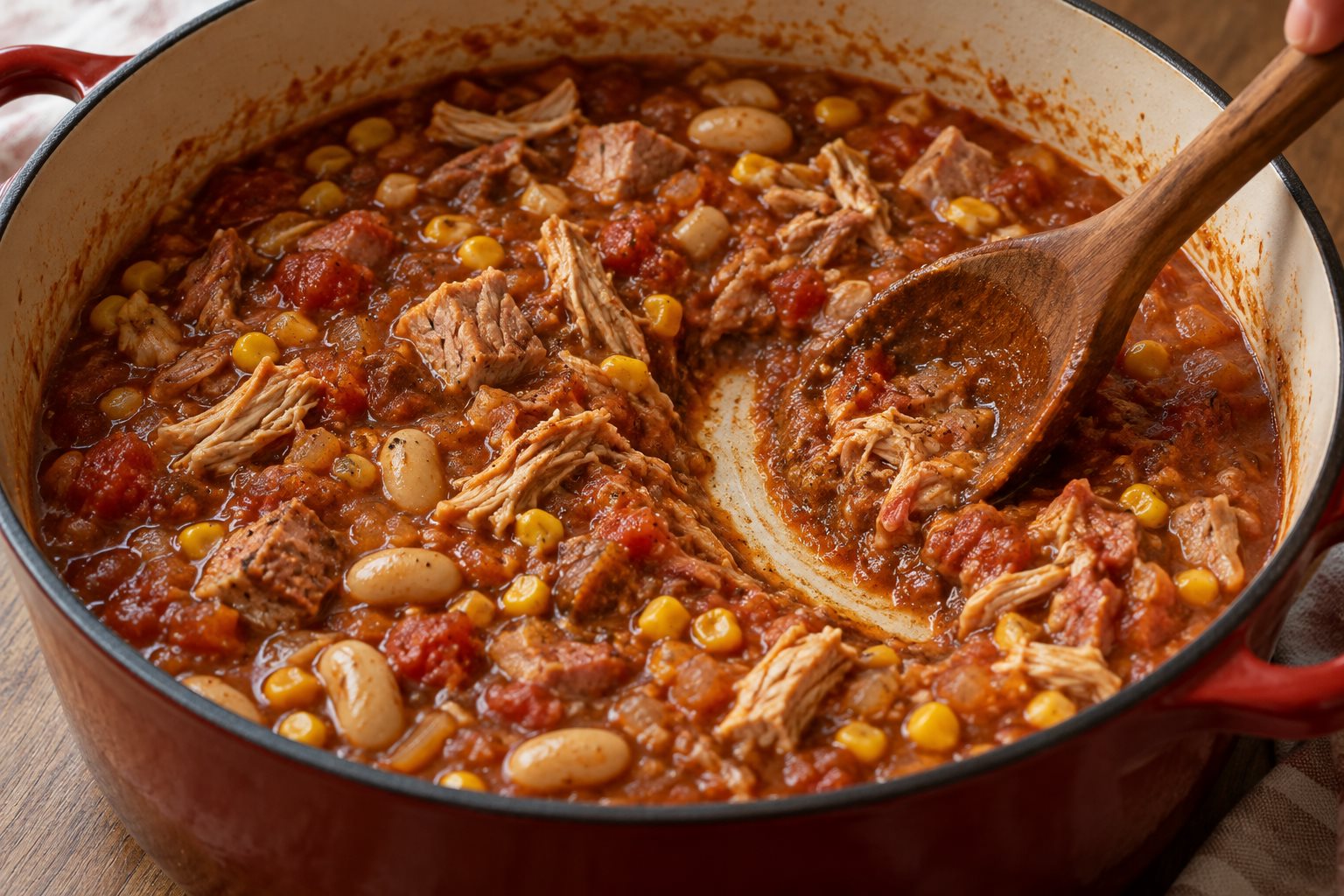
  7. Judge the thickness. A spoon dragged across the bottom should leave a track that closes slowly. If it is still loose, keep going; if it has gone past you, a ladle of hot water brings it back. The 1906 column finishes with stale breadcrumbs stirred in, and that is the quickest rescue if time is short.
    A wooden spoon leaving a track through thick Brunswick stew.
    The finished stew should be thick enough for a spoon to leave a track that closes slowly. AI-generated illustration.
Scorched bottom is the one failure you cannot stir out — the burnt taste travels through the whole pot in a minute. The moment you smell it, stop stirring, take the pot off the heat and ladle the stew out from the top into a clean pot without scraping anything, leaving the last inch behind. Then season again from scratch, because what you rescued is under-seasoned by definition. Prevention is a flame lower than you think necessary and a flat-ended paddle that actually reaches the corners.

Storage and make-ahead

Better on day two and good for 4 days refrigerated. It sets solid when cold; reheat gently with a splash of water, stirring, and expect to correct the salt and the pepper each time, because both flatten in the fridge.

Freezes well for 3 months in quart containers. Thaw in the fridge overnight rather than in the pot — from frozen the bottom scorches before the middle is warm, which undoes the one thing this stew cannot survive.

What to serve with it

In Georgia this comes on the same plate as barbecue and is not asked to be a main course. Give it white bread or saltines, sliced onion and pickles, and something sharp to drink. If it is dinner on its own, cornbread and a vinegar slaw are all it needs.

A wide cast iron pot of thick red-brown stew crowded with shredded chicken, pork, corn kernels and butter beans, a long wooden paddle resting in it

From the recipe box / Georgia

Brunswick Stew

Chicken and pork simmered down with salt pork, onion, tomato, corn and butter beans until a spoon will nearly stand in it, the way the stew sheds at a Georgia barbecue have always made it.

Prep
30 min
Cook
3 hr 30 min
Total
4 hr
Serves
8
Calories
628 per serving

Ingredients

Scale

Instructions

  1. Render the diced salt pork in a heavy 8-quart pot over medium heat, 8–10 minutes, leaving the pieces in.
  2. Brown the pork shoulder in the fat in two batches and set aside; soften the onions in the same pot for 8 minutes.
  3. Return the pork, add the chicken, water, 2 teaspoons salt, the black pepper and half the cayenne, and simmer partly covered 1½ hours, skimming.
  4. Lift out the meats, pull the chicken off the bones, shred both, and return everything to the pot.
  5. Add the butter beans and simmer uncovered 45 minutes, then the corn for 15 minutes more.
  6. Crush in the tomatoes with their juice, add the sugar, vinegar, remaining cayenne and remaining salt, and simmer 1 hour on the lowest flame, stirring along the bottom.
  7. Stir in the butter, taste for salt and heat, and thicken with the breadcrumbs only if a spoon still leaves no track.

Nutrition

Fat36 g (13 g saturated)
Sodium1150 mg
Protein40 g
Servingabout 1½ cups
Calories628
Cholesterol165 mg
Carbohydrates36 g (9 g sugar, 6 g fiber)

Nutrition is an estimate calculated from the listed ingredients and is provided as a courtesy, not as dietary advice.

Questions readers ask

Squirrel, really?

Really, in the old text: the 1906 recipe offers lamb, chicken or squirrel, and the Griffin Daily News wrote in 1924 that "in the early days in Brunswick county hunters prepared this Virginia dish, using squirrels as the meat." Small game is what a hunting-camp stew was made of. Chicken and pork are what the barbecue stands settled on, and that is what is written here.

How thick is too thick?

Georgia's stew sheds serve it thick enough to hold a spoon upright and thin enough to eat with one. If it sets into a paste it will scorch before you serve it and taste pasty when you do; loosen with hot water. If it pools on the plate around the barbecue, it has another half hour to go.

So who actually invented it?

Nobody has proved it and the papers show why. The Richmond Times piece Georgia reprinted in 1906 says Brunswick County, Virginia, and cannot even settle which of two men there made the first pot. Georgia's House Resolution 906 of 1988 says the City of Brunswick, Georgia, on 2 July 1898, and rests on a pot the city displays. A 1955 Georgia paper sided with Virginia; the 2025 state stew bill sides with Brunswick. Both claims are sincere, neither is documented in a way that closes the argument, and this recipe takes from both.

Can I make it in a slow cooker?

Through the first simmer, yes — meat, onions and liquid on low for 6 hours will pull apart fine. The last two stages will not work there. Butter beans, corn and tomato need open evaporation to thicken, so move everything to a wide pot on the stove once the meat is shredded.