American cooking Recipes & regional stories

Skillet & Sage

A culinary journey through the fifty states

The regional table / Georgia

Boiled Peanuts
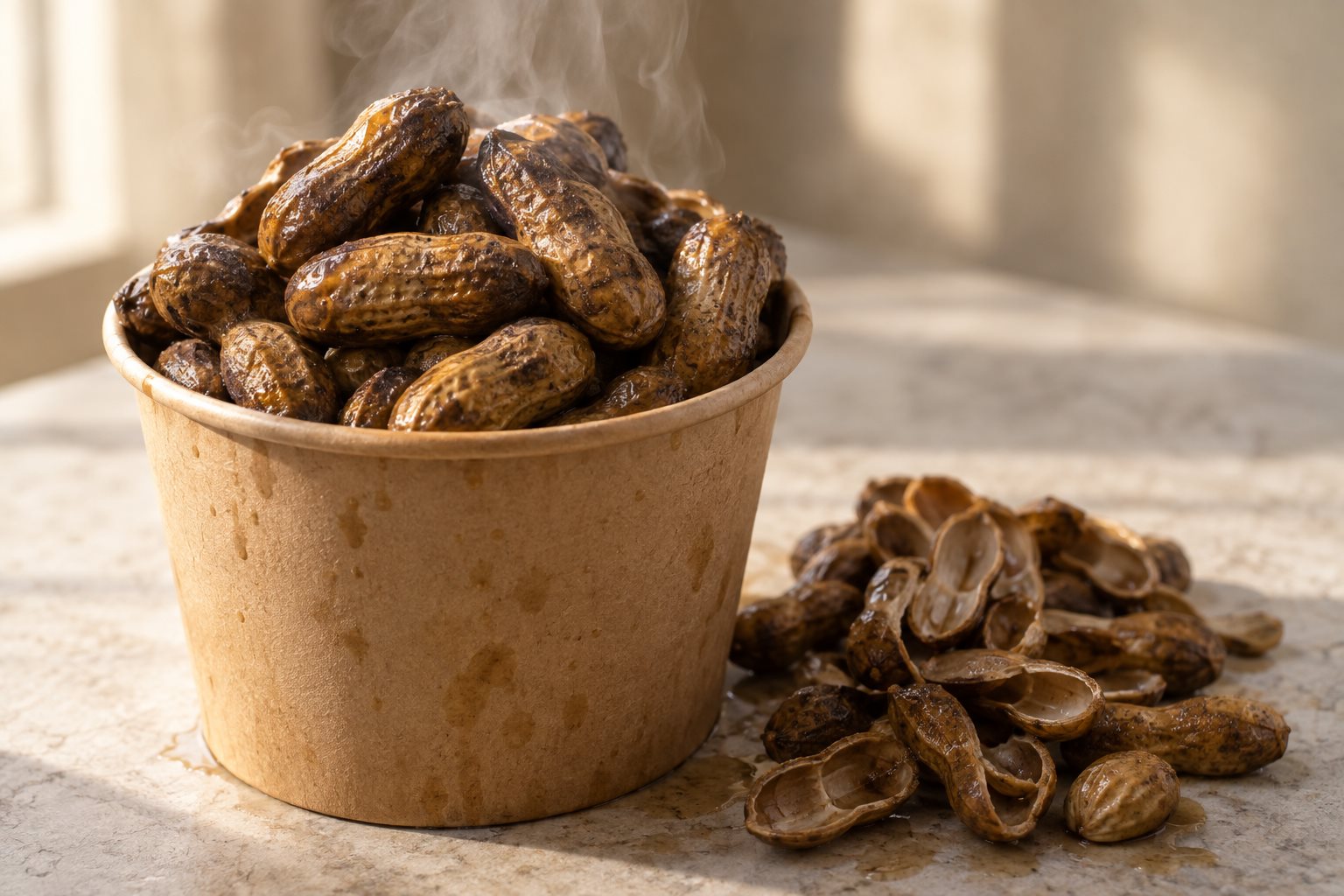
A brown paper cup heaped with wet, dark-stained peanuts in the shell, steam rising, a pile of split shells beside it
They come out of the pot dripping and stay hot for a long time. The split shells beside the cup are the only way anyone has ever eaten them. AI-generated illustration.

Boiled peanuts are not roasted peanuts wet. They are a legume cooked like a bean, and the raw material has to be a peanut that never dried.

The United States Department of Agriculture published a thorough account of the Georgia peanut in 1911 and never mentioned this dish. Farmers' Bulletin 431, "The Peanut," by W. R. Beattie of the Bureau of Plant Industry, issued 11 March 1911, runs to the local names — "goober," "goober pea," "pindar," "ground pea," and "groundnut" — the commercial types, Virginia Bunch and Virginia Runner and Spanish and Tennessee Red and Valencia, and the habit across Georgia and the Gulf states of planting peanuts in the alleys between the corn rows and turning the cattle and then the hogs in afterwards to clean up. It gives digging, stacking, curing, picking and cleaning. Then it lists the "important uses for human food": eaten from the shell, salted shelled, blanched, in candies and brittle, with popcorn and puffed rice, as peanut butter, as meal and salad oil. Boiling is not there. The federal government was writing about a crop that gets dried; boiled peanuts are made from a peanut caught before that happens, which is why the dish lived at the field edge and the roadside rather than in the bulletins.

Where Georgia's own record does show it, the instructions are short and practical. The Houston Home Journal of Perry reported on 21 September 1944 that among the meats and fruit put up at the community cannery that season, one person had canned boiled peanuts to send to boys overseas. The Jackson Progress-Argus of 15 August 1968 announced 4-H'ers selling boiled peanuts hot on the spot from half past six until they sold out, with green peanuts on hand for anyone who wanted raw ones to take home. And the Summerville News printed the method outright in its Recipe Corner on 3 October 1974, as given by the county extension agent Pam Tawzer, who hailed from Tifton: wash them well, put them in a large stewer with about a cup of salt, boil an hour and a half, refrigerate or freeze what is left. "This is the way the South Georgians like them," the column says. The University of Georgia has since printed the brine for canning green peanuts in So Easy to Preserve — a cup of salt to the gallon of water — and that is the strength used below. The hours are longer than 1974 because a peanut out of a modern bag is rarely as green as one out of a Tift County field.

Why this version works

Green peanuts, not dried ones. A green peanut is one dug days ago and never cured, still holding its field moisture, sold refrigerated or frozen and spoiling within a week. Its shell is pale and pliable and its kernel cooks like a fresh bean. A cured peanut has had that water pulled out and pulls it back grudgingly, which is why the same recipe takes three hours with one and eight with the other.

Doneness is a texture, not a time. Three hours is a starting figure, not a rule — size, freshness and how recently they were dug all move it. The test is a peanut opened and bitten: it should give like a cooked pinto bean with no chalk at the center. Pulled early they squeak; left too long they turn to mush in the shell and cannot be brought back.

A brine strong enough to taste wrong. A cup of salt to a gallon of water is the strength the University of Georgia publishes for putting up green peanuts, and dipping a finger in it is unpleasant. It has to be: the shell is a barrier, the salt only reaches the kernel through hours of boiling, and a brine seasoned to taste like soup leaves the peanuts inside bland.

The soak after the boil does the seasoning. Peanuts pulled from the pot the moment they go tender taste salty on the outside and flat in the middle. Killing the heat and leaving them in the hot brine for an hour lets salt keep moving inward while nothing else changes, and it is the difference between a good batch and a batch people politely finish.
Ingredient notes

Heat: entirely optional and entirely modern. Two tablespoons of cayenne, a few split hot peppers or a Cajun seasoning blend go into the brine at the start, and roadside pots across south Georgia sell both kinds. Nothing in the older Georgia record calls for it.

Salt: a cup to each gallon of water. That figure comes from a canning brine, so use plain kosher or pickling salt without iodine or anti-caking agents, which turn the water cloudy. If you only have fine table salt, use three quarters of a cup, because it packs heavier in the cup.

Water: a gallon covers two pounds with room to boil. Keep a kettle of hot water going and top the pot up as it drops, because peanuts poking above the waterline cook unevenly and pick up no salt at all.

Peanuts: two pounds of raw green peanuts in the shell, which is roughly a produce-stand bag. Valencia types, the small ones with three or four kernels to the pod, are the ones usually recommended for boiling; runners, which is what most of Georgia grows, work fine. Rinse them hard in a sink of water, rubbing off field dirt, and skim off any that float — those are empty pods.

Step by step

  1. Wash and sort. Put the peanuts in a sink or large bowl of cold water, rub them between your hands to loosen the dirt, and pour off the water. Repeat until it runs clear. Discard any pod that floats and any that is black or soft.
  2. Build the brine. Put the peanuts in a tall 8-quart pot, add the salt and the cayenne if you are using it, and pour in a gallon of water. Stir until the salt dissolves. The peanuts will bob; that is normal.
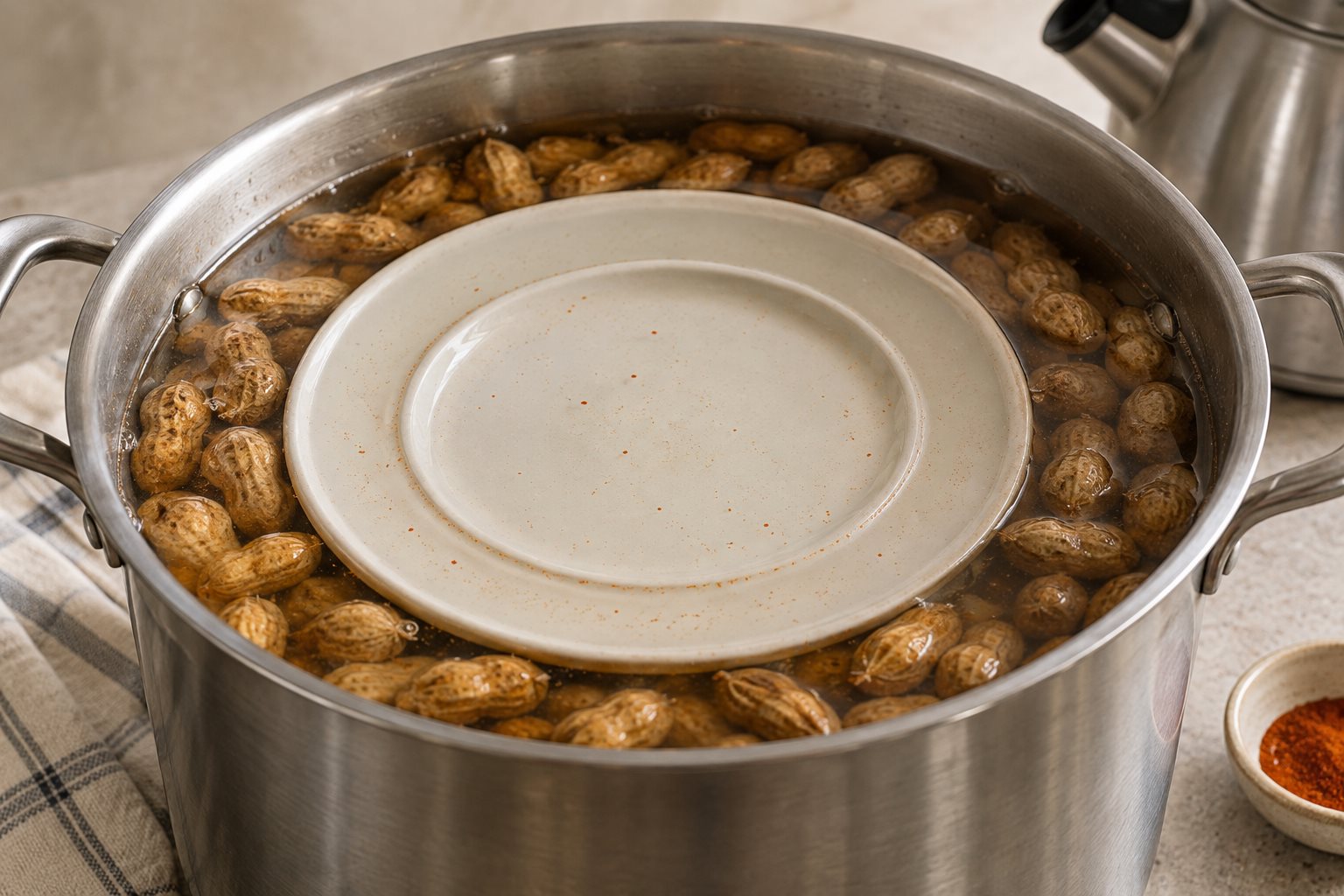
  3. Weight them down. Set a heatproof plate or a small lid directly on top of the peanuts to hold them under the surface. Without it the top layer stays pale and unsalted while the bottom overcooks.
    A heatproof ceramic plate holding in-shell peanuts under brine in a large pot.
    Use a heatproof plate to keep the floating peanuts submerged in the brine. AI-generated illustration.
  4. Boil long. Bring to a boil, then lower to a steady simmer, cover, and cook 3 hours, adding boiling water from a kettle whenever the level drops below the peanuts.
  5. Start tasting. From 3 hours on, fish out a peanut every 20 minutes, open it and bite. Green peanuts usually need 3 to 4 hours, raw cured ones 6 to 8 after an overnight soak. Stop when the kernel is tender through with no chalky core.
  6. Soak off the heat. Turn off the burner and leave the peanuts in the brine, covered, for 1 hour. Taste again: if they want more salt, leave them another 30 minutes rather than adding salt to the pot.
  7. Drain and serve hot. Lift them out with a spider into a bowl and serve them steaming, with an empty bowl alongside for shells. Any that sit in the brine overnight get saltier, so drain what you are not eating.
Peanuts that are still squeaky after five hours were dried, not green, whatever the sign said. Do not raise the heat — a hard boil bursts the shells and floods the pot with starch. Instead let them cool in the brine, refrigerate them overnight in it, and boil them again the next day for two to three hours; the soak does the work the boil could not. Peanuts that have gone the other way and turned to paste in the shell are finished as a snack, but the kernels squeezed out, mashed with a little of the brine and some hot sauce, make a good spread on crackers.

Storage and make-ahead

They keep 7 days refrigerated, drained, in a sealed container, and taste best reheated in a little of their own brine rather than plain water. They will go on absorbing salt for as long as they sit in liquid, so drain them once they are where you want them.

Freezing is the standard Georgia answer and works perfectly: bag them wet in portions and freeze up to 6 months, then reheat from frozen in simmering water for 10 minutes. Raw green peanuts also freeze, which is the only way to have them out of season.

What to serve with it

They are their own occasion — a paper cup, a cold drink, somewhere to throw the shells. If they have to be part of a meal, they sit well beside barbecue and a beer, and the cooking liquid left over is good in place of salt in a pot of greens.

A brown paper cup heaped with wet, dark-stained peanuts in the shell, steam rising, a pile of split shells beside it

From the recipe box / Georgia

Boiled Peanuts

Green peanuts simmered in heavy brine for hours until the shells go soft and the kernels inside turn savory and beanlike, eaten hot out of the pot.

Prep
15 min
Cook
3 hr 30 min
Total
4 hr 45 min
Serves
8
Calories
245 per serving

Ingredients

Scale

Instructions

  1. Wash the peanuts in several changes of cold water, discarding any that float.
  2. Put them in a tall 8-quart pot with the salt, the cayenne if using, and a gallon of water; stir to dissolve.
  3. Set a heatproof plate on top to hold the peanuts under the brine.
  4. Boil, then simmer covered 3 hours, topping up with boiling water as the level falls.
  5. Taste one every 20 minutes from 3 hours on; stop when the kernel is tender with no chalky center.
  6. Turn off the heat and let them soak in the brine 1 hour.
  7. Drain and serve hot, with a bowl for the shells.

Nutrition

Fat18 g (3 g saturated)
Sodium940 mg
Protein11 g
Servingabout 1 cup in the shell
Calories245
Cholesterol0 mg
Carbohydrates9 g (2 g sugar, 4 g fiber)

Nutrition is an estimate calculated from the listed ingredients and is provided as a courtesy, not as dietary advice.

Questions readers ask

Is a pressure cooker faster?

Much — green peanuts come tender in about 45 minutes at high pressure in the same brine. The trade-off is control: you cannot taste as you go, and the window between tender and mushy is narrow. If you use one, start checking at 35 minutes and still give them the hour-long soak in the brine afterwards, because that is where the seasoning happens.

How salty should the water be?

A cup of salt to a gallon of water, the strength the University of Georgia publishes for green peanuts in So Easy to Preserve. It tastes far too strong on its own and is right once it has spent hours crossing a shell. The one adjustment worth making is downward, not upward, if you plan to keep the peanuts sitting in the brine.

What if I can only find raw dried peanuts?

They work, on a longer clock. Soak them overnight in plain water, drain, then boil in the same brine for 6 to 8 hours, topping the pot up as it evaporates. The texture comes out slightly firmer than green peanuts and the flavor is nuttier and less green-tasting.

Can I use the peanuts from the grocery snack aisle?

No. Roasted or salted peanuts have been cooked and dried and will never soften; they turn to wet sawdust. You need raw peanuts, and ideally green ones, sold refrigerated or frozen from late summer into autumn at produce stands and farmers markets across the South.