The regional table / Florida
Stone Crab Claws with Mustard Sauce
This is the only fishery in America where the law forbids you to keep the animal and permits only its hands.
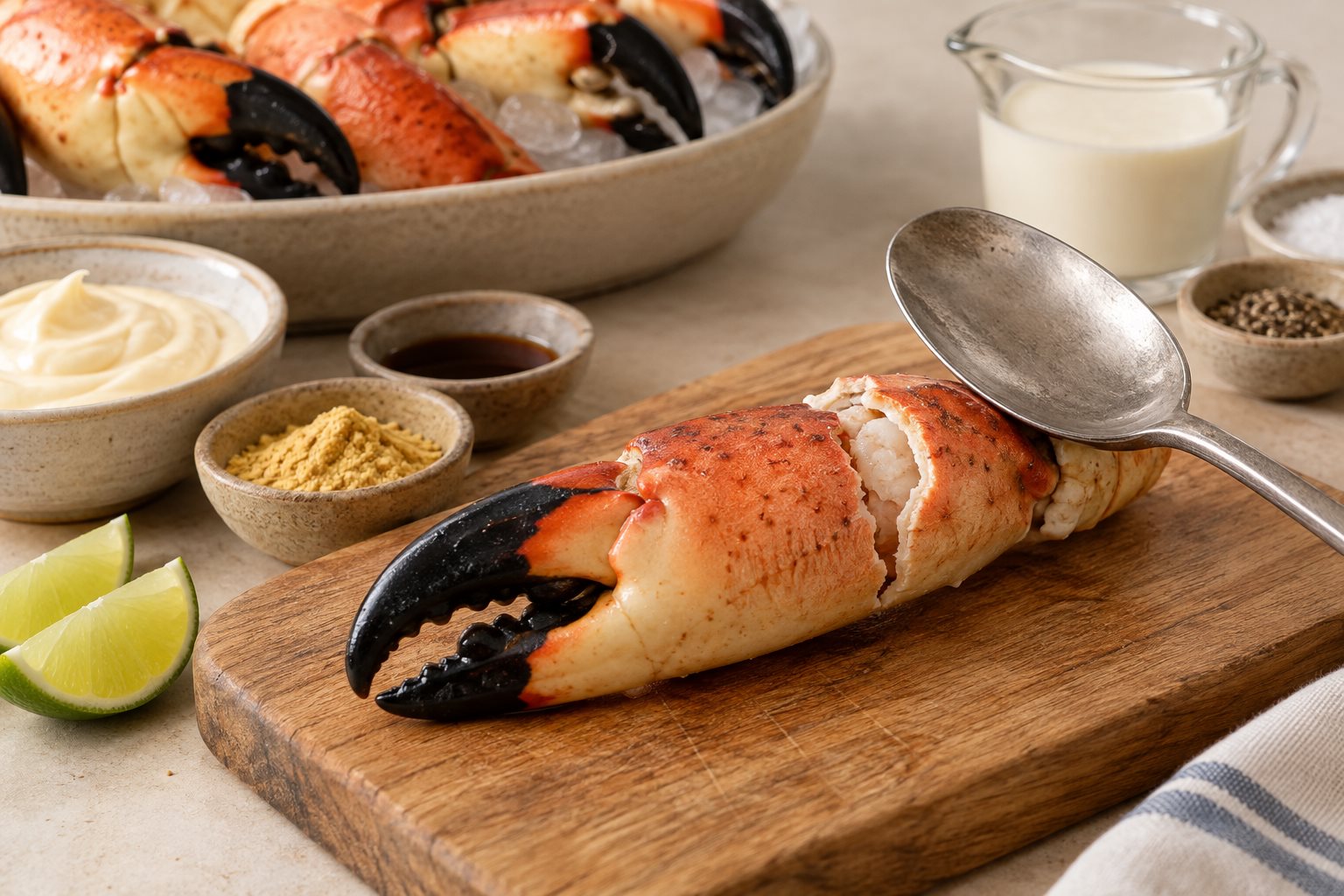
Florida writes this dish into its rulebook. Rule 68B-13.007 of the Florida Administrative Code, amended with effect from 1 October 2020, states that "it is unlawful for any person, firm, or corporation to possess or transport by boat, land vehicle, airplane, or other conveyance any intact stone crab or stone crab body whether dead or alive. Only legal sized claws of stone crabs may be possessed or transported." The same rule sets the size: it is unlawful to take or sell "any stone crab claw at any time which has a forearm (propodus) of less than 2 7/8 inches in length, measured by a straight line from the elbow to the tip of the lower immovable finger." The companion rule, 68B-13.005, opens the season on 15 October and closes it on 1 May, and after 1 May nothing but dealer inventory may be sold. Everything about how this dish reaches a table is decided by those three sentences: the claws arrive cooked, they arrive without a crab attached to them, and for five and a half months of the year they do not arrive at all.
It was not always the claws. The Evening Leader of Tarpon Springs printed a bill on 16 April 1917 from Representative Harris of Pinellas, "the champion of the toothsome stone crab," which set a closed season from the first day of May to the thirtieth day of September and then, in Section 4, made it unlawful to sell "any dead stone crab or any stone crab the claws of which have been removed from the body of such crab; that in all cases where crabs are offered for sale, the whole live crab shall be sold or offered for sale, unless they have been thoroughly cooked and are served for immediate consumption." In 1917 a Florida legislator wanted to outlaw the declawed crab; a century later the state outlaws the crab and permits only the claw. By the time the Federal Writers' Project compiled Florida Seafood Cookery for the state Department of Agriculture — the February 1944 bulletin — the practice had settled: "The huge claws, filled with rich meat, are the only part eaten." Its whole recipe is three lines. To cook: "Boil in salt water 20 minutes." To serve: "Crack with a hammer," then "Extract the meat and dip in melted butter." There is no mustard sauce for stone crab in that book. The only mustard sauce it prints — dry mustard, a few drops of Worcestershire, water, melted butter — is attached to broiled scallops. The sauce below is therefore mine, worked out for this page and not recovered from any document, and you should know that the butter it replaces has ninety years of Florida state printing behind it.
Why this version works
Dry mustard, not prepared. English dry mustard bloomed in liquid gives clean volatile heat that rises into the nose and clears within seconds, which is exactly the right contrast to a sweet, fatty, cold shellfish. Prepared mustards carry vinegar and turmeric and leave a sour flat note on the tongue that sits on top of the crab instead of moving out of its way.
Cream, not more mayonnaise. The sauce needs to be loose enough to coat a lump of claw meat and drip back off it. A few tablespoons of cream thin the mayonnaise without diluting the mustard, where thinning with water or lemon juice breaks the emulsion and leaves an oily slick.
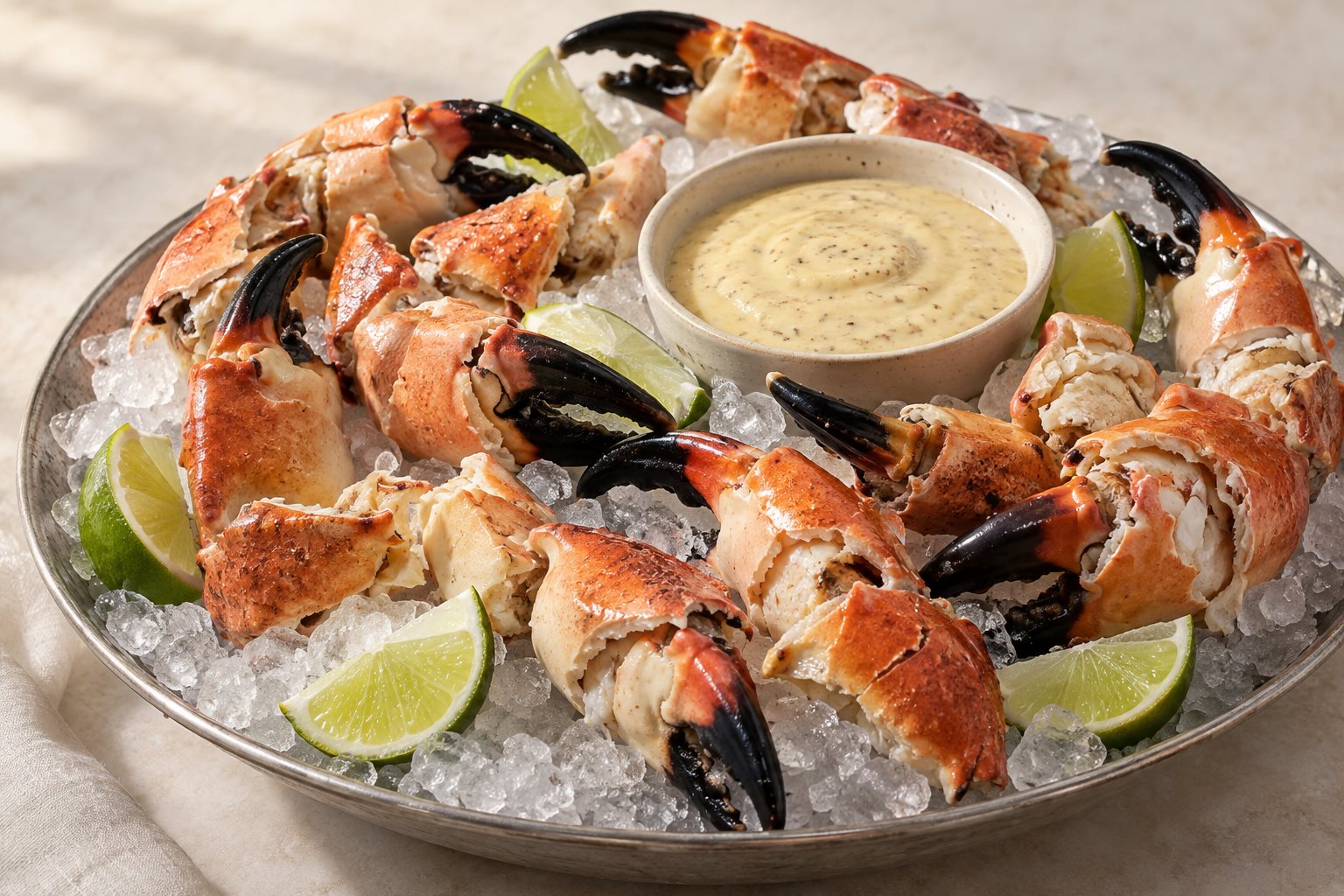
Everything is cold except nothing. The claws are cooked, then chilled hard, and the sauce comes out of the refrigerator with them. Warm stone crab is a waste of money: the meat is delicate and slightly sweet and goes stringy and faintly sulphurous when reheated, which is why no Florida fish house will sell you a hot one.
A cracked shell holds the meat cold. Crack the claws and leave the meat in them until it is eaten. Shell them ahead and the exposed meat warms, dries at the edges and loses the film of moisture that makes it taste of the sea. The shell is the serving dish.