American cooking Recipes & regional stories

Skillet & Sage

A culinary journey through the fifty states

The regional table / Nebraska

Cheese Frenchee
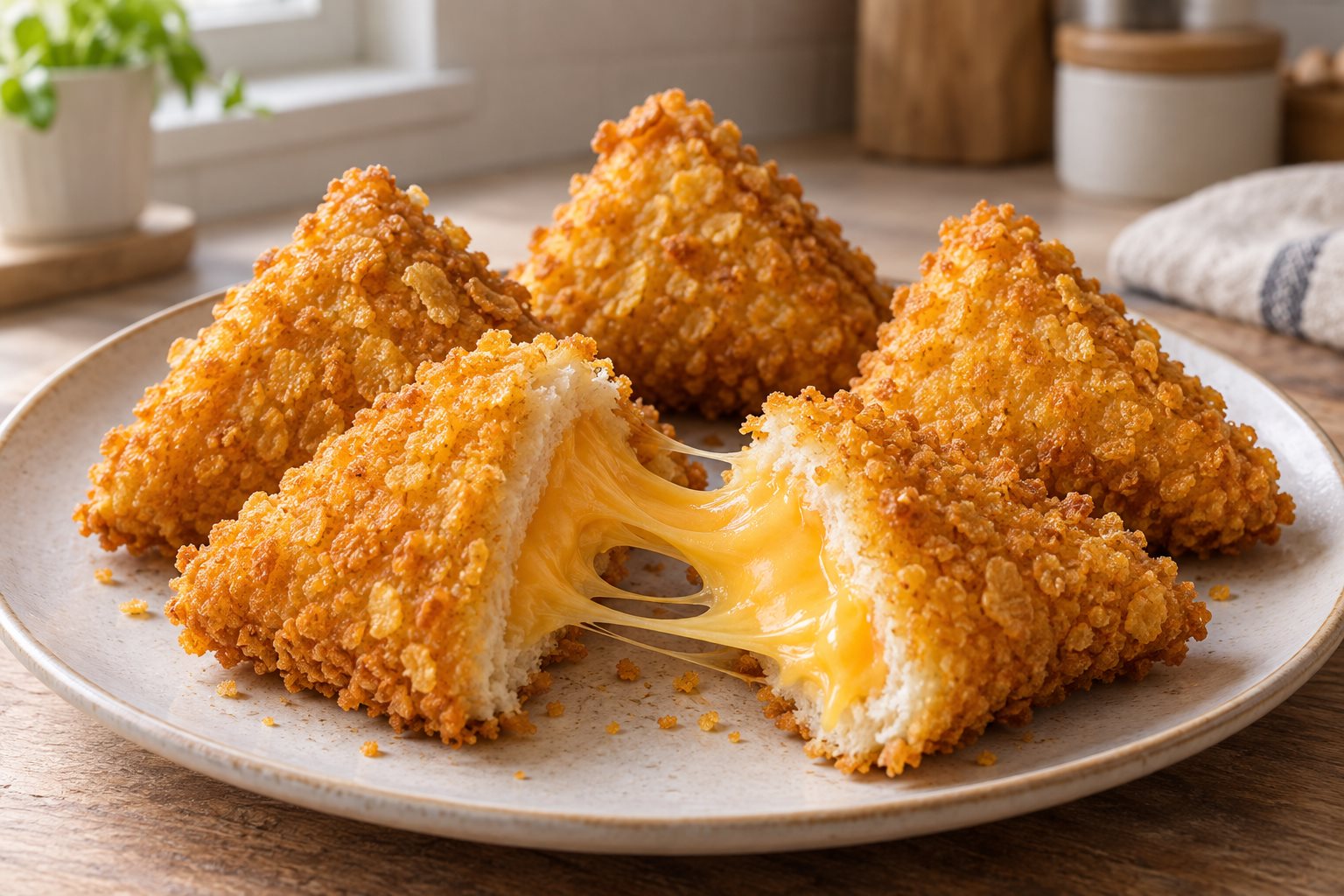
Four deep-fried sandwich triangles crusted with golden corn flake crumbs, one pulled apart with melted cheese stretching between the halves
The crust is the dish. If the crumbs are dark brown rather than gold, the oil was too hot and the middle never melted. AI-generated illustration.

A grilled cheese lets fat through the bread; this one wraps the bread in a crust so nothing gets out, and that changes everything about what happens inside.

This one is a restaurant's invention and much too young to have an old document behind it, so this page does not pretend otherwise. The name belongs to Lincoln and to a chain called King's Food Host, which the record puts in the middle of that city's ordinary life: The Daily Nebraskan of 13 August 1968, advertising concert tickets for Pershing Auditorium, lists King's Food Host among the places you could buy one, in a row with Miller & Paine, Hovland-Swanson and the Nebraska Book Store. The sandwich itself surfaces in the same paper seven years later. A coupon printed on 12 March 1975 reads: "This coupon good for 25 off to UNL students, faculty or staff members toward a Tuna or Cheese Frenchee", expiring the following week — two flavours, no explanation of what a frenchee was, because in Lincoln nobody needed telling. By 22 September 1977 the word had come loose from the company altogether and gone into the classifieds as a business name of its own: "Frenchees Hamburger Joynt, 1316 N St. is looking for help for over the noon hours."

What the archive will not give is a birth date. The dish is often placed in the 1950s, and that may well be right, but Nebraska's open newspaper archive at nebnewspapers.unl.edu holds no genuine occurrence of the word before that 1975 coupon — the handful of earlier hits its search offers are optical-character noise in papers from the 1880s and 1910s. The Lincoln papers that would carry the chain's own advertising through the fifties and sixties are not in the open instance, which runs the student paper for the modern decades, and everything a company of that vintage printed about itself is in copyright anyway. So: no founding date is claimed here, no company recipe is reproduced, and nothing below comes from a document. The quantities were worked out for this page, and they are built around the one structural fact that makes the sandwich work — mayonnaise inside instead of butter outside, because the fat has to be in the sandwich when the outside is sealed shut by a crust.

Why this version works

350°F, not hotter. The crust is thin and the filling starts cold, so the oil has to be gentle enough to give the cheese ninety seconds to run. At 375°F and up the crumbs are dark before the middle has moved, which is the commonest failure and the one nobody can fix afterwards.

Mayonnaise, not butter. In a fried sandwich there is no contact with a hot pan to melt butter into the bread, and no way for anything to escape once the crust sets. Mayonnaise is fat already emulsified with egg and acid; it softens into the crumb and carries the cheese as it goes, which is why the middle ends up liquid rather than merely warm.

A flour-thickened batter. Egg and milk alone run off the bread and leave bald patches where oil gets in. Whisking flour into them gives a batter that clings in an even coat, and the coat is what holds the crumbs on through the fryer.

Corn flakes, crushed coarse. Crushed to gravel rather than dust, corn flakes give a crust with ridges and air in it that shatters when you bite. Breadcrumbs pack tighter, brown faster and go hard instead of crisp, and panko fries too pale to look like the thing.
Ingredient notes

Oil: a neutral oil with a high smoke point — peanut, canola or sunflower — two inches deep in a heavy pot. You need a thermometer for this. Dropping sandwiches into oil you have judged by eye is how the crust ends up black.

Bread: soft white sandwich bread, and this is the one dish where the cheap squashy kind is correct. It compresses under the batter, fries without going tough, and its sweetness belongs here. A firm sourdough will fight the crust and stay bready in the middle.

Cheese: American slices, two a sandwich, for the reason people use them: they melt to a smooth liquid rather than breaking into oil and curd. Mild cheddar sliced thin works if you want more flavour, but it will be greasier where it melts.

Corn flakes: three cups of plain unsweetened flakes, crushed in a bag with a rolling pin to the texture of coarse sand with some flakes still recognisable. Do not use a food processor; it takes them to powder in seconds.

Step by step

  1. Build the sandwiches. Spread mayonnaise on one side of each slice of bread, right to the edges. Make four sandwiches, each with two slices of cheese between the mayonnaise faces. Press each one flat with your palm and trim the crusts off square.
  2. Chill them. Put the trimmed sandwiches on a plate in the freezer for 10 minutes. Cold, firm sandwiches take batter evenly and hold together in the oil; room-temperature ones tear at the corners.
  3. Set up the coating. Whisk the egg, milk, flour and salt to a smooth batter about the thickness of single cream. Spread the crushed corn flakes in a wide dish.
  4. Heat the oil. Bring 2 inches of oil to 350°F in a heavy pot and hold it there. Set a rack over a tray beside the stove.
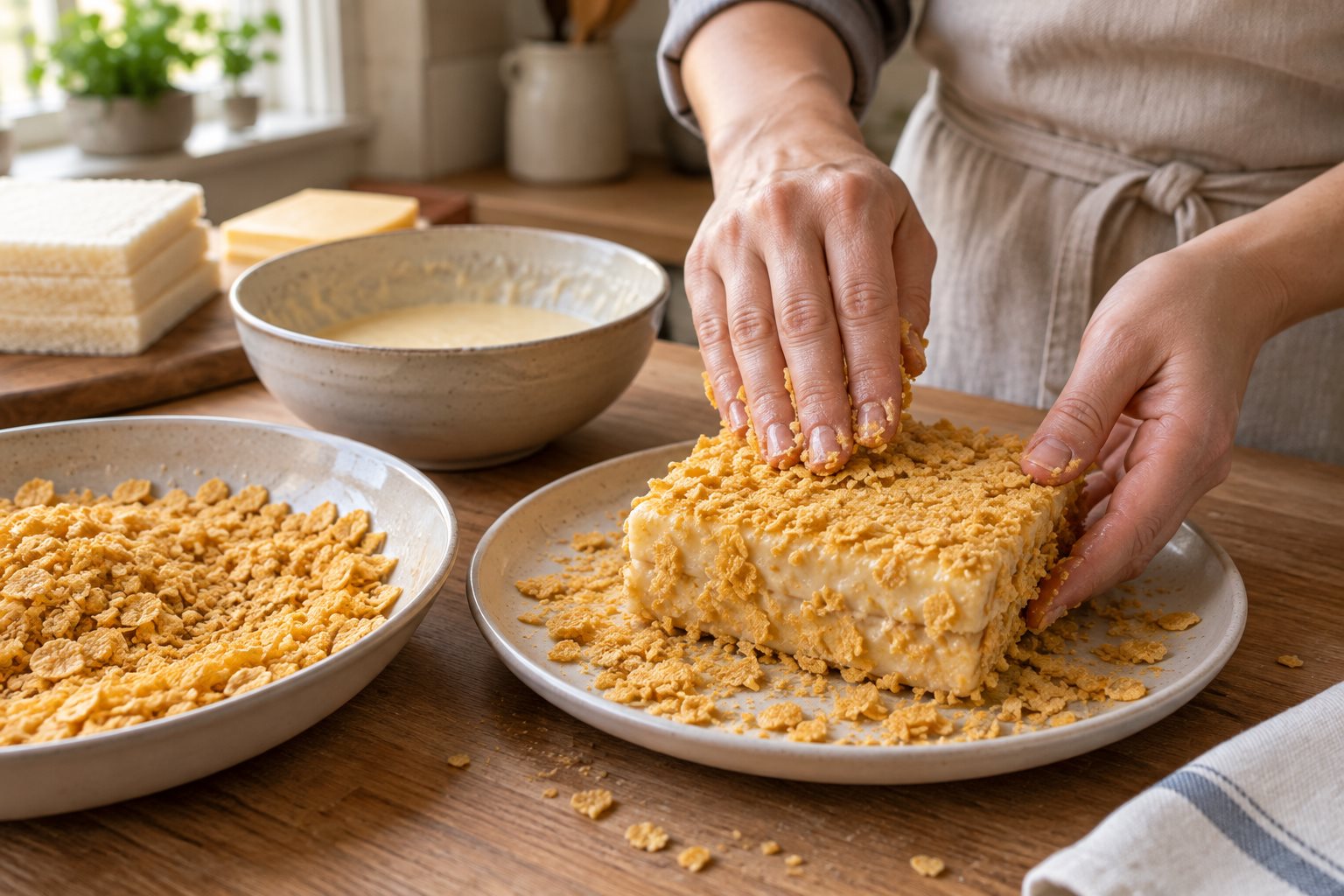
  5. Coat. Dip a sandwich in the batter, let the excess run off for a count of three, then lay it in the corn flakes and press the crumbs onto both faces and all four edges. Coat them all before you fry any.
    Cornflake crumbs pressed onto a whole square cheese sandwich
    Coat both faces and every edge before frying the sandwiches whole. AI-generated illustration.
  6. Fry and cut. Fry two at a time, 90 seconds to 2 minutes a side, turning once, until deep gold. Lift onto the rack, salt lightly, and wait 2 minutes before cutting each into four triangles — cut straight away and the cheese runs out onto the board.
If you cut one open and the cheese is still solid, the oil was too hot. Put the halves back in oil brought down to 325°F for 45 seconds a side; the crust will darken further but the middle will catch up. For the rest of the batch, let the oil settle to temperature and add ten seconds a side.

Storage and make-ahead

Eat them within five minutes. A fried sandwich is a five-minute food and reheating it gives you a hard crust over cold bread.

The sandwiches themselves can be built, trimmed and refrigerated a day ahead, which actually improves how they fry. Coat them only when the oil is at temperature — batter left standing on bread soaks in and slides off in the pot.

What to serve with it

Tomato soup, which is the natural other half of any fried cheese sandwich, or dill pickles and crisps if you want the counter version. Something sharp to drink: lemonade, or a cola with plenty of ice.

Four deep-fried sandwich triangles crusted with golden corn flake crumbs, one pulled apart with melted cheese stretching between the halves

From the recipe box / Nebraska

Cheese Frenchee

A cheese sandwich made with mayonnaise, dipped in batter, rolled in crushed corn flakes and deep fried until the crust cracks and the inside has gone to liquid.

Prep
15 min
Cook
10 min
Total
25 min
Serves
4
Calories
645 per sandwich

Ingredients

Scale

Instructions

  1. Spread mayonnaise to the edges of every slice, make four sandwiches with two slices of cheese in each, press flat and trim the crusts square.
  2. Freeze the trimmed sandwiches 10 minutes.
  3. Whisk the egg, milk, flour and salt to a smooth batter and spread the crushed corn flakes in a wide dish.
  4. Heat 2 inches of oil to 350°F and set a rack over a tray.
  5. Dip each sandwich in batter, let it drain, then press it into the corn flakes on both faces and all four edges.
  6. Fry two at a time, 90 seconds to 2 minutes a side, until deep gold. Drain on the rack, salt lightly, rest 2 minutes and cut each into four triangles.

Nutrition

Fat44 g (12 g saturated)
Sodium1250 mg
Protein17 g
Serving1 sandwich, four triangles
Calories645
Cholesterol75 mg
Carbohydrates44 g (8 g sugar, 2 g fiber)

Nutrition is an estimate calculated from the listed ingredients and is provided as a courtesy, not as dietary advice.

Questions readers ask

Tuna frenchee?

It was on the same 1975 coupon as the cheese one, so it is as authentic as its sibling: tuna salad in place of the cheese, everything else identical. It fries in the same time and needs the sandwich chilled just as firmly.

Is this the restaurant's recipe?

No. No company recipe for it has ever been published, and nothing here is taken from one. This is the sandwich as it is understood and made at home, with quantities worked out for this page.

Why mayonnaise instead of butter?

Because nothing touches a hot surface here. Butter on the outside would simply fry off into the oil, while mayonnaise inside softens into the bread and helps the cheese go liquid in the ninety seconds the crust allows.

Can I bake or air-fry them instead?

You can get a crisp crust in an air fryer at 375°F for about 8 minutes if you spray the crumbs with oil, but the coat stays drier and paler and the middle takes longer to melt. It is a decent weeknight version and it is not the same thing.