Oregon has been legislating about this clam since 1900, and the oldest rule in the book has since been turned exactly upside down.
The earliest razor clam document I can read is a state scientist's and it comes with a bill attached. In 1900 F. L. Washburn, biologist to the State of Oregon, printed "Notes on the spawning habits of the razor clam" at Eugene as part of his report, and the reason for the work was legislative: a cannery man had been sending him batches of six to ten clams a month from Astoria through 1899 so that microscopical examination could establish when the animal spawned. The bill he prints is headed "A BILL For an Act providing for the protection of razor clams, and declaring an emergency", and its first section makes it unlawful "to dig, take, kill, injure, destroy, buy, sell, or offer for sale any shellfish commonly known as the razor clam" between 1 June and 15 July and between 15 October and 15 December each year, "provided, however, that it shall not be considered unlawful for any person to dig razor clams for his or her own use". Section 2 is the one that has not survived: a digger who turns up a clam "whose length is less than two and one half inches" must "immediately replace said clam in the place from which it was dug, with the least possible injury to the clam". Washburn's worry was industrial rather than domestic — "A clam cannery, in its zeal to make a big season's pack of minced clams, might use very small individuals, such as one seeking clams for his own need would discard." Nine years later the protection had widened: on 27 May 1909 the Tillamook Headlight printed the text of "An Act to provide for the protection of crabs, razor clams and crawfish".
The modern rule reverses the 1900 bill's second section outright, and it says why. Oregon's shellfish regulations list for razor clams "First 15 dug — no sorting or releasing", and the department's own clamming guide is blunter: "harvesters must retain the first 15 clams dug regardless of size or condition. Small and broken clams can not be returned and must be included in the bag limit", because "80 percent of discarded clams die because they are broken, have their necks cut off, or are improperly reburied". The gear is specified — hand, shovel, clam gun or tube "with an opening no less than 4"" — and so is the order of work: it is "Unlawful to remove clams from the shell before leaving the clamming area", so the shucking happens in your kitchen. The geography is extraordinarily concentrated: "The 18-mile stretch of Clatsop beaches accounts for 90 percent of Oregon's razor clam harvest", and those beaches have closed every year from 15 July to 30 September since 1967. As for the cooking, this dish is old enough to have a document of its own. On 27 August 1884 the Daily Morning Astorian ran a column of clam cookery in which a cook is quoted through chowder, soup, fritters and pie, and the fritter is the recipe below: "Chop fifteen medium sized clams with a ten-cent bunch of soft shell clams. Add half a cup of the liquor and as much of the milk; stir in two beaten eggs and flour enough to make a batter, as for fritters. Sift an even teaspoonful of sea-foam through the flour. Drop in small tablespoonfuls into boiling hot fat." The quantities here are that formula made exact.
Why this version works
Chop the clams, and barely cook them. A razor clam is mostly muscle — the digging foot and the neck — and it toughens quickly. The chopping is the mechanical answer: fine pieces through the batter cannot be chewy in the way a whole neck can. The same 1884 column gives the thermal answer in its chowder, where the clams go on the fire in their own liquor and boil "two or three minute" before being strained and chopped. Two or three minutes was the limit then and it is the limit in the fritter now.
Small spoonfuls, because the inside has to cook first. The instruction in the 1884 column is "Drop in small tablespoonfuls into boiling hot fat", and the size is a thermal argument. A walnut-sized fritter reaches the middle in two to three minutes, which is about as long as the outside can take at 375 °F before it goes past brown. Double the size and you choose between a pale fritter with wet batter inside and a dark one with the clam overcooked.
Clams are 79 percent water, so the batter has to be thick. Raw clam meat is 79.0 percent water with 14.7 grams of protein per hundred grams, and every bit of that water comes out into the batter in the pan. "Flour enough to make a batter, as for fritters" means a drop batter stiff enough to sit on the spoon and hold a dome in the fat, not a coating batter. Too loose and the fritter spreads, steams and drinks oil; the test is that a spoonful holds its shape for a second before it settles.
Half the liquid is clam liquor, and that is the seasoning. The 1884 cook calls for half a cup of the liquor and as much milk, and the USDA record explains why the ratio works: clam liquor is 97.7 percent water with 215 milligrams of sodium per hundred grams, so it brings almost no body and a great deal of savour. That is a seasoning delivered as liquid. It is also the reason no salt is added to this batter at all — raw clam meat itself carries 601 milligrams of sodium per hundred grams, nearly twice what Dungeness crab carries, and the baking powder brings more.
Ingredient notes
The fat: a neutral oil, half an inch deep in a heavy pan, held at 375 °F. "Boiling hot fat" is the 1884 instruction and a thermometer is the modern version of it: below about 350 °F the batter absorbs oil instead of sealing, and above 400 °F the outside is dark before the clam is hot. Fry in batches of four or five and let the oil come back up to temperature between them.
The clams: a pound of cleaned chopped meat, which is roughly what a single day's legal limit of fifteen clams comes to. They arrive home in the shell because the law requires it, so the kitchen work starts with opening them: a few seconds in boiling water loosens the shell and the clam can then be cut out, slit open, and have the dark digestive parts and the tip of the neck taken off. Frozen razor clam meat sold on the coast is the honest substitute. Failing that, chopped bay clams or two or three tins of minced clams will make a good fritter and a less particular one — and the minced-clam pack is itself the thing Washburn was writing about in 1900.
Flour and leavening: a cup and a half of plain flour and two teaspoons of baking powder for this quantity of clams, which is what "flour enough to make a batter" and "an even teaspoonful of sea-foam" come to when you make them definite. Sift the leavening with the flour as the old recipe says — stirred in afterwards it streaks, and a streak of baking powder in a fritter tastes of metal. Mix the batter within half an hour of frying it, because the lift starts as soon as the liquid goes in.
Rinse them, then strain the liquor: razor clams live in surf sand and they carry it. Rinse the chopped meat in a sieve under cold water until the water runs clear, and pour the liquor through muslin or a coffee filter rather than straight from the bowl, where the grit has settled. Sand in a fritter is the one fault nobody forgives, and it cannot be fixed afterwards. If you have no liquor at all, bottled clam juice is close enough.
Step by step
Open and clean the clams. Dip the clams a few at a time into boiling water for 5 to 10 seconds, until the shells gape, and lift them straight into cold water. Cut the meat free, slit the neck and the digger open lengthwise, and strip out the dark stomach, the gills and the tip of the neck. Keep every drop of liquid that comes out.
Chop, rinse, and strain the liquor. Rinse the cleaned meat well under cold water, then chop it medium-fine — pieces about a quarter inch, not a paste. Spread it on a towel and pat it dry. Pour the collected liquor through muslin or a coffee filter and measure out half a cup, topping up with bottled clam juice if you are short.
Mix the batter. Sift the flour with the baking powder and the pepper. Beat the eggs, the strained liquor and the milk together, pour them into the flour and stir just until no dry flour remains. Fold in the clams and the parsley. The batter should hold a soft dome on the spoon; if it slumps flat, add flour a tablespoon at a time.
Heat the oil and test it. Heat half an inch of oil in a heavy pan to 375 °F. If you have no thermometer, a teaspoon of batter dropped in should rise and sizzle hard at once and colour in about a minute. Have a rack or a plate of paper ready beside the pan before you start.
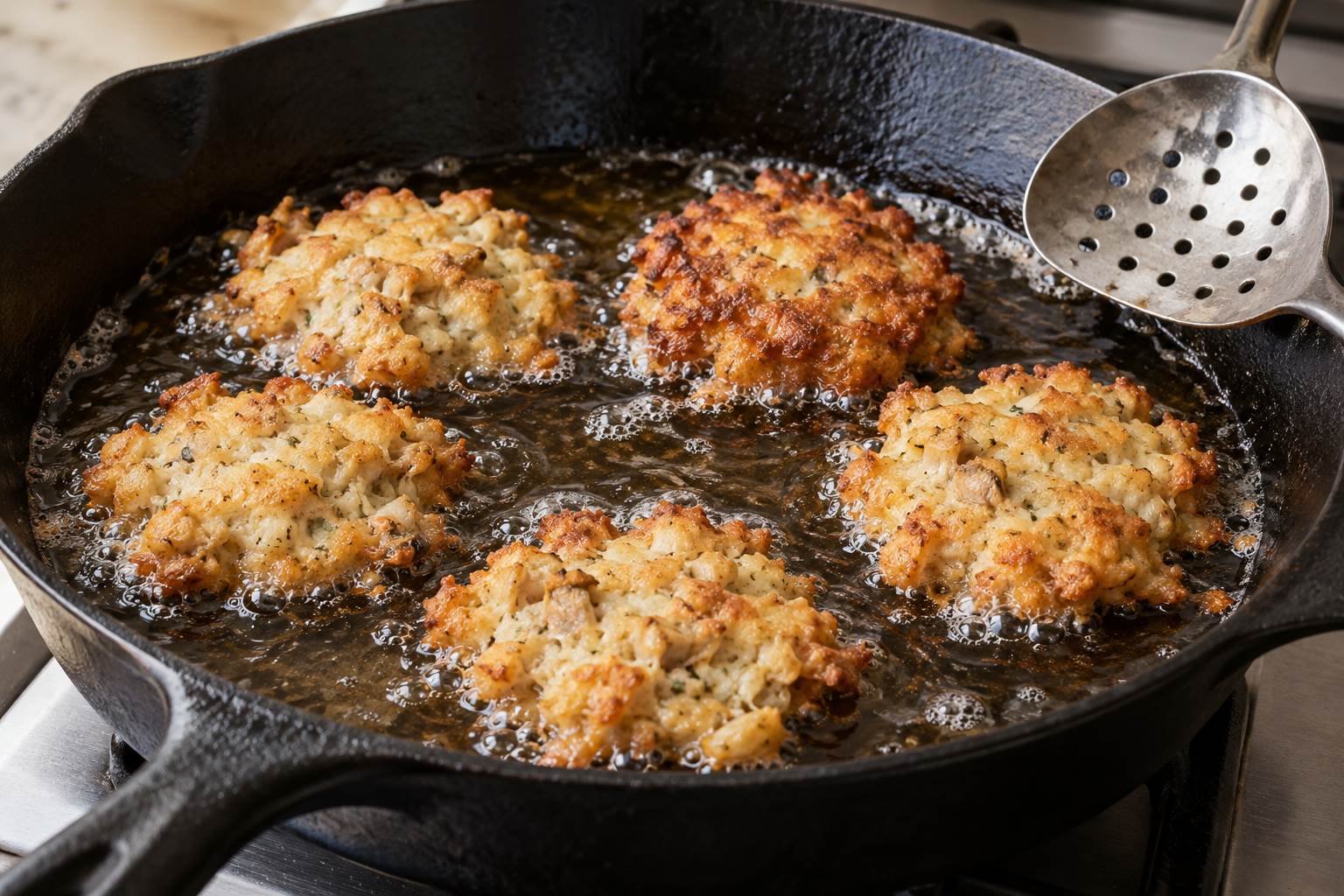
Fry in small spoonfuls. Drop the batter in by small tablespoonfuls, four or five at a time, and do not crowd them. Fry 1½ to 2 minutes, until the edges are set and brown, then turn them once and give them the same again. They should be deep gold all over; a pale fritter is an undercooked one.
Fry small tablespoonfuls without crowding and turn once the edges are set and brown.
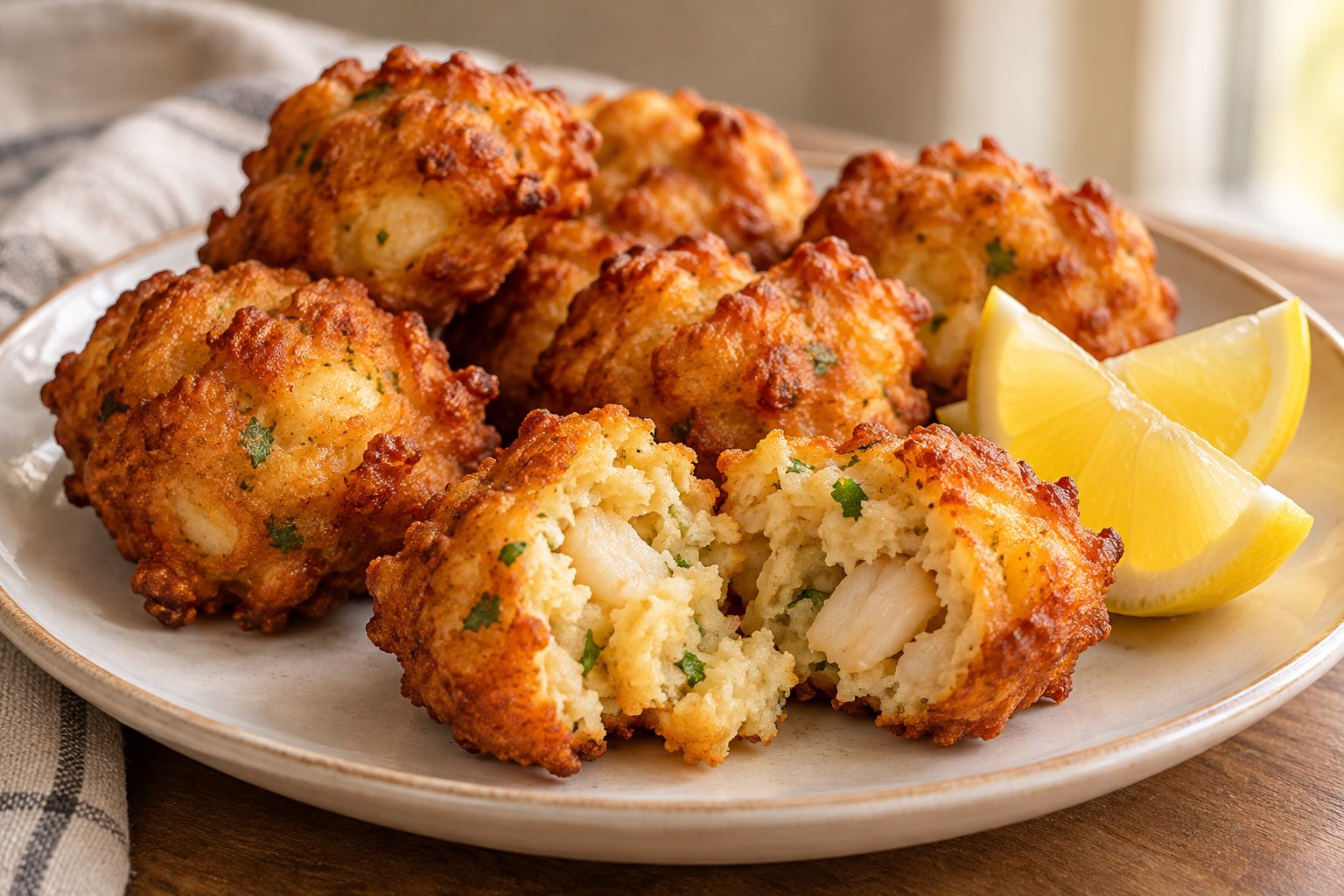
Drain and serve at once. Lift them out with a slotted spoon, drain them on the rack, and taste the first one before frying the rest so you can correct the pepper. Serve them hot with lemon. They are at their best within five minutes of leaving the pan and noticeably worse after twenty.
Greasy, heavy fritters mean the oil was too cool, and the cause is almost always crowding the pan: five small fritters drop the temperature of a shallow pan of oil by thirty degrees or more. Fry fewer, wait for the oil to recover, and keep the thermometer in. If the outsides are dark and the middles are wet batter, the spoonfuls were too big — the 1884 instruction is small tablespoonfuls and it means it. Flatten the next ones slightly with the back of the spoon as they go in, which buys the middle a shorter distance to cook. Tough, rubbery clam is overcooking, and it happens in the chopping stage as often as the frying: clams scalded for a minute rather than a few seconds to open are already half cooked before they reach the batter. Grit is the one unrecoverable fault. If you find it in the first fritter, stop, tip the batter into a sieve, rinse the clams again and remake the batter — frying the rest will only produce more sandy fritters.
Storage and make-ahead
The batter does not wait. Baking powder starts working as soon as the liquid goes in, and a fritter mixture left for an hour fries flat and dense. Mix it when the oil is already heating. The clams themselves keep ahead of time: cleaned, chopped and covered, 1 day refrigerated, or frozen in their own liquor for 3 months, which is how most razor clam meat is kept on the coast anyway. Thaw it in the fridge and drain it well before it goes into flour.
Fried fritters keep badly and reheat only moderately well. If you must hold them, spread them on a rack, not a plate, and warm them in a 350 °F oven for 6 to 8 minutes, which drives off some of the steam they have absorbed. Do not refrigerate and reheat: a day-old fritter is leathery outside and wet inside, and no oven brings it back.
What to serve with it
Lemon first and always, and then whatever sharp cold sauce you like — tartar, a plain mayonnaise with vinegar and parsley, or hot sauce. The fritter is salty, fatty and soft, so everything beside it should be acid and crisp: a vinegar slaw, sliced cucumber in salt, or pickled onions. Chips alongside make it a plate rather than a snack, but two fried things together is a lot; a cold potato salad does the job better.
To drink, beer or cold cider. The 1884 column that carried this recipe was printed in a working river town where the clams came off the beach the same week, and nothing about the dish has gone upmarket since.
From the recipe box / Oregon
Razor Clam Fritters
Chopped razor clams in a thick batter of their own liquor, milk, egg and flour, dropped in small spoonfuls into hot fat — the formula an Astoria newspaper printed in 1884, with the quantities worked out for this page.
Prep
30 min
Cook
15 min
Total
45 min
Serves
4
Calories
455 per serving
Ingredients
Scale
Instructions
Dip the clams briefly in boiling water until the shells gape, cut out the meat, and strip off the stomach, gills and neck tip, saving all the liquid.
Rinse and chop the meat about ¼ inch, pat it dry, and strain the liquor through muslin to get ½ cup.
Sift the flour with the baking powder and pepper, beat the eggs with the liquor and milk, stir the two together and fold in the clams and parsley.
Heat ½ inch of oil to 375 °F in a heavy pan.
Drop the batter in small tablespoonfuls, four or five at a time, and fry about 2 minutes a side until deep gold.
Drain on a rack and serve hot with lemon wedges.
Nutrition
Fat
20 g (3 g saturated)
Sodium
1030 mg
Protein
26 g
Serving
about 4 fritters, counting the oil they absorb rather than the oil in the pan
Calories
455
Cholesterol
130 mg
Carbohydrates
41 g (3 g sugar, 1 g fiber)
Nutrition is an estimate calculated from the listed ingredients and is provided as
a courtesy, not as dietary advice.
Questions readers ask
When can you get them?
Most of the year, but not everywhere at once. The 18-mile stretch of Clatsop beaches that produces about 90 percent of the state's razor clams has been closed every year from 15 July to 30 September since 1967, to let young clams settle; beaches further south stay open and are dug on the big minus tides. The commercial fishery has a minimum size of three and three quarter inches under OAR 635-005-0385, so bought clams are large ones. Frozen meat is sold year round on the coast and is what most fritters are made from.
Can I use canned clams?
Yes, and the pack is older than you might think — the 1900 report of Oregon's state biologist was written because canneries were making "a big season's pack of minced clams" out of razor clams, small ones included. Use two or three tins of minced clams, drained, with their juice made up to half a cup for the batter. The fritter will be softer and less sweet than one made from fresh clams, and it will not be sandy, which is a fair trade on a weeknight.
Why must every clam be kept?
Because a razor clam that goes back does not usually live. Oregon's regulations give the razor clam limit as "First 15 dug — no sorting or releasing", and the state's own guidance explains that "80 percent of discarded clams die because they are broken, have their necks cut off, or are improperly reburied". The 1900 bill required exactly the opposite — any clam under two and a half inches had to be replaced where it was dug — which tells you how much has been learned about the animal's thin shell in the century between.
Should I worry about domoic acid?
You should check before you dig, and you cannot cook your way out of it. The state's guidance is explicit that razor clams hold the toxin where other clams do not — bay clam species "tend to expel these toxins immediately and do not retain them in fatty tissues as the razor clam does" — and on removing it: "No, since the toxin is a chemical it cannot be cooked out like the bacteria found in other meats." Oregon closes beaches on test results and publishes the closures, so look them up for the beach you are going to on the day you are going. Clams bought from a shop have come through that testing.