No inventor, no trademark, no old recipe: the earliest proof of this dish I can produce is a bar advertising itself to students as the Home of the Slopper in 1993.
This is a young dish and the archive treats it accordingly. The Colorado Historic Newspapers Collection answers only a real browser, and searched in one, "slopper" returns 111 pages and "sloppers" 39, nearly all of them accidents. The oldest are from 1896 and have nothing to do with food; an advertisement in Cervi's Rocky Mountain Journal of 18 October 1967 matches because of a joke about "apple polishers, book sloppers" and the like; a 1994 found-property list from a Front Range police department matches a search for Gray's Coors because it includes a "GRAY COORS LIGHT DUFFLE BAG". Searching for the bars usually credited with the invention gets nowhere: "coors tavern" returns 231 pages of beer taverns from across the state, going back to the late 1930s, and not one readable Pueblo founding among the ones I opened. The first page I could verify as this dish is an advertisement in USC Today, the student paper of what was then the University of Southern Colorado in Pueblo, on 29 September 1993: a bar at 515 W. 4th Street billing itself "Home of the Slopper" and welcoming students "TO A PUEBLO TRADITION", with the "BEST BURGERS" and "CHILI IN TOWN SERVED 9a.m.-11 p.m." Four months later, on 26 January 1994, the same paper carried the Riverside Sports Bar offering "Marie Zimmerman's Green Chili Sloppers Served Daily 11a.m.-Midnight". Note the spelling the advertisement uses: chili.
What can be counted has been counted, and it says the dish belongs to one city. Colorado's Secretary of State publishes the state business register as open data that answers a plain query without a key, and every registered entity in Colorado with "slopper" in its name has a Pueblo address: Gray's Sloppers Ltd., formed 13 February 2013; Gray's Sloppers LLC, 29 August 2016; Sloppers Inc., 6 January 2017; Slopper in Paradise LLC, 4 August 2022; Sloppers LLC II, 22 May 2024; and a Pueblo sausage slopper from 5 June 2013. Six entities, six Pueblo addresses, three of them already delinquent — and all of them formed in the last fifteen years, which dates paperwork rather than kitchens. The state trademark file is emptier still: a search for slopper returns nothing at all, while the same file readily produces "Pueblo Chile Beer", registered 29 December 2015 and first used 1 October 2014, and "Pueblo Chile Fest", registered 18 July 2024 and first used 1 September 1994. The index works; the name simply belongs to nobody. So there is no founding story here that I can stand behind, and the quantities below were worked out for this page. The green chile is the one on the Pueblo green chile page; this recipe assumes you have a pot of it.
Why this version works
The bun is a plate, not a sandwich. A hamburger roll is only 34.3 percent water, which is exactly why it works underneath: dry crumb takes up hot chile for a few minutes without turning to paste, the same property that makes a hard roll survive a French dip. But it is a floor, not a lid. Split the bun, lay both halves cut side up, and accept that the dish is eaten with a fork — the 1993 advertisement sells burgers and chile in the same line and nobody in Pueblo picks this up.
The patty is a griddle spec, and the Army wrote it down. The Armed Forces Recipe Service, TM 10-412, card No. L 038 00, Grilled Hamburger Steak, gives the whole thing in three numbers: "Shape into steaks about 1 inch thick by 4 inches weighing 6 ounces each", then "Grill steaks on 350 °F. griddle for 9 minutes on each side or until well done", with the control point "Internal temperature must reach 155 °F. or higher for 15 seconds." That is the right patty for this dish. A thin fast-food patty disintegrates under a ladle of chile; a thick one griddled at moderate heat holds its shape and its juice and still gets a crust.
Fat is capped by law and you want to be close to the cap. Under 9 CFR 319.15 both "Chopped Beef" and "Hamburger" "shall not contain more than 30 percent fat" and neither may contain "added water, phosphates, binders, or extenders"; the only difference between the two names is that hamburger may have beef fat added "as such". For a slopper, buy near the limit. The USDA record for an 80/20 patty cooked pan-broiled is 15.9 grams of fat to 24 grams of protein per hundred grams, and that fat is what keeps the meat tasting of beef once a cup of chile is sitting on top of it. A 93 percent lean patty under chile reads as grey crumbs.
The chile has to be thick, and hot enough to melt the cheese again. Green chiles are 87.7 percent water by the USDA figure, so a loose, under-reduced pot will flood the plate and leave the bun swimming. Reduce the chile until a spoon leaves a track, and ladle it at a simmer: it arrives hot enough to re-melt the cheese on the patty and to warm the bun through, which is the difference between a slopper and a cheeseburger with soup on it.
Ingredient notes
The bun: one plain hamburger roll each, split. Nothing enriched, nothing sweet, nothing seeded — brioche collapses and a sweet bun fights the chile. If the bun is soft, toast the cut faces dry first; it buys several minutes before the base goes.
The beef: twelve ounces for two sloppers, as two six-ounce patties, ground chuck at about 80 percent lean. Form the patties loosely and salt them only on the outside, just before they hit the pan: salt mixed through ground beef dissolves the protein and gives a springy, sausage-like texture. Make them an inch thick and wider than the bun, because they shrink.
The cheese: one slice each, and this is the one place where processed cheese is the better choice rather than the lazy one. Pasteurized process cheese is defined at 21 CFR 133.169 as cheese comminuted and mixed "with the aid of heat" with "an emulsifying agent" into "a homogeneous plastic mass", and that emulsifying agent is why it melts smooth under hot chile instead of breaking into oil and strings the way an aged cheddar does. Mild cheddar works if you grate it.
The chile and the onion: about a cup of green chile per slopper, from the Pueblo green chile recipe on this site, and a couple of tablespoons of raw white or yellow onion diced small over the top. The onion is not a garnish — raw, cold and sharp against a hot heavy plate is the only thing keeping the dish from being one note. Add it at the table, never in the pan.
Step by step
Get the chile simmering first. Put the green chile on in a saucepan over low heat and bring it to a bare simmer, stirring now and then. It needs to be properly hot when it hits the plate, and it needs to be thick enough that a spoon dragged through it leaves a track that closes slowly. If it is thin, take the lid off and reduce it while you cook the meat.
Shape the patties and salt the outside. Divide the beef in two and pat each half into a round about an inch thick and four inches across, handling it as little as possible. Salt and pepper both faces just before cooking.
Griddle them at moderate heat. Heat a heavy pan or griddle to medium — about 350 °F, which is the military card's figure — with a film of oil. Cook the patties without pressing them, 4 to 5 minutes a side for a one-inch patty, until a thermometer in the middle reads 155 °F and stays there for a quarter of a minute. Thick patties on a moderate griddle brown slowly and evenly; a screaming pan gives you a burnt crust and a raw middle.
Melt the cheese on the meat. Lay a slice of cheese on each patty, take the pan off the heat and cover it for a minute. The cheese belongs on the beef, under the chile, not floating on top where it would skin over.
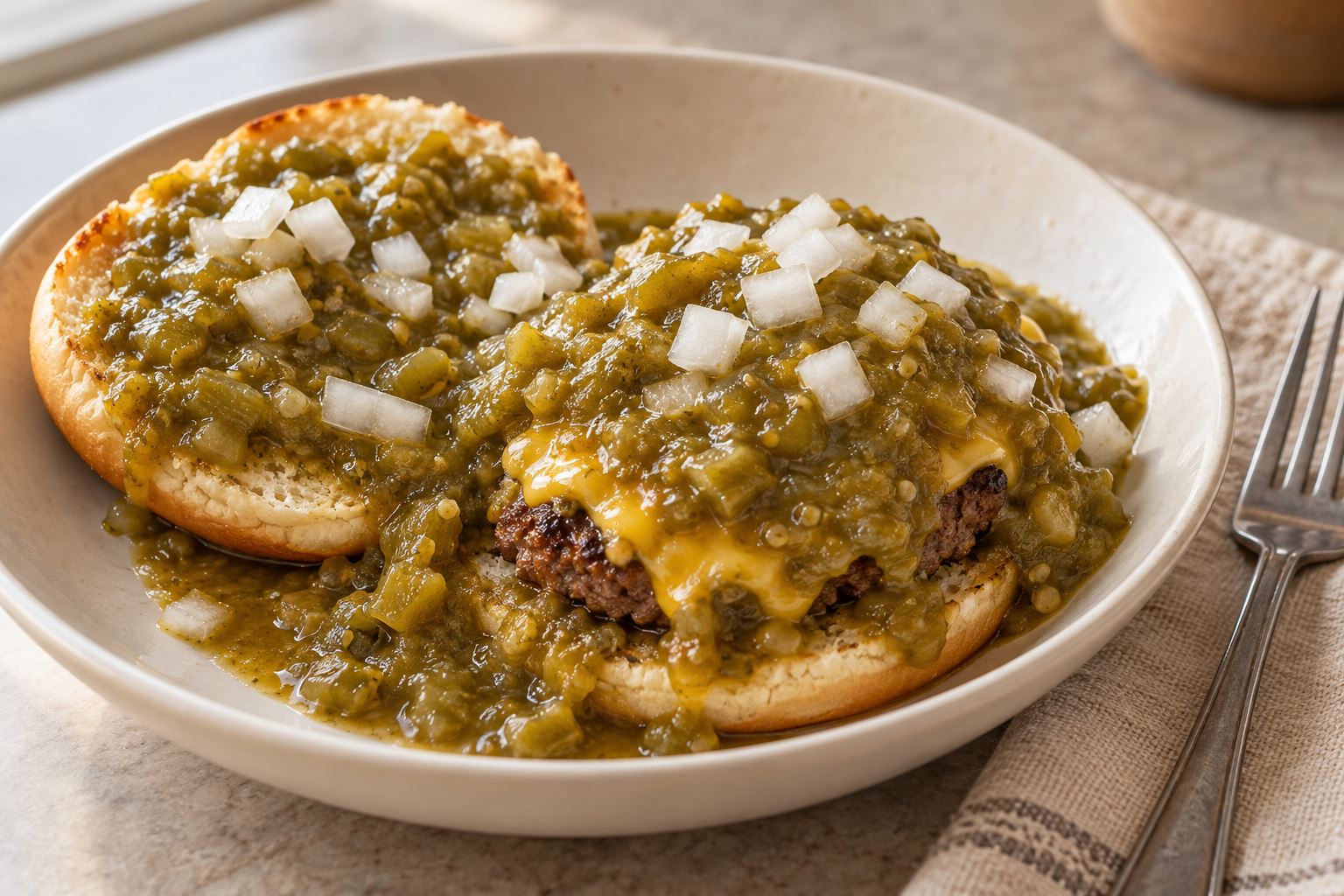
Build it on the split bun. Split the buns and set both halves cut side up in a shallow bowl or a rimmed plate — a flat plate will not hold what comes next. Put a patty on one half, or across both if you want the bread to go further.
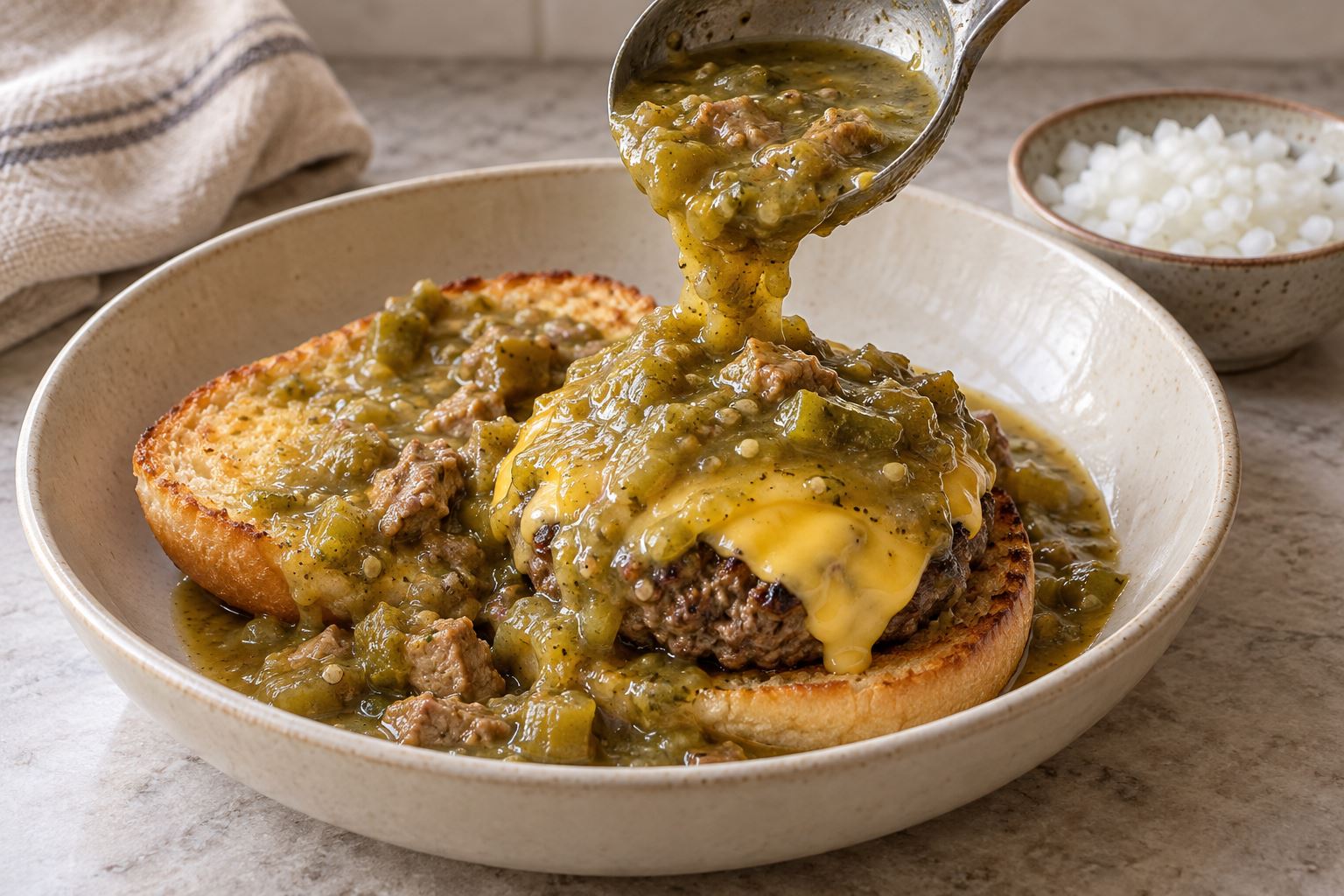
Flood it and finish cold. Ladle a cup of simmering chile over the whole thing, bun and all, until nothing is dry and the bowl has a quarter inch of chile in the bottom. Scatter the raw onion over the top and serve it immediately, with a fork and a knife and no expectation that anyone will pick it up.
Cover the burger and both bun halves with hot chile, then add the raw onion.
The two failures are opposite and both are about liquid. A flooded plate, with the bun gone to pulp in a pool, means the chile was too thin: reduce it next time until it mounds on a spoon, and ladle a little less of it. There is no rescue once it is poured, though eating it faster works better than you would think. A dry slopper is the commoner fault in a home kitchen, where people are cautious with the ladle — the dish is called what it is called for a reason, and the chile should reach the rim. If the patty comes out grey and crumbly, it was too lean or it was pressed with a spatula while it cooked; both squeeze out the fat the dish depends on. And if the cheese breaks into oily strings, it was an aged hard cheese under very hot chile: use a process slice or grate a mild cheddar fine so it melts before it splits.
Storage and make-ahead
Do not build one to keep. The parts keep separately and the assembled dish has a shelf life of about four minutes before the bun gives out. Green chile is better on the second day and keeps 4 days refrigerated or 3 months frozen; cooked patties keep 3 days and are best reheated in the chile itself, dropped into the simmering pot for two minutes rather than microwaved.
If you are feeding a crowd, work the way a bar does: a pot of chile at a simmer, patties cooked ahead and held hot, cheese slices and split buns at hand, and each plate built to order in thirty seconds. The one thing worth making well in advance is the chile, which is why that recipe makes six servings and this one makes two.
What to serve with it
Fries, and plenty of houses in Pueblo put the patty straight onto them instead of a bun. The dish is already heavy, so everything else on the table should be cold and sharp: pickled jalapeños, a vinegar slaw, sliced raw onion, or nothing at all. Beer is the drink, as the 1993 advertisement that first proves this dish makes clear — it is selling pitchers in the same breath.
If you want something to cut the heat rather than match it, a glass of cold milk is the honest answer and horchata the better one. Save the lime for the chile pot.
From the recipe box / Colorado
Pueblo Slopper
An open-faced cheeseburger on a split bun, drowned in Pueblo green chile and raw onion and eaten with a fork — a dish with no printed ancestor, no trademark and no datable founder, built here on a federal griddle card and the city's own advertisements.
Prep
10 min
Cook
20 min
Total
30 min
Serves
2
Calories
815 per serving
Ingredients
Scale
Instructions
Bring the green chile to a bare simmer and reduce it if it is thin enough to run.
Shape the beef into two 6-ounce patties an inch thick and salt and pepper the outsides.
Griddle them in a little oil over medium heat, about 4 to 5 minutes a side, to an internal 155 °F held for 15 seconds.
Lay a slice of cheese on each patty, cover the pan off the heat and leave it a minute.
Set the split buns cut side up in shallow bowls and put a patty on each.
Ladle a cup of simmering chile over everything, scatter the raw onion on top and serve at once with a fork.
Nutrition
Fat
45 g (17 g saturated)
Sodium
1170 mg
Protein
58 g
Serving
one slopper, with 1 cup of green chile
Calories
815
Cholesterol
195 mg
Carbohydrates
38 g (5 g sugar, 3 g fiber)
Nutrition is an estimate calculated from the listed ingredients and is provided as
a courtesy, not as dietary advice.
Questions readers ask
Chile or chili?
On this site the pepper and the stew are chile, following the usage in Colorado's own newspapers, where "green chile" outnumbers "green chili" before 1930 by 417 pages to 296. The two Pueblo advertisements that first prove this dish both use chili — "Marie Zimmerman's Green Chili Sloppers" in January 1994 and "BEST BURGERS [&] CHILI IN TOWN" in September 1993 — which is a fair reminder that the bars that made the thing spell it the other way.
Who invented it?
Nothing open to me answers that, and I looked at the places where an answer would leave a trace. Colorado's digitised newspapers have no verifiable mention of the dish before an advertisement of 29 September 1993; the bars usually named cannot be dated from that collection at all; the state trademark register contains no claim to the word; and the six Colorado companies with "slopper" in their names were all registered between 2013 and 2024. The dish is clearly older than its paperwork — the 1993 advertisement already calls it "A PUEBLO TRADITION" — but how much older is not something I can show you, so I am not going to put a year or a name on it.
Bun or fries underneath?
Both are served in Pueblo and neither is documented as the original, because nothing documents the original. The bun is the version the name describes best: a split roll that soaks up chile and holds together for the few minutes it takes to eat. Fries underneath make a sturdier plate and a much larger one. If you use fries, cook them crisp and dry, salt them lightly, and ladle at the last second.
Does it have to be an open-faced burger?
That is what the dish is. Put the top of the bun on and you have a cheeseburger with chile in it, which is good and is not a slopper: the whole construction assumes a ladle poured over the top of an open plate and a fork to eat it with. The only structural decisions left are how thick to reduce the chile and whether the patty sits on one half of the bun or bridges both.