American cooking Recipes & regional stories

Skillet & Sage

A culinary journey through the fifty states

The regional table / Arkansas

Pan-Fried White River Trout
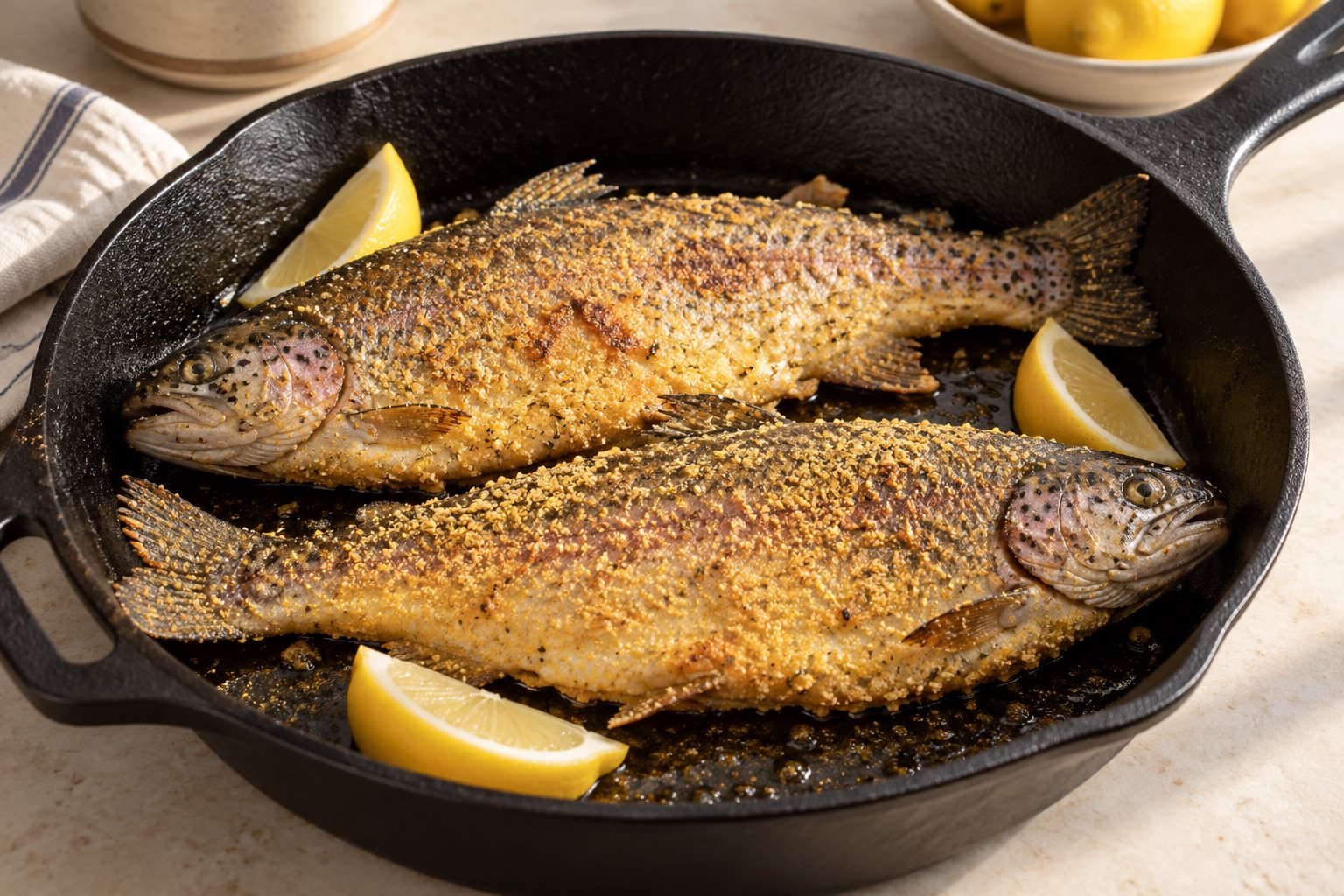
Two whole trout with a golden cornmeal coating nested head to tail in a black skillet, with lemon wedges at the edges.
Pull the dorsal fin. If it lifts out clean with its little bones attached, the fish is done, and nothing had to be cut open to find out. AI-generated illustration.

There were no trout in the White River until the Corps of Engineers put two dams across it and began letting the water out of the bottom of the lakes.

On 13 July 1950 the Newspaper Enterprise Association filed a dispatch from Forsyth, Missouri, which the Athens Banner-Herald printed in Georgia under the headline "Uncle Sam Plans To 'Flood Out' The White River". The lede is one sentence long: "Uncle Sam's going to flood out the river." The reporter had gone up to Forsyth to watch the float-trip guides work while there was still a river to float on. The guide, he wrote, labours only on the way home — going down he lets the boat drift while he shows his customers where to catch them, and he brings the poles, the bait, the food and a tent for overnight. What the customers were catching he sets down as a list: "people who want to catch a nice string of bass, pike, bluegill or a mess of catfish the easy way". The town's hundred and ninety residents had already sold their land to the government and picked out a new site for Forsyth on Shepherd of the Hills Mountain, two and a half miles west and up. Asked about the float trips, they told him they were still going on, at least for the rest of that summer. That is what the White River was: bass, pike, bluegill and catfish, written down by a man standing on the bank. Norfork Dam on the North Fork tributary had been finished in 1944 and Bull Shoals on the main stem was finished in 1951, both of them built and run by the U.S. Army Corps of Engineers for flood control and hydroelectric power — the dates are from two U.S. Geological Survey reservoir studies, Water-Resources Investigations Report 03-4077 on Bull Shoals Lake and 02-4250 on Norfork Lake, both written by Joel Galloway and Reed Green with the Arkansas Game and Fish Commission. The NEA man was told the dam was to go up the following spring, eighty miles downstream; the Survey dates its completion to 1951. Either way he had the last summer of it.

The dam drowned the river above it and chilled the river below it, and the second thing is why this recipe exists. Bull Shoals Lake is about 63 metres deep at the dam and the conservation pool stands at 199.3 metres above the 1929 datum, but the release structure sits at 163 metres: the water that leaves the dam is taken from roughly thirty-six metres, a hundred and twenty feet, down in the dark. The Geological Survey gauges what comes out, at station 07054501, White River at Bull Shoals Dam near Flippin. Across its record the monthly mean water temperature in June is 9.2 degrees Celsius and in July 10.4 — 49 and 51 degrees Fahrenheit, in an Arkansas July. An hour away, Big Creek at Carver, a tributary of the undammed Buffalo, has only a few years of record and only one July in it, and that July mean is 27.3 degrees, 81 Fahrenheit. Thirty degrees Fahrenheit of difference between two Ozark streams, one of which has a dam in it. Nothing on the 1950 list can live in the outflow, and trout can, so trout were put there and are still being put there: the Fish and Wildlife Service opened Norfork National Fish Hatchery in 1957, by its own account to raise trout for restocking areas hit by dam construction, and it supplies the tailwaters below Norfork and Bull Shoals to this day. It has to. Pender and Kwak, reporting in the Transactions of the American Fisheries Society in 2002, found that brown trout reproductive success in the White River tailwater reaches is highly variable, "resulting in the need for supplemental stocking", and the rainbows are hatchery fish from the day they go in. This is a manufactured fishery in a river that was taken away from somebody, and it is worth knowing that while you eat one. No old book holds the measurements below; they were worked out for this page.

Why this version works

Buttermilk first, then cornmeal. Fish skin offers a crust almost nothing to hold on to. A dip in buttermilk leaves a film of milk protein and acid over the whole fish, and the meal grips that rather than the skin. The browning then happens in the coating, on milk sugars and milk protein, so the crust colours well before the fish inside is anywhere near done — which is exactly the order you want on a fish that needs eight minutes.

The bone is the reason it works at all. A pan-dressed trout is about an inch thick at the shoulder and tapers to nothing; the two fillets cut off the same fish are half an inch. Whole, the skeleton is a frame that holds the flesh flat and still while the proteins set, so nothing curls, tears or slides off the slice. It also gives the heat something to travel through rather than straight across: the fish cooks inward from both flanks towards the backbone and arrives at one moment, instead of a thin sheet of muscle going from raw to dry in the time it takes to turn it.

You can tell it is done without opening it. Take the dorsal fin between finger and thumb and pull straight up. On a raw or underdone fish it resists and tears; on a cooked one it lifts free in one piece with the little cluster of bones at its base, because the connective tissue anchoring them has let go. The eye backs it up: it turns from clear to opaque white and stands proud of the socket. If you want a number, push an instant-read probe in at the shoulder behind the head, keeping clear of the backbone — the FDA Food Code of 2022 sets fish at 63 degrees Celsius, 145 Fahrenheit, held fifteen seconds, in section 3-401.11.

The skin is the wrapper, so leave it closed. Trout skin is thin, unscaled and full of collagen, and all the way round the fish it is an unbroken envelope. Fry it whole and the cavity fills with its own steam while the outside crusts. That is also why nothing goes inside: a cavity packed with lemon and herbs insulates the thickest part of the fish from the pan and turns eight minutes into twelve, by which time the shoulder is dry.
Ingredient notes

Fat: six tablespoons of lard, or peanut oil if you have no lard. You want a film about an eighth of an inch deep across a 12-inch skillet, not a fry bath. Butter is wrong for this one — it browns and burns inside the window the fish needs, and the crust is already carrying all the flavour the dish wants.

Trout: four pan-dressed trout of about 12 ounces each, gutted and gilled, head and tail left on. A stocked tailwater rainbow of eleven to thirteen inches is the size this method is built around, and it is the size the White River gives you. USDA FoodData Central puts raw rainbow trout between 3.5 and 6.2 grams of fat per hundred — wild at the bottom of that range, farmed at the top — so a river fish is a lean fish and has no margin for an extra two minutes.

Cornmeal: a cup of fine stone-ground white meal. White is what the Ozarks grind and it is the right choice here for a reason beyond habit: a pale crust shows you its colour honestly, and on a fish that is finished in eight minutes the colour of the crust is the clock you are watching. A quarter cup of plain flour in with it stops the meal sliding off in sheets.

Buttermilk: a cup, straight from the carton, no soaking. This is a two-second dip and a lift, not a marinade. Leave a trout sitting in buttermilk and the acid starts working on the surface protein and the skin goes slack in the pan.

Step by step

  1. Salt the fish and let it stand. Rinse the trout inside and out, pat them dry, and wipe the blood line along the backbone channel with a paper towel. Salt the cavities and both sides of each fish with 2 teaspoons of the salt and stand them on a rack for 20 minutes. The surface will go tacky rather than wet, which is what the meal wants to meet.
  2. Mix the meal. Whisk the cornmeal, flour, the remaining teaspoon of salt, the black pepper and the cayenne together on a wide plate or a tray long enough to take a whole fish.
  3. Get the skillet hot. Heat a 12-inch cast iron skillet over medium-high with the lard until it shimmers and a pinch of meal dropped in sizzles hard and floats — about 355°F. A pan below that soaks the crust; a pan above it colours the meal before the shoulder is cooked.
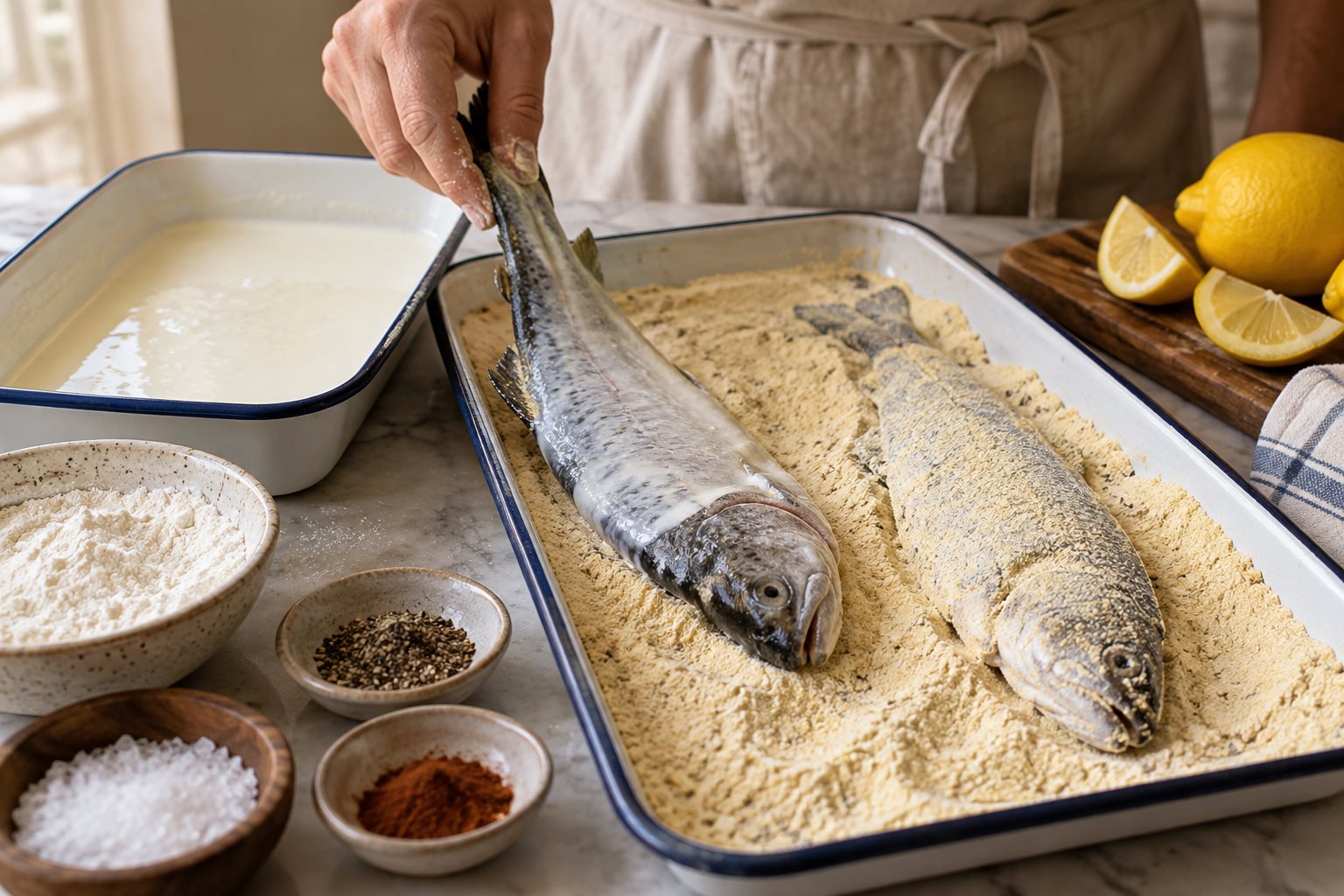
  4. Dip and coat. Pour the buttermilk into a shallow dish. Take one fish by the tail, draw it through the buttermilk on both sides, let it drip for a second, and lay it in the meal. Press, turn, press again, and lift it out with the loose meal shaken off.
    A whole trout being dipped into fine cornmeal beside an already coated fish, with a dish of buttermilk nearby.
    After the buttermilk dip, press both sides into the fine cornmeal and shake off excess. AI-generated illustration.
  5. Fry, and turn once. Lay 2 fish into the pan away from you, head to tail so they nest. Fry 4 to 5 minutes without touching them, then turn each one with a fish slice under the belly and a spoon against the back, and fry 3 to 4 minutes more.
  6. Test at the fin and drain standing up. Pull the dorsal fin: clean and free means done, and 145°F at the shoulder confirms it. Stand each fish on a rack rather than laying it on paper, so the underside keeps its crust, and fry the second pair. Serve straight away with lemon.
If the crust came away in the pan, the fish went in wet under the buttermilk or the meal never got pressed on — dry the next two properly and press the meal hard with the flat of your hand. If the fish tore on the turn, you used one tool; use two, a slice under the belly and a spoon against the back, and roll it towards you. If the crust is dark but the fin still resists, the pan was too hot: pull it off the burner, wait a minute, and give the fish two more minutes on the lower heat rather than more colour. A fish that is already overcooked cannot be saved as a whole fish, so lift the flesh off the frame, flake it, and treat it as the trout salad in the storage note.

Storage and make-ahead

Cooked trout keeps 2 days covered in the fridge and is better cold than reheated. Lift the fillets off the frame while it is still warm, when they come away in one piece, and keep them in a box with a squeeze of lemon; flaked into mayonnaise with onion and black pepper they make a better sandwich than they ever made a second dinner.

Raw trout wants cooking the day you get it. If it has to wait, lay the fish belly down on a rack over ice in the fridge, uncovered, and never in the meltwater — a whole fish sitting in its own thaw goes soft in the belly walls first, and the belly is where this recipe is thinnest.

What to serve with it

Hush puppies out of the same meal and the same fat, fried after the fish, and a vinegar slaw. This is a fish-fry plate and the fried starch belongs on it.

To drink, cold beer or iced tea, and nothing sweet next to the fish. If you want a green vegetable, cook it sour — poke beans, or cucumbers in vinegar and salt.

Two whole trout with a golden cornmeal coating nested head to tail in a black skillet, with lemon wedges at the edges.

From the recipe box / Arkansas

Pan-Fried White River Trout

A whole pan-dressed trout in white cornmeal, fried hard in lard in one skillet and turned once — the fish a federal dam put in an Arkansas river that never had one.

Prep
20 min
Cook
20 min
Total
40 min
Serves
4
Calories
445 per serving

Ingredients

Scale

Instructions

  1. Rinse and dry the trout, wipe the backbone channel, salt them inside and out with 2 teaspoons of the salt and stand them on a rack 20 minutes.
  2. Whisk the cornmeal, flour, remaining salt, black pepper and cayenne together on a wide tray.
  3. Heat a 12-inch cast iron skillet over medium-high with the lard to about 355°F, when a pinch of meal sizzles hard.
  4. Draw each fish through the buttermilk, then press it into the meal on both sides and shake off what is loose.
  5. Fry 2 fish at a time, head to tail, 4–5 minutes on the first side and 3–4 minutes on the second, turning once with a slice and a spoon.
  6. Test by pulling the dorsal fin, or 145°F at the shoulder; drain on a rack, fry the second pair, and serve with lemon wedges.

Nutrition

Fat23 g (7 g saturated)
Sodium880 mg
Protein39 g
Serving1 whole trout
Calories445
Cholesterol120 mg
Carbohydrates19 g (1 g sugar, 2 g fiber)

Nutrition is an estimate calculated from the listed ingredients and is provided as a courtesy, not as dietary advice.

Questions readers ask

What was in the river before the dams?

Bass, pike, bluegill and catfish, and a guiding trade built on floating down to them. That list comes from a Newspaper Enterprise Association dispatch out of Forsyth, Missouri, dated 13 July 1950 and carried by the Athens Banner-Herald, which went up to report the last summer of the float trips before the Bull Shoals reservoir took the water — "Uncle Sam's going to flood out the river". It is worth saying where that came from and where it did not: Arkansas has no open newspaper archive of its own, so the contemporary account had to be found in a Georgia paper that carried the syndicated wire, and the Corps of Engineers' own district site refuses automated requests entirely. The dam dates in this article come from the Geological Survey's reservoir reports rather than from the Corps.

Why are there trout in Arkansas at all?

Because of where the water leaves the dam. Bull Shoals Lake is about 63 metres deep at the dam, the conservation pool stands at 199.3 metres above the 1929 datum, and the release structure is centred at 163 — so the outflow is drawn from about a hundred and twenty feet down, out of water that never sees the summer. The Geological Survey gauge at the dam, station 07054501, records monthly mean outflow temperatures of 9.2 degrees Celsius in June and 10.4 in July, which is 49 and 51 Fahrenheit. That is a trout stream by accident, made by a flood-control and hydropower project, and it runs through country where the July stream temperature in an undammed valley nearby is measured at 81 Fahrenheit.

Can I fillet the trout and cook it this way?

You can, but you are throwing away the part of the method that does the work. A fillet off a 12-ounce trout is about half an inch thick and needs roughly two minutes skin down and one minute flesh up; miss that by sixty seconds and it is dry, because there is no bone slowing the middle and no closed skin holding the steam. You also lose the fin test, which is the only way to check a whole fish without cutting it, and the collar meat behind the head, which is the best mouthful on the animal. If you must fillet, keep the frames and heads and make stock with them.

Do the trout breed in the river, or are they all stocked?

Mostly stocked, and the federal record is plain about why it has to be that way. The Fish and Wildlife Service opened Norfork National Fish Hatchery in 1957 to raise trout for restocking water affected by dam building, and it still supplies the Norfork and Bull Shoals tailwaters. Pender and Kwak, in the Transactions of the American Fisheries Society for 2002, studied brown trout across four Ozark tailwater reaches and found reproductive success highly variable, "resulting in the need for supplemental stocking"; one reach they looked at is known for outright reproductive failure. Brown trout at least try. The rainbows you are most likely to catch and cook are hatchery fish put in as catchable-size stock.