American cooking Recipes & regional stories

Skillet & Sage

A culinary journey through the fifty states

The regional table / Minnesota

Tater Tot Hotdish
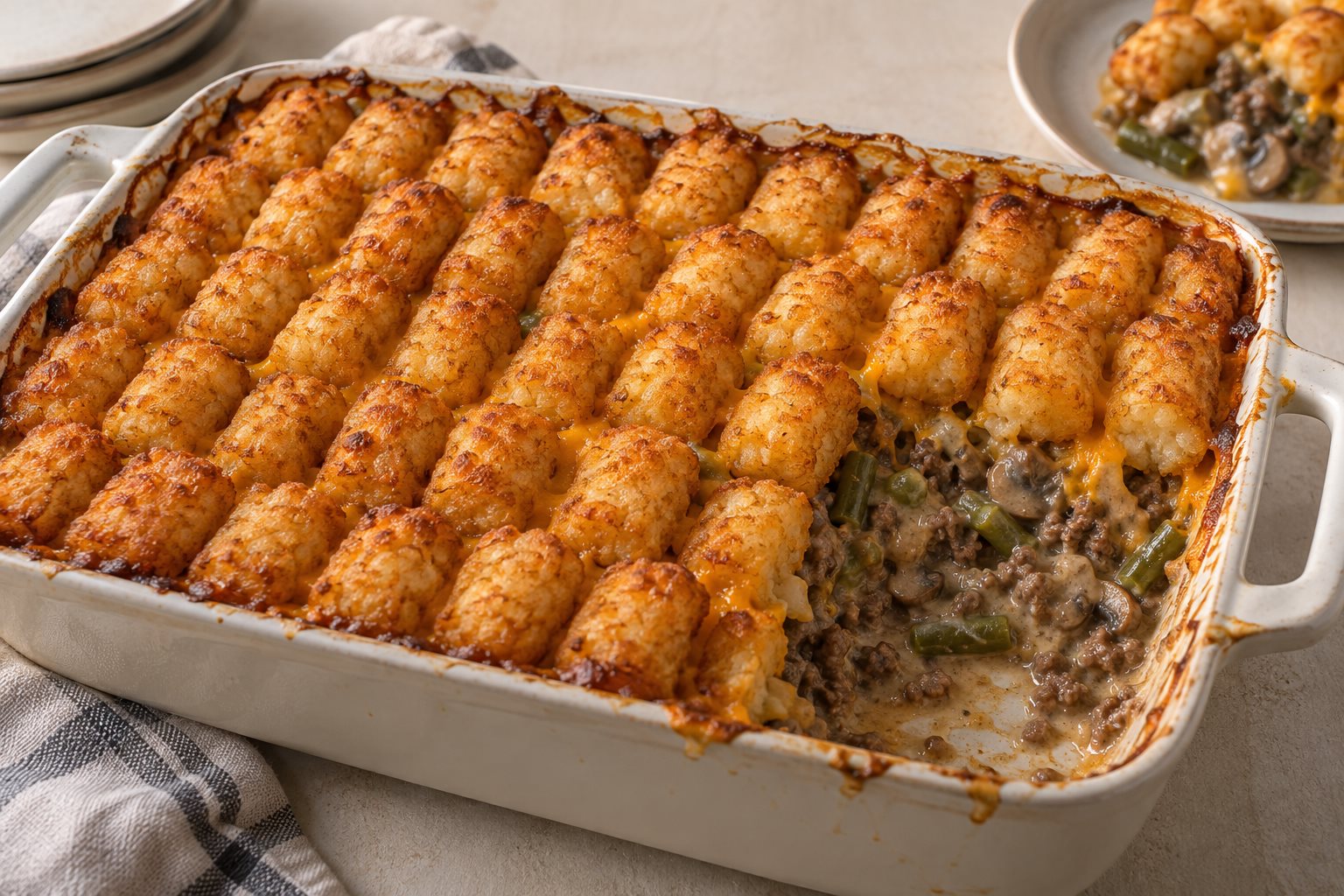
A 9 by 13 inch baking dish filled with browned potato tots in rows over a bubbling beef and mushroom filling, one corner served out
The tots should be gold on top and pale where they met the filling; the served corner shows how thick the sauce sets. AI-generated illustration.

This is not a recipe so much as a grammar, and once you have the grammar you can build a hundred of these without opening anything again.

Hotdish is a category with a fixed sentence structure: a protein, a starch, a vegetable, a binder out of a can, and something crisp laid over the top, baked in one dish and carried to a table that is not yours. The form is older than the word and older than the tot, and it can be watched assembling itself in the press. The Covington News of 16 November 1939 printed a column that reads like a template rather than a dish — one cup of diced cooked turkey or chicken, one cup of cooked peas, a large can of cooked spaghetti in tomato sauce, "Place in one large or individual casseroles. Sprinkle with — Rice flakes, finely crushed. Bake in a moderate oven (375° F.) 20 minutes, or until heated through." — and added that cooked macaroni in cream sauce with cheese may be substituted for the spaghetti. In the next column on the same page the binder appears by name: "1 small (10 oz.) can cream mushroom soup", stirred with flour and corn liquid into a thick gravy over chipped beef. The Jackson Herald of 27 June 1940 gives the same trick in one sentence: "Half a can of mushroom soup added to the gravy in the pan of baked meat loaf will give a grand flavor to that good old stand-by and make it seem like a new acquaintance." Interchangeable parts, a can of concentrate for sauce, a crushed-cereal lid, a moderate oven. That is hotdish, three years before anyone who could be found in print had written the word down for the food. Searched across the whole Georgia newspaper archive, the compound word "hotdish" turns up once before the war, in The True Citizen of 29 July 1938, and it is not a supper at all — it is pine needles and willow twigs woven into "hotdish mats".

The tot on top is not folk cooking and there is no point pretending otherwise: it is a factory product with a company behind it. That company is Ore-Ida, and its own patents put it on the federal record at Ontario, Oregon — United States Patent 3,865,964, granted 11 February 1975 to inventors "all of Ontario, Oreg." and assigned to "Ore-Ida Foods, Inc., Ontario, Oreg.", and United States Patent 4,186,836 of 5 February 1980, an optical machine for pulling the dark-spotted pieces out of a moving bed of cut potatoes, assigned to the same company at Boise. The tots reach a shopper in a dated document on 6 June 1958, in a grocery advertisement in the Atlanta Daily World: "Ore-Ida Tater Tots", thirty-three cents, between the candied yams and the sharp cheese. The 1975 patent is also the most honest description of the problem this recipe solves, because it is the manufacturer writing about its own frozen potatoes: put in an oven from frozen, it says, the product "is by no means the equivalent of the original", because moisture migrates out of the centre "without the compensating crisping effect of deep fat frying", which "tends to make the reconstituted product limp and soggy" and leaves it "generally a disappointment to the purchaser". Everything below is arranged to keep that from happening. No patent covering the invention of the tot itself could be found from here, so none is claimed; the quantities in a hotdish were never printed by anyone official and these were worked out for this page.

Why this version works

The tots ride on top and are never stirred in. Ore-Ida's own 1975 patent explains why in its background section: a frozen fried potato reheated in an oven goes limp because water moves out from the middle and there is no hot fat to dry the surface as it arrives. A tot buried in sauce is in a steam bath and has lost before the oven is warm. Laid in one layer above the filling, with its top face in dry oven air, it behaves like a fry in a fryer — the underside softens into the sauce, which is the point, and the top browns.

The soup is a sauce, not a soup, and the government says so. Condensed cream of mushroom soup has no standard of identity anywhere in Title 21 of the Code of Federal Regulations — FDA never wrote one, which is why no two brands are alike. What the regulations do fix is the concentration: § 101.9(b)(7)(v) uses condensed soup as its worked example of a product declared as "1/2 cup (120 mL) concentrated soup (makes 1 cup prepared)", and § 101.12 sets a reference serving of 245 grams for soups as eaten. Tipped into a casserole undiluted, a can is a starch-thickened emulsion at double strength. Treat it as the roux you did not make and add liquid deliberately, or it sets like wallpaper paste.

The mushrooms in the can are legally defined even though the soup is not. 21 CFR 155.201 does have a standard, and it is worth knowing what you are pouring: canned mushrooms are the food prepared from caps and stems of Agaricus bisporus or A. bitorquis, in one of six styles, of which the relevant one is "Pieces and stems — consisting of pieces of caps and stems of irregular shapes and sizes." That is the grey confetti in the can. Adding half a pound of fresh mushrooms browned hard in a dry pan puts back the flavour that the piece-and-stem style never had.

The beef is browned hard and drained, and the fat is not a seasoning here. Under 9 CFR 319.15, ground beef and hamburger may run up to 30 percent fat by law, and two pounds of it will give back most of a cup of grease. Left in, it rises through the sauce and pools under the tots, which then fry in it, break up and go greasy rather than crisp. Brown in a wide pan so the meat colours instead of stewing, then pour the fat off and keep it for eggs.
Ingredient notes

Beef: two pounds of 85/15 chuck. Leaner than that and there is no fond in the pan to build on; fatter and you will pour off more than you brown. Break it up coarsely and leave some lumps — a hotdish wants texture, and a uniform crumble reads as pet food under a lid of potato.

Tots: two pounds of frozen potato tots, kept frozen until the second they go on. A thawed tot is a wet tot. Buy the plain ones: the seasoned versions carry enough salt on their own to push the finished dish past what the soup has already done to it.

The soup: two 10.5-ounce cans of condensed cream of mushroom, plus half a cup of milk and a spoonful of Worcestershire. Cream of chicken and cream of celery are the other two legitimate dialects; cream of mushroom is the one this dish is built around. Do not dilute to the label's one-cup-prepared strength, which is for a bowl, not a bake.

Vegetable: twelve ounces of frozen green beans or corn, added frozen. Canned vegetables collapse, and fresh ones give up water into a sauce that is already carrying as much as it can. Frozen is not a compromise here, it is the right answer.

Step by step

  1. Brown the beef. Heat the oven to 425°F. Cook the beef in a wide dry skillet over medium-high heat, breaking it into coarse lumps, 8 to 10 minutes, until it is browned rather than grey. Pour off the fat and reserve it for something else.
  2. Cook the onion and mushrooms. Return the pan to the heat with 1 tablespoon of the reserved fat, add the onion and the fresh mushrooms, and cook 8 minutes until the mushrooms squeak, release their water and then take colour. Season with the salt and pepper.
  3. Build the filling. Stir in the soup, the milk and the Worcestershire, scraping the pan. Add the frozen beans and the beef. It should be thick enough to mound on a spoon — thinner than that and the tots will sink.
  4. Spread and cheese. Scrape it into a 9x13-inch dish and level it. Scatter the cheddar over the surface. The cheese is a gasket as much as a flavour: it stiffens as it melts and holds the tots up out of the sauce.
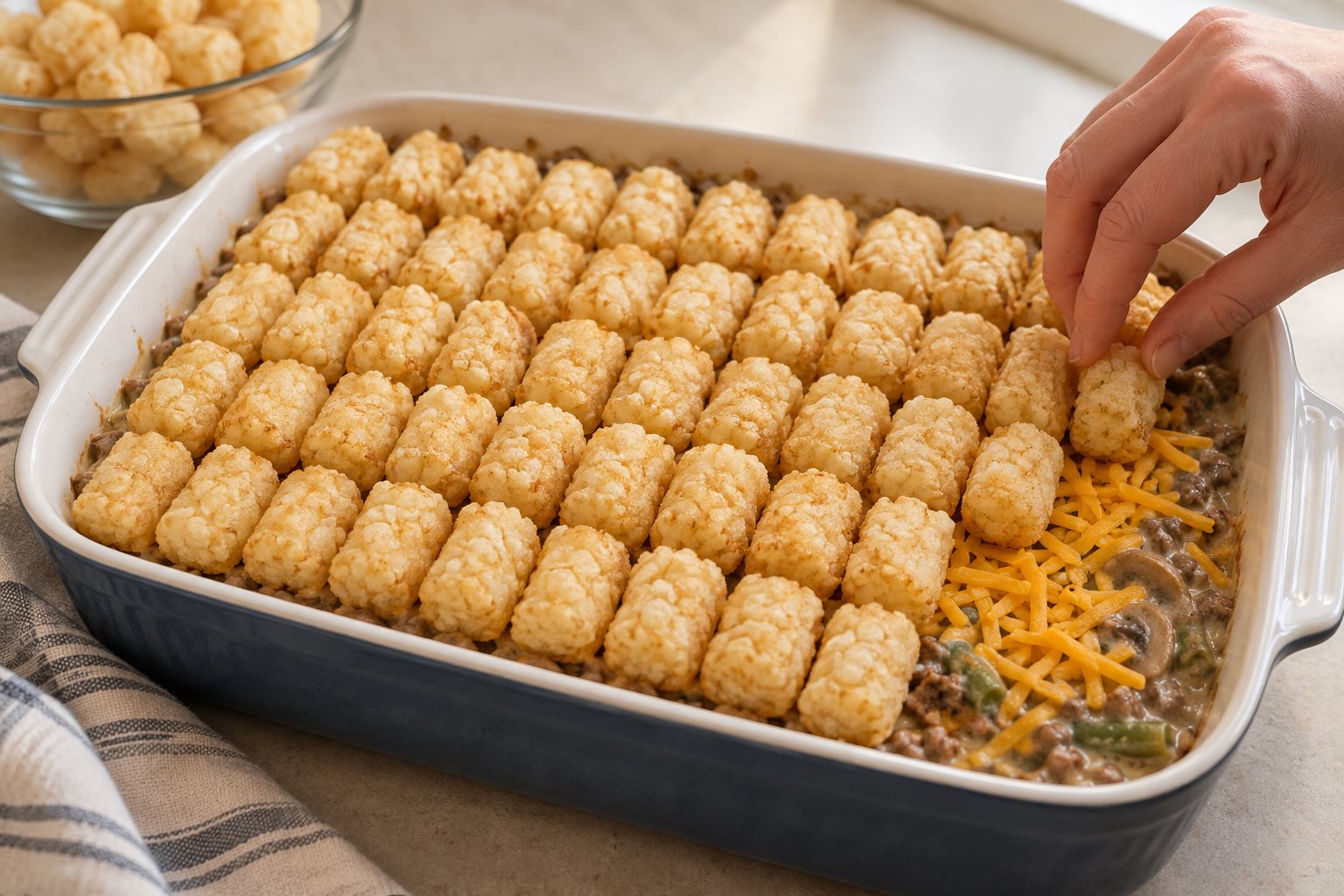
  5. Lay the tots. Set the frozen tots in close single-file rows, touching but not overlapping, covering the whole surface. Two pounds fills a 9x13 exactly. Do not press them down.
    Frozen potato tots arranged in rows over shredded cheddar and beef filling
    Arrange frozen tots in a single layer without pressing them into the filling. AI-generated illustration.
  6. Bake uncovered. Bake 40 to 45 minutes at 425°F, no foil at any point, until the tots are deep gold and the filling is bubbling around the edge. If the top is pale at 45 minutes, give it 5 minutes under the broiler and watch it.
  7. Rest. Ten minutes on the counter. Straight from the oven the sauce runs and the cheese is molten; after ten minutes a spoon cuts a square that holds its shape.
Soggy tots mean one of three things and all are fixable next time: the pan was covered, the filling was too loose, or the oven was below 400°F. To rescue the dish in front of you, run it under the broiler for 3 to 4 minutes — the top layer dries and browns even when the underside has gone soft. If the filling is soupy rather than thick, tip the dish and spoon off the free liquid before broiling rather than trying to bake it away, which only cooks the tots further.

Storage and make-ahead

Keeps 4 days covered in the fridge. Reheat portions uncovered at 400°F for 15 minutes; a microwave turns the tots into the exact failure Ore-Ida's patent describes.

It freezes badly baked and well unbaked. Build it through the cheese layer, freeze without the tots, then thaw overnight, top with frozen tots and bake as written plus 10 minutes.

What to serve with it

A sharp, cold, vinegary salad is the whole job here — shredded cabbage with cider vinegar and a little sugar, or cucumbers in dill and vinegar. The dish has salt, fat and starch covered and nothing acid anywhere in it.

Pickles on the table, and not as a joke. Dill spears or bread-and-butter chips cut the soup's salt better than anything you could cook.

A 9 by 13 inch baking dish filled with browned potato tots in rows over a bubbling beef and mushroom filling, one corner served out

From the recipe box / Minnesota

Tater Tot Hotdish

Browned beef and a can of condensed soup under a single close-packed layer of frozen potato tots, baked uncovered until the top is gold and the underneath is bubbling at the edges.

Prep
25 min
Cook
50 min
Total
1 hr 25 min
Serves
8
Calories
610 per serving

Ingredients

Scale

Instructions

  1. Heat the oven to 425°F. Brown the beef in a wide dry skillet 8–10 minutes, then pour off the fat.
  2. Cook the onion and mushrooms in 1 tablespoon of the reserved fat for 8 minutes, and season with the salt and pepper.
  3. Stir in the soup, milk and Worcestershire, then the frozen beans and the beef.
  4. Spread into a 9x13-inch dish and scatter the cheddar over the top.
  5. Lay the frozen tots in close single rows across the whole surface without pressing them down.
  6. Bake uncovered 40–45 minutes, until deep gold and bubbling at the edges.
  7. Rest 10 minutes on the counter before cutting, so the sauce sets enough to hold a square.

Nutrition

Fat37 g (14 g saturated)
Sodium1390 mg
Protein31 g
Serving1/8 of a 9x13 dish
Calories610
Cholesterol75 mg
Carbohydrates35 g (5 g sugar, 4 g fiber)

Nutrition is an estimate calculated from the listed ingredients and is provided as a courtesy, not as dietary advice.

Questions readers ask

Why is it so salty?

Because two cans of condensed soup carry most of a day's sodium between them before you add cheese and seasoned potatoes. That is why the salt in the recipe is a single teaspoon for eight servings and why the vegetable is unsalted frozen. Taste the filling before it goes in the dish and add salt only if it genuinely needs it.

Do I have to use canned soup?

No, and a scratch mushroom velouté tastes better. But it behaves differently: the can is a stabilised emulsion at roughly double strength, which is why it holds under a hot oven for 45 minutes without breaking or weeping. If you go scratch, make it thicker than seems right and use less milk than you think.

Can I stir the tots into the filling?

You can, and you will get dumplings. The reason to keep them on top is written into Ore-Ida's own patent of 1975: a frozen fried potato reheated without hot fat goes limp because moisture leaves the centre and nothing dries the outside. Dry oven air above the sauce is the only crisping this dish gets.

Is hotdish just a casserole with a different name?

The word is regional and the form is not unique, but the grammar is tighter than "casserole" implies: one protein, one starch, one vegetable, one can of condensed soup as binder, one crisp lid, one dish, one oven. The 1939 newspaper column that printed the structure before the word was attached to it substituted spaghetti for macaroni and chicken for turkey in the same breath, which is the tell — the parts are meant to be swapped and the sentence is meant to stay.