American cooking Recipes & regional stories

Skillet & Sage

A culinary journey through the fifty states

The regional table / Massachusetts

New England Clam Chowder
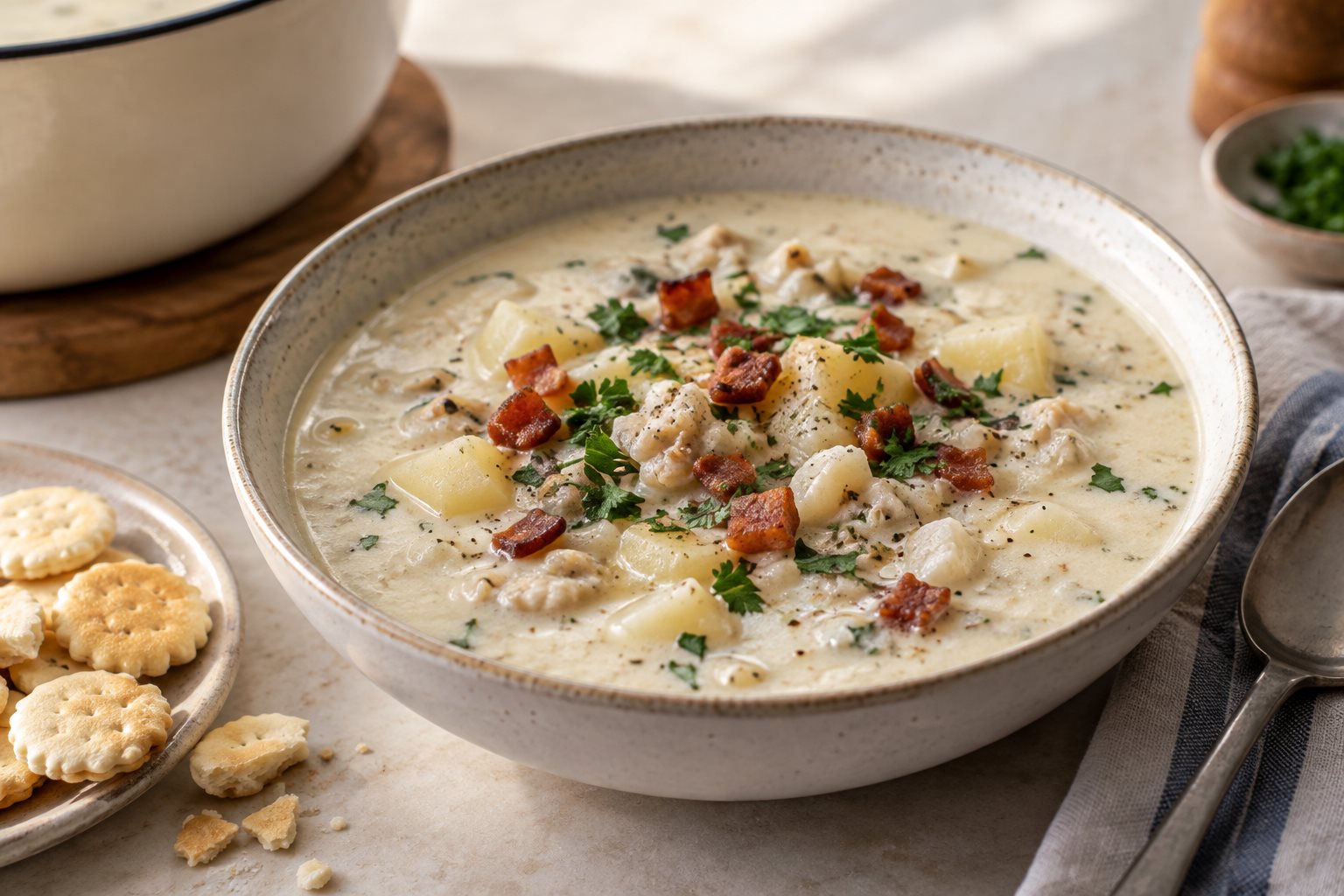
A wide bowl of pale clam chowder with cubes of potato and chopped clam showing through, crisp salt pork scraps and parsley scattered on top, split crackers beside the bowl
The potatoes should still be cubes you can count. A chowder you cannot see into has been cooked too hard. AI-generated illustration.

Fannie Farmer held the clam liquor back to the last second because it curdled her milk. Put it in first instead, hold the milk to the end, and the problem stops existing.

The document is The Boston Cooking-School Cook Book, Fannie Merritt Farmer, Little, Brown and Company, 1896. The chowders close out Chapter IX, pages 127 to 129, five of them in a row, and Clam Chowder is the fourth. Her list is a quart of clams, an inch-and-a-half cube of fat salt pork, one sliced onion, four cups of diced potatoes, a tablespoon of salt, four tablespoons of butter, four cups of scalded milk and eight common crackers. No cream. No bacon. No thyme, no bay, no wine. The book never uses the name New England clam chowder at all — the recipe is headed simply Clam Chowder, and printed directly above it on the same page is Connecticut Chowder, which is the same chowder with stewed and strained tomatoes in place of the milk, set down without a word of argument.

Two things in her method are worth knowing before you cook a modern one. She builds the pot in layers rather than making a roux: parboiled potatoes on the bottom, the finely chopped hard part of the clams, salt and pepper, flour dredged generously over the lot, then the rest of the potatoes, more salt and pepper, more flour, and two and a half cups of boiling water over the top. And she keeps the clam liquor out of the pot until the very last second, reheated and thickened separately with butter and flour, for a reason she states plainly in a line under the recipe: the clam water has a tendency to cause the milk to separate. This version inverts that. The potatoes cook in the clam broth from the start, which puts clam flavor through the whole pot instead of leaving it on the surface, and the milk goes in at the end and off the boil, where it cannot break. The other change is smaller and harder to give up: her crackers are split, soaked in cold milk and stirred in, so they thicken the chowder. Mine go on top, dry.

Why this version works

Salt pork, not bacon. Farmer cuts fat salt pork small, tries it out, fries the onion in the fat and strains that fat into the stewpan, leaving the scraps behind entirely. Bacon puts smoke into a dish that has none in the 1896 book, and smoke sits on top of clam and flattens it. Use unsmoked salt pork, and keep the crisp scraps for the top of the bowl rather than throwing them out as she does.

The clam broth is the stock. Nothing else in the pot tastes of the sea, so every cup of plain water is a cup of dilution. One cup of water under four pounds of clams comes back as two to three cups of concentrated broth once they have opened and given up their own liquor, and the potatoes should cook in all of it.

Flour early, milk late, no boil. Her flour is dredged over the potato layers and her chowder boils three minutes after the milk goes in. A roux cooked in the pork fat does the same thickening more evenly, and the starch coats the milk proteins enough that they hold together against the salt and acid of the clam broth. Past a bare simmer they stop holding, so bring the finished pot to about 180°F and take it off.

The clams go back in at the end. Farmer splits each clam into its hard part, chopped fine and cooked through the whole chowder, and its soft part, added near the finish with the milk. Hard-shell clams offer no such split — the whole meat is firm and it turns to eraser in minutes — so all of it goes in at the end for two minutes of heat and no more.
Ingredient notes

Clams: four pounds of littlenecks or small cherrystones, scrubbed, which yields about a cup and a quarter of chopped meat and enough broth to cook the potatoes in. Farmer buys hers already shucked, by the quart: she picks them over in a cup of cold water and reserves the liquor that drains off. Throw out any shell that has not opened after eight minutes of steam.

Potatoes: a pound and a half of Yukon Gold in half-inch dice, close to her four cups. Waxy potatoes keep their corners in the broth. A russet will collapse and thicken the chowder for you, which some people want and which turns the bowl opaque.

Salt pork: her inch-and-a-half cube is about two ounces. Three is better here, because the rendered fat has to sweat the onion and carry a roux and still leave scraps worth eating. Ask for unsmoked salt pork or fatback. If bacon is the only option, blanch it two minutes in water first to take the edge off the smoke.

Common crackers: the eight in her list are split and soaked, which tells you the cracker is a thick round biscuit rather than a thin wafer. Oyster crackers are the easy modern stand-in. Saltines are not — they dissolve into salt and paste within a minute of hitting the surface.

Step by step

  1. Steam the clams open. Scrub the clams under cold water. Put them in a heavy 6-quart pot with 1 cup of water, cover, and set over medium-high heat for 6 to 8 minutes, lifting out each clam as it opens so it does not overcook. Discard any that stay shut.
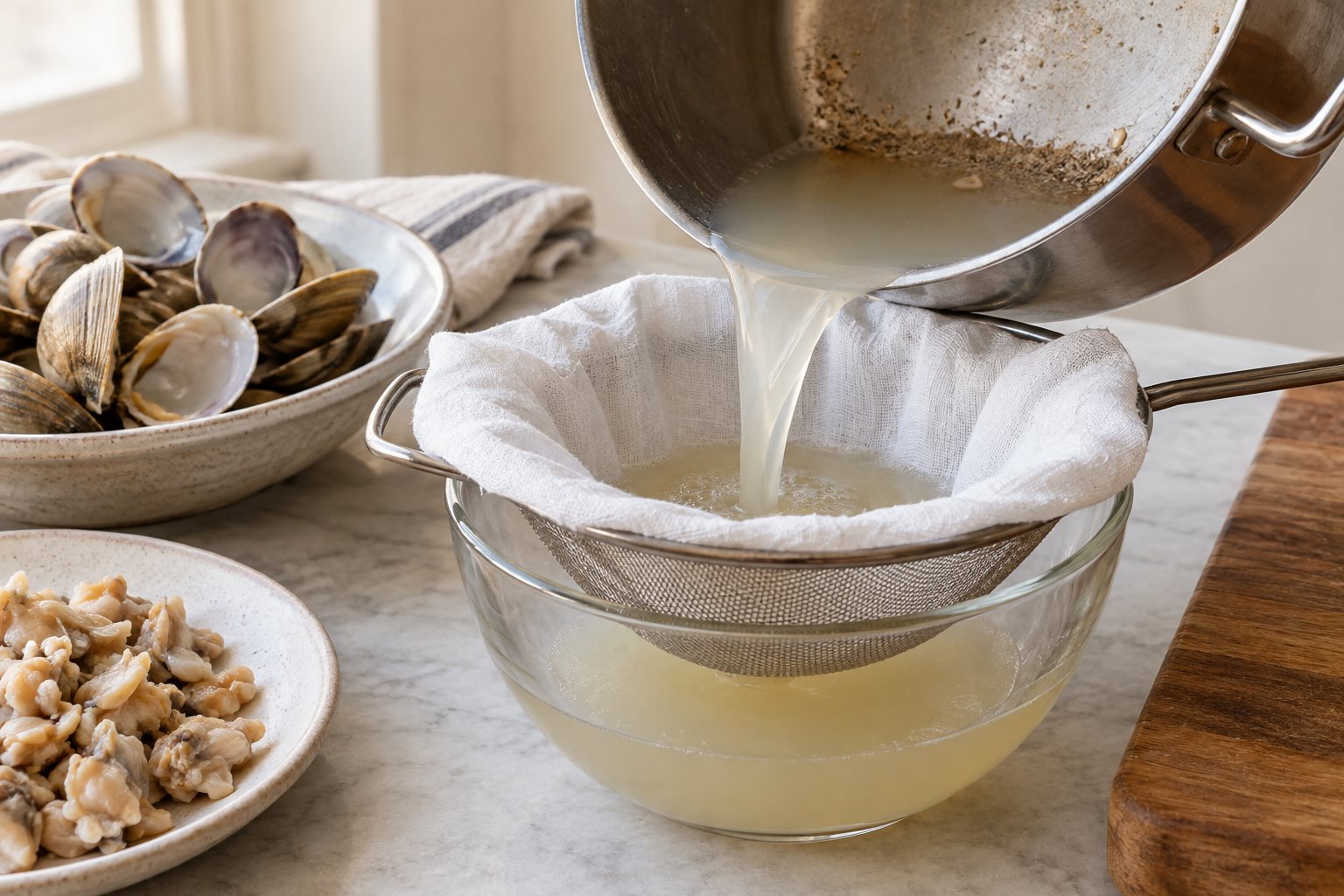
  2. Strain the broth and chop the meat. Pour the pot liquor through a fine sieve lined with a coffee filter or a doubled cloth, stopping about half an inch short of the bottom where the sand sits. You want 2½ to 3 cups; top up with water if you are short. Pull the meat from the shells and chop it coarse. Wipe the pot dry.
    Clam liquor poured through a cloth-lined sieve with sediment left in the pot
    Strain the clam liquor through cloth and leave the sandy last half inch in the pot. AI-generated illustration.
  3. Render the salt pork. Put the diced salt pork in the dry pot over medium-low heat and cook 8 to 10 minutes, stirring now and then, until the fat has run and the scraps are gold and crisp. Lift the scraps out with a slotted spoon onto paper and keep them for the top.
  4. Onion, then roux. Cook the onion in the pork fat for 5 minutes over medium heat, stirring often so it does not color. Add the butter, let it melt, then stir in the flour and cook 2 minutes, until it smells like biscuit rather than raw flour.
  5. Potatoes in the clam broth. Pour in the clam broth a little at a time, whisking each addition smooth before the next. Add the potatoes, the bay leaves, the thyme and the pepper. Bring to a simmer and cook 12 to 15 minutes, uncovered, until a potato cube gives to a knife without falling apart.
  6. Milk and cream, under a boil. Take the pot off the heat, stir in the milk and the cream, and return it to the lowest heat. Bring it to about 180°F — steaming, with a single lazy bubble at the edge — and do not let it boil.
  7. Clams last, then rest. Stir in the chopped clams, heat 2 minutes, and taste for salt; the broth carries most of what it needs. Pull the bay leaves. Let the pot stand off the heat 15 minutes before serving, then top each bowl with the pork scraps, the parsley and the crackers.
If the chowder has broken — grains of milk solid suspended in a thin gray liquid — it boiled, or the milk met hot clam broth all at once. Stirring will not bring it back. Ladle out a cupful with plenty of potato in it, blend it smooth, and whisk it into the pot off the heat; the potato starch pulls the emulsion back together well enough to serve, and nobody at the table will know. Farmer met the same failure and wrote it into the book, which is exactly why her clam liquor goes in last of all.

Storage and make-ahead

Chowder is better on the second day and keeps 3 days refrigerated. Reheat it in a saucepan over low heat, stirring, and pull it at the first steam. A reheated chowder brought to a boil breaks in exactly the way a fresh one does.

Do not freeze it. The milk separates, the potatoes go grainy, and neither recovers. To get ahead, steam the clams and strain the broth up to two days early and keep the meat and the broth in separate covered jars in the fridge.

What to serve with it

Crackers and nothing else is the traditional answer and it is a good one. If the table needs more, keep it cold and sharp against all that pork fat and milk — cabbage slaw dressed with cider vinegar, or pickled beets, or a plate of radishes and butter.

A wide bowl of pale clam chowder with cubes of potato and chopped clam showing through, crisp salt pork scraps and parsley scattered on top, split crackers beside the bowl

From the recipe box / Massachusetts

New England Clam Chowder

Clams steamed open in the pot the chowder is built in, salt pork rendered in the same pot, and milk that never comes to a boil.

Prep
30 min
Cook
45 min
Total
1 hr 15 min
Serves
6
Calories
425 per serving

Ingredients

Scale

Instructions

  1. Scrub the clams, steam them in a covered 6-quart pot with 1 cup water over medium-high heat 6–8 minutes, lifting each one out as it opens.
  2. Strain the pot liquor through a cloth-lined sieve, leaving the sandy last half inch behind, to get 2½–3 cups. Chop the meat coarse and wipe the pot dry.
  3. Render the diced salt pork in the dry pot over medium-low heat 8–10 minutes, then lift the crisp scraps out and reserve them.
  4. Cook the onion in the fat 5 minutes without color, add the butter, then stir in the flour and cook 2 minutes.
  5. Whisk in the clam broth a little at a time, add the potatoes, bay, thyme and pepper, and simmer 12–15 minutes until the potatoes give.
  6. Off the heat, stir in the milk and cream, then bring back to about 180°F without letting it boil.
  7. Add the clams, heat 2 minutes, season, and rest 15 minutes off the heat. Serve topped with the pork scraps, parsley and crackers.

Nutrition

Fat27 g (13 g saturated)
Sodium910 mg
Protein14 g
ServingAbout 1½ cups
Calories425
Cholesterol75 mg
Carbohydrates33 g (7 g sugar, 2 g fiber)

Nutrition is an estimate calculated from the listed ingredients and is provided as a courtesy, not as dietary advice.

Questions readers ask

Can I use canned clams?

Yes, and it is the honest weeknight version. Use three 6.5-ounce cans of chopped clams, drained, and make up the broth with two bottles of clam juice plus the drained canning liquid. Add them at the very end as you would fresh, and expect a flatter, saltier chowder — taste before you salt at all.

Should I thicken it more?

Three tablespoons of flour gives a chowder that coats a spoon and still pours. Farmer thickens harder — flour dredged over two layers of potato, plus a butter-and-flour thickening stirred into the clam liquor at the end — and if you want that body, mash a few cooked potato cubes against the side of the pot rather than adding more flour.

Can I make it a day ahead?

It is better a day ahead, with one adjustment: stop after the potatoes are tender and refrigerate the pot without the milk, cream or clams. Add those on the day, off the boil. A chowder that has already been through a cooling and a reheat with the milk in it is a chowder with one more chance to break.

Why is there no bacon in it?

Because there is none in the source. Farmer renders fat salt pork, strains the fat into the pot and leaves the scraps out, and the chowders around hers do the same. Bacon is a later substitution, and its smoke covers the clam rather than supporting it. If bacon is what you have, blanch it first.