American cooking Recipes & regional stories

Skillet & Sage

A culinary journey through the fifty states

The regional table / Delaware

Boardwalk Fries with Cider Vinegar, Cut from Whole Potatoes and Fried Twice
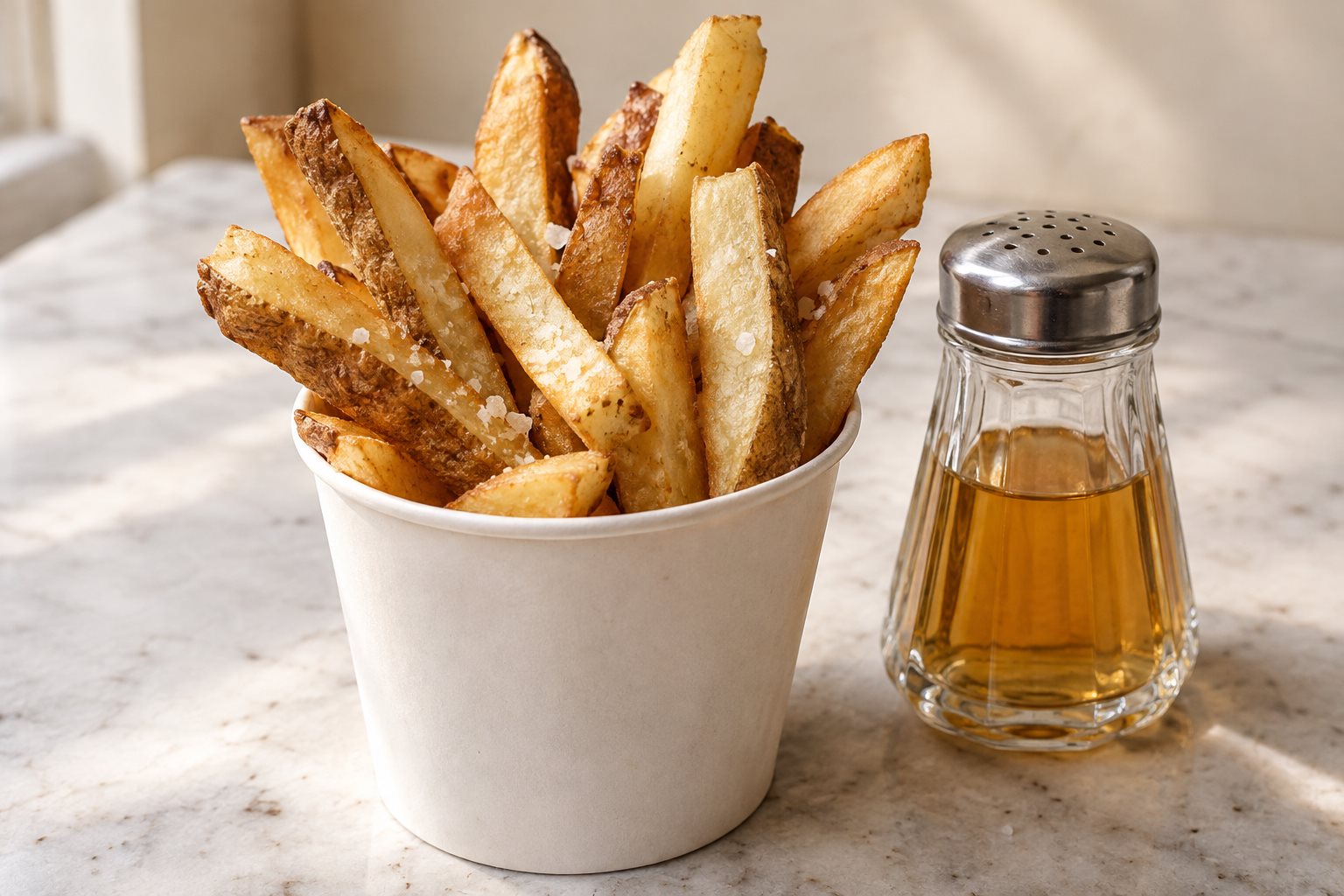
A paper cup of thick fresh-cut fries, pale gold and uneven, with salt visible on them and a glass vinegar shaker with a perforated cap beside it
Uneven lengths, skin on some of them, and a wet shine where the vinegar has just gone on. A fry that all looks the same length came out of a bag. AI-generated illustration.

The potato decides this, not the cook: how much water is in it and how much sugar, which is why the same recipe gives you pale gold in October and something close to mahogany in March.

The federal government has written down how to measure a frying potato, and the document is more use in a kitchen than most cookbooks. The United States Standards for Grades of Potatoes for Processing carry an optional test for specific gravity at 7 CFR 51.3417: take a representative sample, weigh it in air and in water, correct the reading against a table of temperature factors that runs from 38 to 100 degrees for both the potato and the water, and then read the answer off Table II, a conversion chart built for 5,000 grams of potatoes. Four hundred grams of apparent weight in water is a specific gravity of 1.0870 and 22.2 percent total solids; three hundred grams is 1.0638 and 17.2 percent; the chart tops out at 1.1040 and 26.0 percent. The arithmetic behind it is just the weight in air divided by the weight the sample loses in water, which means you can run the same test with a kitchen scale, a bowl and a bag from the supermarket. What is not in the standard is a threshold: specific gravity is offered as an instrument and no grade requires a number. The grade itself, at 7 CFR 51.3410, is about the outside of the potato rather than the inside — U.S. No. 1 Processing wants similar varietal characteristics, moderately firm, fairly well shaped, free from blackheart and freezing injury, and not less than 2 inches in diameter or 4 ounces in weight. Nothing in there tells you how a potato will fry. The number that does is the one the inspector only takes if somebody asks for it.

The vinegar is the other half of the order, and it is the half the record is thinnest on. Henry Mayhew's London Labour and the London Poor of 1851 costs out the London street trades item by item, and the vinegar bottle is in the inventories: a penny apiece for the pickled whelk sellers, a penny apiece for the four men selling hot green peas, and three quarts of it in the weekly reckoning of an eel-liquor stall, where the portions go out in halfpenny cupfuls with a little vinegar and pepper and where, Mayhew says, the street-boys are extravagant in their use of vinegar. The fried fish sellers in that same accounting get trays, frying pans, knives, earthenware pans, shallows and salt dredgers — a salt dredger and no vinegar bottle — and the street potato of 1851 London is baked, out of a can with salt on one side and butter on the other. Vinegar, fried fish and potatoes were all on that street and had not yet arrived in one paper wrapper. By 1905 they had: a Waycross, Georgia weekly of 27 May reprints Robert H. Sherard on London slum children sent out with coppers for a penn'orth of fish and chips from the fried fish shop on the corner, and Georgia papers of 1916 and 1918 are still describing those shops, the dogfish sold in them as plaice and their closure when the submarines took the fishing fleet. Vinegar on the chips I could not date in any pre-1930 American page I could reach; in the Georgia archive malt vinegar and French fried potatoes only turn up in the same sentence from the 1970s on. British origin is the sensible reading of all this and I am not going to dress it up as a proven crossing. As for Rehoboth, the plan sent me to the Delaware boardwalk and the state press, and there is no state press to read: every Delmarva town on the Advantage network — Rehoboth Beach, Lewes, Milford, Georgetown, Seaford — answers with the same WebsiteNotFound page, and Pennsylvania's archive, which does answer, holds no page joining the famous stand's family name to the town and nothing at all under the phrase Thrasher's French Fries. So the origin story told about one Rehoboth family is a claim, and this article prints no founding year for it. Two things about the boardwalk fry are on the record: a Maryland Court of Special Appeals opinion of 21 December 2018 in a boardwalk zoning fight, Nathans Associates v. Mayor and City Council of Ocean City, in which the trial judge overrules an objection by listing what a witness up on the boardwalk might have seen — he could have observed Thrasher's French Fries, he could have observed the men's room — a landmark so plain a judge uses it without explaining it; and the fact that the thing travelled, because by the summer of 1992 Boardwalk Fries was a Franchise 500 company at 8307 Main Street, Ellicott City, Maryland, advertising in the Penn State Daily Collegian for managers for a shop about to open in the Nittany Mall, three hours from any ocean. The quantities below were worked out for this page.

Why this version works

A denser potato fries drier. Total solids is mostly starch and the rest of the tuber is mostly water, so a potato at 22 percent solids has less water to boil off and more structure left when it has gone. That is what the specific gravity table in the federal standard is measuring, and it is the reason a mature russet fries mealy and a waxy new potato fries into something closer to a chip of boiled potato in a wet jacket.

Two fries, two different jobs. The first pass at 325°F is a cooking step: it takes the inside to a soft paste of gelatinised starch and pushes water out of the outer millimetre or two, which is why the fries come out pale and floppy and why that is correct. The second pass at 375°F is a drying step on ground that is already dry, and it sets a brittle shell in two or three minutes. One pass cannot do both, because the time needed to cook a half-inch of potato through at a crusting temperature is the time needed to burn the outside.

Colour is sugar, and sugar is storage. Browning here is reducing sugars meeting amino acids at frying heat, so the potato arrives in your kitchen with its colour already decided. USDA's Agriculture Handbook 66, in the potato chapter by Ronald E. Voss, puts tubers for fresh eating at 45 to 50°F to hold down the conversion of starch to sugars that darken during cooking, and tubers for frying warmer still, at 50 to 59°F. A household refrigerator runs at 37 to 39°F, which the handbook singles out as the range where reducing sugars rise to levels not reversible with reconditioning. The fridge is the worst place in the house for a potato you mean to fry.

The vinegar goes on hot, from a shaker. Acetic acid is volatile and the fries are at frying temperature when the vinegar hits them, so most of what you shake on leaves immediately as the smell — which is half the point, since that smell is what a boardwalk stand sells from fifty feet away. What stays is a thin acid film on a salty fatty surface. Shaken it evaporates and seasons; poured or dipped it soaks, and a crust built over ten minutes of frying collapses in about twenty seconds.
Ingredient notes

Oil: 2 quarts of peanut oil, or any neutral oil you are willing to heat to 375°F and can afford to use 2 quarts of. Strained through a coffee filter and kept in the dark it will do this three or four more times. The pot matters as much as the oil: 2 quarts in a tall 6-quart pot leaves the headroom you need when the water in a cold potato hits hot fat.

Salt: a tablespoon of kosher salt, and it goes on the second the fries leave the oil, while the surface is still wet enough to hold it. Salt applied to a cooled fry falls into the bottom of the cup. This is a hard-salted food and the salt is doing a job — it is the thing the vinegar has to argue with.

Vinegar: cider vinegar, about half a cup, in a shaker or any bottle you can punch a few holes in the cap of. FDA's compliance policy guide on vinegar, CPG 525.825, notes that there is no federal standard of identity for vinegar at all; the agency's labelling policy defines cider vinegar as the product of alcoholic and then acetous fermentation of apple juice at about 4 grams of acetic acid per 100 millilitres, and malt vinegar as the same process worked on an infusion of barley malt. That policy has a long tail: the Supreme Court decided United States v. Ninety-Five Barrels, More or Less, Alleged Apple Cider Vinegar on 2 June 1924, holding that vinegar made from dried apples could not carry the apple cider name. Malt is the British answer and cider is the mid-Atlantic one, and at 4 percent acid they behave the same on a hot fry.

Potatoes: russets, 3 pounds, and buy them loose rather than in a bag if the shop lets you, so you can pick heavy ones. Heavy for its size is the kitchen version of the federal specific gravity test: the same potato weighed in air and in water tells you the solids, and the weight in your hand tells you most of it. Keep them in a paper bag in a cupboard, never the fridge. If all you have is fridge-cold potatoes, give them a week or two on the counter before frying.

Step by step

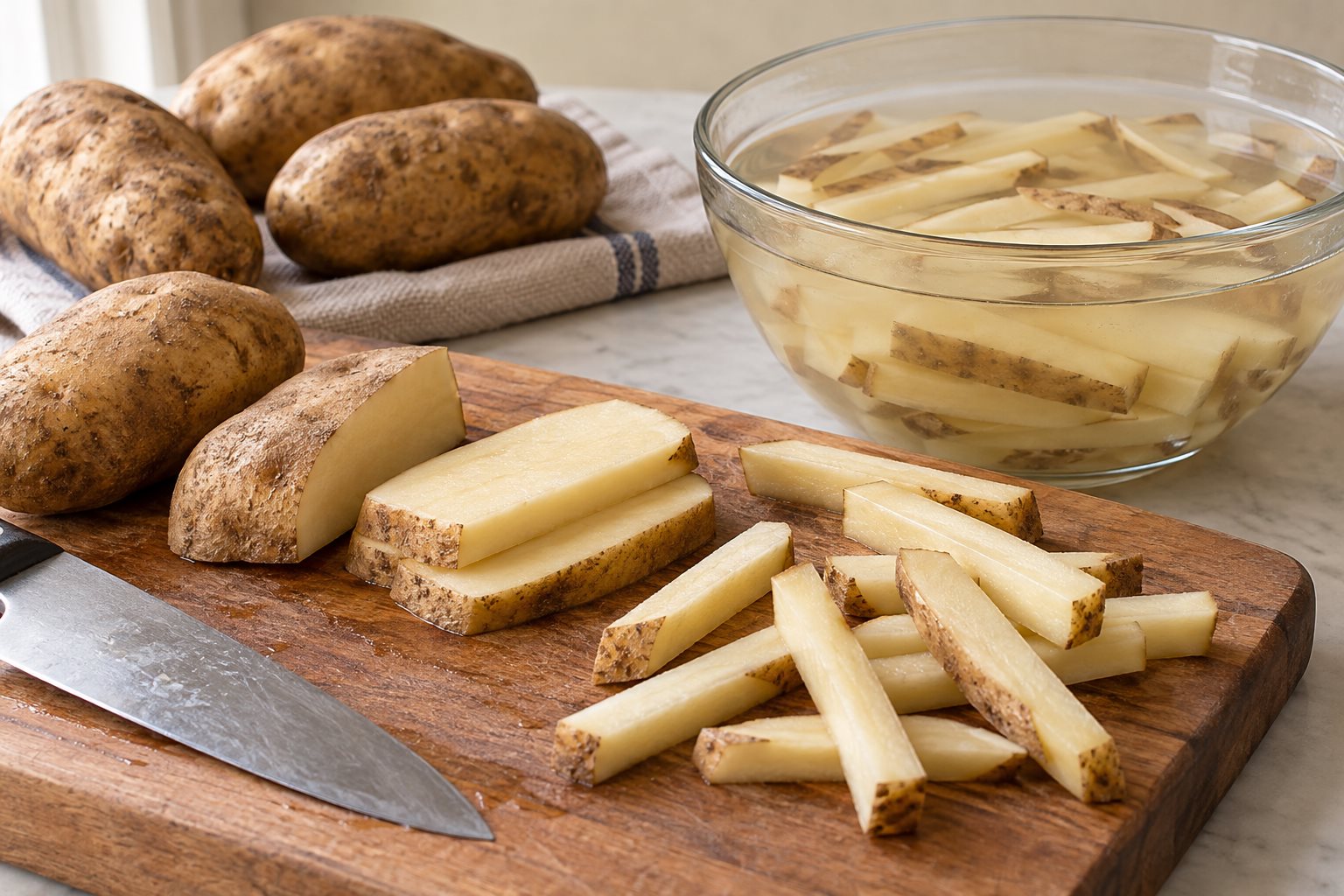
  1. Cut the potatoes. Scrub the potatoes and leave them unpeeled. Square off each one, then cut it lengthwise into slabs a little over 3/8 inch thick and the slabs into batons of the same width. Uneven lengths are right; uniform ones are a sign you are fussing. Drop them into a bowl of cold water as you go.
    Skin-on potatoes cut into slabs and even batons on a wooden board beside a bowl of water.
    Cut skin-on potatoes into batons of similar width so they cook evenly. AI-generated illustration.
  2. Rinse and dry them. Change the water twice, until it runs off nearly clear, then leave them 30 minutes in the last change. Drain them and dry them properly on towels — two changes of towel, and press. Water on the outside of a potato turns straight to steam and drops the oil temperature 40 degrees in ten seconds.
  3. First fry, low. Heat the oil to 325°F in a tall pot and fry in three batches, about a third of the potatoes each time, for 5 to 6 minutes. They should end up limp, pale, and soft the whole way through when you squeeze one. Lift them out onto a rack set over a tray. Let the oil come back to 325°F between batches.
  4. Rest them. Leave the fries on the rack at least 20 minutes and up to 2 hours; the steam coming off them now is water that would otherwise be trapped under the crust. This is the step people skip and it is the one that decides whether the fries are still crisp when they reach the table.
  5. Second fry, hot. Bring the oil to 375°F and fry the batches again, 2 to 3 minutes each, until the surfaces are rigid and deep gold and the fries rattle against each other in the spider. Work faster here than feels comfortable — the colour moves quickly at the end.
  6. Salt and shake. Tip each batch straight into a warm bowl, throw a third of the salt over it and toss it hard while it is dripping. Pile them into paper cups, shake cider vinegar over the top from a height, and eat them standing up. Do not shake the vinegar on more than a few seconds before they are eaten.
Fries gone limp on the plate mean the second fry was too cool or too crowded: get the oil back to 375°F, put the whole lot in again for a minute, and salt them a second time. Fries that came out dark and tasted faintly sweet before they were done inside are a storage problem, not a heat problem — the potatoes have been cold, their starch has turned to reducing sugars, and the handbook is blunt that below about 39°F that change is not reversible with reconditioning. Above it, a week or two at room temperature will pull some of it back. If the oil boiled up over the rim, the potatoes went in wet; pull the pot off the heat, let it settle, and dry the next batch properly. And if the whole cup has gone soft at the table, that is vinegar applied too early or poured rather than shaken.

Storage and make-ahead

Fried and salted, these have a life of about ten minutes and no storage at all. What does keep is the first fry: spread the once-fried batons on a rack, cool them completely, and hold them uncovered in the fridge for a day or frozen on a tray for a month. They go into 375°F oil straight from cold or frozen, with an extra 30 seconds for frozen, and come out better than fries taken through both stages in one sitting.

Raw cut potatoes hold overnight in cold water in the fridge, which is the one time a fridge helps here, since they are already cut and the sugar damage takes longer than that. Drain and dry them twice as thoroughly the next day. Used oil, strained while warm through a coffee filter and kept sealed in the dark, is good for another three or four fryings; throw it out when it darkens, foams at the edges or smells of fish.

What to serve with it

On the boardwalk this is the whole meal, eaten walking, and the things that go with it are a paper cup of something cold and whatever came out of the same water — steamed clams, a crab cake, fried fish. In a kitchen it belongs beside anything fatty and unseasoned that needs a sharp edge: a plain burger, roast chicken, fried flounder. Skip the ketchup, not out of piety but because sugar on top of a browned potato flattens it; the vinegar is doing the job ketchup is usually asked to do.

A paper cup of thick fresh-cut fries, pale gold and uneven, with salt visible on them and a glass vinegar shaker with a perforated cap beside it

From the recipe box / Delaware

Boardwalk Fries with Cider Vinegar, Cut from Whole Potatoes and Fried Twice

Whole russets cut into batons, fried once to cook them through and once more to set the crust, salted while they are still dripping and doused from a vinegar shaker into a paper cup.

Prep
20 min
Cook
40 min
Total
1 hr 30 min
Serves
4
Calories
700 per serving

Ingredients

Scale

Instructions

  1. Cut the unpeeled potatoes into batons a little over 3/8 inch square, dropping them into cold water as you go.
  2. Rinse through two changes of water, soak 30 minutes in the last, then drain and dry them thoroughly on towels.
  3. Fry in three batches at 325°F for 5 to 6 minutes, until limp, pale and soft through, and drain on a rack.
  4. Rest the fries on the rack at least 20 minutes, up to 2 hours.
  5. Fry again at 375°F for 2 to 3 minutes a batch, until rigid and deep gold.
  6. Toss each batch with a third of the salt while dripping, cup them, and shake cider vinegar over the top just before eating.

Nutrition

Fat33 g (6 g saturated)
Sodium700 mg
Protein9 g
Servingabout a quarter of the batch, a generous cup
Calories700
Cholesterol0 mg
Carbohydrates88 g (3 g sugar, 7 g fiber)

Nutrition is an estimate calculated from the listed ingredients and is provided as a courtesy, not as dietary advice.

Questions readers ask

Do I have to peel them?

No, and leaving the skin on is closer to a stand that cuts its own potatoes all day. The skin browns faster than the flesh, so a few ends will be dark; that is what a fresh-cut fry looks like. Do cut out any green patches, which are bitter, and any sprouted eyes.

Can I get away with one fry?

Not for this. A single fry has to choose between cooking the middle and building the crust, and the boardwalk fry is defined by having both — a shell stiff enough to survive salt and a shake of vinegar, over a middle that is soft the whole way through. If you only have time for one pass, cut the fries thinner and accept a crisp chip rather than a fry.

Cider vinegar or malt vinegar?

Malt is the British one and cider is what a mid-Atlantic shaker usually holds, and at the strength FDA's policy guide describes — around 4 grams of acetic acid per 100 millilitres for both — they do the same work on a hot fry. Malt tastes rounder and slightly sweet, cider tastes of apple, and white distilled vinegar, made by fermenting dilute distilled alcohol, tastes of nothing but acid. Use that last one only if it is what you have.

Why did my fries come out dark before they were cooked?

Almost always the potatoes were stored cold. Agriculture Handbook 66 puts frying potatoes at 50 to 59°F and warns that 37 to 39°F — ordinary refrigerator temperature — drives up reducing sugars past the point where warming them back up fixes it. Those sugars brown long before the inside of the fry is done. Buy fresh potatoes, keep them in a dark cupboard, and if they have been chilled, leave them out for a week or two and accept that some of it is permanent.