The regional table / Kansas
Zwieback
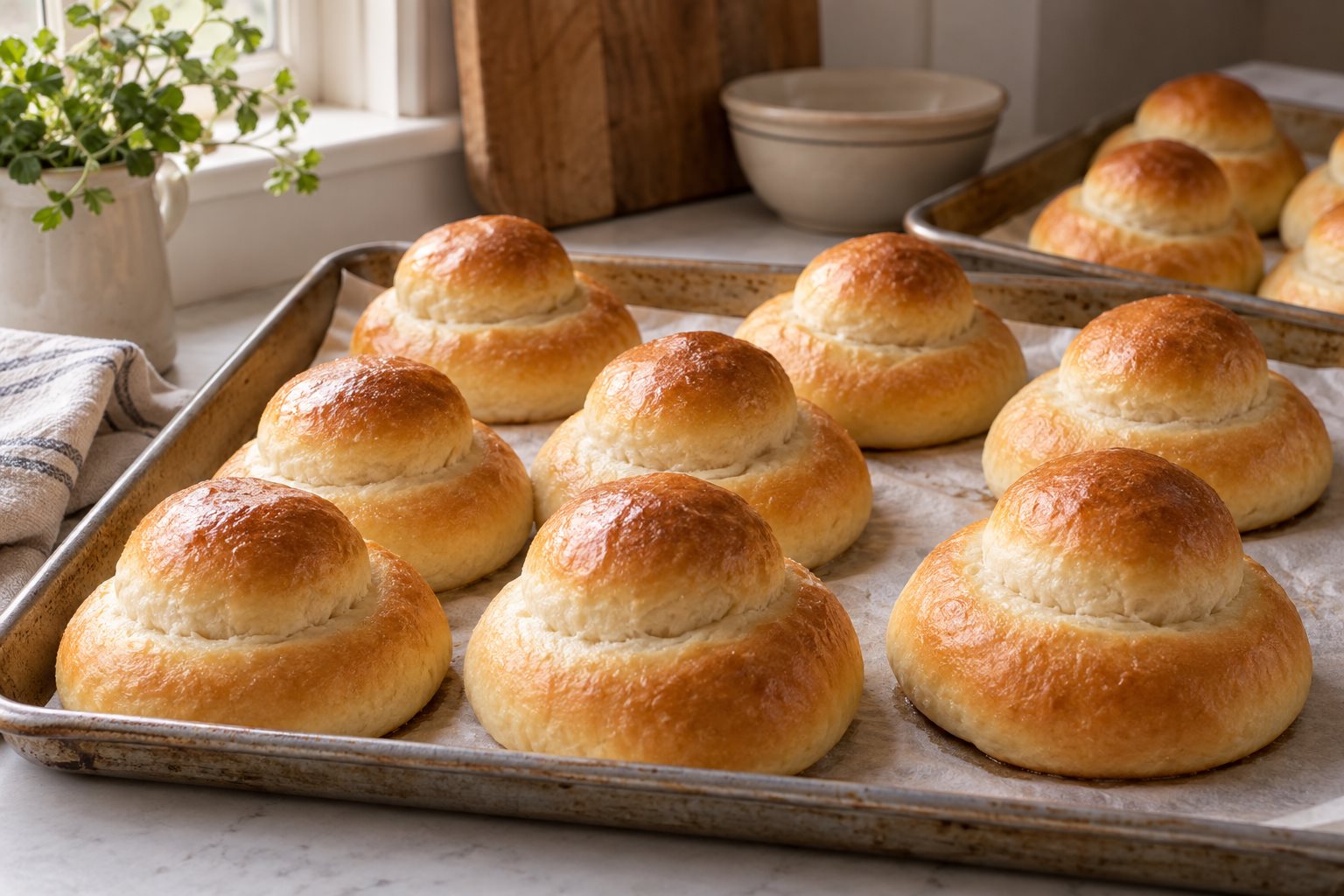
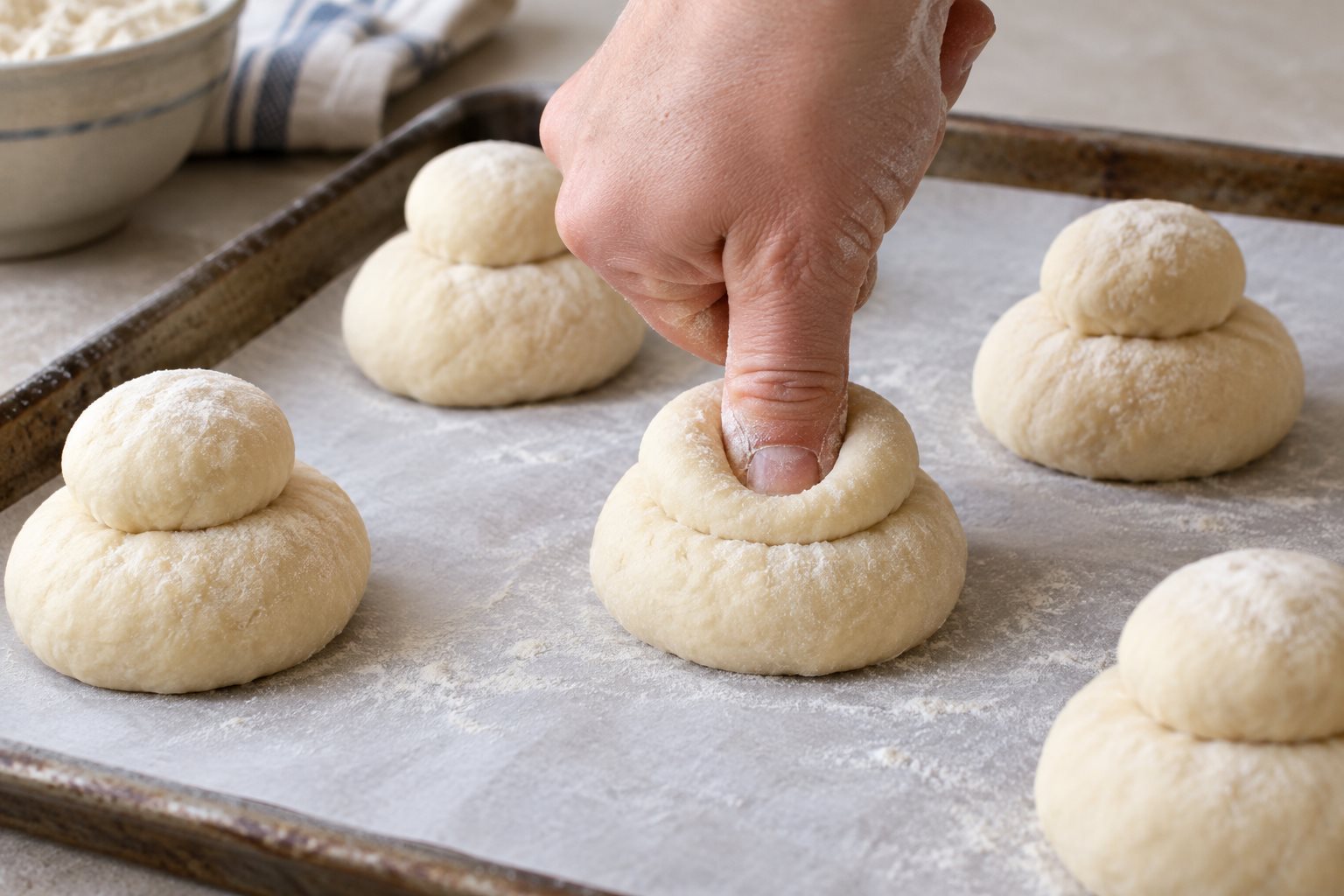
One ball of dough on top of another, and a thumb driven through both — everything else about this roll follows from that.
The best evidence for what this roll was for is a sentence about running out of it. C. Henry Smith's The Coming of the Russian Mennonites, printed in 1927 and long out of copyright, follows a party of emigrants across the continent and reports that "some of the newcomers had brought a limited supply of eatables from their Russian homes, but even these exhausted their bags of roasted Zwieback by the time they reached Moorehead, Minnesota". Roasted — that is, twice-baked, which is what the word means and which is why it keeps. The same book records the one piece of Russian kit that survived the crossing intact: of all the contrivances they brought, "the big brick heating oven" alone "easily proved itself superior to any of the native American stoves", because fuel on the treeless plains was buffalo chips and weeds and an oven that held heat was worth more than one that made it. The people who carried those bags settled in Harvey, Marion, McPherson and Reno counties in the 1870s, and they are Low German Mennonites out of South Russia — not the Volga German Catholics of Ellis and Rush, who are a different migration with a different church and different food, and the two get blurred constantly.
Two more things are documented and one famous thing is not. The wheat: the Federal Writers' Project guide of 1939 tells the heroic version, "the bushel or so of hand-picked hard Turkey Red wheat carefully stowed away in the baggage of each family", and Smith in 1927 puts it more carefully — "It was through their influence also that the Turkey Red wheat, which is now the leading variety sown throughout the western states, was introduced from the Crimea." Before 1874 Kansas had never grown as much as five million bushels of wheat in a year; the 1939 guide reckons the state at thirty times that. The word: zwieback is in print in the plains press earlier than you would guess, though always as a foreign object. The Omaha Daily Bee of 24 August 1890 puts it in quotation marks in a piece about a European spa, every guest buying "his 'zwieback' from the bakers"; the German-language Grand Island Anzeiger und Herold of 11 May 1900 sets it beside ordinary loaf in a line about material for "die Bereitung von Zwieback oder Brod". Both of those I pulled as raw page text and read, because that archive's matching is fuzzy enough to invent hits. What is not documented is any of it in Kansas: the word appears zero times in the 1939 state guide despite its pages on these settlements, and Kansas's own newspapers answer a script with a 401 or a block. No first baker, no date, no village. The quantities below were worked out for this page.
Why this version works
Rich, but not sweet. Half a cup of butter and a cup of whole milk to four cups of flour makes a short, tender crumb that tears. The two tablespoons of sugar are there to feed the yeast and brown the crust, not to make a sweet roll — this goes on a table with cold ham and cheese, not with jam.
A firm dough, not a slack one. Soft enough to be smooth, dry enough to hold a ball on the counter without spreading. Slack dough relaxes during the prove, the top ball sinks into the bottom one, and what comes out of the oven is a lump with a scar across it.
The thumb goes all the way through. Press the small ball onto the large one and then drive a floured thumb down through the centre of both until you feel the sheet. That plug of dough is a rivet. A top ball merely set on the base rides off sideways in the oven every time.
The top ball is about a third the size. Any bigger and it outweighs its own attachment and topples; any smaller and it bakes into a knob rather than a second dome. A third of the weight of the base is the proportion that gives a roll with a waist.