American cooking Recipes & regional stories

Skillet & Sage

A culinary journey through the fifty states

The regional table / Minnesota

Wild Rice Soup
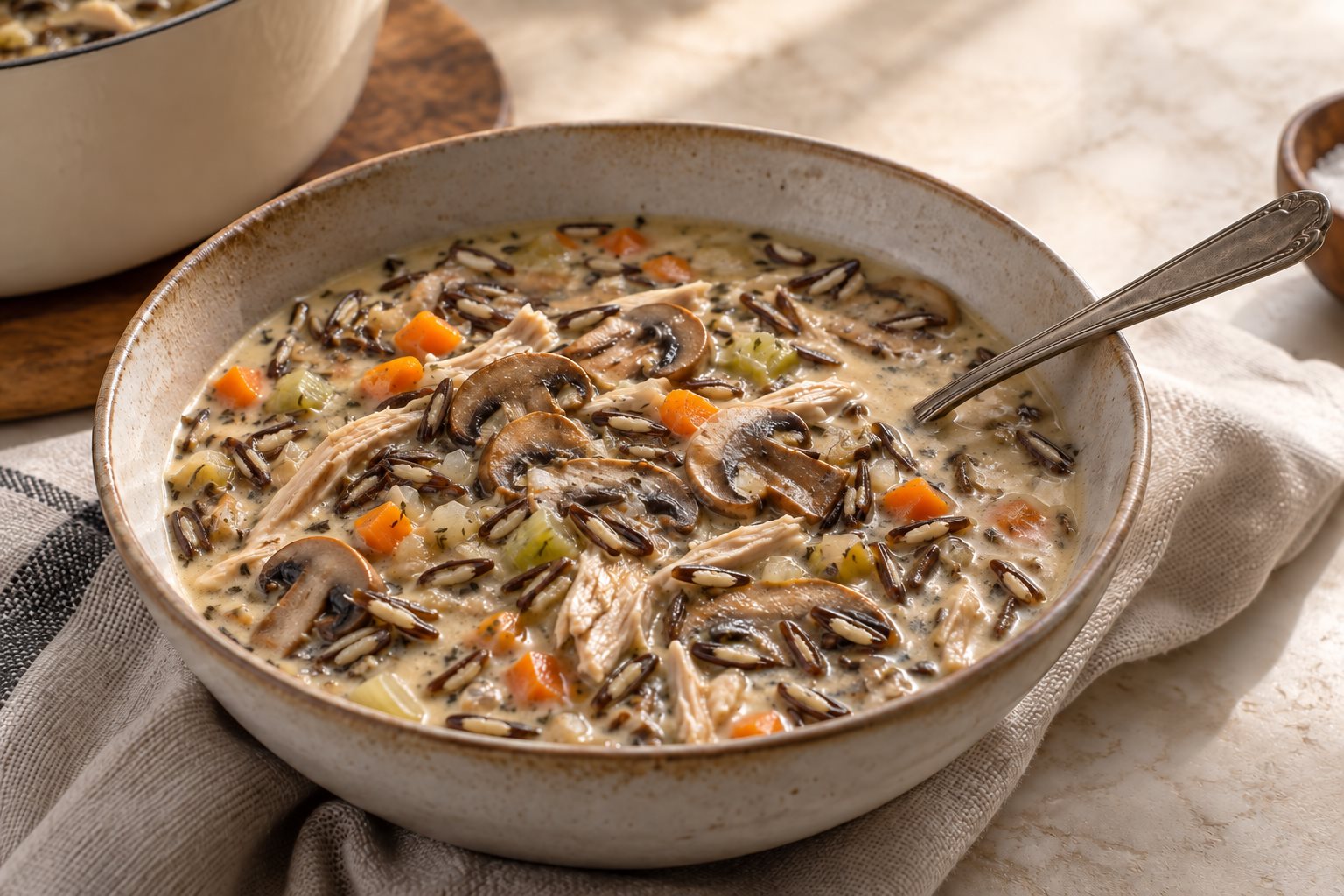
A bowl of pale broth thick with long dark wild rice grains, mushrooms and shredded turkey, with a spoon resting in it
Properly cooked lake rice splits open along its length; grains still shut tight have not had long enough. AI-generated illustration.

The grain is manoomin, the soup is older than the cream in it, and Minnesota has written into law the difference between the rice off a lake and the rice out of a paddy.

Wild rice is not rice and it is not wild in the sense of being unclaimed. It is manoomin in Ojibwe and psin in Dakota, a grain of the lakes and slow rivers, and it sits at the centre of Anishinaabe life rather than at the edge of it: the Minnesota Historical Society's encyclopedia entry on wild rice and the Ojibwe records the migration west from the east coast in search of a homeland "where the food floats on water", which the people recognised in the rice growing around Gichigami, Lake Superior. It is harvested from a canoe in pairs during manoominike giizis, the wild rice moon, one person poling and the other bending the heads over the gunwale with knocking sticks, bawa'iganaakoog; the green rice is then parched over fire, threshed by being danced on — jigging — and winnowed in birch bark trays, nooshkaachinaaganan. Two federal reports print the same work a century ago. Frances Densmore, in Chippewa Customs, Bureau of American Ethnology Bulletin 86 of 1929, writes that each group of relatives had its share of the rice field "as it had its share of the sugar bush, and this right was never disputed", that "the implements used in the harvesting were two sticks about 24 inches long", and that the treading was done by a man in clean moccasins leaning on a pole, "the motion being not unlike that of a dancer". Albert Ernest Jenks, whose study of the wild rice gatherers of the upper lakes fills much of the Nineteenth Annual Report of the same Bureau for 1900, is the one who puts the soup itself on the record: "The Indian is very fond of soups, and wild rice is commonly used by him to thicken food of this kind." He quotes an earlier description from Green Bay — "It is used to thicken their broth of venison, bear, fish, and fowl: it is very nutritious and palatable" — and one of the Dakota calling it "excellent with game broth". Rice in broth is the old form of this dish. The cream is the new part.

Which rice you buy is a legal question in Minnesota, and the statutes are worth reading before the recipe. Wild rice has been the official state grain since 1977 under Minn. Stat. § 1.148, which names it "Zizania aquatica, commonly known as wild rice or manomin". Under § 84.091 "the state is the owner of wild rice and other aquatic vegetation growing in public waters", and members of federally recognised tribes in Minnesota holding a valid tribal identification card "are deemed to have a license to harvest wild rice". The season, § 84.105, is a single sentence: "Ripe wild rice may be harvested from August 15 to September 30." How it may be taken has been fixed since 1949 by § 84.111 — no watercraft other than a boat, skiff or canoe propelled by hand, no more than 36 inches wide and 18 feet long, and no machine for gathering the grain "other than with flails not over 30 inches in length nor over one pound in weight, which flails must be held and operated by hand" — and it is unlawful to harvest between 3:00 p.m. and 9:00 a.m. Densmore's two sticks of 24 inches in 1929 sit comfortably inside a legal limit written twenty years later. The labelling law, § 30.49, then forces the distinction onto the package: cultivated rice must be marked "paddy" or "cultivated"; lake rice may be marked "100 percent naturally grown, lake and river wild rice", and if it was taken by machine the words "machine harvested" must appear beside the product name; and subdivision 5 says flatly that "a wild rice label that implies the wild rice is harvested or processed by Indians is misbranded unless the package contains only 100 percent natural lake or river wild rice harvested by Indians." Minnesota did not legislate this out of tidiness. It legislated because paddy rice, bred and grown in flooded fields from the late 1960s, undercut the hand-harvested crop and took the income with it, and because § 84.10, still on the books from 1939, had already tried to reserve the rice of the named reservations to the people of those reservations. Buy the rice the label calls hand-harvested lake rice, pay what it costs, and know whose work you are eating.

Why this version works

Broth first, cream last. Jenks's nineteenth-century sources describe the grain thickening broth of venison, fish and fowl, not milk, and that order still gives the better soup: build flavour in stock, get the seasoning right while it is still a broth, and stir cream in at the end over low heat. Cream added early boils, flattens and can split against the acid of mushrooms and sherry.

The rice is cooked apart, and its water goes into the pot. Lake rice releases a dark, nutty, faintly smoky liquor as it cooks, and that liquor is most of the reason this soup tastes of anything. Boiled straight in the broth it would muddy the whole pot and thicken it unpredictably; cooked in four cups of plain water it gives you both a properly done grain and two cups of concentrated cooking liquid to pour back in.

The mushrooms are browned dry before anything wet touches them. A pound of mushrooms will give up most of a cup of water. Cooked in butter from the start they poach in it and stay pallid; put into a hot dry pan first, they squeak, release, dry out and then take colour, and that colour is the closest a kitchen without game stock can get to what the old descriptions meant by broth.

Hand-harvested rice and paddy rice are not interchangeable in the pan. Parched lake rice is mottled brown, thin-hulled and done in about 35 minutes, splitting along its length and curling open. Cultivated paddy rice is near-black, thicker and wants 50 minutes or more, and it holds its tube shape rather than butterflying. Cook either one by the clock written for the other and you get gluey shreds or bullets. The law that makes the label tell you which is which is also the cook's instruction.
Ingredient notes

Cream: one cup of heavy cream, off the boil. Half-and-half works and milk does not — milk breaks. If you want it lighter, use less cream rather than thinner cream.

Stock: six cups of unsalted or low-sodium turkey or chicken stock. Turkey is better and the day after a roast bird is when this soup was traditionally made in Minnesota kitchens. If your stock is salted, cut the added salt to half a teaspoon and taste at the end.

The rice: one cup of hand-harvested lake rice, and read the package under Minn. Stat. § 30.49 before you pay — it must tell you whether it is cultivated or paddy, whether it is machine harvested, and where it was grown. A bag that says "100 percent naturally grown, lake and river wild rice" and carries a dealer licence number is the one you want.

Mushrooms: a pound of cremini, sliced thick. Fresh mushrooms and a hot dry pan are doing the work that game did in the older versions. A handful of dried porcini soaked in half a cup of hot water, chopped, with the strained soaking liquid added to the pot, takes it further still.

Step by step

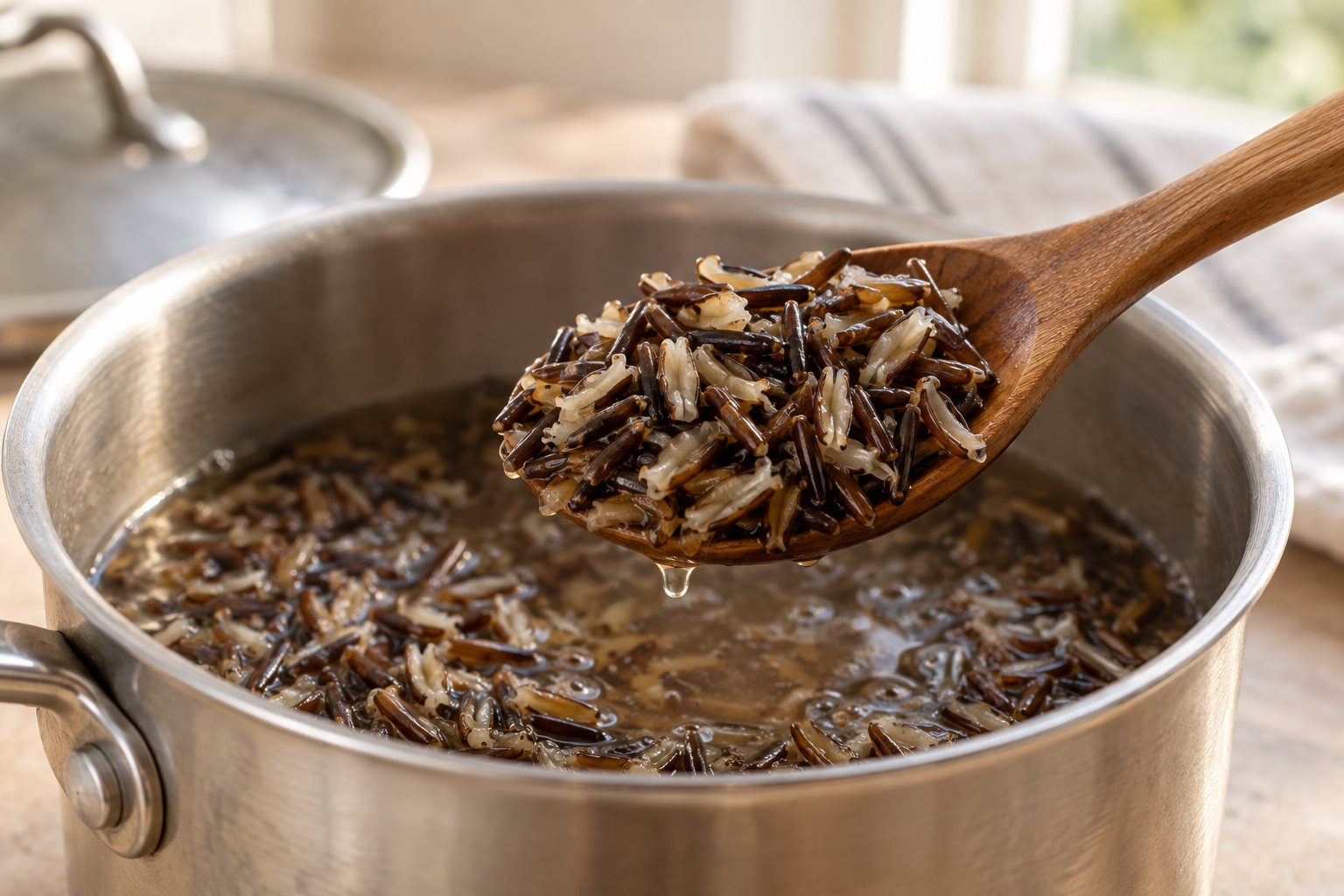
  1. Cook the rice. Bring the rice and 4 cups of water to a boil with a pinch of salt, then simmer covered 35 to 45 minutes, until most grains have split open along their length and curled. Do not drain: set the pan aside with its liquid.
    Cooked wild rice split lengthwise to reveal pale interiors on a wooden spoon
    Cook until most wild rice grains split lengthwise and curl open; keep the cooking liquid. AI-generated illustration.
  2. Brown the mushrooms. Cook the mushrooms in a wide dry pot over medium-high heat 8 to 10 minutes, until they squeak, give up their water and then brown. Add 2 tablespoons of the butter and cook 2 minutes more.
  3. Sweat the aromatics. Add the remaining butter, the onion, celery and carrot, and cook 6 to 8 minutes until soft but not coloured. Season with the salt, the pepper and the thyme.
  4. Make the base. Stir in the flour and cook 2 minutes, then add the stock a ladle at a time, whisking, until it is smooth. Simmer 10 minutes.
  5. Add rice and meat. Tip in the rice with all its cooking liquid and the shredded turkey. Simmer 10 minutes more so the grain finishes in the broth and the liquor colours the pot.
  6. Finish off the heat. Take the pot off the heat, stir in the cream and the sherry, and let it stand 2 minutes before tasting for salt. It will thicken as it sits; loosen with stock rather than water.
If it has gone gluey and grey, the rice was overcooked before it ever met the broth — cooked rice that has burst completely keeps releasing starch. Thin it with stock, add a squeeze of lemon and accept it as a chowder. If it split after the cream went in, it boiled: take it off the heat, whisk in a splash of cold cream, and do not let it come back to a simmer. If the broth tastes thin, the fix is almost never salt but the mushroom liquor and the rice water, so make sure you added all of both.

Storage and make-ahead

Keeps 4 days refrigerated and improves on the second day. The rice keeps drinking, so expect to loosen it with stock when you reheat, over low heat and never at a boil.

Freeze it before the cream goes in. Frozen and thawed, a cream soup with this much starch in it separates; the base without cream freezes for 3 months and finishes exactly as it did the first time.

What to serve with it

Dark rye or a heavy seeded bread, and butter. This is a soup with one texture, and it wants something with a crust.

A plain green salad with a sharp mustard dressing, served after rather than alongside, keeps a rich bowl from closing the evening down.

A bowl of pale broth thick with long dark wild rice grains, mushrooms and shredded turkey, with a spoon resting in it

From the recipe box / Minnesota

Wild Rice Soup

Hand-harvested lake rice cooked apart in its own water, then finished in a mushroom and turkey broth with a little cream stirred in off the heat.

Prep
20 min
Cook
55 min
Total
1 hr 15 min
Serves
6
Calories
430 per serving

Ingredients

Scale

Instructions

  1. Simmer the rice in 4 cups salted water, covered, 35–45 minutes until the grains split open. Set aside in its liquid.
  2. Brown the mushrooms in a dry pot 8–10 minutes, then add 2 tablespoons of the butter and cook 2 minutes more.
  3. Add the rest of the butter with the onion, celery and carrot and cook 6–8 minutes, seasoning with salt, pepper and thyme.
  4. Stir in the flour, cook 2 minutes, then whisk in the stock and simmer 10 minutes.
  5. Add the rice with all its cooking liquid and the shredded turkey, and simmer 10 minutes.
  6. Off the heat, stir in the cream and sherry, stand 2 minutes and taste for salt.

Nutrition

Fat25 g (14 g saturated)
Sodium720 mg
Protein21 g
Servingabout 1 1/2 cups
Calories430
Cholesterol95 mg
Carbohydrates28 g (5 g sugar, 3 g fiber)

Nutrition is an estimate calculated from the listed ingredients and is provided as a courtesy, not as dietary advice.

Questions readers ask

Can I make it without cream?

Yes, and the older form has none. Leave it out, add a further cup of stock, and finish with a spoon of butter and a little lemon. What you lose is body; what you gain is the flavour of the rice liquor, which the cream partly covers.

Can I use a turkey carcass instead of stock?

That is the version worth making. Simmer the carcass for three hours with an onion, a carrot and a bay leaf, strain, and use six cups of it. Jenks's sources in 1900 describe wild rice thickening the broth of venison, bear, fish and fowl — the whole soup is a bird broth with a grain in it, and everything else is decoration.

What is the difference between lake rice and paddy rice?

Where it grew and how it was taken, and Minnesota makes the seller tell you. Under Minn. Stat. § 30.49, cultivated rice must be labelled "paddy" or "cultivated", lake rice may be labelled "100 percent naturally grown, lake and river wild rice", and machine-harvested lake rice must carry the words "machine harvested" beside the product name. In the pot, lake rice cooks faster, splits open and tastes smoky from being parched over fire; paddy rice is darker, tougher and blander.

Is it disrespectful to cook this if I am not Ojibwe or Dakota?

Buying and eating manoomin is not the problem; misrepresenting it is, and Minnesota wrote that into law. Section 30.49 subdivision 5 makes any label implying Indian harvest or processing misbranding unless the rice actually is 100 percent lake or river rice harvested by Indians. Buy from Native harvesters and cooperatives where you can, read the label, and name the grain by its own name.