The regional table / Maine
Maine Whoopie Pies
Maine is the only state whose legislature has written a definition of this thing into the statute book, and the definition is eighteen words long.
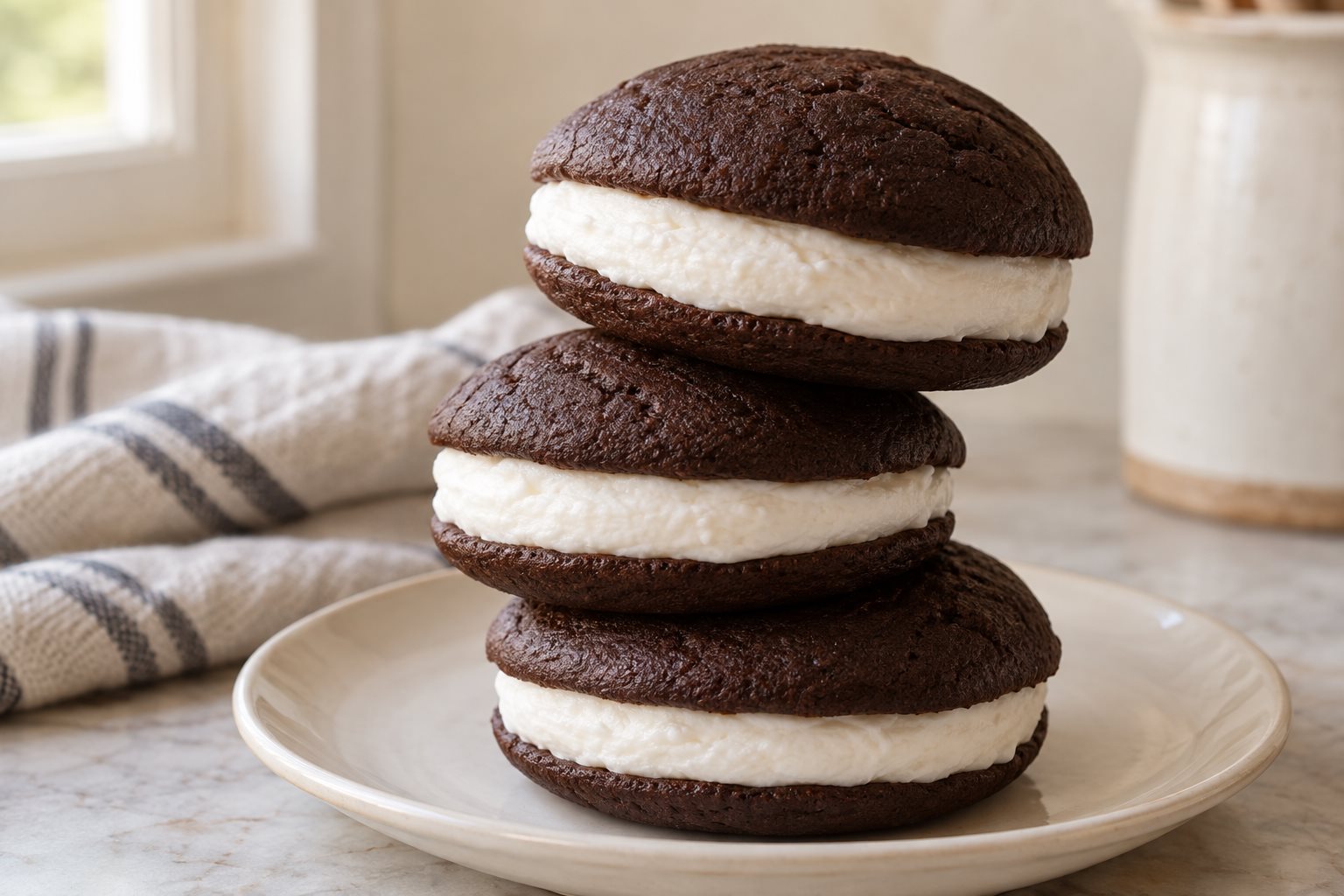
1 MRSA §225 reads: "The whoopie pie, a baked good made of 2 cakes with a creamy frosting between them, is the official state treat." The law that put it there, Public Law 2011, chapter 29, went on the books unsigned on 19 April 2011 under the title "An Act To Designate the Official State Treat and the Official State Dessert", and the paper trail behind it is better than the law. LD 71 was introduced as "An Act To Designate the Whoopie Pie as the State Dessert", and its single section would have enacted a §225 describing "2 chocolate cakes with a creamy frosting between them". The committee's majority report, Committee Amendment "A", struck that out and substituted the version now in force — demoting the whoopie pie from dessert to treat and, as the amendment summary says in so many words, clarifying "that it is made of 2 cakes rather than 2 chocolate cakes". Then House Amendment "A" to Committee Amendment "A", filing number H-20, sponsored by Pilon, added a second section enacting §226: "Blueberry pie, made with wild Maine blueberries, is the official state dessert." Maine did not simply crown the whoopie pie. It argued about the chocolate, refused it the dessert title, and gave that title to a pie instead.
The other quarrel, the one with Pennsylvania, cannot be settled here and I am not going to pretend otherwise. What I can report is what each archive actually holds. In Maine, grocery advertisements in the Biddeford Daily Journal were selling these by the half dozen in the spring and summer of 1938 — the issue of 10 June 1938 carries "WHOOPEE PIE" and the price "Large 6 for 23c" in a supermarket advertisement on page four, with the same item running on 27 May, 3 June and 17 June, and again in April 1941, and under the modern spelling "WHOOPIE PIES" in a grocery advertisement of 1 July 1948. In Pennsylvania, the earliest I could reach is a reader's recipe headed "WHOOPEE PIES" and credited to Hilda Funk, printed in Lancaster Farming on 26 September 1958: a cocoa batter dropped "like cookies on cookie sheet", baked on the top shelf of a 400 degree oven, and filled with a beaten mixture of egg whites, vanilla, flour, milk and confectioners' sugar creamed with vegetable shortening, spread on the bottom cookie with another laid on it "as for a sandwich". That 1938-against-1958 gap proves nothing about priority, and it would be dishonest to use it that way: the Pennsylvania run reachable from here is essentially one weekly farm paper that begins in the mid-1950s, and the Maine claim usually made — a Lewiston bakery in 1925 — sits in a city whose newspapers are in no archive that answered me. Two states, two sets of grandmothers, and an archive gap in the middle.
Why this version works
Assembling cold, eating warm. Cakes must be completely cool or the filling melts into them and disappears. But a whoopie pie straight out of the refrigerator is stiff and mute; give the assembled pies twenty minutes back at room temperature and the filling goes creamy and the cake goes soft again.
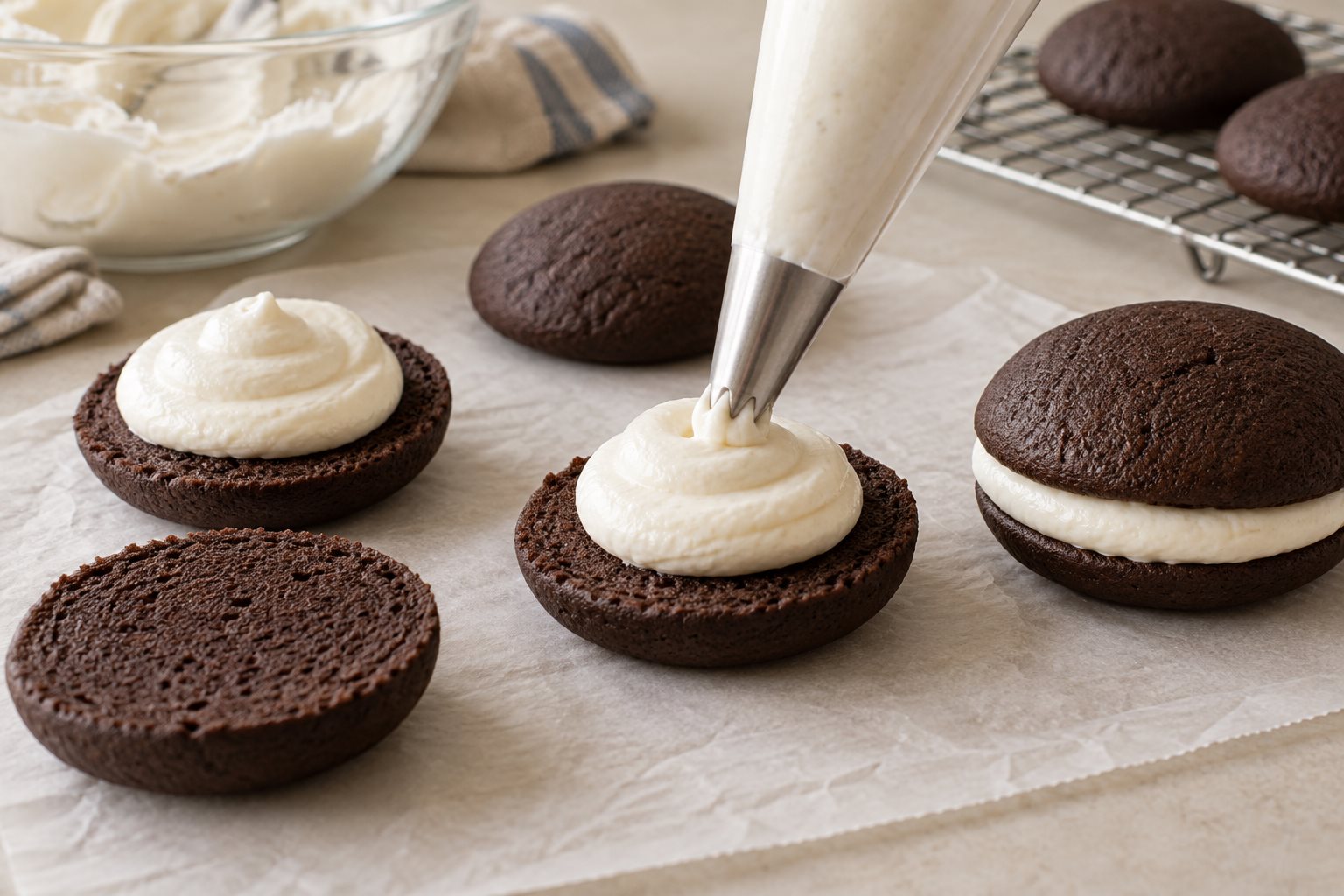
A batter stiff enough to hold its shape. This is a drop batter, not a poured one. Scooped onto the sheet it should sit up like a mound rather than settling into a disc — that is what gives you two cakes with rounded tops and flat undersides, which is the whole architecture of the sandwich.
Cocoa and buttermilk, not melted chocolate. Natural cocoa plus the acid in buttermilk gives baking soda something to react with, which is what produces the high soft dome and the faintly tangy, old-fashioned chocolate flavour. Melted chocolate makes a denser, sweeter, more modern cake that spreads flat instead of doming.
Half butter and half shortening in the filling. Butter alone tastes better but softens at room temperature and slides out from between the cakes; shortening alone holds beautifully and tastes of nothing. Half and half gives a filling with flavour that still stands up on a counter in July, which is exactly the compromise the 1958 Lancaster Farming recipe was making when it beat confectioners' sugar into vegetable shortening.