The regional table / Alabama
West Indies Salad
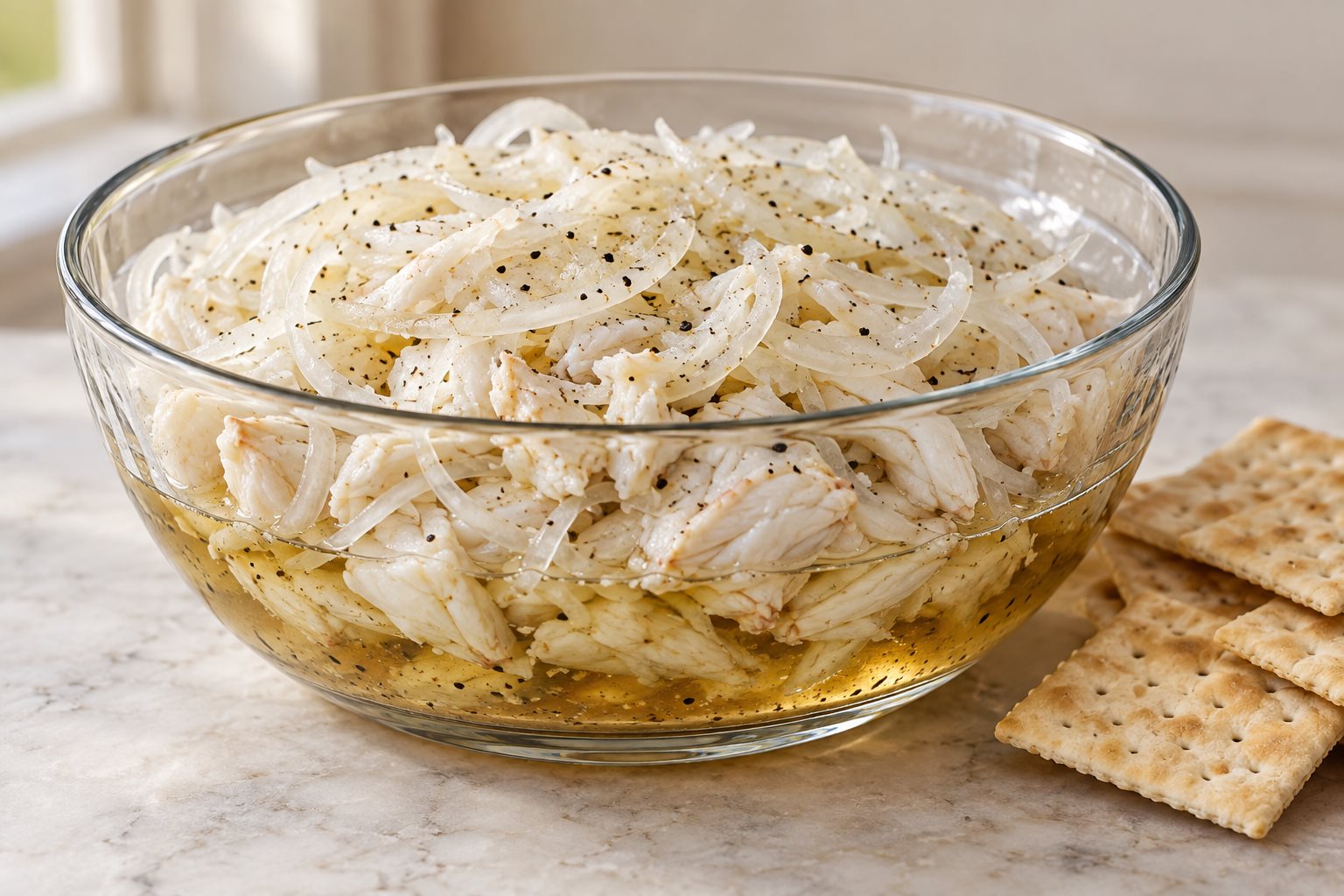
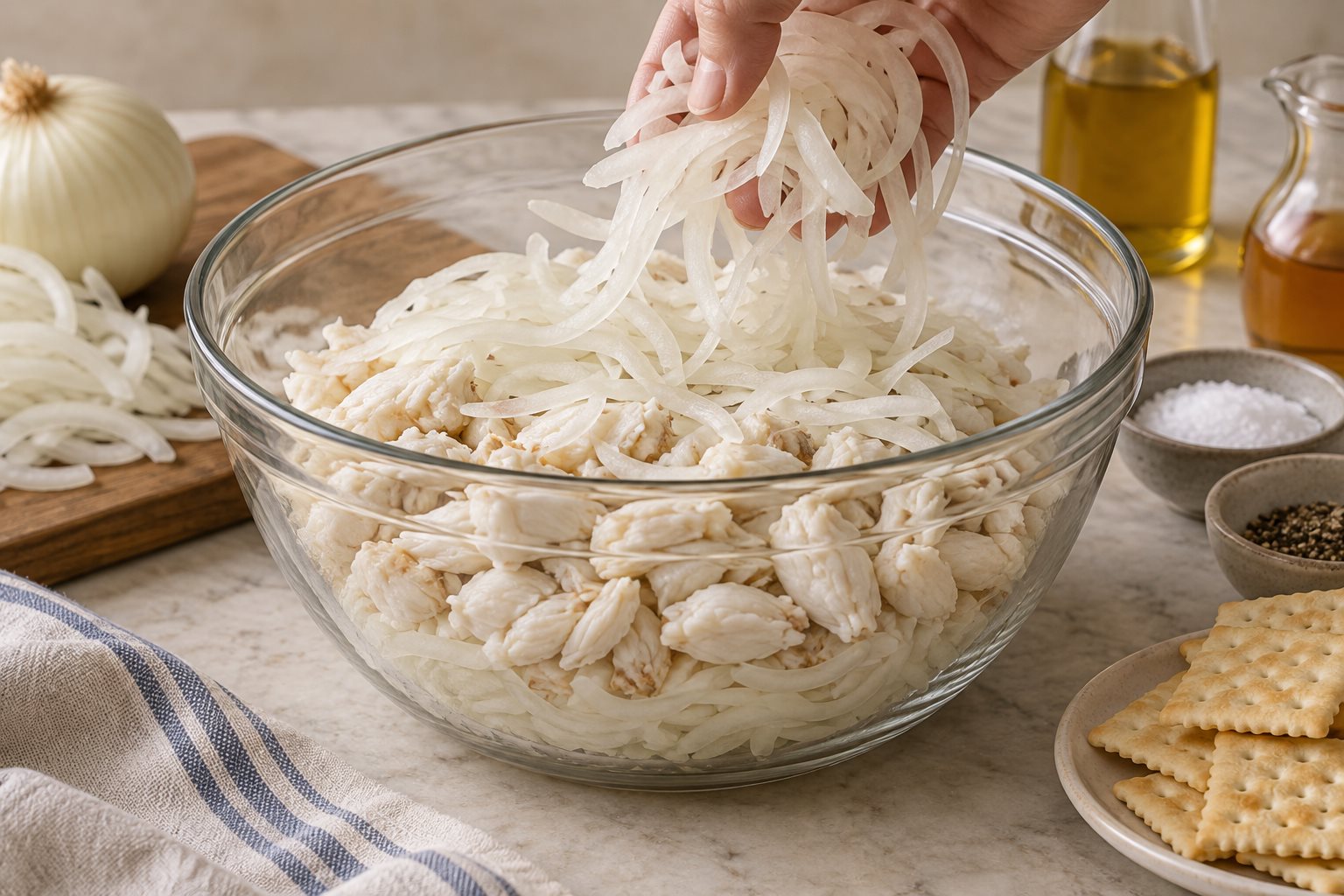
Four things go into the bowl in a fixed order, and then for twelve hours nothing whatever happens to them. The not-stirring is the recipe.
The federal record of Mobile's fisheries begins with crabs as vermin. Part XV of George Brown Goode's The Fisheries and Fishery Industries of the United States, the geographical review for the year 1880, was written by Silas Stearns of Pensacola, the special agent in charge of the Gulf of Mexico, and printed by the Government Printing Office in 1887. His chapter on the fisheries of Mobile and vicinity counts the men, the gill-nets and the seines, gives half the professional fishermen of the city to the oyster business, and mentions crabs exactly once: set-nets do not work well in those waters, he writes, because as soon as a netted fish dies "the alligator-gars, small sharks, and crabs, which are always present in large numbers, begin to eat it, and while doing so often cut holes in the net." Nobody in the Alabama chapters is catching them. The only crabbing described anywhere in Stearns's Gulf pages is over in Louisiana, where crabs are scooped up with a hand-net along the beaches or pulled in on a two-hundred-fathom line hung with baited droppers, and sold alive in the New Orleans markets at fifty cents a basket, a basket being supposed to hold five dozen. Two generations later the blue crab was Alabama's own industry, and the Alabama Cooperative Extension System's account of it — publication ANR-1226, Blue Crabs in Alabama, by Richard K. Wallace, out of the Mississippi-Alabama Sea Grant Consortium — puts sixty-odd crab species in the state's waters and says that Callinectes sapidus is the only one of commercial significance in it, landed at between 1.4 and more than 4 million pounds a year.
The dish itself is dated to 1947 and credited to Bill Bayley of Bayley's, on Fowl River south of Mobile, who is said to have met something like it as a merchant seaman in the Caribbean. Both halves of that are claims, and no document reached while writing this supports either: not the Encyclopedia of Alabama, whose survey of Alabama foodways never names the dish; not the federal statistics, which for 1947 are a hole where the Gulf should be. Statistical Digest 21 of the Fish and Wildlife Service, Fishery Statistics of the United States 1947 by A. W. Anderson and E. A. Power, opens its South Atlantic and Gulf section by admitting that "no general canvass was conducted in the South Atlantic and Gulf States … for the year 1947, because of insufficient funds," and falls back on the 1945 survey — though it still carries, in its table of conversion factors, the rate at which a government clerk turned a count of hard blue crabs into pounds, which in Alabama was 2.4 crabs to the pound. What is documented is the restaurant's standing and the recipe's travels. The Southern Foodways Alliance sent Ashley Hall along the coast during the 2010 oil spill, and her dispatch of 10 July from Fowl River calls Bayley's "the storied home of the West Indies Salad and fried crab claws" and finds both signature dishes off the menu for want of crab meat, the owner having vowed to close rather than serve imported seafood. The earliest dated printing of the recipe that would open for this article is not in Alabama at all: a food column signed BMR in the Leader-Tribune of Fort Valley, Georgia, on 5 August 1982, which lays a pound of lump crab between two halves of a finely chopped onion, insists that the order matters, pours four ounces of oil, three of cider vinegar and four of ice water over it, and then prints the whole method in four words — "DO NOT MIX — Let stand over night." Seven years later the Houston Home Journal of Perry, Georgia, has an Alabama caterer bringing West Indies salad and fried crab claws to a fundraising banquet, which is how far east the thing had got by 1989.
Why this version works
Layering instead of mixing. Lump meat is the two big muscles that worked the swimming paddles, and it comes out of the shell in pieces that a spoon destroys in about four strokes. Building the bowl in layers — onion, crab, onion — means the dressing can reach everything by falling through it, and the crab is never handled after it goes in. What you serve is still in lumps because nothing ever stirred it.
Cold and time do the cooking. There is no heat anywhere in this recipe. Four hours in the refrigerator is the minimum for the onion to lose its raw edge and the dressing to reach the middle of the bowl; overnight is better and is what the 1982 column demands. The bowl goes in cold, with ice water in it, and comes out cold — which is also the only food-safety rule a dish of picked crab meat has.
Ice water is a real ingredient. Four ounces of it to four of oil and three of vinegar puts the acid at roughly half strength before it ever touches the meat. Undiluted vinegar in that quantity cures crab: the surface goes opaque and firm, the sweetness flattens, and by morning you have something closer to a pickle. Watered down, the same vinegar seasons the onion overnight and leaves the crab tasting of crab.
The dressing is supposed to break. Nothing emulsifies this and nothing should. Oil, vinegar and water separate in the bowl while it sits, which is what carries the seasoning down through the layers by simple gravity and leaves a clear pool at the bottom to lift each serving out of. The two folds at the end are the only mixing the dish gets, and they happen at the table.