The regional table / Kansas
Verenike with Ham Gravy

Boiled, they are fine. Boiled and then laid in butter until the edges catch, they are the dish this state means.
These are not the Volga Germans, and running the two together is the commonest mistake made about Kansas. The people behind this dish are Low German Mennonites who left the Vistula delta for South Russia and left South Russia for the plains in the 1870s, and the standing account of that move is C. Henry Smith's The Coming of the Russian Mennonites, published in 1927 and out of copyright, with its whole text on the Internet Archive. Smith puts them into Reno, Harvey, Marion and McPherson counties; the Federal Writers' Project guide of 1939 counts approximately 400 families, about 1,900 persons, arriving in the early 1870s. Smith also quotes the Topeka Commonwealth of 10 September 1874 on 600 of them standing about the King Bridge shops, their outfits including "in almost every case baskets groaning under loads of bread, cheese, sausage" — the three things in this recipe, carried off a train. And he records what they built: Bernhard Warkentin "built the first flour mill in Harvey county, and started an industry that later became famous throughout the West", while David Goerz founded the weekly Zur Heimath at Halstead in 1875. The wheat that made those mills worth building is the hard red winter wheat they brought with them, which is why a Kansas flour sack is part of this story even when the dish on the table is a dumpling.
The dish itself is not in the printed record I could reach, and it is worth saying so rather than writing around it. The word verenike appears zero times in the 1939 state guide, which otherwise spends pages on these settlements. Nebraska's newspaper archive — the one open newspaper instance on this side of the plains — returned exactly one page for it, and when I pulled that page's own optical text the word was not on it: a fuzzy match, not a citation, and a reason to check every hit before dating anything by it. Kansas's own newspapers are shut to a script from every direction. What can be documented is the filling. The curd here is set with acid and not with rennet, and USDA Department Bulletin 576, issued 27 September 1917 and revised in June 1927, describes the mechanism precisely: cut the curd "shortly after it shows a firm and uniform coagulation, with an acidity of from 0.65 to 0.80 per cent", and cut it rather than break it, because a stirrer "produces too many fine particles of curd, which are easily lost in draining". A curd cut clean and drained hard is a curd that will not dissolve in boiling water. That is the difference between this dumpling and a burst one, and the quantities below were worked out for this page.
Why this version works
Boil first, then brown. Water cooks the dough through and sets the filling; butter in a pan afterwards gives the outside a crisp, blistered surface that gravy can cling to. Frying a raw one gives you a brown shell around a cold middle. Doing only the first half gives you a pale dumpling the gravy slides off.
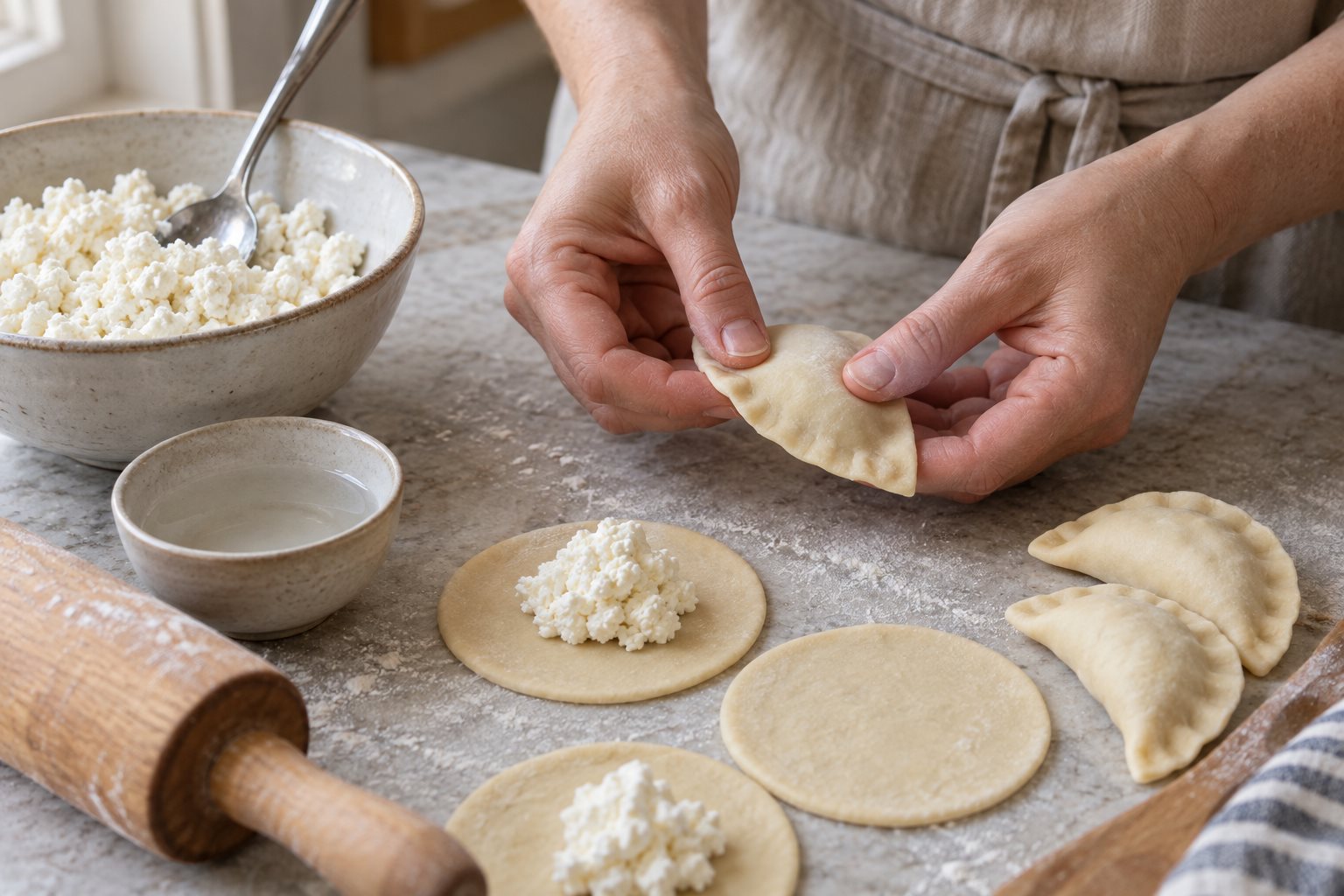
Dry curd, not the creamed tub. Supermarket cottage cheese is curd with cream stirred back into it, and that cream is free water. In a sealed dumpling it turns to steam, finds the seam and blows it. Dry curd — sometimes sold as farmer cheese or baker's cheese — has had the whey driven out and stays a solid mass inside the dough.
The gravy is built on ham fat. Render diced ham, make the roux in the fat that comes out of it, and the gravy tastes of smoke and salt all the way through. Ham stirred into a finished white sauce sits in it as an ingredient and does not season it.
An egg in the filling, not in the dough. One egg to a pound of curd sets the filling into something sliceable rather than something that runs. The dough wants to stay soft and slightly slack so it can be rolled thin without springing back, and an egg in there makes it tough and elastic instead.