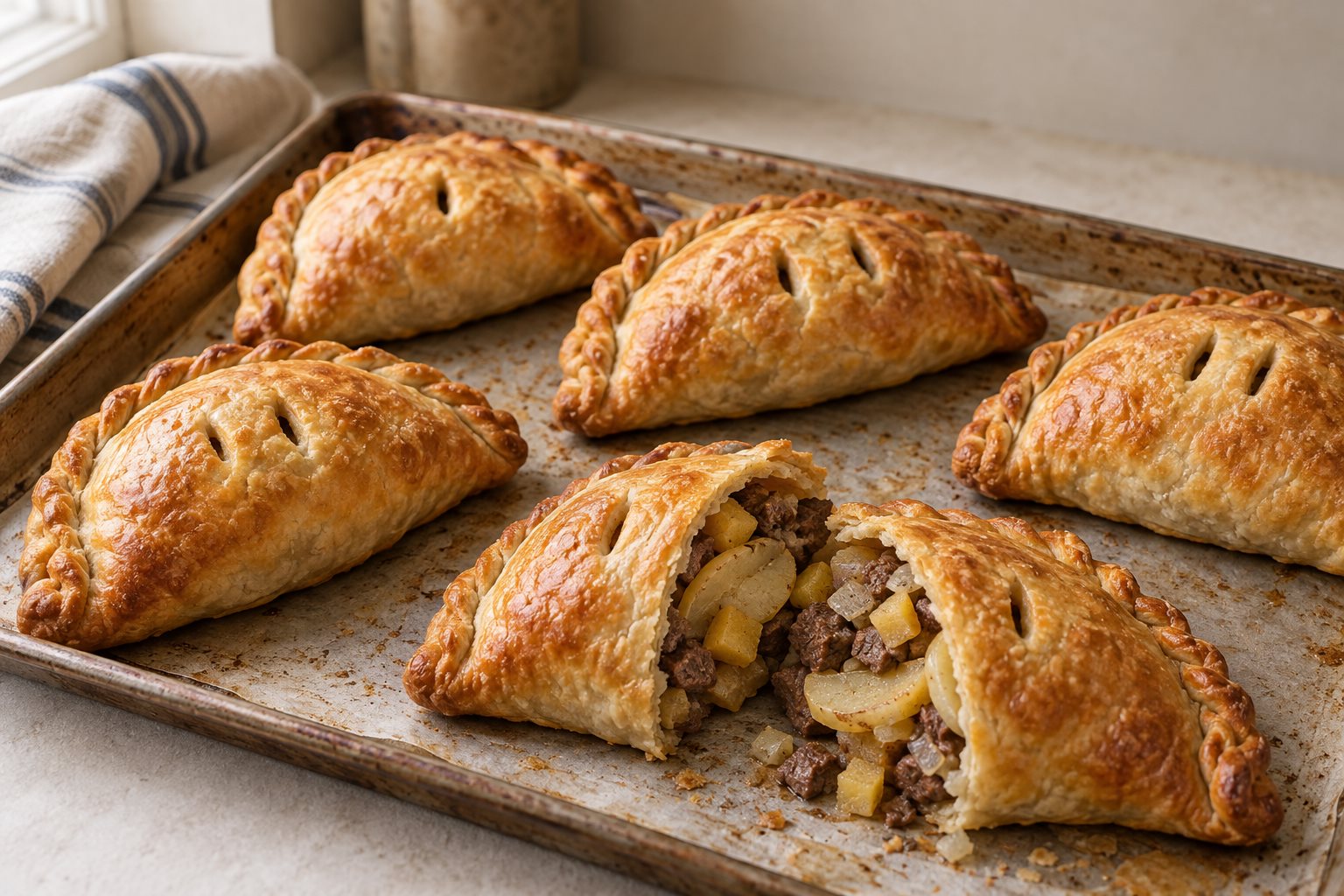
Nothing in it is cooked before it goes in. The meat is raw, the vegetables are raw, and the pastry is the pot they cook in.
The document that explains this food is not a cookbook. It is the Report of the Commissioner of Labor Statistics on the strike in the Michigan copper district, transmitted to the Senate by Secretary of Labor W. B. Wilson in 1914 and free to read in full. Buried in its chapter on hours of labor is the sentence that sets the whole problem: "In the Michigan district all underground workers are under ground from 10 to 11 hours a day or night shift, this including 1 hour for luncheon." Ten or eleven hours below Calumet and Hancock, with one hour of it set aside to eat, and the time counted from the collar of the shaft. The same report shows the vessel: in the list of men hurt on 23 July 1913 is a sprinkler of sixty-seven, injured at the Calumet dry, of whom the report says only that "he had his dinner pail taken away from him". A separate passage shows companies charging men 50 cents a month for the use of the dry house, where they changed their clothes. That is the shift the pasty was built for — carried down cold in a pail, eaten a mile from daylight, by a man who had paid to change his shirt.
Who carried it is documented too. Bureau of Mines Technical Paper 30, on accident prevention at the Lake Superior iron mines, published in 1913, notes that in those parts of the region where underground mining was still the only way of winning the ore "there remains a large proportion of the old-time Cornish and Swedish laborers", displaced wherever the steam shovel had taken over. The Cornish brought the pasty to the Keweenaw copper and the Marquette iron; everyone else on the ranges took it up. The earliest American description of it reachable for this page is a syndicated column printed in the Atlanta Georgian on 28 December 1919 by Mrs. Christine Frederick, who had taught school in a northern Michigan mining district and boarded with a superintendent's family. She remembers two things from it: saffron bread, and "the familiar daily pasty". Her definition is exact — "a kind of meat pie", filling of chopped meat or meat in small pieces "accompanied by cutup carrots, potatoes and turnips", the whole thing "a stew packed into an envelope of paste and then baked and eaten hot or cold". She adds that most pasties are sized for one person and "They are usually triangular in shape". The America Eats Michigan file that would normally carry this dish could not be opened at all, so nothing here is attributed to it.
Why this version works
Everything goes in raw. A cooked filling sealed in pastry has nowhere to send its moisture, and it boils the crust soft from the inside. Raw meat and raw root vegetables release their water slowly over an hour, which is exactly the time the pastry needs to set, brown and hold. This is the one rule the old printed versions agree on across every decade.
Lard pastry, not butter. Butter pastry is made of water and it goes limp when the filling steams. Lard has almost none, so the crust stays short and structurally sound for hours — the whole point of a thing designed to survive a coat pocket and a cage ride. It is also why a cold pasty the next day is genuinely good rather than merely edible.
A slow oven after a hot start. Fifteen minutes hot sets and colours the pastry before the filling has released anything. Dropping the heat for the next fifty lets the beef and the roots cook through without bursting the seam. Bake the whole hour at one high temperature and you get a browned shell around raw rutabaga.
The meat is diced, never ground. The 1924 Kitchen Cabinet column from the Western Newspaper Union syndicate, printed in the Alma Times of 27 June that year, says to "Take good round steak with plenty of suet" and cut it into cubes. Ground beef packs into a dense wet layer and weeps grey liquid; quarter-inch dice stays separate, and the fat you cut in with it bastes the potato.
Ingredient notes
Beef: a pound and a half of chuck or skirt, cut into quarter-inch dice with the fat left on. Suet is traditional and worth adding if your butcher has it — two ounces, chopped fine. Do not buy anything lean; there is no other fat in the filling.
Pastry: three and a half cups of flour to one cup of lard makes six large pasties with enough strength to be picked up. Work it cold and let it rest an hour. This is not a flaky pastry and should not be treated like one.
Potato: a pound and a half of a waxy or all-purpose potato, sliced thin rather than cubed. Thin slices cook in the hour; cubes do not, and an undercooked potato is the classic failure of a home pasty.
Rutabaga: the argument that will not die, and the documents do not settle it. Christine Frederick in 1919 says turnips; the Western Newspaper Union column of 27 June 1924 says "a few slices of parboiled turnip"; the same syndicate's column of 4 October 1928, printed in the Lanier County News, says "parboiled and sliced rutabagas". Both words are in the American print record within nine years, from one syndicate. Rutabaga and swede are the same plant, and in Cornwall a swede is called a turnip, which is how the confusion got on the boat in the first place. Use rutabaga: it holds its shape and it is sweeter.
Step by step
Make the pastry. Rub 1 cup cold lard into 3½ cups flour and 2 teaspoons salt until it looks like coarse meal. Add 3/4 cup ice water, bring it together without kneading, divide into 6, flatten each into a disc and rest them in the fridge for at least an hour.
Cut the filling. Dice the beef and the suet small. Peel and slice the potatoes thin, dice the rutabaga into quarter-inch pieces, chop the onion. Keep them in separate bowls; they get layered, not mixed. Season the meat with the salt and plenty of pepper.
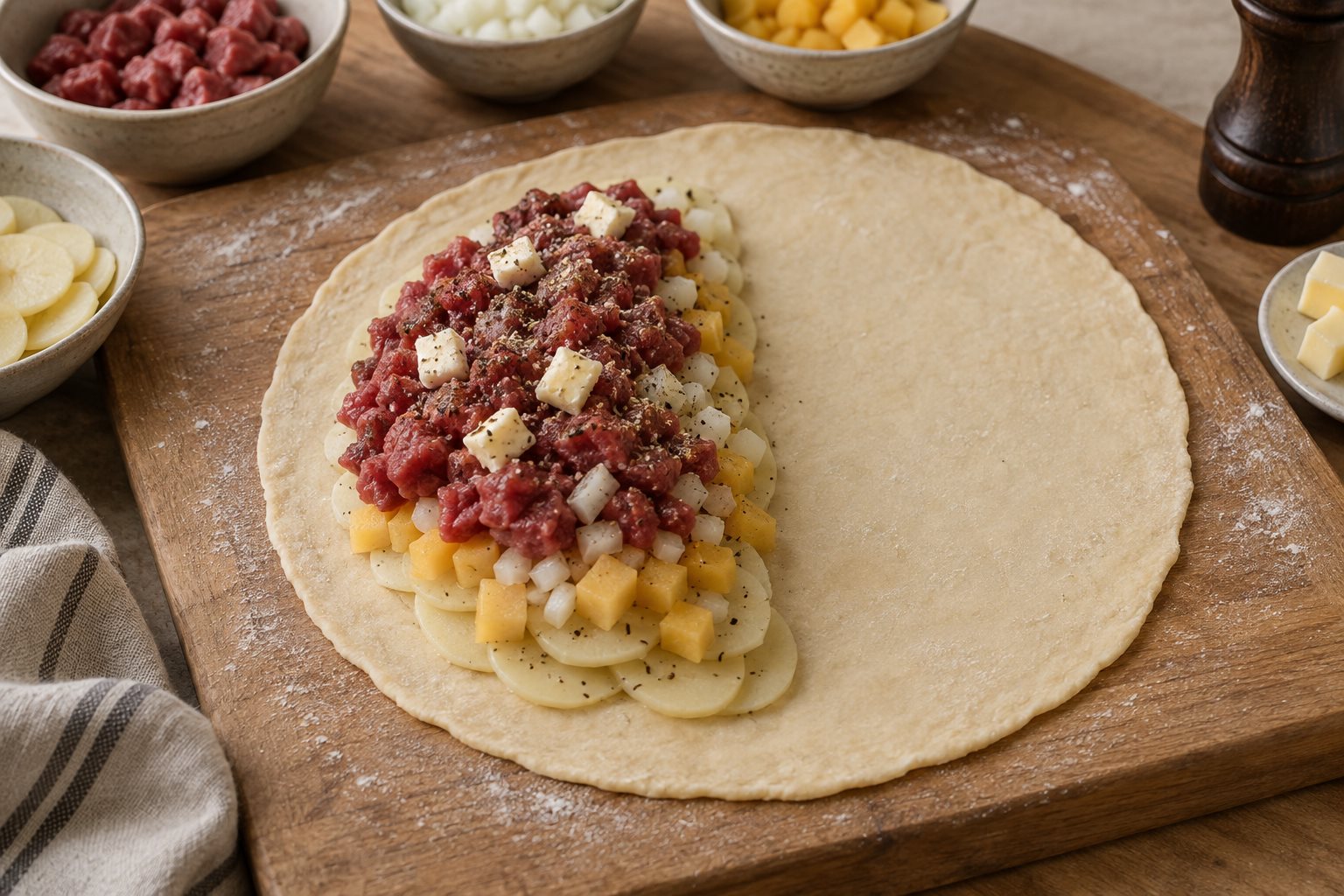
Roll and layer. Roll each disc to a round about 9 inches across. On one half, lay potato first, then rutabaga, then onion, then the meat and suet on top, leaving a 1-inch border. Dot with butter and grind on more pepper. Layering meat last puts its fat above everything, where it runs down as it renders.
Layer potato, rutabaga, onion and meat on one half, leaving a clear border for sealing. AI-generated illustration.
Seal. Wet the border, fold the empty half over, press out the air and crimp the curved edge in a rope, or press with a fork and be done. Cut two short vents in the top. A pasty that bursts has been overfilled or under-sealed.
Bake hot, then slow. Heat the oven to 425°F. Bake on a parchment-lined sheet 15 minutes, then drop to 350°F and bake 45 to 50 minutes more, until deep gold and a skewer through a vent meets no resistance from the rutabaga.
Rest. Ten minutes on the sheet. They are best warm rather than hot, and genuinely good cold four hours later, which is the whole reason they exist.
If the seam split and the juices ran out, the filling was piled too high or the border was not dry-pressed before crimping; the pasty is still fine, it will just be drier — serve it with the pan juices scraped up. If the rutabaga is still hard when the crust is dark, tent the tray with foil and give it another 15 minutes at 325°F rather than pulling it. If the bottom is pale and damp, bake the next batch on a preheated sheet on the lowest shelf.
Storage and make-ahead
Keep 3 days in the fridge, wrapped loosely in paper rather than plastic, which softens the crust. Reheat 20 minutes at 350°F; the microwave ruins them completely.
They freeze better than almost anything else in this collection. Freeze baked and cooled, then reheat from frozen at 350°F for 40 minutes. Freezing them unbaked works too but the potato darkens.
What to serve with it
Ketchup or gravy, and the split between them is real and regional. Nothing in the documents reachable here records either — what the 1919 column does say is that a pasty already gives you the fat and flour of the pastry, the meat, the vegetables and gravy all in one serving, so the sauce is an addition, not a repair.
Something sharp on the side: pickled beets, or a plain cabbage salad with vinegar. The pasty is rich and entirely unacidic.
From the recipe box / Michigan
Upper Peninsula Pasty
Diced beef, potato, rutabaga and onion sealed raw in a lard crust and baked slowly, so the filling cooks in its own steam inside the pastry that carried it down the shaft.
Prep
40 min
Cook
1 hr 5 min
Total
1 hr 45 min, plus 1 hour resting the pastry
Serves
6
Calories
970 per serving
Ingredients
Scale
Instructions
Rub the lard into the flour and pastry salt, add the ice water, divide into 6 discs and chill 1 hour.
Dice the beef and suet, slice the potatoes thin, dice the rutabaga, chop the onion, and season the meat with the salt and pepper.
Roll each disc to a 9-inch round and layer potato, rutabaga, onion and meat on one half, leaving a 1-inch border. Dot with butter.
Fold over, press out the air, crimp the curved edge and cut two vents. Brush with the egg wash.
Bake at 425°F for 15 minutes, then at 350°F for 45–50 minutes, until deep gold and tender through the vent.
Rest 10 minutes before eating, or cool completely and eat them cold.
Nutrition
Fat
58 g (24 g saturated)
Sodium
980 mg
Protein
29 g
Serving
1 pasty
Calories
970
Cholesterol
95 mg
Carbohydrates
82 g (6 g sugar, 7 g fiber)
Nutrition is an estimate calculated from the listed ingredients and is provided as
a courtesy, not as dietary advice.
Questions readers ask
Ketchup or gravy?
Both are usual and the divide is regional, and no document that could be opened for this page records either one. What the 1919 column says is that the pasty supplies its own gravy along with the meat and vegetables, which is an argument for eating the first one plain before you decide.
Why is it so big?
Because it was one hour's meal for a man working a ten- or eleven-hour underground shift, according to the 1914 federal report on the Michigan copper district, and because it had to be eaten cold with your hands in a place with no table. Make them smaller if you like; they will need about 15 minutes less in the oven.
Rutabaga or turnip?
The printed record uses both, from the same syndicate, nine years apart: turnip in the Kitchen Cabinet column of 27 June 1924, "parboiled and sliced rutabagas" in the same column of 4 October 1928, and turnips in Christine Frederick's 1919 description of what she ate in a northern Michigan mining district. Nothing reachable here settles it, and anyone who tells you it is settled is telling you about their family, not about the documents. Rutabaga is what most Upper Peninsula bakeries use now.
Can I use ground beef?
You can and plenty of people do, but it makes a different, wetter thing. The old printed instructions all say cubed steak with suet cut in, and the reason shows in the filling: dice stays in pieces you can identify, while ground beef compacts into a single grey layer and releases its water all at once.