The regional table / New Jersey
Trenton Tomato Pie
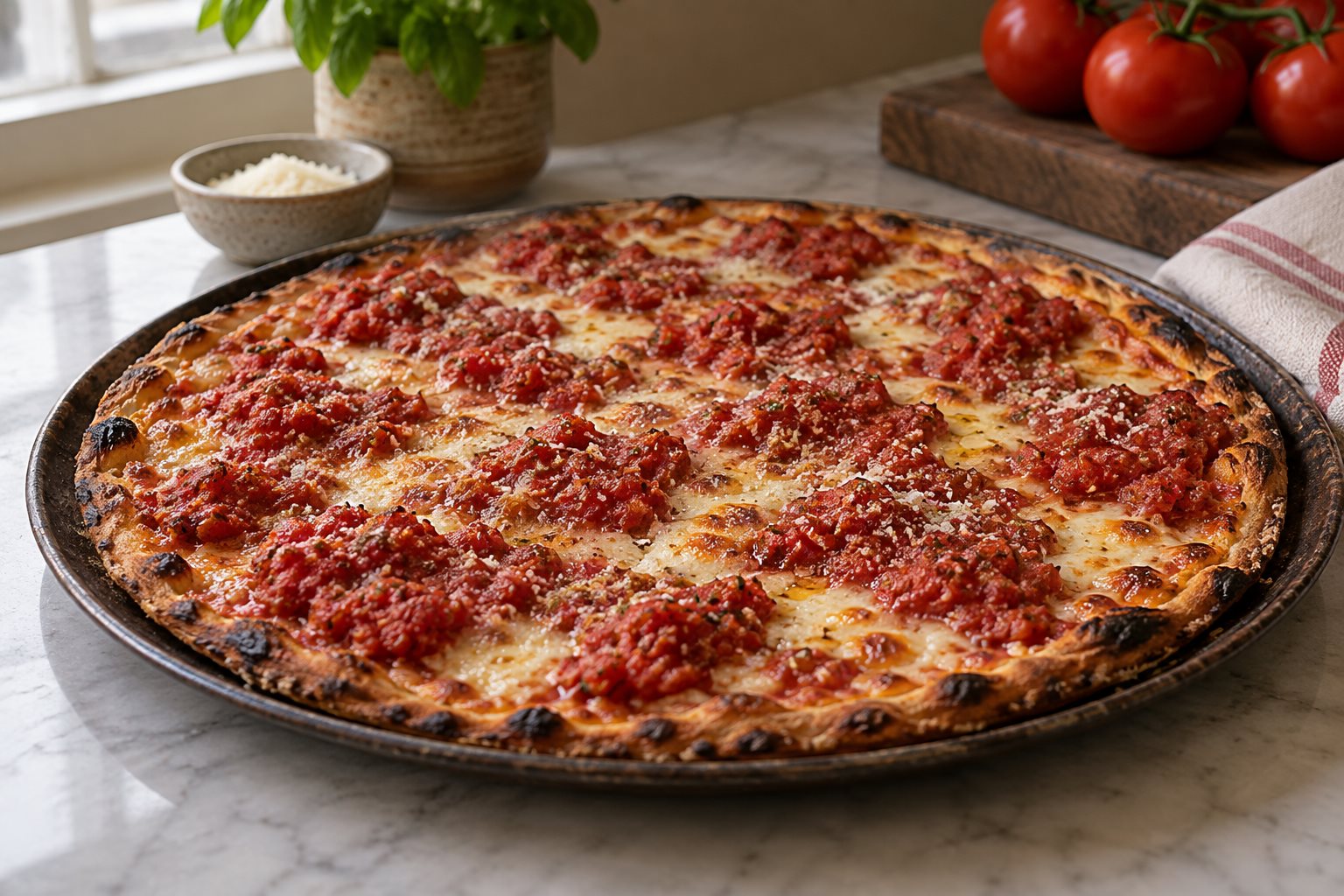
Cheese first, tomatoes on top, and no saucepan anywhere in the method. The order is the entire dish, and it is older than the vocabulary we use to describe it.
Tomato pie meant something else in New Jersey for a long time, and the papers show exactly what. The New Jersey Mirror of Mount Holly printed a receipt for tomato pie on 20 August 1884, contributed by a Southern reader: green tomatoes peeled and sliced to fill one pie, four tablespoonfuls of vinegar, one of butter, three and a half of sugar, nutmeg, baked slowly between two crusts. The Lambertville Beacon, twelve miles up the Delaware from Trenton, ran another on 1 December 1910 — "Green Tomato Pie. This is sometimes called mock mince pie" — one large green tomato and one large apple, both chopped, with a cup of sugar. That is a dessert, and it is what the words meant in this state two years before the Trenton shops date themselves to. I could not test the 1912 founding claim at all: no Trenton or Mercer County newspaper archive answered a script, and the Advantage Archives instances that do answer in New Jersey are Burlington County, Lambertville, Princeton and Vineland, none of them a Trenton paper.
What the Burlington County run does show is the moment the savoury sense arrives, and it arrives labelled. On 16 November 1950 the Central Record of Mount Holly carried an advertisement for the Entree Inn at Evesboro, N. Sabatucci proprietor, between Marlton and Moorestown: "DELICIOUS HOME-MADE RAVIOLI — TOMATO PIE (PIZZA)". The parenthesis is the whole point. The proprietor expected his South Jersey readers to know the phrase tomato pie and to need pizza explained to them, not the other way round. In that archive — 1818 to 1960, more than a hundred and forty years of pages — the word pizza in the food sense does not appear before that 1950 gloss, and then as "Pizza Pie" in December 1951; a Route 73 place was still advertising "TOMATO PIES, SPAGHETTI DINNERS and SUBMARINES" in March 1954. Two apparent hits from 1825 and 1836 are the search engine misreading piazza, a porch, which is the trap in every fuzzy newspaper index and the reason I read the page before I date anything. So: tomato pie is the older New Jersey name, and the recipe below builds it the way the name implies — the tomatoes on top, uncooked, where you can see them.
Why this version works
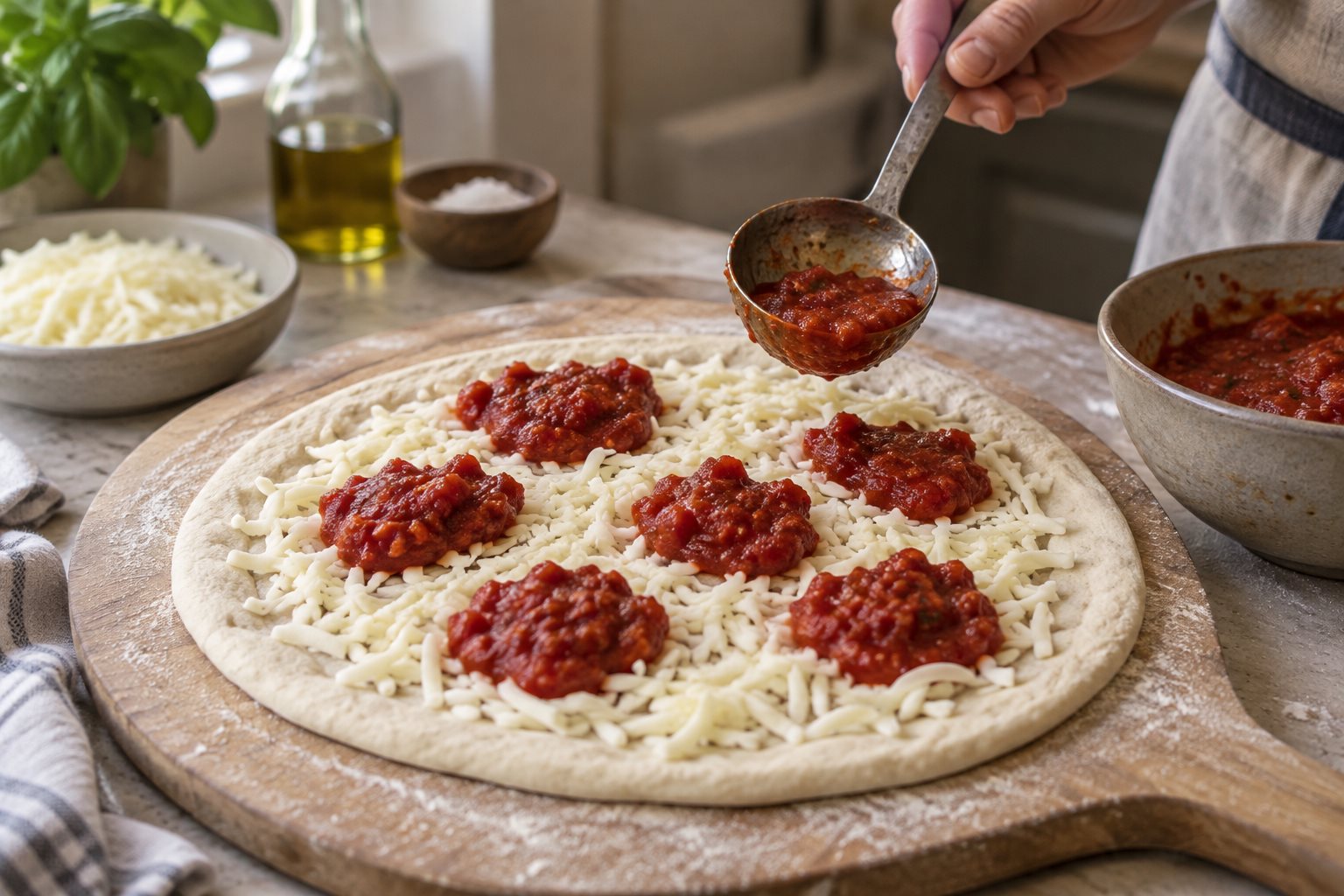
Dollops, not a spiral. Spread thin and even, the tomato covers the cheese and steams it pale. Dropped in ladlefuls with bare patches between, the exposed mozzarella browns and blisters while the tomato stays red. The uneven surface is not rustic carelessness, it is how the two textures both happen.
Cheese underneath, tomatoes above. Mozzarella laid straight on the dough forms a fat barrier that keeps the crust from taking on water, and the tomatoes on top lose their liquid to the oven air instead of into the bread. Reverse the order and the same quantities give you a wet middle you cannot bake out.
The hottest oven you have, and steel or stone. This is a thin pie and its window is short. A preheated steel at 550°F sets the base in two minutes and finishes the whole thing in about twelve, which is faster than the tomatoes can soak in. A cool oven on a cold sheet pan bakes them into the dough.
The tomatoes are never cooked before they go on. Crushed raw and salted, they taste of tomato and hold their colour; twelve minutes in a hot oven is all the cooking they need. A simmered sauce goes sweet and flat, and by the time it reaches the pie it has already spent its aroma on the kitchen.