American cooking Recipes & regional stories

Skillet & Sage

A culinary journey through the fifty states

The regional table / Michigan

Traverse City Cherry Pie
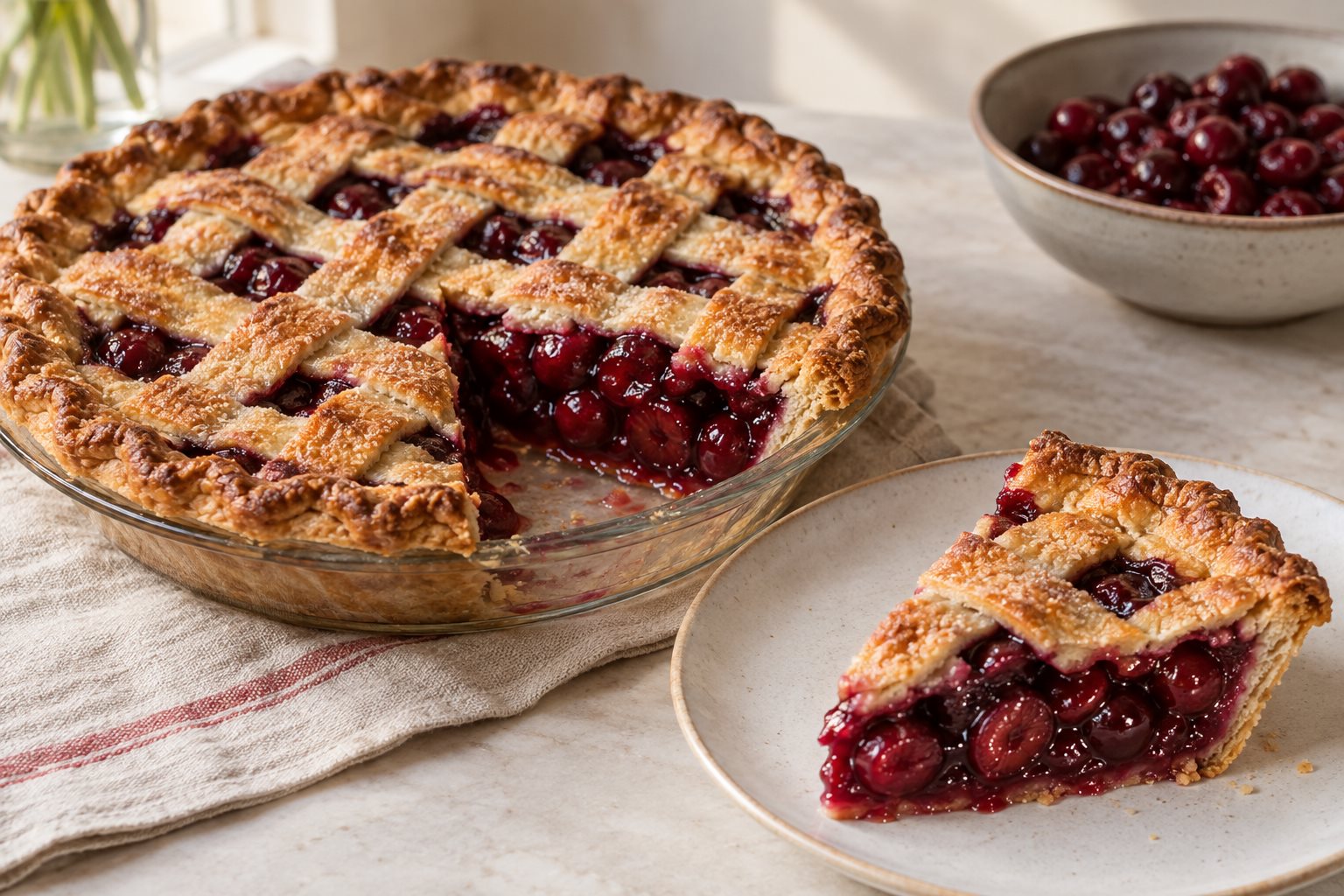
A golden lattice cherry pie with one slice served alongside, its glossy red filling holding its shape
The juice should have bubbled thickly through the lattice, not run thin, and the cut face should stand. AI-generated illustration.

Use frozen cherries. Not as a compromise — the federal standard for a cherry pie allows them by name, and the fruit is better for it.

Northern Michigan's claim on this pie is written into federal regulation. The tart cherry marketing order at 7 CFR part 930 defines its "Production area" as "the States of Michigan, New York, Pennsylvania, Oregon, Utah, Washington and Wisconsin" and then divides that area into nine districts — one apiece for the other six states, and three for Michigan alone: Northern, Central and Southern. District 1, Northern Michigan, is "that portion of the State of Michigan which is north of a line drawn along the northern boundary of Mason County and extended east to Lake Huron", which is the orchard country above Traverse City. Board seats are handed out by tonnage, four of them to any district growing more than 80 million pounds. The fruit itself is defined at § 930.3 as "all tart/sour cherry varieties grown in the production area classified botanically as Prunus cerasas" — the rule's own spelling of cerasus, uncorrected in the Code for decades. This is a crop so concentrated in one state, and so prone to gluts, that the Secretary of Agriculture can order part of it withheld from the market in a heavy year.

The second document explains why your cherries should come out of a freezer bag. USDA Circular No. 981, "Grower Handling of Red Cherries" by J. H. Levin and H. P. Gaston, published in 1956 as a contribution of the Department of Agriculture in cooperation with the Agricultural Experiment Station of Michigan State University, describes what used to happen between the orchard and the plant: "the lugs of cherries often are stacked in tiers in the hot summer sun", "The heat developed by respiration increases the temperature of the fruit", and "The amount of scald and fungus that develops in cherries increases rapidly as the temperature rises and the holding time is extended." Experiments were initiated in Michigan in 1952 to fix it, and what came out of them was the hydrocooling and transportation in water method — cherries tipped straight from the picker's pail into tanks of water. A tart cherry is a fruit that begins failing within hours of being picked; freezing it is not second best, it is the industry's own answer. The FDA agrees in its standard for frozen cherry pie at 21 CFR 152.126, which specifies "mature, pitted, stemmed cherries that are fresh, frozen, and/or canned" and sets the bar for quality at a washed and drained cherry weight of "not less than 25 percent of the weight of the pie".

Why this version works

Sour cherries, not sweet. A Montmorency is roughly twice as acidic as a Bing and that acidity is the entire reason for the cup and a quarter of sugar. Sweet cherries in a pie give you a flat, jammy filling with nothing to cut it, and they collapse to mush because their flesh is softer. The regulation's definition is the right shopping list: tart and sour varieties only.

Frozen fruit, thawed and drained. Frozen tart cherries were picked ripe, cooled fast and pitted by machine, which is more than can be said for most fresh fruit at a supermarket. Thawing them releases about a cup of juice, and reducing that juice separately concentrates flavour you would otherwise boil away inside the pie.

A vented lattice, not a solid lid. That water has to leave. A lattice lets steam out across the whole surface while the filling boils, which is how the starch gets fully cooked and how the juice reduces rather than pooling under a sealed roof.

Cornstarch, and more of it than feels right. A third of a cup for two pounds of fruit. Tart cherries carry more free water than any other pie fruit and their acid weakens starch as it cooks. Under-thicken and the pie floods the plate; the filling should look slightly too stiff in the pan and settle to exactly right as it cools.
Ingredient notes

Sugar: one and a quarter cups. This is a lot and it is not negotiable with genuinely sour fruit; taste the thawed juice before you commit and you will understand why. With sweet cherries you would use half.

Pastry: enough all-butter pastry for a double crust, well chilled. Butter is right here where lard was right for the pasty: this pie is eaten cold from the fridge and butter pastry tastes of something at that temperature.

Cherries: two pounds of frozen pitted tart cherries — Montmorency is what northern Michigan grows and what almost every bag holds. If you have fresh sour cherries in July, use them and cut the sugar by two tablespoons. Canned are acceptable if you drain them hard and drop the sugar to one cup, since they are packed in syrup.

Almond extract: a quarter teaspoon, no more. Cherry and almond are the same family and a trace of it reads as more cherry rather than as marzipan. A half teaspoon crosses the line and cannot be taken back.

Step by step

  1. Thaw and drain. Tip the frozen cherries into a sieve over a bowl and leave them 2 hours at room temperature. You will collect about a cup of red juice. Do not discard it and do not skip this — it is the difference between a set pie and a flood.
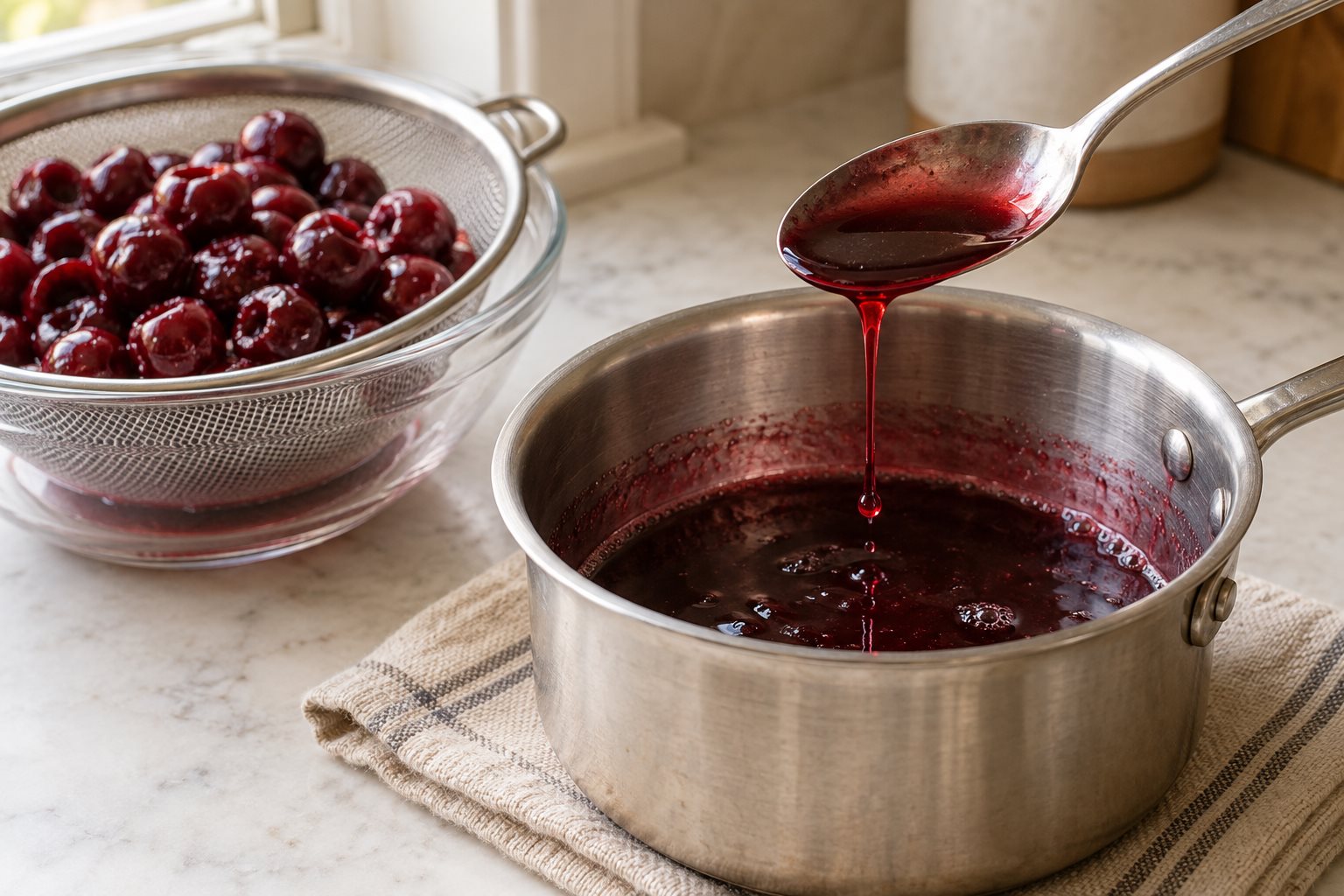
  2. Reduce the juice. Boil the collected juice in a small pan until it is reduced to about ⅓ cup and looks syrupy, 8 to 10 minutes. Cool it slightly.
    Reduced dark red cherry juice dripping slowly from a spoon
    Reduce the drained cherry juice to a syrup before adding it back to the fruit. AI-generated illustration.
  3. Mix the filling. Whisk the sugar, cornstarch and salt together, then fold them through the drained cherries with the reduced juice, the lemon juice and the almond extract. Let it stand 15 minutes while you roll the pastry.
  4. Build the pie. Line a 9-inch plate with pastry, fill it, dot with the butter, and lay a lattice over the top. Trim, crimp, brush with cream and dust with the coarse sugar. Chill the built pie 20 minutes while the oven heats to 425°F.
  5. Bake hot, then moderate. Bake on a preheated baking sheet at 425°F for 20 minutes, then drop to 375°F for 45 to 55 minutes. It is done when the juice is bubbling thickly through the lattice in slow, glassy bursts — not merely simmering at the edge.
  6. Cool completely. At least 4 hours on a rack, and 6 is better. The starch finishes setting as it cools and there is no shortcut; a warm slice will run.
If the filling is runny once cut, it was pulled before the centre boiled — the starch never gelled. Chill the pie hard overnight and it will firm up enough to serve, and next time wait for thick bubbles in the middle of the lattice rather than at the rim. If the top browned before the filling bubbled, cover it loosely with foil and keep going. If the base is soggy, the pie did not start on a preheated sheet.

Storage and make-ahead

Keeps 3 days at room temperature under a cloth, or 5 refrigerated. Michigan opinion is divided on eating it cold from the fridge for breakfast; the pie is on the side of eating it.

Freezes well baked or unbaked. Bake from frozen at 425°F for 25 minutes, then 375°F for an hour, adding 15 minutes to the usual time.

What to serve with it

Vanilla ice cream, or nothing at all. Whipped cream is too soft against a filling this acidic.

If it is going with a meal rather than after one, put it near something salty and smoked — ham, or a sharp aged cheddar — which is how the fruit is eaten across the orchard counties.

A golden lattice cherry pie with one slice served alongside, its glossy red filling holding its shape

From the recipe box / Michigan

Traverse City Cherry Pie

Sour Montmorency cherries, frozen rather than fresh, set with cornstarch under a lattice — a pie built from the one fruit too sour to eat and too fragile to ship.

Prep
30 min, plus 2 hours thawing
Cook
1 hr 15 min
Total
3 hr 45 min, plus 4 hours cooling
Serves
8
Calories
560 per serving

Ingredients

Scale

Instructions

  1. Thaw the cherries in a sieve over a bowl for 2 hours and keep the juice.
  2. Boil the juice down to about ⅓ cup and let it cool slightly.
  3. Whisk the sugar, cornstarch and salt, then fold them into the cherries with the reduced juice, lemon juice and almond extract. Stand 15 minutes.
  4. Line a 9-inch plate, fill, dot with butter, lattice the top, crimp, brush with cream and dust with coarse sugar. Chill 20 minutes.
  5. Bake on a preheated sheet at 425°F for 20 minutes, then at 375°F for 45–55 minutes, until the centre bubbles thickly.
  6. Cool at least 4 hours before cutting.

Nutrition

Fat27 g (17 g saturated)
Sodium230 mg
Protein5 g
Serving1 slice, one-eighth of a 9-inch pie
Calories560
Cholesterol70 mg
Carbohydrates76 g (44 g sugar, 3 g fiber)

Nutrition is an estimate calculated from the listed ingredients and is provided as a courtesy, not as dietary advice.

Questions readers ask

Frozen or fresh?

Frozen, nine months of the year, and without apology. USDA Circular 981, written with Michigan State in 1956, describes fruit scalding in stacked lugs in the summer sun and the heat of its own respiration, which is why the industry went to cooling the cherries in water within minutes of picking. The FDA's own standard for a cherry pie names fresh, frozen and canned fruit in the same breath.

Can I use sweet cherries?

You can make a pie with them but not this pie. The tart cherry marketing order defines the crop as tart and sour varieties only, and the whole balance here — a cup and a quarter of sugar, a third of a cup of starch — is built for fruit that is too sour to eat raw. With Bings, halve the sugar, cut the starch to a quarter cup and expect something softer and duller.

Why is my filling watery?

Almost always one of two things: the thawing juice went into the pie instead of into a saucepan, or the pie came out before the middle boiled. Starch needs to reach a full boil across the whole filling to set, and in a cold-filled pie that takes the last fifteen minutes of the bake.

How much fruit should be in a cherry pie?

The federal minimum for a commercial frozen one is a washed and drained cherry weight of not less than 25 percent of the weight of the pie, under 21 CFR 152.126. Two pounds of cherries in a nine-inch pie puts this one comfortably over 40 percent, which is roughly the difference between a home pie and a supermarket one.