The regional table / Connecticut
Connecticut Steamed Cheeseburger
Every instinct a cook has about hamburgers says brown it hard. This one says the opposite, and does it in a cabinet full of steam.
Start with what the record does not contain, because in this case that is the honest place to start. The phrases "steamed cheeseburger", "steamed cheeseburgers", "steamed hamburger" and "steamed hamburgers" return zero hits across five Connecticut community newspaper archives searched for this article — the Branford Review and East Haven News, which also holds a long run of the New Haven Evening Register; the Wallingford collection; the Southington Emblem; the Stonington Mirror and Mystic Journal; and the New Britain scrapbook collection. Those five towns sit within twenty miles of the counters the dish belongs to, and their runs reach back to the 1830s. The dish has been sold in Meriden and Middletown for decades, and none of those papers ever printed the name. Two dated printings could be verified, and both are 2008, both in a Georgia weekly carrying national syndication. On 16 April 2008 an American Profile feature describes O'Rourke's, the diner beside Wesleyan University, rebuilt after a fire with donated equipment — booths, grills, ovens, walk-in freezers, refrigerators, pots and pans — and reports that "the new nine-page menu includes a steamed cheeseburger", quoting the owner and cook, Brian O'Rourke. On 21 June 2008 the same paper reviews a book on American hamburger houses and, listing regional oddities alongside Shady Glen in Manchester, Connecticut, ends with "Not to mention loose meats on a bun or steamed cheeseburgers." That is the whole documentary record reachable from here, and it is thin. The quantities below were worked out for this page.
The mechanics, on the other hand, are on the federal record in a way that is genuinely useful. 9 CFR 319.15(b) defines hamburger as "chopped fresh and/or frozen beef with or without the addition of beef fat as such and/or seasoning", not more than thirty percent fat, and says it "shall not contain added water, phosphates, binders, or extenders". That is a rule about what is in the meat, not about what happens to it afterwards — the section names no cooking method at all, so a steam cabinet stands on exactly the same legal footing as a griddle, and the prohibition on added water applies to the raw product rather than to the steam around it. The thirty percent ceiling matters here more than it does for a griddled burger, because there is no rendering and no browning to carry flavour: the fat you buy is the fat you get. The cheese is settled by 21 CFR 133.113, which sets cheddar at a minimum milkfat content of fifty percent by weight of the solids and a maximum moisture content of thirty-nine percent. A cheese that is half fat and well under two-fifths water is one that will slump into a thick, pourable sauce in a covered tray of steam without splitting or turning to rubber, which is precisely the trick the steam cabinet performs on it and precisely why sliced process cheese, engineered for a griddle, is the wrong thing to reach for.
Why this version works
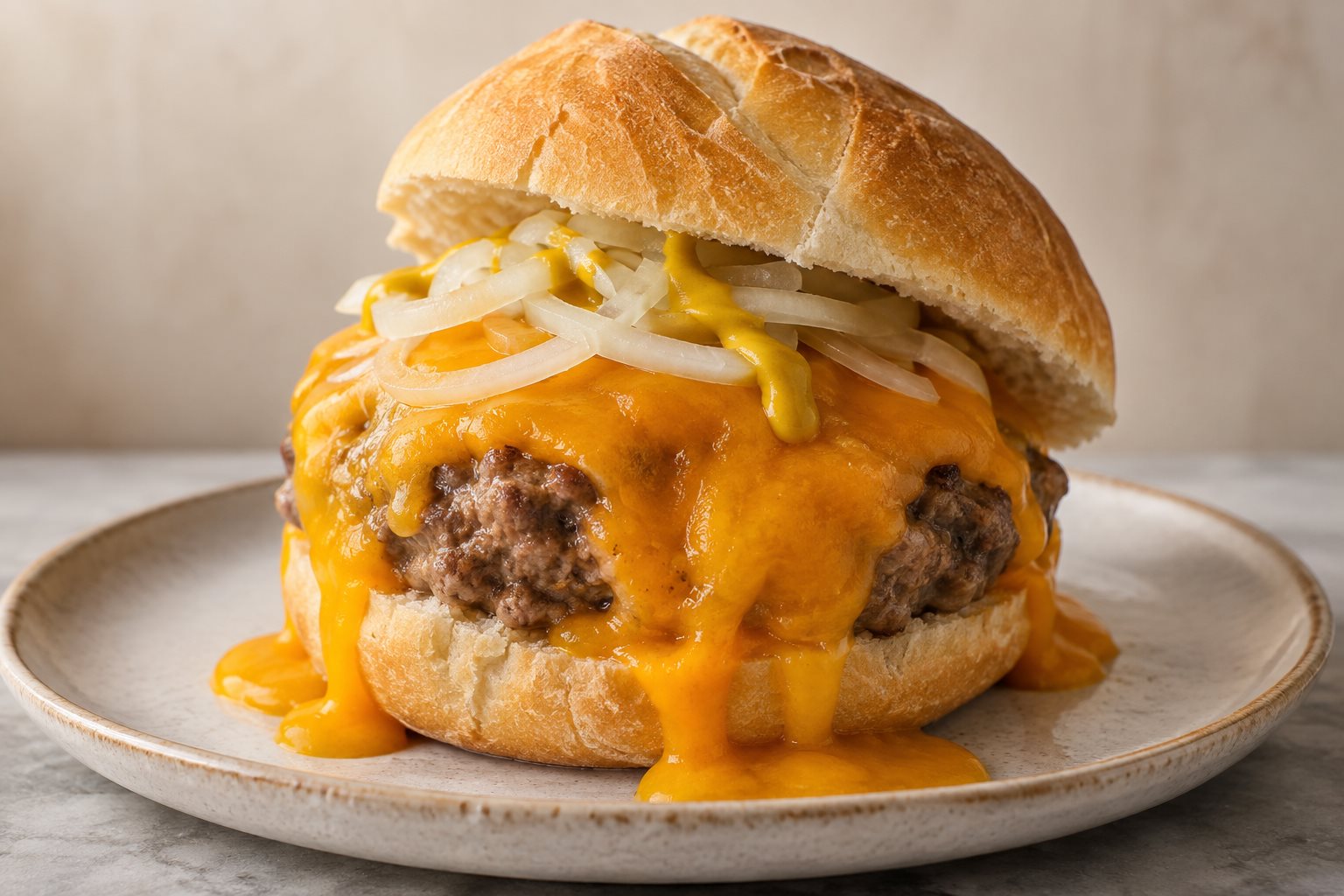
A hard roll, because the sandwich is wet. Everything about this burger is moist — a steamed patty that has not lost surface water, plus a ladle of molten cheddar. A soft bun disintegrates under it within a minute. A crusty hard roll, cut but not toasted, has the structure to hold the cheese and the absorbency to take what runs down without turning to paste.
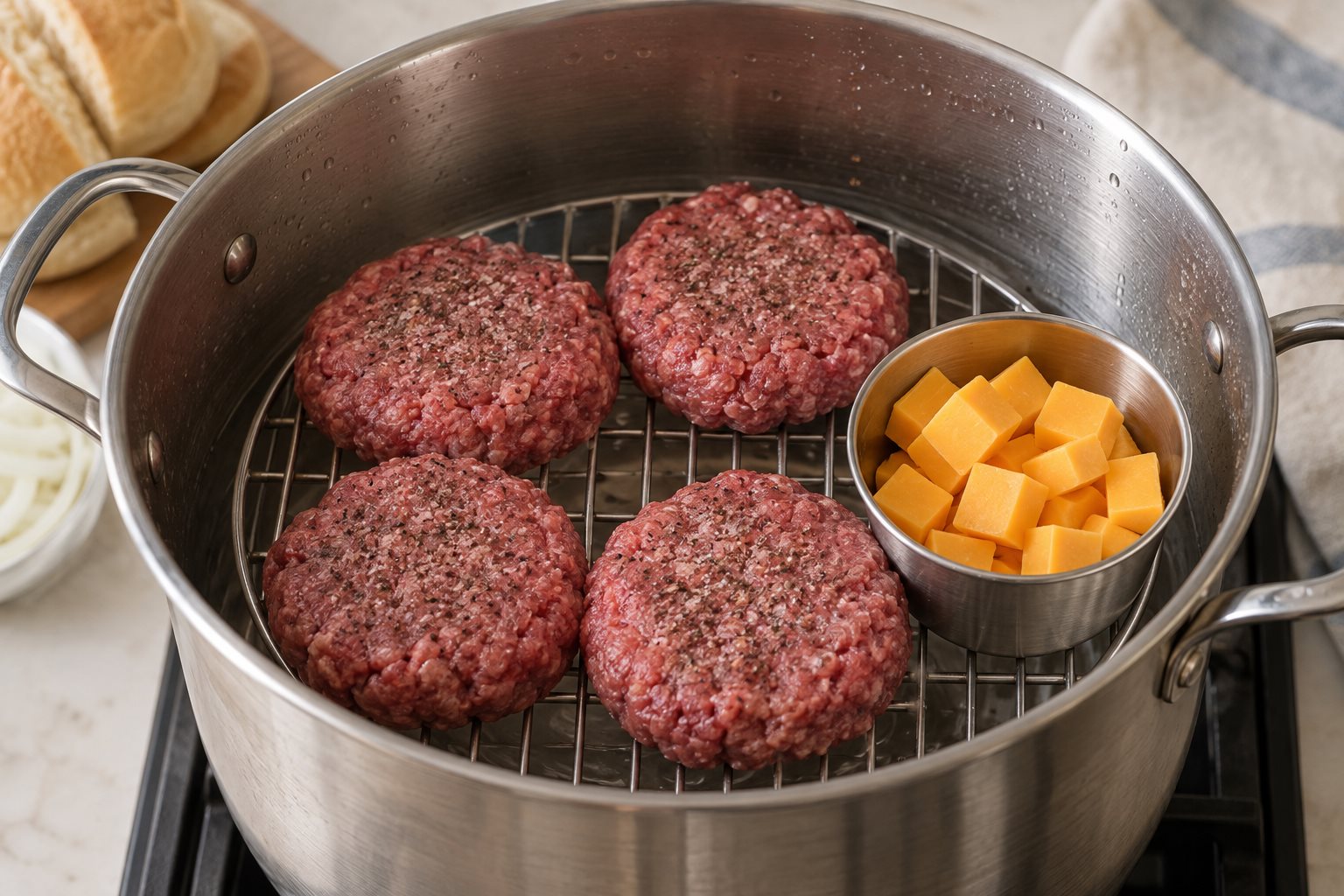
Cheddar melted separately becomes a sauce, not a lid. Cheese laid on a burger under a dome melts into a sheet that slides off in one piece. Cheese melted on its own in a small covered container, held in the same steam, goes further: the fat and the protein loosen together into something that pours. That is why the cheese gets its own tray in a real steam cabinet and why it should get its own cup here.
Steam cooks a thick patty evenly, which a griddle cannot. A griddle heats one face at a time and drives a hard gradient through the meat: crust, grey band, pink middle. Steam surrounds the patty at a temperature that cannot exceed boiling, so a burger two inches thick comes out the same colour and the same texture from edge to centre. Give up the crust and you gain a uniformity no pan will give you at that thickness.
No browning means no pressing, and no pressing means juice stays in. Half of what makes a griddled burger dry is the cook flattening it to chase contact with the metal. There is nothing to chase here. The patty is formed loosely, set down once, and never touched again until it comes out, so the fat that melts inside it stays inside it.