American cooking Recipes & regional stories

Skillet & Sage

A culinary journey through the fifty states

The regional table / New Mexico

Stacked Red Chile Enchiladas with a Fried Egg
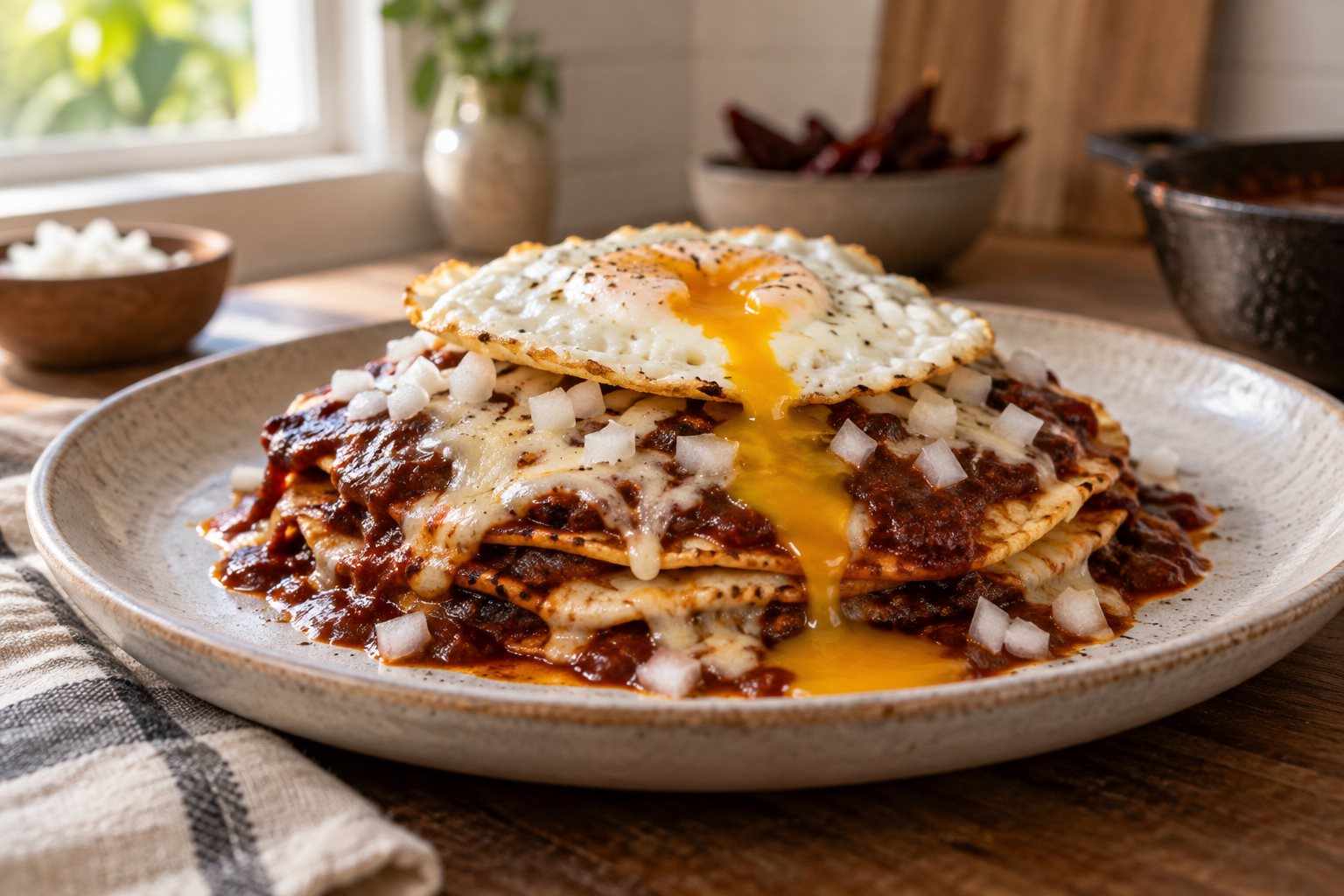
Three corn tortillas stacked flat on a plate under dark red chile sauce, melted cheese and raw white onion, a fried egg on top with the yolk just broken
The stack is built on the plate rather than in a baking dish, with sauce, cheese and onion between every layer and the egg set on last. AI-generated illustration.

The tortillas are laid flat and stacked, sauce between every one of them, and the egg on top is in the document too.

New Mexico State University has been publishing on this crop since 1888, and two of its Extension sheets are between them the whole of this dish. Guide E-327, Using Chile to Make Ristras and Chile Sauce, by Danise Coon and Stephanie Walker, says what to do with a pod: 12 to 14 large ones make a pint of purée, they are washed in warm water changed several times, covered with boiling water for 30 minutes until the pulp separates easily from the skin, blended with fresh hot water, strained through a sieve to take out the peel, and simmered 10 minutes. Circular 517, New Mexico Favorites: Chile and Pecans, says what to do with the purée, and its recipe is headed Red Enchiladas. Fry each tortilla briefly in hot oil and drain. Dip one in the sauce, "place tortilla flat on a plate, sprinkle cheese and onion on top, and repeat." Three tortillas make a serving. "May be topped with a fried egg." The egg is ordered, not assumed, and it is ordered by the state's own land-grant college.

Red and green are not two crops. Research Report 763, which lists every chile cultivar NMSU released between 1913 and 2008, describes the same cultivars twice over — NuMex Big Jim is grown for green chile and, in addition, "adapted for dry red chile products"; Española Improved is an early-maturing red cultivar whose green pods are also picked and sold — and Guide H-236 notes that fruit on a single plant runs the whole range at once, from partially dried pods set early in the season to succulent green pods set late. Green is the pod picked; red is the pod left. Who first laid the tortillas flat instead of rolling them is a question the record I could reach does not answer: the New Mexico Digital Collections at UNM hold nothing on the dish, and the Office of the State Historian refused every connection on 22 September 2026. The oldest printed description I found is a New York Sun piece reprinted in the Savannah Morning News of 10 December 1899, which calls enchiladas "tortillas with grated cheese and chopped onions on them the whole moistened with a rich gravy" — flat, and with the same two garnishes Circular 517 still uses, but written about the Rio Grande country at large rather than New Mexico in particular. That is evidence about the form. It is not evidence about who, so nobody is credited here.

Why this version works

Stacked, not rolled. A rolled enchilada has sauce outside it and filling inside. A stack has sauce at every level — plate, tortilla, sauce, cheese, onion, tortilla — so nothing is ever dry and nothing is ever a tube of cheese. It also means the dish is assembled to order on a warm plate instead of baked in a dish, which is why the tortillas keep their edges.

Whole pods rather than powder. Guide H-236 is blunt about what happens to ground chile: it loses color faster than whole pods in storage, the ground seed in it drags the initial color down, and processors hold the crop as flakes precisely to put off the final grinding. A bag of powder is an old pod with its clock already run most of the way down. A whole pod you soak yourself still has its pulp, and the pulp is the sauce.

The tortillas go through hot fat first. Thirty seconds a side in oil, then drained. It softens them enough to lie flat without cracking and seals the surface enough that they hold under three ladles of sauce rather than turning to paste. Skip it and the stack collapses into wet corn before it reaches the table.

The pulp is the thickener, so there is no roux. Circular 517 also prints a quick sauce of chile powder whisked with flour, which is the version most people meet. It exists because powder alone has nothing to hold a sauce together. Sixteen soaked pods blended and strained give you two cups of body without a spoonful of flour, and the difference on the plate is that you can taste the chile all the way through instead of tasting thickened stock with chile in it.
Ingredient notes

Eggs: One a plate, fried in the tortilla fat while the stacks are being built, and pulled while the yolk still runs. The yolk is the second sauce; a hard yolk leaves the plate one-dimensional.

Corn tortillas: Plain corn, nothing else, and a day old if you have them — fresh ones are wetter and soak up more oil. Count three per person and fry two spares, because the first one out of the pan is always the one you got wrong.

Cheese and onion: Circular 517 names cheddar, jack or asadero, and grated is right; a slice will not melt in the seconds the stack gets. The onion is raw, chopped fine, and goes between the layers cold. It is not a garnish — the sharpness is the only thing cutting three cups of chile and ten ounces of cheese.

Dried red chile pods: New Mexican pod type, deep red, pliable, unbroken. The pod type exists because Fabián García spent nine years selecting it from the local chiles grown by Hispanic gardeners around Las Cruces, choosing the red colorado strain over the black negro one; RR-763 dates the release of New Mexico No. 9 to 1913, with the paper describing it not printed until 1921. For heat, H-236 names New Mexico 6-4, Sandia and Española Improved among the pungent red cultivars and NuMex Conquistador, NuMex R Naky and LB-25 among the non-pungent. One warning from E-327 that matters more than any of this: ristra pods sprayed with plastic, shellac or insecticide are decorative only and must never be cooked.

Step by step

  1. Clean the pods. Pull off the stems and shake out the seeds. Wash the pods in warm water, lifting them out and changing the water several times, which E-327 asks for because dried pods carry field dust in their folds.
  2. Rehydrate. Put the pods in a 5-quart pan, cover them with boiling water, and leave them 30 minutes. They are ready when the pulp separates easily from the skin under a thumbnail.
  3. Blend and strain. Lift the pods into a blender with about 2 cups of fresh hot water and run it until smooth, then push the purée through a sieve and throw away the bits of peel. You want about 2 cups of purée. Simmer it 10 minutes before it goes any further.
  4. Build the sauce. Heat the lard in a wide pan, cook the garlic 1 minute without coloring it, and pour in the purée with 1 cup of water and the salt. Simmer 10 minutes, stirring often, add the oregano, and simmer 5 to 7 minutes more. You should have about 3 cups. Keep it hot and loose enough to pour from a ladle.
  5. Fry the tortillas. Heat the frying oil in a small skillet until a corner of tortilla sizzles hard. Pass each tortilla through for about 30 seconds a side, until it is limp and blistered but nowhere near crisp, and drain it on paper. Work through all 12 and keep them in a stack under a cloth.
  6. Fry the eggs. Pour off all but a thin film of the frying oil and fry the 4 eggs in it over medium heat, 3 minutes, until the whites are set and the yolks still move. Salt them in the pan.
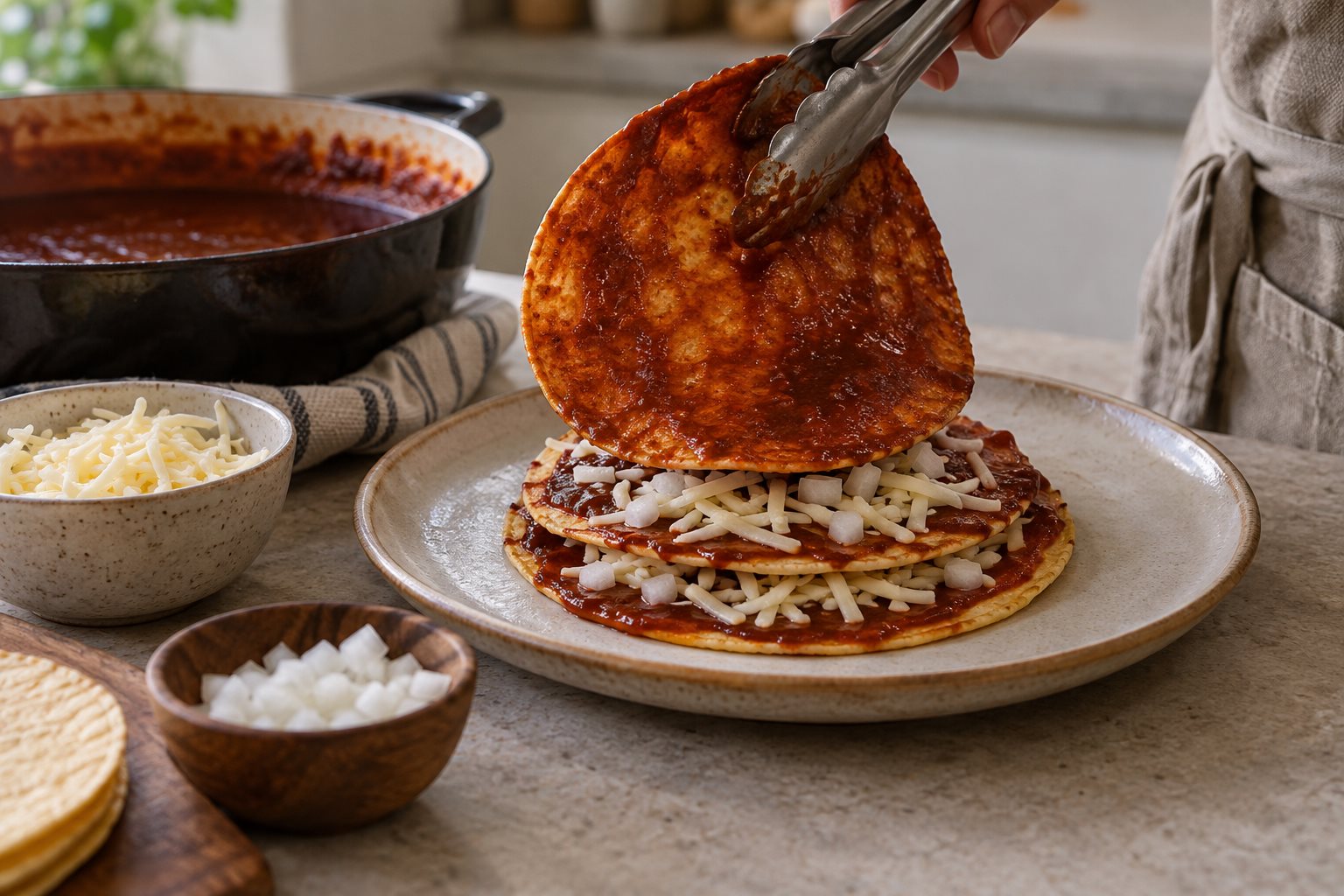
  7. Stack on warm plates. Dip a tortilla in the sauce, lay it flat on a warm plate, and spoon over a little more sauce, a handful of cheese and a scatter of onion. Repeat twice, finishing with sauce, cheese and onion on the top tortilla. Slide an egg on last and serve at once, while the cheese in the middle is still going.
    Flat corn tortillas stacked with red chile sauce cheese and onion
    Build the stack flat, with sauce, cheese and onion between every tortilla. AI-generated illustration.
If the sauce tastes bitter, the pods sat past 30 minutes in water that stayed near boiling, or some seed went through the blender. Stir in a pinch of salt and a teaspoon of the frying fat and give it five more minutes at a bare simmer — that carries most of it. If it is gritty on the tongue rather than bitter, it went unstrained or the sieve was too coarse; push it through again. If a stack goes to mush, the tortillas were underfried: give the next ones a full 30 seconds a side and drain them properly.

Storage and make-ahead

The sauce is the thing worth making ahead. It keeps 3 days refrigerated — Circular 517 and Guide E-327 both say to refrigerate promptly and use or freeze within 3 days — and it freezes for months in flat bags. Everything else in this recipe takes ten minutes once the sauce exists.

Assembled stacks do not keep. The tortillas go on drinking sauce in the fridge and come out as a single wet layer. If you have leftovers, store the components apart and build a fresh stack on a hot plate.

What to serve with it

Circular 517 puts refried beans, Spanish rice and a salad alongside the Red Enchiladas, and that is still the plate. If you are choosing one, make it the beans. Nothing sweet, nothing creamy, and no sour cream on top — this is a dish about one ingredient, and the egg is already doing the softening.

Three corn tortillas stacked flat on a plate under dark red chile sauce, melted cheese and raw white onion, a fried egg on top with the yolk just broken

From the recipe box / New Mexico

Stacked Red Chile Enchiladas with a Fried Egg

Whole dried red chile pods soaked, blended and strained into a sauce, then corn tortillas passed through hot fat and laid flat on the plate with cheese and raw onion between the layers.

Prep
20 min
Cook
55 min
Total
1 hr 15 min
Serves
4
Calories
880 per serving

Ingredients

Scale

Instructions

  1. Stem and seed the pods and wash them in warm water, changing the water several times.
  2. Cover them with boiling water in a 5-quart pan and soak 30 minutes, until the pulp lifts from the skin.
  3. Blend with about 2 cups fresh hot water until smooth, strain through a sieve, and simmer the purée 10 minutes.
  4. Cook the garlic in the lard 1 minute, add the purée, 1 cup water and the salt, simmer 10 minutes, add the oregano and simmer 5–7 minutes more to about 3 cups.
  5. Fry each tortilla in hot oil about 30 seconds a side until limp, and drain.
  6. Pour off all but a film of oil and fry the 4 eggs 3 minutes, until the whites set and the yolks still run.
  7. On warm plates, dip a tortilla in sauce, lay it flat, and top with sauce, cheese and onion; repeat to three tortillas, finish with sauce, cheese and onion, and set an egg on top.

Nutrition

Fat56 g (22 g saturated)
Sodium1180 mg
Protein33 g
Serving3 tortillas with sauce, cheese, onion and 1 egg
Calories880
Cholesterol260 mg
Carbohydrates60 g (8 g sugar, 11 g fiber)

Nutrition is an estimate calculated from the listed ingredients and is provided as a courtesy, not as dietary advice.

Questions readers ask

Can I roll them instead?

You can, and half of New Mexico does. If you do, hold the sauce back to about 2 cups and put a little cheese and onion inside each roll rather than between layers. What you lose is the sauce at every level, which is the whole argument for the stack.

How hot is this going to be?

It depends entirely on which pods you bought, and the range is enormous. H-236 groups New Mexico 6-4, Sandia and Española Improved as pungent red cultivars, while NuMex Conquistador, NuMex R Naky and LB-25 are grown for color with little or no heat. Bags are usually labeled mild, medium or hot; taste a scrap of the soaked pod before you commit the whole batch, and blend in a couple of milder pods if it is fiercer than you want.

Can I use chile powder instead of pods?

Circular 517 prints a powder sauce — half a cup of powder, 2 tablespoons of flour, water, oil, oregano, simmered 15 minutes — so the state's own Extension service allows it, and on a weeknight it is a real answer. It is a different sauce. The flour is there because powder cannot thicken anything on its own, and Guide H-236 explains why the flavor is thinner too: ground chile loses color, and with it aroma, far faster in storage than a whole pod does.

Is the fried egg traditional or an affectation?

It is printed in NMSU Circular 517 as an option on the Red Enchiladas — "May be topped with a fried egg" — so it is neither invented nor compulsory. Ordering enchiladas "with an egg" in New Mexico is ordering the version the Extension service wrote down.