American cooking Recipes & regional stories

Skillet & Sage

A culinary journey through the fifty states

The regional table / Illinois

Springfield Horseshoe Sandwich
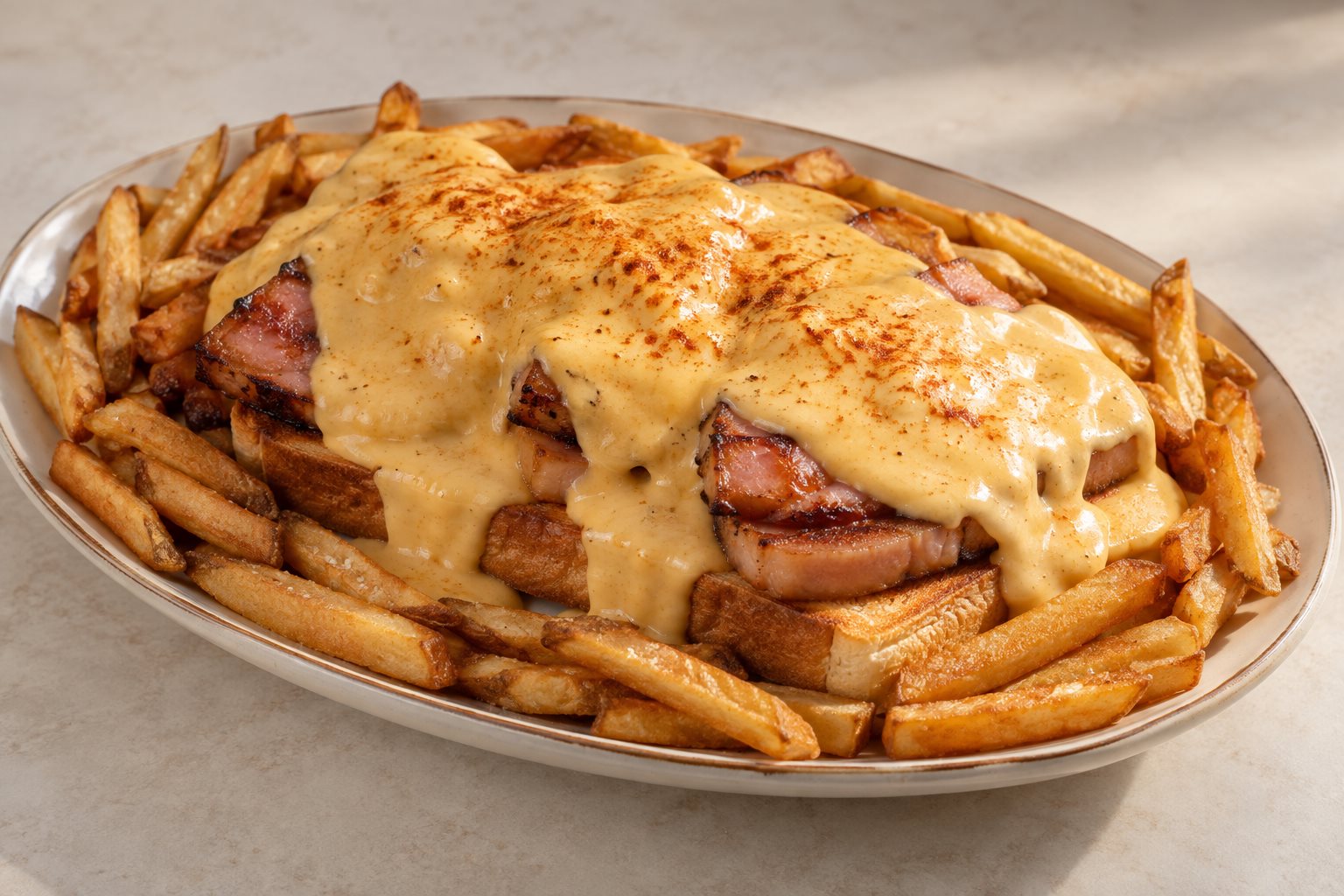
An oval platter holding two slices of thick toast under carved ham, blanketed in pale gold cheese sauce, with french fries banked around the rim
The fries go around the rim, not under the sauce. They are the nails; the platter is the anvil. AI-generated illustration.

It is a knife-and-fork sandwich built on a hot platter, and the only difficult part is a cheese sauce that has to stay smooth from the stove to the table.

The horseshoe is younger than the public domain and the quantities below were worked out for this page, but Springfield has kept better paper on this dish than most cities keep on any of theirs — and the paper does not agree with itself. The Sangamon County Historical Society, writing at SangamonLink, says that although accounts differ, most people credit Joseph Schweska, chef at the Leland Hotel at Sixth Street and Capitol Avenue in the late 1920s, who needed a new lunch item and whose wife Elizabeth suggested a Welsh rarebit sauce. By family account the first one was made with ham cut off the bone in a horseshoe shape and served with potato wedges rather than fries, and the cheese sauce was Schweska's own. The Springfield Convention and Visitors Bureau, on its own printed recipe sheet, credits the sandwich jointly to Joe Schweska and Steve Tomko at the Old Leland Hotel in 1928. Those are two named local authorities giving two different answers to the same question, and this page is not going to break the tie. What both agree on is Tomko's undisputed contribution: he worked at the Leland alongside Schweska and then carried the dish to Norb Andy's Tabarin and to Wayne's Red Coach Inn, which is how it left one hotel kitchen and became the food of a city.

The documentary record is sharper than either claim and it contains the best fact on this page. The Illinois State Journal reporter Robert Wood printed recipes from three Springfield hotel chefs on Christmas Day 1938, Schweska's rarebit sauce among them; the chef told him he made six gallons of it a day, that he had started making it around 1932, and that it was no secret because he had already given it away to hundreds of people. The proportions he gave were half a pound of butter, half a pound of flour, a quart of milk, a pint of beer, a pound of old English or American cheese, salt, an eighth of a teaspoon each of cayenne and dry mustard and a tablespoon of Lea and Perrins, cooked in a double boiler with the beer stirred in just before serving. And the word horseshoe does not appear in that article once. SangamonLink's search of the newspaper files puts the first horseshoe attached to rarebit sauce in an advertisement of 8 October 1946 for the Mill, where Schweska was then the chef — ham and eggs on toast with Welsh rarebit sauce and French fries — and the first printed horseshoe sandwich in another Mill advertisement of 21 October 1948. The dish is older than its name by twenty years, which is a thing almost no famous sandwich can say. The CVB sheet, incidentally, prints an entirely different sauce, thickened with egg yolks and beer rather than with a roux, and dates the newspaper recipe to 1939 rather than 1938. Take your pick; the version below follows Schweska's roux, loosened, because it is the one that will not curdle on you.

Why this version works

A roux, not egg yolks. The two published Springfield sauces take opposite routes. The egg-yolk version has to be kept piping hot without ever bubbling, stirred in one direction with a wooden spoon, and it scrambles the moment anybody looks away. A flour-thickened base is nearly unbreakable by comparison: the starch gets between the proteins and holds the emulsion even if the pan gets away from you for a second.

The fries go round the rim. Under the sauce they are wet in ninety seconds. Banked around the outside of a hot platter they stay crisp long enough to be eaten as fries, with as much sauce as each forkful chooses to collect. That is also where the name comes from: the ham is the shoe, the fries are the nails, and the sizzling platter is the anvil.

The beer goes in at the end. Schweska's own instruction was to add the beer just before serving, and the chemistry agrees with him. Beer is acidic, and acid added to hot milk protein early will curdle it; added at the end, off the boil, it thins the sauce to a pouring consistency and puts back the bitterness that all that cheese needs.

American cheese in the blend, and the federal rule says why. Title 21 of the Code of Federal Regulations, section 133.169, defines pasteurized process cheese and lists what may be used to emulsify it — sodium citrate, potassium citrate, and a row of sodium and potassium phosphates — up to 3 percent of the finished weight. Those salts are exactly what keeps melted cheese from separating into oil and rubber. Cheddar alone brings flavour and breaks; a third of the cheese as process American brings the emulsifying salts along with it and the sauce stays glossy.
Ingredient notes

Ham: a thick-carved bone-in ham steak, about six ounces a person, cut in a broad curve if you want the original shape. The first horseshoes were cut off a bone and the curve was the whole joke. Springfield now serves the sandwich with hamburger patties, fried chicken, even walleye, and none of that is wrong — but ham is the one the family accounts describe.

Beer: a plain lager. Schweska was cooking under Prohibition when he started, so the original sauce was made with near beer, and a non-alcoholic lager is therefore the most authentic thing you can put in it as well as a perfectly good one. Avoid anything hoppy, which turns bitter as it reduces.

Toast: Texas toast, or ordinary white bread cut an inch thick yourself. It has to be thick enough to sit under sauce for ten minutes without dissolving, and it should be toasted dark and buttered while hot so the butter seals the surface.

Cheese: two-thirds sharp cheddar for flavour, one-third process American for insurance. Schweska called for old English or American, which in 1938 meant a sharp cheddar and a process cheese in roughly those roles. Grate it yourself; the anti-caking starch on pre-shredded cheese makes the sauce grainy.

Step by step

  1. Fry the potatoes. Cut the potatoes into 1/2-inch fries, soak them 30 minutes in cold water, drain and dry them hard. Fry at 325°F for 5 to 6 minutes until cooked and pale, drain on a rack, then fry again at 375°F for 2 to 3 minutes until rigid and gold. Salt them at once and keep them warm and uncovered.
  2. Warm the platters and the ham. Put four oven-safe platters into a 200°F oven. Cut the ham into four broad pieces and warm them in a dry skillet over medium, 2 minutes a side, until the edges colour. Keep them with the platters.
  3. Make the roux. Melt the butter in a heavy saucepan over medium-low and whisk in the flour. Cook 2 minutes, whisking, until it smells of biscuit but has taken no colour.
  4. Build the sauce base. Whisk in the hot milk a third at a time, letting each addition thicken before the next. Add the dry mustard, cayenne, Worcestershire and a pinch of salt and cook 3 minutes at a bare simmer, until it coats a spoon heavily.
  5. Melt the cheese off the heat. Pull the pan off the burner and add the grated cheeses in three handfuls, whisking each one smooth before the next. The sauce should never go above about 160°F from here on.
  6. Beer last, then assemble. Stir in the beer off the heat until the sauce pours in a broad ribbon. Lay two slices of toast on each hot platter, set the ham over them, pour the sauce across the whole surface, bank the fries around the rim and serve at once.
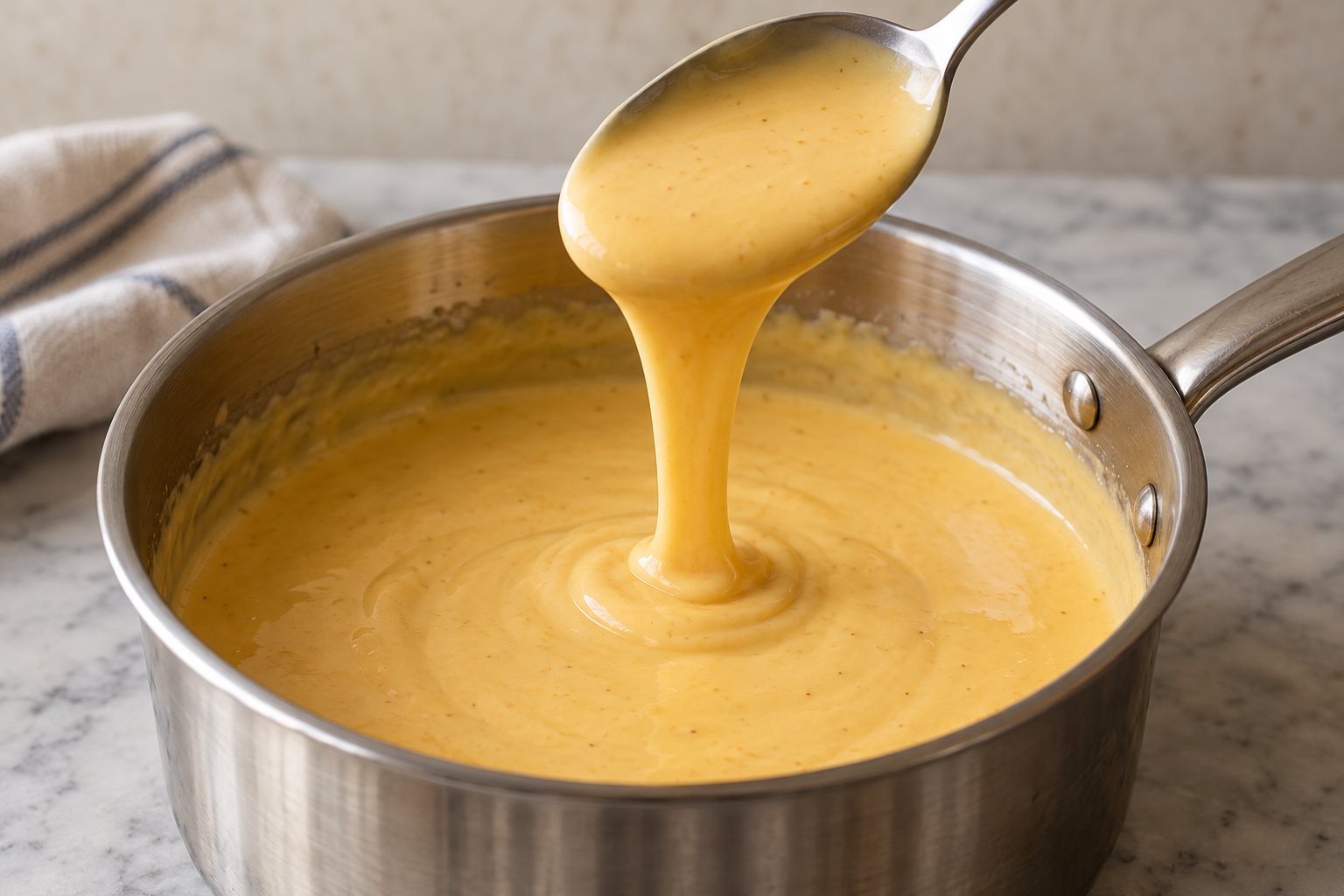
    A spoon pouring a broad ribbon of smooth pale-gold cheese sauce into a saucepan off the heat.
    Stir in the beer off the heat until the cheese sauce pours in a broad ribbon. AI-generated illustration.
If the sauce turned grainy or split into oil, it got too hot after the cheese went in — take it off the heat, whisk in two tablespoons of cold milk a spoonful at a time, and it will usually come back. If it set into a paste on the way to the table, thin it with warm milk rather than more beer, which past a point makes it bitter. If the toast went to mush, it was cut thin or toasted pale; an inch, and dark, is the answer.

Storage and make-ahead

Assembled horseshoes do not keep for five minutes and should not be attempted ahead. The sauce keeps 4 days refrigerated, where it sets to a firm block; reheat it gently with a splash of milk, stirring, and never let it boil.

Once-fried potatoes hold an hour at room temperature or overnight in the fridge before their second fry, which is the useful make-ahead if you are feeding several people at once.

What to serve with it

Nothing rich. A plain green salad with a sharp vinaigrette, or sliced tomatoes with salt, is all the relief this plate needs and all it will accept.

Beer, and ideally the same one that went into the sauce.

An oval platter holding two slices of thick toast under carved ham, blanketed in pale gold cheese sauce, with french fries banked around the rim

From the recipe box / Illinois

Springfield Horseshoe Sandwich

Two slabs of thick toast, a horseshoe of carved ham laid over them, a pile of hot fries banked around the plate, and a beer-and-cheese rarebit sauce poured over the whole platter.

Prep
20 min
Cook
40 min
Total
1 hr
Serves
4
Calories
1240 per serving

Ingredients

Scale

Instructions

  1. Soak, dry and fry the potatoes at 325°F for 5–6 minutes, rest them, then fry again at 375°F for 2–3 minutes and salt at once.
  2. Warm four platters in a 200°F oven and colour the ham 2 minutes a side in a dry skillet.
  3. Melt the butter, whisk in the flour and cook 2 minutes without colour.
  4. Whisk in the hot milk in thirds, add the mustard, cayenne, Worcestershire and salt, and simmer 3 minutes until it coats a spoon.
  5. Off the heat, whisk in the cheddar and American cheese in three handfuls until smooth.
  6. Stir in the beer off the heat, then build each platter — toast, ham, sauce over everything, fries round the rim, a dash of paprika — and serve at once.

Nutrition

Fat74 g (36 g saturated)
Sodium2950 mg
Protein58 g
Serving1 horseshoe
Calories1240
Cholesterol215 mg
Carbohydrates84 g (12 g sugar, 6 g fiber)

Nutrition is an estimate calculated from the listed ingredients and is provided as a courtesy, not as dietary advice.

Questions readers ask

Who invented the horseshoe?

The Leland Hotel and the year 1928 are not really in dispute; the person is. The Sangamon County Historical Society says most accounts credit Joseph Schweska, the Leland's chef, with his wife Elizabeth suggesting the Welsh rarebit sauce. The Springfield Convention and Visitors Bureau credits Schweska and Steve Tomko jointly on its own recipe sheet. Tomko was in that kitchen and took the dish out into the city's restaurants afterwards, which nobody questions. Beyond that the two local authorities simply disagree and no document settles it.

Why did my cheese sauce go grainy?

Heat, almost always. Once cheese is in, the sauce must stay below about 160°F or the casein squeezes the fat out and you get oil on top and grit underneath. Melt the cheese off the burner, in handfuls, and do not put the pan back on the heat afterwards. The process American in the blend is there for exactly this reason: the emulsifying salts the federal standard permits are what hold it together.

How big is a horseshoe supposed to be?

Large enough to be a problem, which is the point of the dish. The recipe here gives each person two slices of toast, six ounces of meat, half a pound of potatoes and most of a cup of sauce, and that is a full Springfield portion. If that is too much, halve everything but the sauce and build it on a single slice of toast.

Can I make it with something other than ham?

Yes, and Springfield does constantly — hamburger patties are now the most ordered version, and chicken, walleye and corned beef all appear on menus around town. Ham is the version the family accounts describe and the one that explains the name, since the shape of the cut off the bone is where horseshoe came from. Whatever you use, cook it fully before it goes on the toast; nothing finishes cooking under the sauce.