The regional table / Alabama
Smoked Chicken with Alabama White Barbecue Sauce
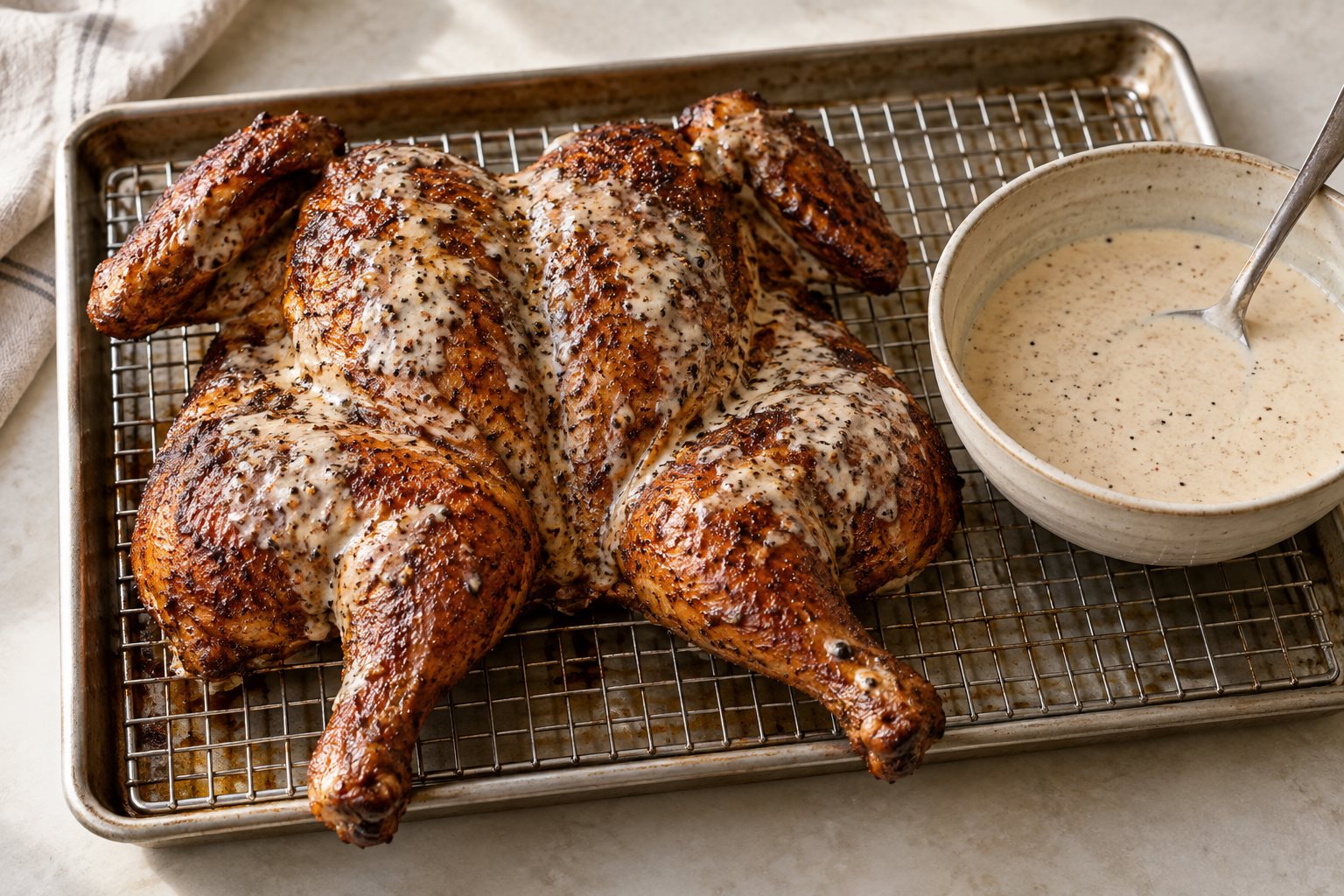
The sauce never meets the fire. The bird comes off the smoke hot and goes straight down into a bowl of cold mayonnaise and vinegar, and that is the whole trick.
The dish belongs to one pit in one river town. The Encyclopedia of Alabama entry on Big Bob Gibson Bar-B-Q, written by Mark A. Johnson of the University of Tennessee at Chattanooga, who also wrote the 2017 book An Irresistible History of Alabama Barbecue, puts Robert Gibson (1888–1972) in Decatur, Morgan County, as a Louisville and Nashville Railroad man who cooked barbecue on weekends from a pit dug in his backyard off Danville Road. He stood six feet four and weighed over three hundred pounds, which is where the name came from. He left the railroad, opened a restaurant on Moulton Road called Gib-All's with his brother-in-law Sam Woodall, and carried on alone under his own name when Woodall left. Johnson describes the method plainly: Gibson split his chickens, seasoned them, roasted them over hickory smoke for about three hours, and then dunked them in a sauce of mayonnaise, vinegar and black pepper. In 1952 he moved the business to Sixth Avenue and handed the daily running of it to his daughter Catherine McLemore (1919–2004) in exchange for half of it, because he would rather be fishing. His grandchildren took it over after his death, his grandson Don McLemore (1941–2026) led it through two more moves, and the pitmaster since the nineties has been Chris Lilly, who joined in 1992 after marrying Gibson's great-granddaughter Amy McLemore. The restaurant turned a hundred in 2025 and the family still owns it.
The 1925 date is the family's, and the family is careful about what it actually knows. In November 2006 Amy C. Evans recorded Don McLemore in Decatur for the Southern Foodways Alliance's Southern BBQ Trail; the transcript is online. Asked straight out whether they claim his grandfather invented the white sauce, McLemore says yes, they do say it, and that nobody has ever come forward to dispute it — and then adds that how his grandfather came up with the recipe, he has no idea, and wishes he did. So 1925 is the year the pit is dated to, not a dated recipe: no menu, advertisement or label from the twenties has been produced for it. The Decatur papers would settle the question, and the Library of Congress newspaper archive was answering automated requests with a challenge page while this was written, so that lane stayed shut. What can be said is that the sauce cannot be much older than the pit, because jarred mayonnaise was itself a new thing — Richard Hellmann was selling it in glass jars in New York from 1912 and Eugenia Duke was bottling hers in Greenville, South Carolina, by about 1923. It stayed a north Alabama local taste until the restaurant began bottling it in 1994, which is McLemore's own date. Why there was so much chicken to put it on is a separate story with better paperwork: Donald E. Conner's Encyclopedia of Alabama article on the state's poultry industry describes a northern half of the state that lacked the soils of the Black Belt, turned to animals instead of row crops, and got feed mills built along the Tennessee River from the 1940s to bring midwestern corn and soybeans in by water. Decatur sits on that river. But the broilers arrived two decades after Gibson did. The sauce came first and the supply caught up with it.
Why this version works
Smoke at 300°F, not 225°F. The skin has to survive a bath, which is a harder job than skin normally has. Chicken fat renders slowly and low smoke leaves the skin slack and rubbery, and slack skin turns to paste the moment it gets wet. Run the fire at 300°F and the fat renders and the skin tightens while the bird still takes two full hours of smoke.
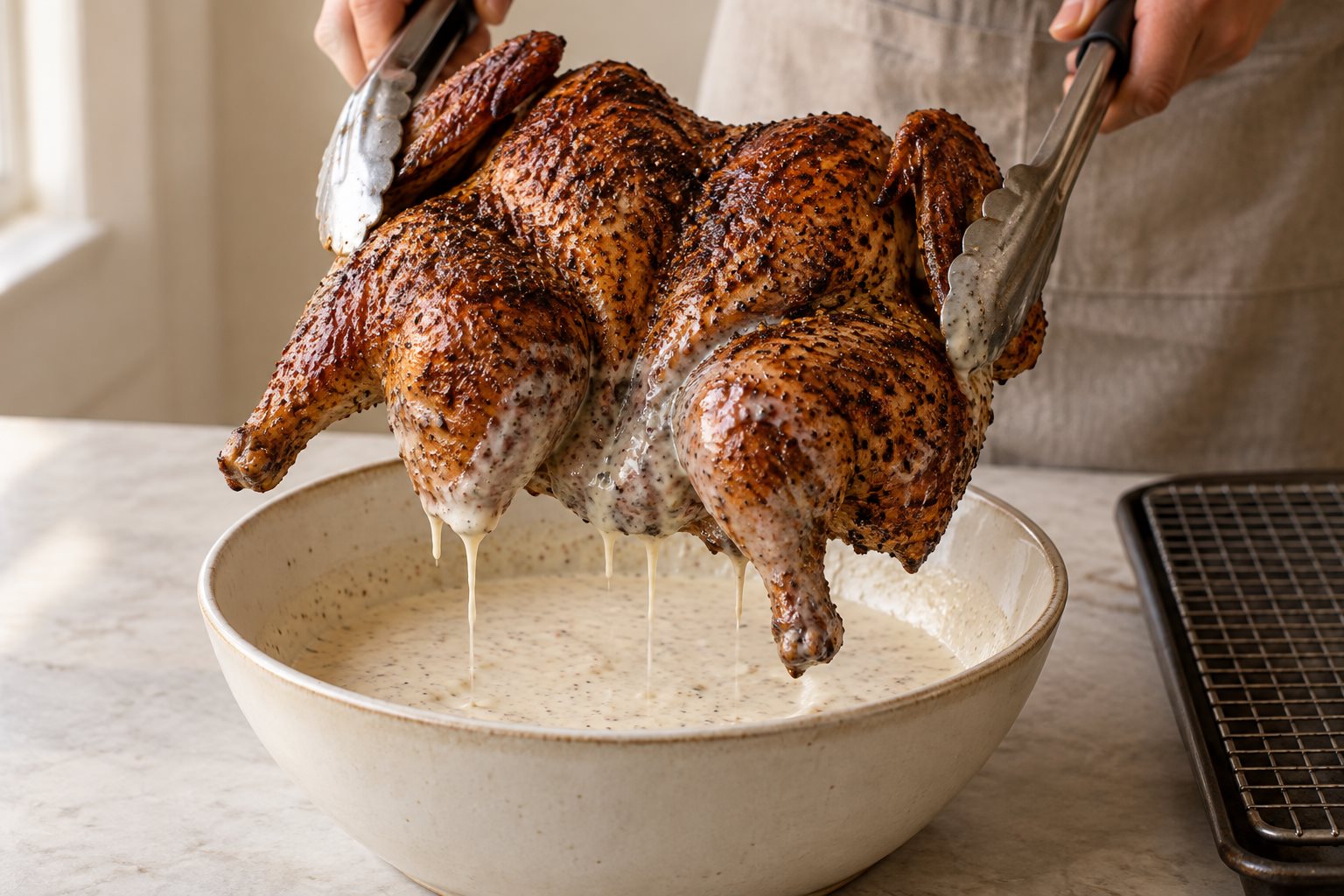
The bird is dunked, not brushed. A whole hot chicken lowered into a deep bowl is coated everywhere at once — under the wings, into the joints, along the split back — and the heat in the skin thins the sauce on contact so it drains off in a film rather than sitting in ridges. At Big Bob Gibson's they call it baptizing the chicken, and Don McLemore uses exactly that word for it in the 2006 interview.
Mayonnaise is a finishing sauce, not a mop. It is an emulsion of oil suspended in water and held there by egg yolk. Heat sets the yolk proteins and thins the oil, and the emulsion splits into grease and cloudy liquid. Brushed on at smoking temperature it streaks, beads and slides off; there is no version of this where the sauce goes near the coals. Everything it does, it does after the fire is finished with the bird.
Vinegar at half the volume of the mayonnaise. Two parts mayonnaise to one part cider vinegar, plus the lemon, pours like heavy cream. That is the consistency the dip needs: thin enough to run off a bird instead of clinging to it, sharp enough to cut through skin that has been sitting in hickory smoke for two hours. Made any thicker it stops being barbecue sauce and becomes a dressing.