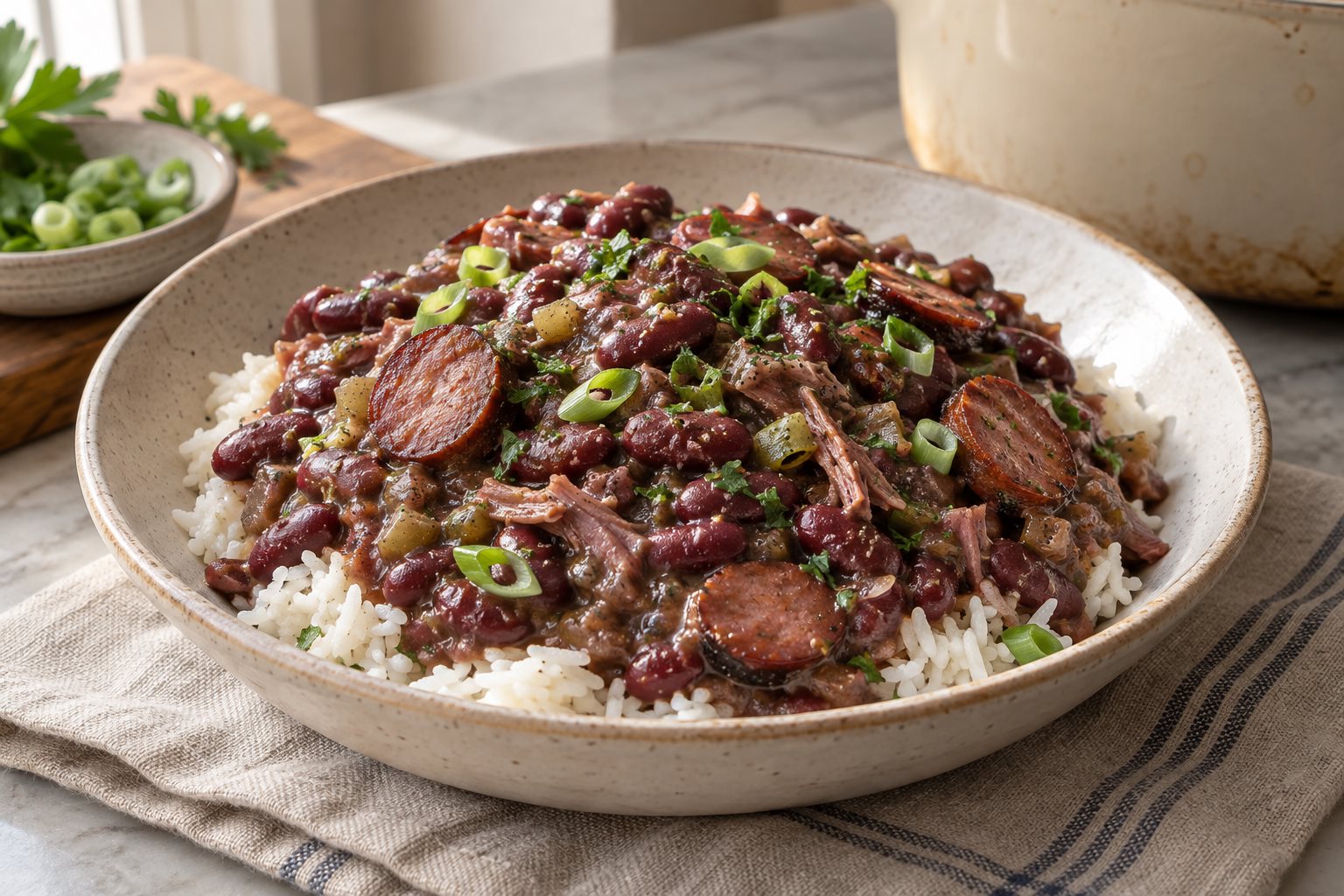
Nothing here needs watching for the first two hours, which is the whole point of the dish and the reason it survived a washday.
The bean chapter of The Picayune's Creole Cook Book opens flatly: Red Beans are the favorite dish among Creole families. The New Orleans paper printed the book for decades and the readable scans are later printings — the fourth edition on the Internet Archive carries copyright dates of 1901, 1906 and 1910, the sixth carries 1922 — and the recipe is the same in both. Haricots Rouges au Riz is a quart of dried red beans, a carrot, an onion, a bay leaf, a tablespoon of butter and a pound of ham or salt meat. Soak overnight. Cover very deep with at least two quarts of cold water, for beans must cook thoroughly. Let the water heat slowly. Boil at least two hours, or until tender enough to mash easily under pressure, and then put the salt meat or ham on top of the dish and serve it hot as a vegetable, with boiled rice as an entrée. The carrot is the one ingredient every modern version has quietly dropped, and it is worth putting back.
What is not in the book is Monday. Neither edition contains the words wash day or washing day anywhere, and the only weekday the book ever ties red beans to is the wrong one: the plain boiled recipe calls itself an excellent way of preparing red beans for Fridays and fast days. Both editions print a week of economical menus, and red beans and rice lands on the Wednesday dinner, next to grillades. The other half of the Monday story is documented, and by the same book — its chapter on running a kitchen cheaply says to buy a whole ham rather than slices, work it down through the week, and then do not, under any circumstances, throw away the bone, but save it to boil with cabbage, white beans, red beans, lentils. The ham bone is on the record. The washtub is not, at least not from here: the LOUISiana Digital Library answered automated requests with a firewall page on 22 September 2026, and the Library of Congress newspaper archive answered 403, so this article dates the bone and leaves the laundry as the living habit it is.
Why this version works
Cold water, heated slowly. The Picayune gives the reason two chapters away, in its notes on vegetables: dried beans, split peas and lentils do not boil to softness in hard water, that is, when put into boiling water, because the seeds contain salts of lime that coagulate on contact with heat, and no after amount of boiling can ever bring them quite to softness. Whatever you make of the chemistry, the instruction is right and it is the single thing most home versions get wrong.
Rice boiled apart and dried out. The rice chapter is emphatic that properly boiled rice is snowy white, perfectly dry and smooth, every grain separate and distinct: into fast-boiling salted water, stirred only until the grains begin to soften and then not touched again, drained, and set in the oven ten minutes to dry without browning. Two dishes reach the table, not one — the book calls boiled rice the standing dish on every Creole table and never cooks it in the beans.
The creaminess is mashed beans, not cream. The Picayune does print a creamy version, and it is a different recipe with a different name — Purée of Red Beans, pressed through a colander with butter and a half pint of cream, recommended for invalids. The gravy on a plate of red beans and rice comes from crushing a cup of the cooked beans against the side of the pot and stirring them back in. Nothing goes in that was not already in.
The ham bone does the work the recipe does not list. A pound of ham or salt meat is the book's wording, and a bone with meat still clinging to it is better than either: collagen from the joint gives the pot liquor the body that turns a pan of beans into gravy. This is why the dish belongs to the day after a ham, and why a hock bought for the purpose is the honest substitute when there was no ham.
Ingredient notes
Rice: long grain, and the book has a reason to care. Its rice chapter notes that cultivation began in Louisiana nearly a hundred years after Georgia and South Carolina, and that the state by then produced more than both combined. Cook a cup of raw rice for eight servings and cook it separately, which also means leftovers reheat without turning to paste.
Beans: dried red kidney beans, the small dark red ones rather than the pale light-red kidney. A pound feeds eight with rice. Old beans are the usual reason a pot refuses to soften after three hours, and there is no way to tell by looking, so buy from somewhere that sells them quickly.
Sausage: the Picayune puts sausage in the bean pot itself — a few Chaurice thrown into the pot of boiling cabbage or beans add greatly to the flavor. Chaurice is its hot fresh Creole sausage, hashed pork seasoned with cayenne, chili pepper and red pepper, and the book says this high seasoning distinguishes the Creole sausage from all others, so do not fear to have too much red pepper. Smoked andouille is the common modern choice and behaves better over two hours; fresh chaurice, if you can get it, goes in for the last twenty minutes only.
The smoked meat: a leftover ham bone with meat on it is the point of the dish; a smoked ham hock is the stand-in. The book's own salt meat is petit salé, pickled pork, which it brines twenty hours after killing with coarse salt, bay leaves, onions, cloves, allspice and an ounce of saltpetre to twenty-three pounds of pork. Pickled pork is still sold in tubs in New Orleans groceries and is worth a half pound alongside the bone if you find it.
Step by step
Soak overnight. Pick the beans over for stones, rinse them, and cover them with cold water by three inches. Leave them overnight, or at least five or six hours, then drain and discard that water.
Brown the sausage and the vegetables. Cook the sausage coins dry in a heavy 6-quart pot over medium heat until browned and the fat runs, about 8 minutes, and lift them out. Add the lard if the pot looks dry, then the onion, bell pepper, celery and carrot, and cook 8 minutes until soft. Add the garlic for a minute more.
Start it cold. Add the drained beans, the ham hock or bone, the bay leaves, thyme, cayenne and black pepper, and pour in 2 quarts of cold water. Do not salt yet. Bring it up slowly over medium-low heat — twenty minutes to a simmer is about right.
Simmer two hours. Hold it at a bare simmer, uncovered, stirring up from the bottom every twenty minutes so nothing catches. Top up with hot water if the beans ever stand proud of the liquid. They are ready when one mashes easily under pressure against the side of the pot.
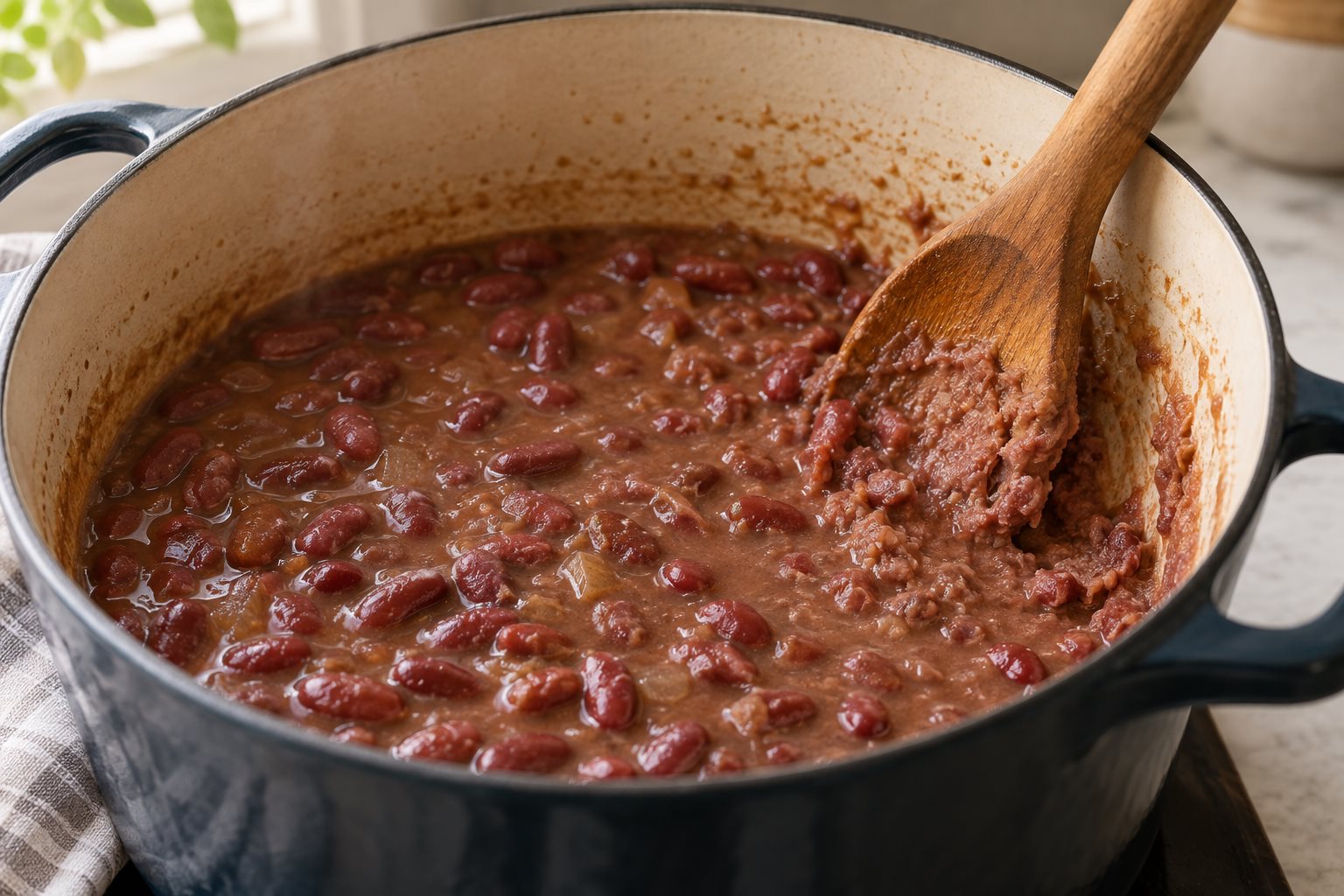
Mash and return the sausage. Crush about a cup of beans against the pot wall with the back of a spoon and stir them through; the liquid goes from broth to gravy in a minute or two. Return the sausage and simmer 30 minutes more.
Mash about a cup of soft beans against the pot wall to turn their broth into gravy. AI-generated illustration.
Pull the meat, then salt. Lift out the hock or bone, strip the meat off it, and stir the meat back in. Now taste and salt — usually about 1½ teaspoons, sometimes none at all if the pork was heavily cured. Fish out the bay leaves.
Boil the rice separately. A quart of water and a teaspoon of salt to a cup of washed rice, at a hard boil. Stir gently until the grains start to soften, then stop touching it. Twenty minutes, drain, and set the uncovered pot in a low oven ten minutes to dry without browning. Spoon the beans over it and finish with green onion and parsley.
Beans still chalky after three hours is the common failure and it has three causes. If you salted at the start, or added tomato, vinegar or hot sauce to the pot, take the pot off the heat and accept a longer simmer — acid and salt both firm the skins. If you topped the pot up with cold water, you did what the Picayune warns against in the opposite direction; top up with boiling water only from here. If neither applies, the beans are simply old, and old beans do eventually soften: keep them at a bare simmer and check every half hour. A scorched bottom is the one thing not worth fighting. Ladle the beans into a clean pot without scraping the base and without stirring, leave the last inch behind, and carry on.
Storage and make-ahead
Refrigerated, red beans keep 5 days and are better on the second, when the gravy has set and thickened. Loosen with hot water rather than stock when you reheat, and keep the rice in its own box so it can be steamed back to life separately.
They freeze 3 months. Freeze the beans alone and cook fresh rice on the day — frozen and thawed rice goes to paste. Leave the green onion and parsley out of anything destined for the freezer and add them at the reheat.
What to serve with it
Rice, in a dish of its own. The book serves the beans as a vegetable next to a plate of something fried or braised, and names three: Veal Sauté, Daube à la Mode, and Grillades à la Sauce. Grillades is the one that stuck — a pounded round steak fried in lard with onion and tomato, and the Picayune calls beans, rice and grillades a meal a king might not disdain to eat.
French bread for the gravy, and something sharp against two hours of pork fat: a green salad with a lot of vinegar, or pickled onions. Hot sauce belongs at the table rather than in the pot, since vinegar added early keeps the skins tough.
From the recipe box / Louisiana
Red Beans and Rice
Kidney beans started in cold water with a ham bone and simmered until a spoonful mashes against the pot, served over rice boiled dry and separate the way the Picayune insists on.
Prep
20 min
Cook
2 hr 30 min
Total
2 hr 50 min
Serves
8
Calories
560 per serving
Ingredients
Scale
Instructions
Soak the beans overnight in cold water to cover by three inches, then drain and discard the soaking water.
Brown the sausage dry in a heavy 6-quart pot over medium heat 8 minutes and lift it out. Cook the onion, bell pepper, celery and carrot in the fat 8 minutes, adding lard if the pot is dry, then the garlic for 1 minute.
Add the beans, ham hock, bay leaves, thyme, cayenne and black pepper with 2 quarts of cold water and no salt, and bring slowly to a simmer over medium-low heat.
Simmer uncovered 2 hours, stirring up from the bottom every 20 minutes and topping up with boiling water, until a bean mashes easily under pressure.
Crush a cup of beans against the side of the pot and stir them through, return the sausage, and simmer 30 minutes more.
Lift out the hock, strip the meat back into the pot, discard the bay leaves, and season with the salt.
Boil the rice separately in a quart of salted water 20 minutes, drain, dry it 10 minutes in a low oven, and spoon the beans over it with green onion and parsley.
Nutrition
Fat
22 g (8 g saturated)
Sodium
980 mg
Protein
29 g
Serving
1¼ cups beans over ⅓ cup rice
Calories
560
Cholesterol
55 mg
Carbohydrates
58 g (5 g sugar, 11 g fiber)
Nutrition is an estimate calculated from the listed ingredients and is provided as
a courtesy, not as dietary advice.
Questions readers ask
Is this really a Monday dish?
In New Orleans today, yes, and the reasoning everyone gives is that Monday was wash day and a pot that needs no attention suited it, with Sunday's ham bone going in. The half that can be shown from the document is the bone: the Picayune tells you plainly never to throw it away and to boil it with red beans. The book itself never mentions wash day, ties red beans to Fridays and fast days instead, and puts them on a Wednesday in its own weekly menus. The newspaper archives that might date the Monday habit refused automated access when this was written.
Do I have to soak the beans overnight?
The book gives you the short way itself — overnight, or at least five or six hours. Unsoaked beans will cook, but reckon on three to four hours instead of two, more water, and a pot that is likelier to catch on the bottom. What you must not do is soak them in hot water or start them in it.
No ham bone and no hock — what then?
A half pound of pickled pork, a smoked turkey wing, or a thick slice of country ham cut into chunks will all carry the pot, in that order of preference. Sausage alone is not enough: it gives fat and smoke but no gelatin, so the liquid stays thin no matter how long you cook it. In that case mash rather more of the beans.
Why are my beans watery instead of creamy?
Either they were not cooked long enough for the starch to loosen, or nothing was mashed. Crush a cup of the cooked beans against the pot and stir them back in, then let it simmer uncovered ten minutes longer. Do not add flour, and do not add cream — the Picayune's creamed version is a separate recipe called Purée of Red Beans, and it is a different dish.