The regional table / New Mexico
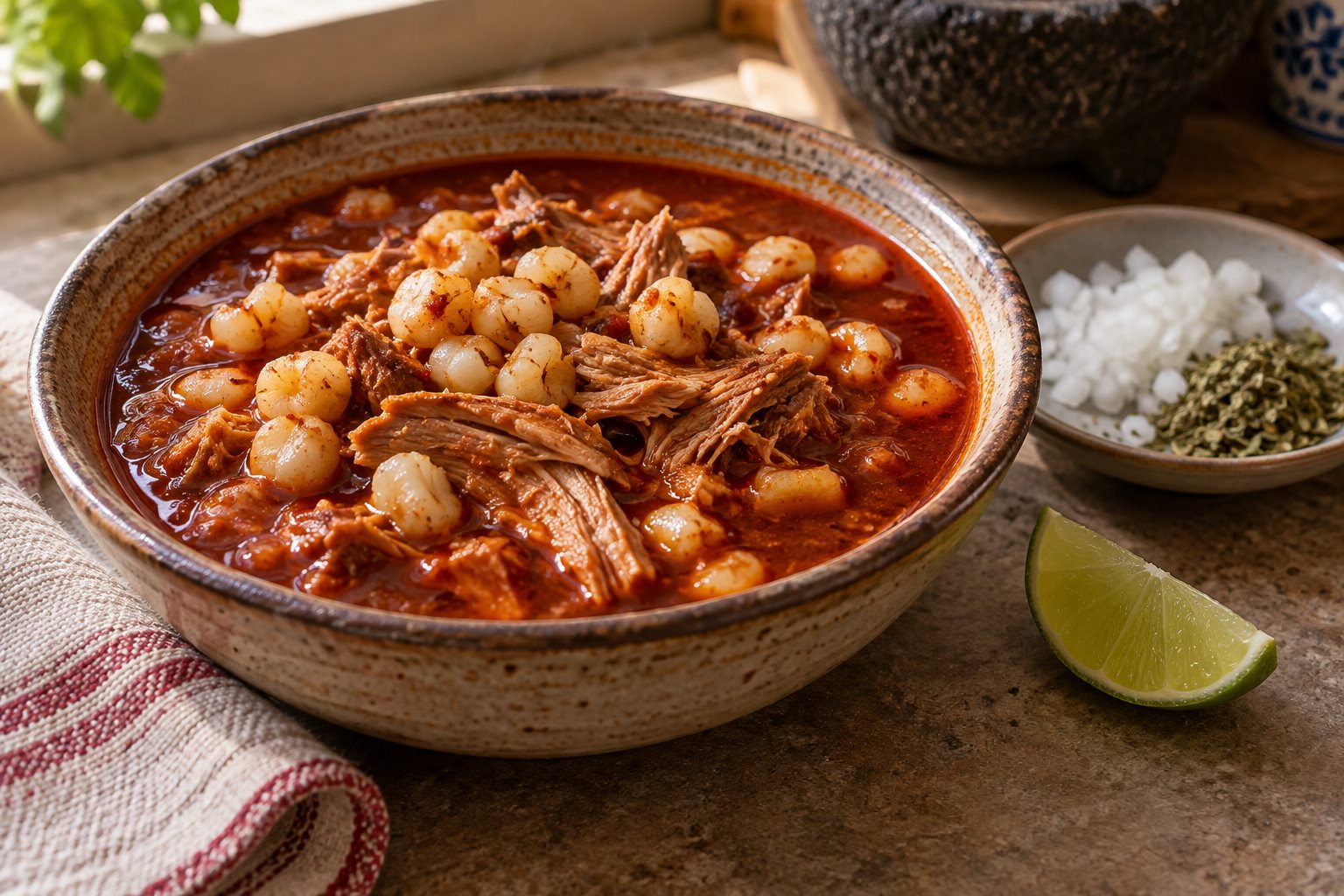
Posole
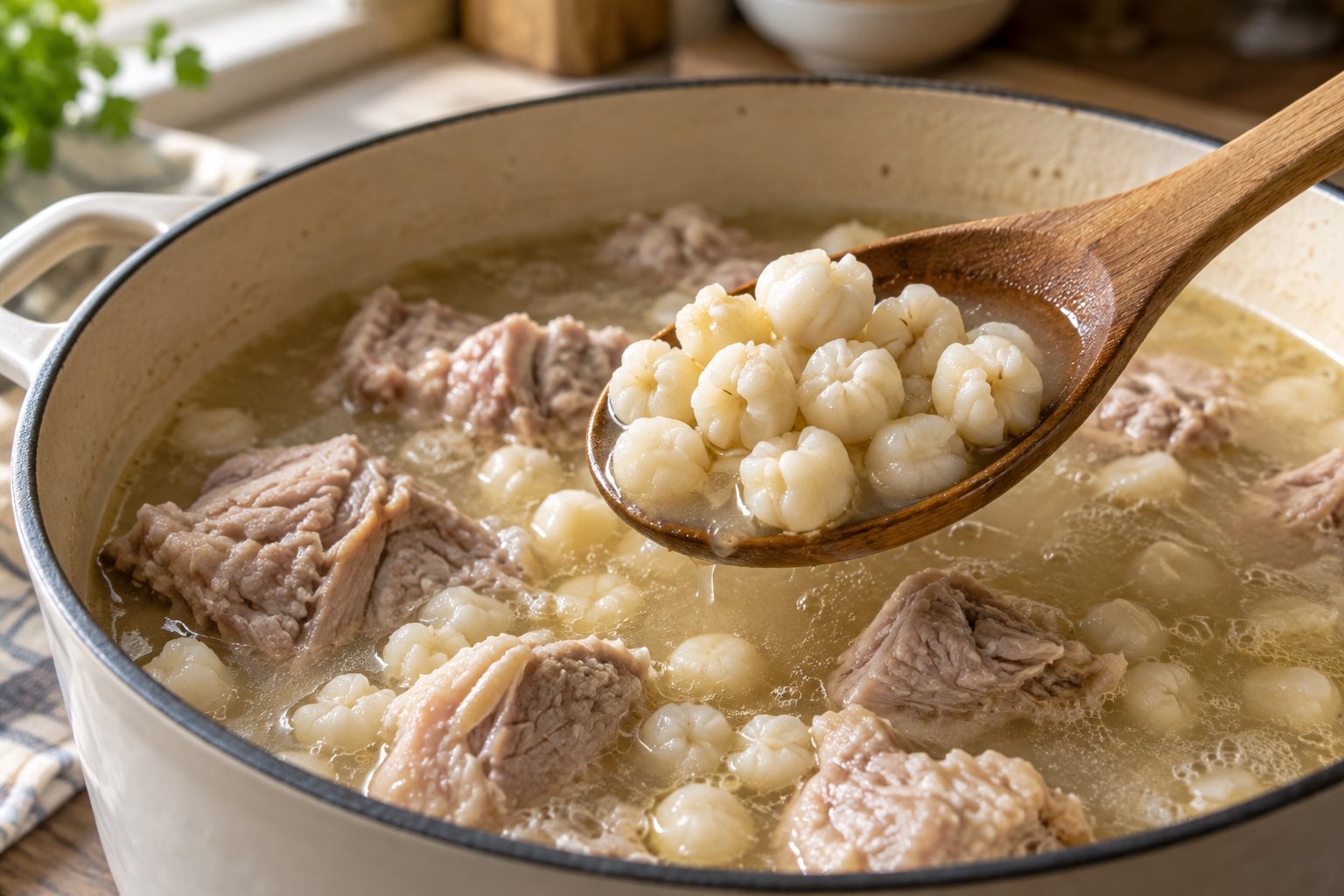
The dish is named after the corn, and the corn is not corn until somebody cooks it in lime or wood ash.
The first job is telling three things apart, because they all wear the same two words on a label. United States Food Leaflet No. 19, headed simply Hominy and issued jointly by the Department of Agriculture and the U.S. Food Administration in 1918, sorts them out better than anything printed since. "The coarse hominy, samp, or pearl hominy," it says, is corn whose "grain is split to remove the germ, hulled and polished by machinery"; "the fine hominy or hominy grits" is "made by grinding the coarse hominy"; and lye hominy is made "by boiling the grain in lye or potash until the germ will come out and then washing out the lye." Two of those three are machinery. Only the third is the process this dish is built on, and it is the older one: the leaflet notes that settlers "also learned to remove the germ and hull from the corn by boiling the grain with lye," a product "they sometimes called 'hulled corn'" before the lye name stuck. The federal definition of the can on the shelf is narrower still. The United States Standards for Grades of Canned Hominy, effective 10 March 1958, say at section 52.3281 that "canned hominy" means the product "prepared from clean, sound field corn, either white or golden (yellow), by removal of the pericarp, by precooking or other processing, soaking," and sorting. Removal of the pericarp is the entire definition. How you remove it is not specified, and no alkali is named. What the food standards do not do is define hominy at all: there is no standard of identity for it in 21 CFR, where the word survives only in a list of collective names for animal feed and in the table of reference amounts, which files hominy grits under hot breakfast cereals at one cup prepared. The 1958 grade standard is gone from the Code of Federal Regulations too — the word hominy appears nowhere in title 7 today.
Who the dish belongs to is a harder question, and the New Mexico archives that would answer it are shut: the Office of the State Historian refuses connections, the University of New Mexico collections return nothing, and the Federal Writers' Project America Eats files that the plan pointed at are down on every path, which means the Christmas and matanza customs attached to this dish in the plan row are a lead and not a document. Nothing below rests on them. What is open, and is better than a folklore column anyway, is Bulletin 55 of the Bureau of American Ethnology, Ethnobotany of the Tewa Indians, by W. W. Robbins, J. P. Harrington and Barbara Freire-Marreco, printed by the Government Printing Office in 1916. Its Hano Tewa section prints the technique flat: "White corn is put into warm water with ashes of corn-cobs, and boiled, more water being added if necessary, until it swells up to three times its original bulk. After the ashes are thoroughly washed out the corn is boiled again, with mutton." Its Rio Grande section prints the dish under its own name and then, carefully, prints an absence: "White corn is boiled with mutton or beef; the stew is called posoli (< Span. posole). Hominy does not seem to be in use." So at Santa Clara, in 1916, the stew was recorded and the alkali step was not, though lime was in that kitchen for other work — a footnote on the same page says the Tewa of Santa Clara mix lime, itunu, "stone ashes," into their breads, that the "stone" for burning "can be found in Santa Clara Canyon, but, to save trouble, the lime is more often bought from 'Mexican' peddlers," that "the Zuni also use lime," and that Torquemada's informant around 1600 "particularly notes that the Tewa of San Gabriel (Chamita) did not mix ashes or lime in their atole as did the Indians of Mexico." Pueblo and Hispano hands are both on this pot and the name arrived in Spanish; beyond that the record I could reach does not let anyone claim it outright, and I am not going to invent the part that would.
Why this version works
Lime is the step, not a seasoning. New Mexico State University Extension Guide H-226, Blue Corn Production and Marketing in New Mexico, revised by Lois Grant, puts it in one sentence: "Hominy is made by a process called nixtamalization, which involves soaking dried kernels in heated limewater to remove the pericarp (hull) from the kernels. The limewater is an alkaline solution made by adding slaked lime (cal) or wood ash." FAO's Maize in Human Nutrition gives the working proportions behind that: one part whole maize to two parts of roughly one percent lime solution, held at 80°C for twenty to forty-five minutes, left to stand overnight, then washed two or three times "to remove the seed-coats, the tip caps, excess lime." Field corn boiled in plain water stays a hard seed with a skin on it. Boiled in alkali it loses the skin, takes up water, and can burst.
The chile waits until the corn has opened. Red chile purée in the pot from the start does two bad things over three hours: it thickens and settles, so it catches and scorches on the bottom while the corn is still hard, and its flavour flattens into something dull and slightly burnt. Going in for the last hour it stays bright and still has time to marry. This is also why the corn is salted late — seasoning a pot you will reduce by a third for another hour is how it ends up inedible.
The corn sets the clock, and the pork just rides along. Whole hominy is the slowest thing in any New Mexican pot. The 1918 leaflet, writing about the pearl kind, budgets a soak of six hours or overnight, then forty-five minutes at a boil, then eight to twelve hours in a fireless cooker, and warns you may have to reheat and put it back "to cook it soft." A covered pot on a low flame is faster than a hay box but not by as much as you want: three hours is the earliest the kernels here have ever opened, and three and a half is more usual. The 1916 bulletin gives the target by volume rather than by minutes — the corn "swells up to three times its original bulk" — and that is the measurement to trust, because a burst kernel is visible from across the kitchen and a tender one is not.
The nutrition claim, said as carefully as the record says it. Alkali cooking is genuinely a nutritional act, but the literature is more argued than the popular version admits. FAO's review states that "the alkaline treatment of maize has been reported to destroy its pellagragenic factor," then says the point "has been extensively debated between those who claim that niacin in maize is bound and not available" and those who credit an improved amino acid balance instead, and notes that plain boiling in water has been shown to raise niacin availability too. The federal pellagra work sits one layer under that: Joseph Goldberger, writing in Public Health Reports on 5 April 1918, reported that eleven convicts fed "an unbalanced diet composed mainly of biscuit, corn bread, grits, rice, gravy, and sirup" developed the disease, and his pellagra-preventing bill of fare answers it not by removing corn but by adding milk, meat and beans — boiled hominy grits are on that breakfast menu. Niacin itself was not identified as the missing factor until nearly twenty years after he wrote.