The regional table / Indiana
Persimmon Pudding
The fruit this is made of is genuinely inedible until it has gone soft enough that most people would throw it away, and no amount of frost will hurry that along.
The United States Department of Agriculture went out of its way to kill the frost story more than a century ago. Farmers' Bulletin 685, "The Native Persimmon", written by W. F. Fletcher of the Bureau of Plant Industry and issued on 12 October 1915, lists the reasons the tree had been neglected and puts this first: "One reason for the neglect of this fruit seems to be the erroneous yet oft-repeated statement that persimmons are unfit to eat until they have either been touched by frost or frozen." Then it explains what is really going on. "The truth of the matter is that freezing is as detrimental to the quality of persimmons as to the quality of any other fruit. If persimmons are not edible and free from astringency before frost, it is because the variety is a late one and the fruit has not yet matured." The bulletin quotes John Smith on the unripe fruit drawing a man's mouth awry with much torment and says the line "so well characterizes the puckering, astringent effect of the tannin contained in the immature fruit that no other comment is necessary." Ripeness, not cold, is the whole test, and ripe means soft to the point of collapse.
The same bulletin is quietly an Indiana document. Of the varieties it describes, five are Indiana introductions: Early Bearing and Ruby from Cartersburg, Golden Gem from Borden, Hicks from Washington County and Shoto from Danville, all in the southern half of the state where this pudding belongs. And its recipe headed "Persimmon Pudding (cake or pone)" — a pint of fine persimmon pulp, three cups of flour, a cup of sugar, a quart of sweet milk, a teaspoonful of ground cinnamon and two teaspoonfuls of baking powder — carries a footnote crediting Indiana Experiment Station Bulletin 60, which is to say Purdue's. Bulletin 685 also gives the one piece of technique nobody guesses: "Since heat makes the astringency of the persimmon more apparent, it is always well to add one-half teaspoonful of baking soda (bicarbonate of soda) to each cupful of persimmon pulp in all recipes where the fruit is subjected to heat." The dish is not only Indiana's — the native persimmon grows across half the country, and the oldest dated recipe reachable here ran in the Atlanta Constitution of 10 December 1900, a reader sending in half a gallon of "good persimmons (not those that are puckery)" scalded, mashed, strained through a colander, mixed with a quart of sweet milk, four eggs and a cup of sugar, and baked two hours. But the Indiana record is thin for a reason worth printing: The Princeton Cook Book of 1909, from Gibson County in the state's own persimmon country, contains the word persimmon exactly zero times. Wild fruit that everyone gathers is the last thing anybody writes down.
Why this version works
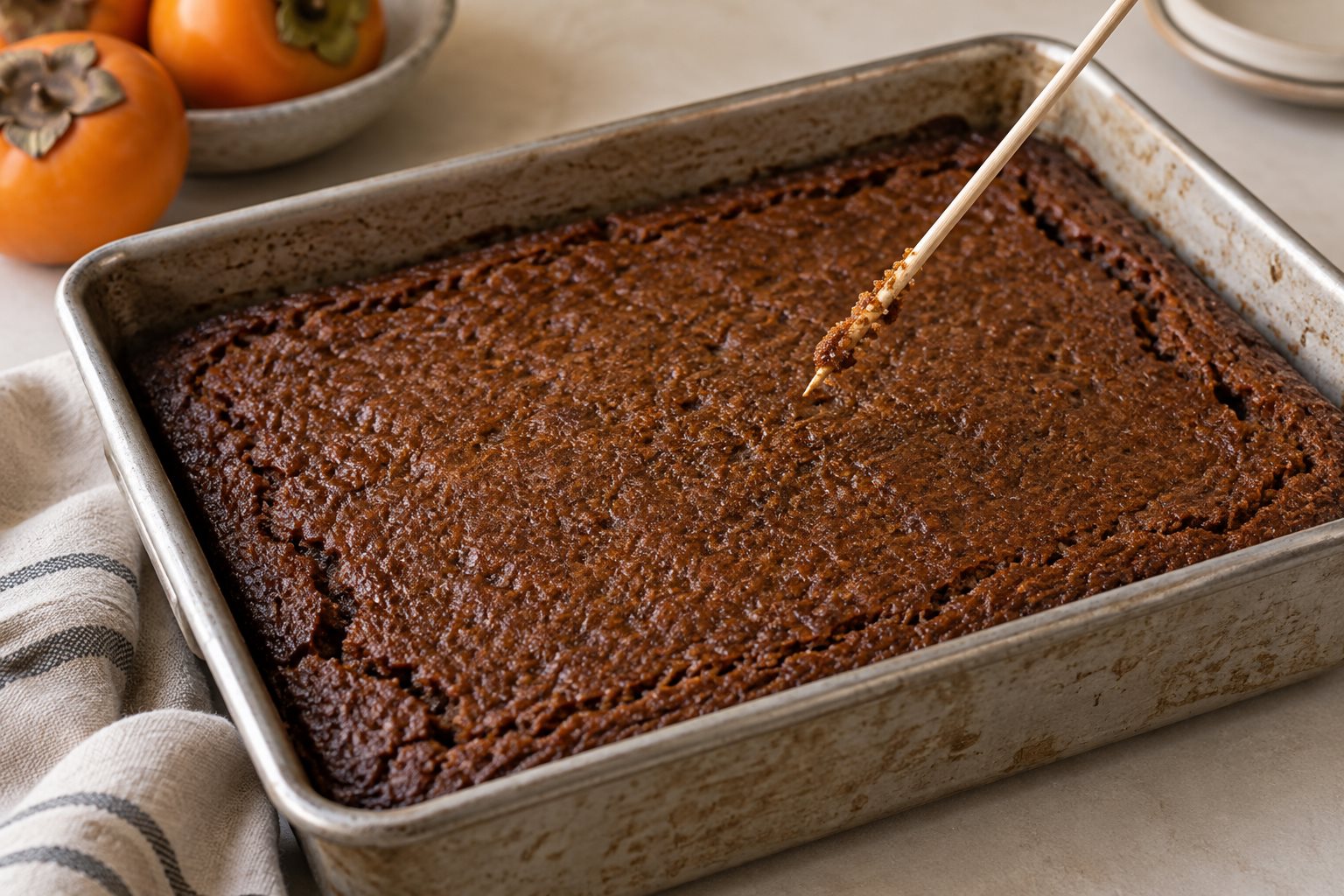
It is supposed to fall. The batter is mostly fruit purée and milk with just enough flour to hold it, so it puffs on the baking powder and sinks as the steam leaves. The sunken, dense, slightly chewy middle is the finished texture, not a failure. Judge it by the edges pulling away and a skewer coming out with damp crumbs.
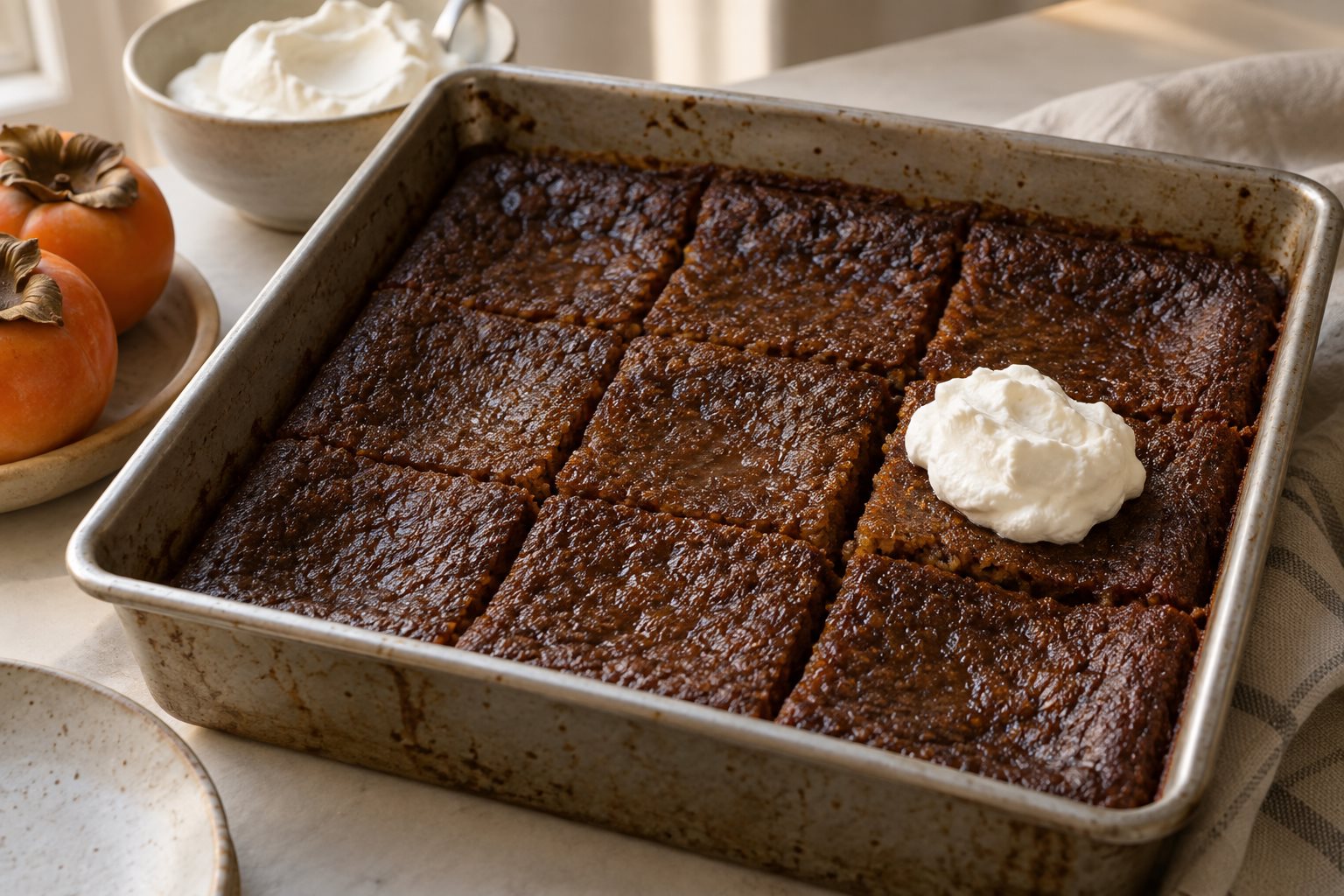
A shallow pan, not a basin. This is called a pudding but it is baked flat and thin, about an inch deep, so a lot of surface caramelises against the buttered pan while the middle stays wet. Bake the same batter in a deep dish and you get a heavy, uniform, faintly gluey cake with none of the edges anyone actually fights over.
Ripeness is the only variable that matters. Tannin in an immature persimmon binds to the proteins in your mouth and that is the pucker. It does not cook out and it does not freeze out; it disappears as the fruit matures. A persimmon ready for this pudding is wrinkled, translucent, and so soft it collapses when you pick it up — the condition at which a supermarket would have thrown it out a week earlier.
The soda is doing chemistry, not leavening. Bulletin 685's half teaspoonful per cup of pulp is there because heat makes any residual astringency more noticeable, and the alkali counters it. It also darkens the pudding, which is why a proper one is nearly black rather than orange. Use it even with fruit you are sure of; the cost of being wrong is an inedible pan.