American cooking Recipes & regional stories

Skillet & Sage

A culinary journey through the fifty states

The regional table / New York

Pastrami on Rye
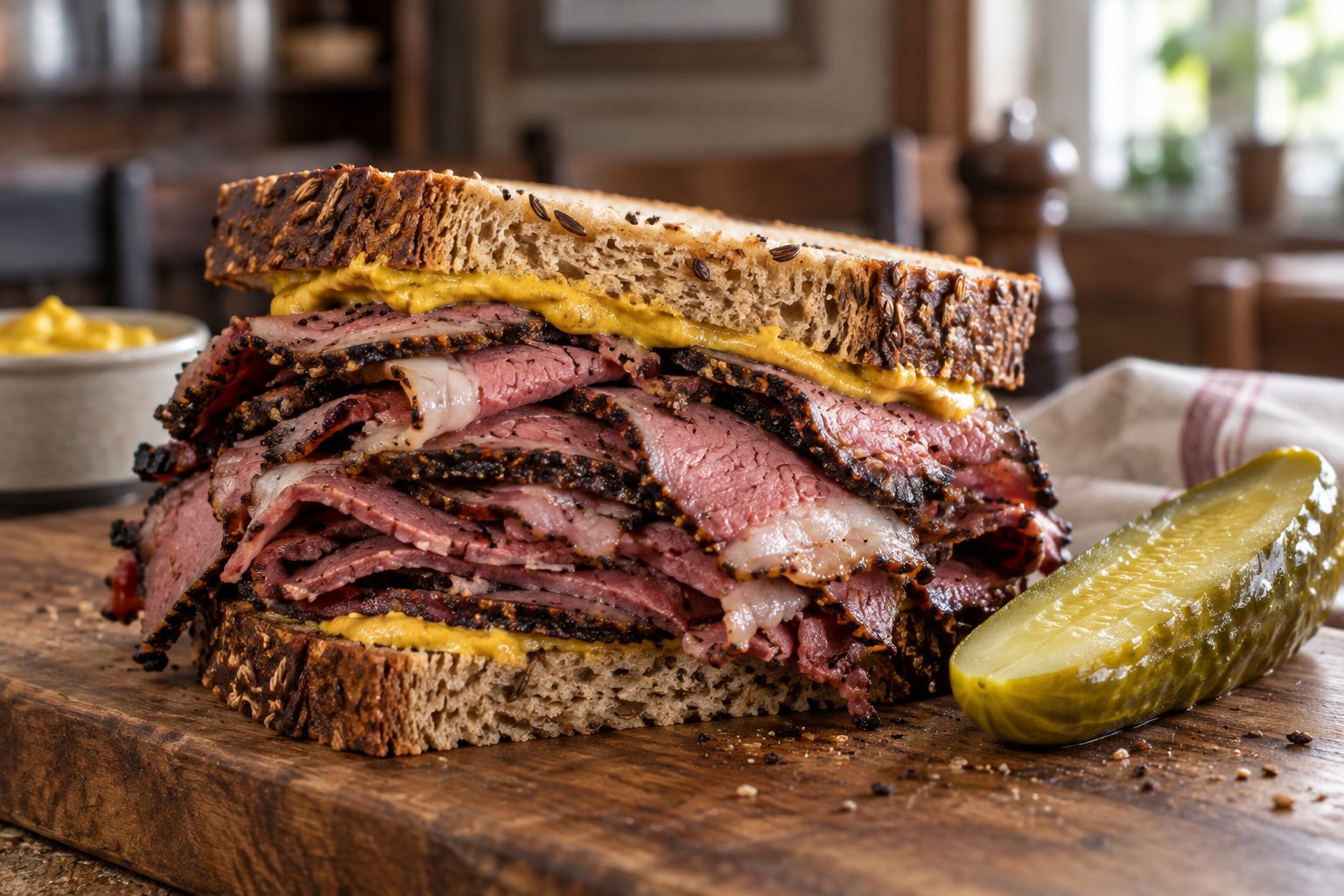
Thick hand-cut slices of peppered pastrami, pink through with a dark crust and a soft fat line, piled on seeded rye with yellow mustard and a dill pickle
The slice should be pink to the edge with the fat gone translucent and the black crust still standing proud of it. Grey meat and a dry crust mean the steam was cut short. AI-generated illustration.

Pastrami is four processes in a row — a cure, a crust, a smoke and a steam — and the one people skip is the steam, which is the one that makes it tender.

The word gets to New York before the sandwich does, and it can be followed in dictionaries. Sir James Redhouse's A Turkish and English Lexicon, London 1890, prints basdirma with the note "vulg. pastirma" and defines it as meat flavored with spices and garlic, and cured under pressure; the verb underneath it, basdirmaq, is to press, and the lexicon gives basdirmaji for the man who makes or sells the stuff. Three years later Frédéric Damé's Nouveau dictionnaire roumain-français, a Romanian dictionary of 1893, has PASTRAMA as "viande salée et séchée à l'air" — meat salted and dried in the air — and thinks the trade around it worth two entries of its own, pastramar for the maker and pastramagiŭ for the seller, that last one still carrying the Turkish suffix. The people who brought the word are in the record too. The Savannah Tribune of 18 June 1892 reprints a special census of the Jews of New York's east side sweaters' district — something more than 111,000 people, of whom it says "All of these were foreigners, most of them Russian, Polish and Roumanian Jews". Ten years later the Macon Telegraph of 18 September 1902 leads its front page with Secretary Hay's appeal to the European powers over Romania's treatment of its Jews and the emigration it was driving. The Immigration Commission's Dictionary of Races or Peoples, 1911, counts Roumanians and Hebrews as two separate races, puts Roumanian immigration for 1890–1910 at 82,704 with 76,755 of those arriving from Austria-Hungary and comparatively few from Romania itself, and lists, in its table of Romania's own population after Reclus, 300,000 Jews among 4,700,000 Roumanians.

For the earliest dated appearance of the food itself, the open archive that answers is Georgia's, which carries syndicated and local advertising from everywhere. Searched under every spelling, it puts the word on an American counter in 1901: the Macon Telegraph of 30 March 1901 runs a grocer's line of bologna, ring, frankfurter, liver wurst and pastroma; the Brunswick Times-Call advertises through that August that there is "Fine pastrama and spiced beef on ice, fresh every Monday at Nussbaum's Delicatessen store", and by 29 September the same paper's list of the store's meats reads "Spiced beef, Smoked beef, Smoked tongue, Rolat, Pastrami" — the modern spelling, in Georgia, in 1901. The Brunswick News has it among the sausages in November 1906, next to knackwurst and corn beef; the Athens Banner of 6 January 1916 goes further and sells "Pastrama Raulade Flanks", which puts the cut in the belly of the animal where it belongs. These are advertisements and not origins: nothing opened here names a shop, a man or a year as the beginning of the dish, so this page names none. What they do show is a word nobody thought needed explaining in 1901 and that American print was still translating half a century later — the Atlanta weekly The Southern Israelite prints "Pastrami — lb. 90c (Spiced Beef)" on 1 April 1938 and "HOT PASTRAMI SANDWICH ON TWIST (Peppered Beef)" on 12 December 1958, and a Georgia menu of 5 February 1959 offers "Kosher Salami or Rumanian Pastrami on Rye" for sixty cents. No pre-1930 printing gives quantities for any of it, so everything below was worked out for this page.

Why this version works

The steam is the step people skip. Smoke gets the meat to 160°F and then stalls, and a navel at 160°F is still a chewy, collagen-bound piece of beef. What turns it is hours between 195°F and 205°F in wet heat: the connective tissue goes to gelatin, the fat between the muscle layers renders, and the crust softens just enough to slice instead of shattering. Push it to that temperature in the dry smoker instead and you get the same number on the thermometer with a dried-out, sooty slab attached to it.

Nitrite does three jobs and has a legal ceiling. It fixes the colour that makes pastrami pink instead of grey, it gives cured meat its particular tang, and it is the thing standing between a week-long cure and the bacteria a long low smoke would otherwise suit. 9 CFR 424.21(c) sets the terms: for a dry cure, 1 ounce of sodium nitrite to 100 pounds of meat, and in no case more than 200 ppm calculated as sodium nitrite in the finished product. The same regulation orders that supplies of it be kept under the care of a responsible employee and their nitrite content clearly marked, which tells you what sort of substance it is. Weigh it, never scoop it, and use only the diluted curing salt sold for home use.

The crust goes on dry meat, after the cure comes off. Coriander and black pepper cracked coarse and pressed onto a rinsed, air-dried slab make a shell that smoke sticks to and that survives hours of steam. Ground spice does not: it dissolves into the wet surface, goes bitter over a long smoke and washes off in the steamer. The cure is rinsed and the meat soaked first because a slab salted for a week has a rim far saltier than its middle, and an hour in cold water evens that out.

The cut is the belly, and the federal papers say so twice. USDA's Institutional Meat Purchase Specifications for fresh beef, Series 100, make item 120A — the brisket flat — the M. pectoralis profundi alone, trimmed practically free of fat, which is exactly the wrong piece of meat for a week of curing and a day of heat. The plate items, 121 and 122, are the belly: the full plate is the short plate and brisket intact. And 9 CFR 319.100, the corned beef standard, spells out the cuts cured beef is made from — "beef briskets, navels, clods, middle ribs, rounds, rumps, or similar cuts". Navel is a curing word: the purchase specification for fresh beef uses it exactly once, in its glossary, as a direction marker for which way is up.

Ingredient notes

Rye: a dense seeded deli rye, cut thick enough to hold a pile of hot meat without going to pulp, and yellow mustard. Sourdough rye is better than the soft sandwich kind because the crumb is tight. Nothing else belongs on it: the bread is there to keep your hands off the meat.

Beef: a five-pound piece of beef navel — the trimmed boneless short plate, IMPS item 121B — is the cut to ask a butcher for, and deckle-on brisket point, item 120B, is the substitute sold everywhere. Leave a quarter inch of fat on the outside. Do not buy the flat: that is the lean muscle the specification isolates as item 120A, and a week of cure and nine hours of heat leave it dry however carefully you cook it.

Spice: whole coriander seed and whole black peppercorns in roughly equal measure, toasted dry for a minute and then cracked in a mortar or under a pan — coarse, not powder. Mustard seed and garlic powder fill it out. Garlic powder rather than fresh garlic here because fresh cloves burn on the outside of a slab that sits in smoke for five hours.

Curing salt: the pink pre-diluted mixture sold for home curing, one level teaspoon to five pounds of meat, weighed rather than guessed. Read the percentage of sodium nitrite printed on the packet and follow the maker's ratio; at the strength these are usually sold, a teaspoon to five pounds puts the meat well under the 200 ppm ceiling of 9 CFR 424.21. Never substitute undiluted sodium nitrite, and keep it away from the table salt.

Step by step

  1. Trim and weigh. Square the navel or the brisket point and trim the fat cap to about a quarter inch. Weigh the meat — the cure is measured against it, not against the recipe. Five pounds is the size this is written for.
  2. Dry-cure a week. Mix the kosher salt, brown sugar, curing salt, 1 tablespoon of the cracked coriander and 1 tablespoon of the cracked pepper. Rub every face of the meat, seal it in a bag with whatever mix falls off, and refrigerate 7 days, turning it over each day. It will firm up and darken; that is the cure working through.
  3. Rinse and soak. Take it out, rinse the cure off under cold water, and soak the slab in a bowl of cold water for 1 hour, changing the water once. Pat it dry and leave it uncovered on a rack in the fridge for 2 to 4 hours until the surface is dry and tacky to the fingers.
  4. Crust it. Combine the remaining coriander and pepper with the mustard seed and garlic powder and press the mixture onto every surface, hard, until no meat shows through. Do not shake off the excess.
  5. Smoke. Smoke at 250°F over oak, cherry or hickory until the centre reads about 160°F, roughly 5 hours for a five-pound slab. Look at the crust rather than the clock: it should be set and dark, and it should not be brushed or basted at any point.
  6. Steam. Move it to a rack over an inch of simmering water in a covered roasting pan, or into a steamer, and steam 2 to 3 hours until a probe slides into the thickest part with no resistance at all and the centre reads 200–205°F. Tenderness is the test; the number only confirms it.
  7. Rest, slice and build. Rest the slab 30 minutes under foil. Find the grain, turn the knife across it, and cut slices about an eighth of an inch thick, angling the blade on the fattier end. Pile 5 to 6 ounces onto rye spread with mustard, close it, and serve it while the fat is still soft.
If it is tough, it is undercooked rather than overcooked, and the fix is more steam: put it back over the water for another 45 minutes and test with a probe rather than a thermometer. If it tastes too salty, slice it thinner, skip the pickle and serve it on plain rye — and next time soak the rinsed slab for 2 hours instead of 1, changing the water twice. If the crust fell off in the steamer, it went on wet meat; the surface has to be dry and tacky before the spice touches it.

Storage and make-ahead

Keep the slab whole and unsliced, wrapped tight, for 5 days in the fridge or 3 months frozen. Slicing it in advance dries the cut faces and costs you the thing you spent a week making.

Reheat by steaming, 30 to 45 minutes from cold, never in a microwave and never in a dry oven — both drive out the moisture the steam put in and turn the crust to grit. Chilling a finished pastrami overnight and steaming it again before serving is no loss at all; the slices come off cleaner cold-firm than hot.

What to serve with it

Half-sour pickles, yellow mustard and something sharp and fizzy. Chicken soup on the side if you are making a meal of it, and coleslaw if you must, but next to the sandwich rather than inside it.

Leave sweetness off the plate entirely — the cure is already carrying sugar, and a sweet relish or a honey mustard flattens the coriander and pepper that the whole crust was built for.

Thick hand-cut slices of peppered pastrami, pink through with a dark crust and a soft fat line, piled on seeded rye with yellow mustard and a dill pickle

From the recipe box / New York

Pastrami on Rye

A beef navel cured a week with salt and nitrite, crusted in cracked pepper and coriander, smoked to 160°F and then steamed for hours until it gives — the last step being the one everybody leaves out.

Prep
45 min
Cook
8 hr
Total
8 days
Serves
8
Calories
585 per serving

Ingredients

Scale

Instructions

  1. Trim the fat cap to 1/4 inch and weigh the meat; the cure below is measured for 5 pounds.
  2. Mix the kosher salt, sugar, curing salt and 1 tablespoon each of the coriander and pepper, rub it over every face, bag it and refrigerate 7 days, turning daily.
  3. Rinse off the cure, soak the meat 1 hour in cold water with one change, then dry it uncovered on a rack in the fridge 2–4 hours.
  4. Press the remaining coriander and pepper with the mustard seed and garlic powder onto every surface until no meat shows.
  5. Smoke at 250°F to an internal 160°F, about 5 hours, without basting.
  6. Steam over simmering water 2–3 hours, to 200–205°F and until a probe meets no resistance.
  7. Rest 30 minutes, slice 1/8 inch thick across the grain, and pile 5–6 ounces on mustard-spread rye.

Nutrition

Fat33 g (12 g saturated)
Sodium1780 mg
Protein38 g
Serving1 sandwich
Calories585
Cholesterol105 mg
Carbohydrates34 g (4 g sugar, 4 g fiber)

Nutrition is an estimate calculated from the listed ingredients and is provided as a courtesy, not as dietary advice.

Questions readers ask

Can I use a brisket flat?

You can cure and smoke one, and people do, but it is a different and drier sandwich. USDA's specification isolates the flat as item 120A, the deep pectoral muscle alone trimmed practically free of fat, while the cured-beef standard at 9 CFR 319.100 lists navels among the cuts cured beef is made from. Fat between muscle layers is what survives nine hours of heat. If the flat is all you can get, cut the steam short at the first sign of tenderness and slice it thinner.

Which delicatessen invented it?

No document opened for this page names one, and the ones that get named in the usual retellings are not in anything reachable. What the record gives is a word already ordinary on American counters in 1901 — a Macon grocer's list on 30 March and a Brunswick delicatessen advertising "Fine pastrama and spiced beef on ice" that August — and two dictionaries older still, Redhouse in 1890 and Damé in 1893. That is where this page stops.

Is the pink curing salt necessary?

For this method, yes. A week in the fridge followed by five hours between 100°F and 160°F is the condition nitrite exists to cover, and it is also what makes the meat pink and gives it the cured flavour. It is regulated because it is potent: 9 CFR 424.21(c) allows 1 ounce of sodium nitrite per 100 pounds of meat in a dry cure and caps the finished product at 200 ppm, and requires processors to keep their supplies marked and under the care of a responsible employee. Buy the diluted pink mixture, weigh it, and leave the undiluted chemical alone.

No smoker — can I still make it?

Yes, with a loss you should know about. Cure and crust it the same way, then cook it uncovered on a rack at 250°F until it reads 160°F, and steam it exactly as above. You get a peppered, cured, genuinely tender steamed beef and no smoke, which is closer to corned beef with a spice crust than to pastrami. A covered kettle grill with a handful of wood chunks off to one side gets you most of the way for the price of an hour's attention.