The regional table / New York
New York Cheesecake
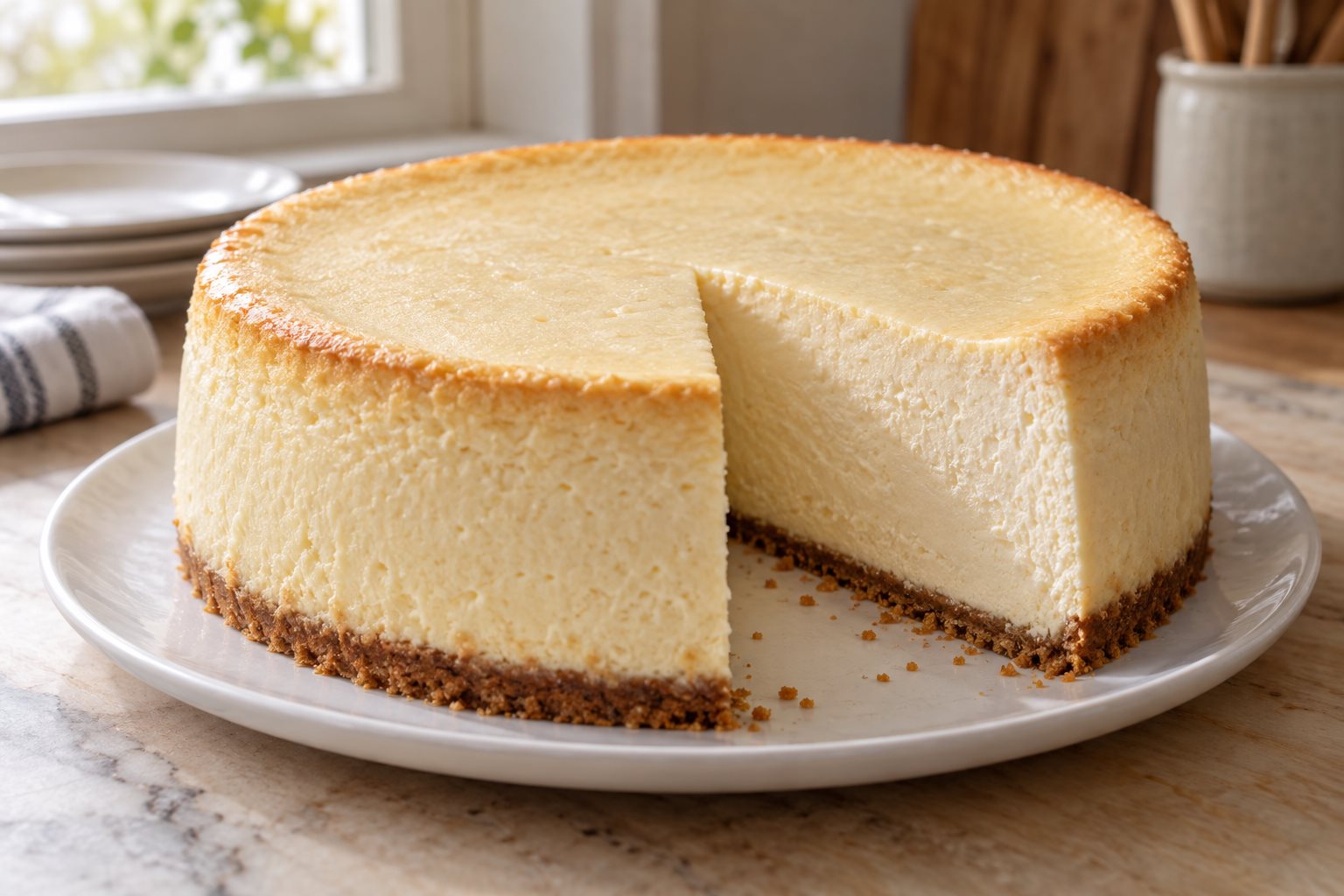
Cream cheese is not an ingredient in this cake so much as the whole of it, and the federal government has written down exactly what it must be.
Everything this cake does is set by one manufactured American product, and that product has a legal definition you can read. 21 CFR 133.133, the standard of identity for cream cheese, calls it "the soft, uncured cheese" whose "minimum milkfat content is 33 percent by weight of the finished food, and the maximum moisture content is 55 percent by weight". Two numbers, and between them they describe your batter: a block sitting at the legal extremes is a third fat and more than half water, which leaves barely a tenth of it for the protein and milk sugar that have to hold a baked custard together. The same section allows stabilizers up to half a percent of the finished weight, which is the gum in the brick and the reason a supermarket block is firmer than anything you could drain at home. Two sections nearby draw the other boundaries. Neufchatel, at 133.162, is "not less than 20 percent but less than 33 percent" milkfat with a maximum moisture of 65 percent — ten points more water, which is precisely why a cheesecake built on it weeps. Dry curd cottage cheese, at 133.129, "contains less than 0.5 percent milkfat" and not more than 80 percent moisture. That last one matters here, because it is what the older American cheesecakes were made of.
The cream cheese itself is documented as a factory product well before any restaurant claim. USDA Bureau of Animal Industry Bulletin 146, Doane and Lawson's Varieties of Cheese: Descriptions and Analyses of 1911, describes a cream cheese moulded into pieces of two to four ounces, wrapped in tin foil, sold uncured, and "manufactured on an extensive scale by a few large factories in the United States"; it adds that in this country the stuff "is usually sold under some trade name, such as Philadelphia Cream", and its entry for that name says only, and usefully, that it is "an ordinary cream cheese put up by a firm in New York State", 3 by 2½ by 1¼ inches, in parchment and foil. The same bulletin files cottage cheese as a sour-milk cheese "often called Dutch cheese, and Smearcase". Now look at what American cookbooks were calling cheesecake while that was on sale. Jennie June's American Cookery Book, New York 1878, prints eight cheese cakes — rice twice, English, apple twice, bread, cocoanut, almond — and not one of them contains cheese of any kind; they are tartlets baked in patty pans, and the name means the shape. Mrs Lincoln's Boston Cook Book of 1883 has no cheese cake at all, and its only "cream cheese" is in a Welsh rarebit that tells you to "break the cheese in small pieces, or if hard grate it". Fannie Farmer's Boston Cooking-School Cook Book of 1896 does print Cheese Cakes, and you make the cheese yourself: "Scald sweet and sour milk, strain through cheese cloth. To curd add sugar, yolks of eggs slightly beaten, lemon, and salt." The International Jewish Cook Book of 1918 has three — a Hungarian one, a Cheese Cake or Pie, and a Covered Cheese Cake — and every one of them is pot cheese, even though cream cheese is elsewhere in the same book, sold by the cake and by the package, in the salads and the sandwiches. A Nebraska farm column in the Gordon Journal of 6 January 1927 still calls the dessert "old fashioned Dutch cheese cake" with a foundation of cottage cheese. As for the name: the Second Circuit, ruling on 7 May 1959 in Kitchens of Sara Lee, Inc. v. Nifty Foods Corporation, lists "cream cheese cake" among "familiar bakery products" sold frozen, and does not call it a New York anything. The earliest dated print of the phrase this page could verify in an open archive is a restaurant bill of fare in the Boynton Beach News Journal of 17 December 1970, where the dessert line reads "New York Cheese Cake with Strawberries"; the earliest verified in Georgia's archive is 12 August 1977. Nebraska's archive, which returns 131 pages for "cheese cake" across a run reaching 1996, returns none at all for the phrase under either spelling. The famous delicatessen and restaurant claims of the 1920s and 1930s are claims: nothing opened for this page names a founder, a house or a year, so this page names none, and the quantities below were worked out for this page.
Why this version works
Cornstarch is insurance against the egg. Five eggs in a two-pound cheesecake set it firm, and left to themselves they will also curdle it: the proteins tighten, squeeze out the water the cream cheese was holding, and you get a grainy cake with a crack down the middle. Three tablespoons of starch get between those proteins, raise the temperature at which they seize and hold the released water in suspension. This is the same job flour does in Farmer's custards, done with less flavour of its own.
The set finishes in the refrigerator, not in the oven. A cheesecake pulled at 150°F in the middle looks underdone and is not. Milkfat is solid at refrigerator temperature and liquid at oven temperature, and it is the hardening fat, not the egg, that gives the cold cake its density and its clean slice. Chilling is a cooking step here in a way it is not for any other cake, which is why every instruction below that sounds like patience is actually chemistry.
The standard of identity is the specification for the batter. At 33 percent milkfat and 55 percent moisture, two pounds of cream cheese bring roughly ten ounces of fat and seventeen of water into the pan. The fat is what makes the crumb close and short instead of spongy; the water is what has to be driven gently, because it is the majority of the block and it will boil if you hurry it. Buying the full-fat brick rather than the tub or the reduced-fat one is not fussiness. The tub is whipped with air and extra water, and Neufchatel is legally allowed 65 percent moisture against cream cheese's 55 — the difference shows up as a puddle on the plate.
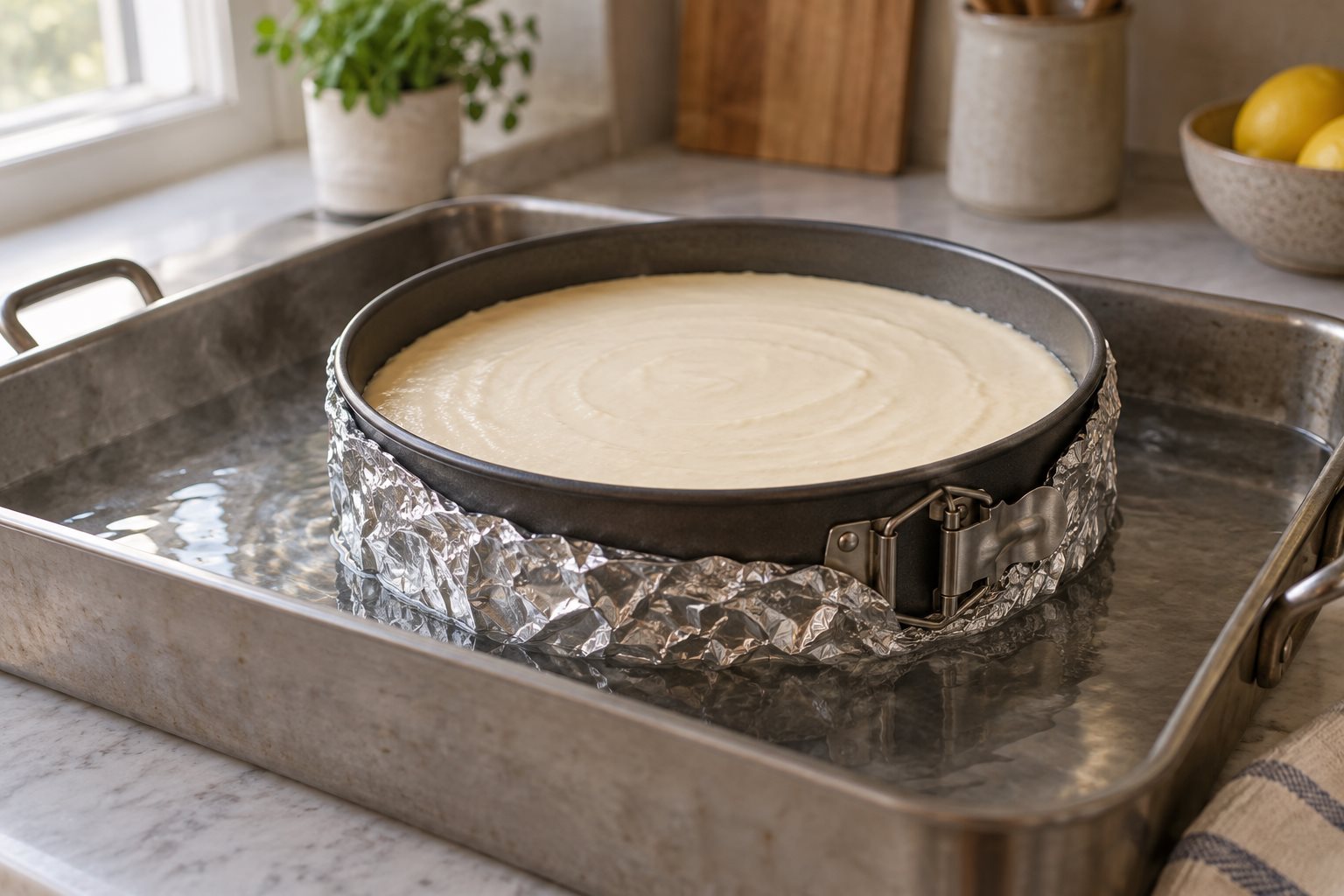
A low oven and a water bath, because the batter is mostly water. A pan of water in a 325°F oven cannot get above the boil, so the outside of the cake climbs slowly and the middle catches up before the rim overcooks. Bake it dry and hot and the edge sets, then keeps setting, then dries and pulls away from the tin while the middle is still liquid — and the crack you get is the skin tearing as the shrinking edge drags on it. Wrap the springform tightly, use hot water, and take the cake out while the centre still moves.