American cooking Recipes & regional stories

Skillet & Sage

A culinary journey through the fifty states

The regional table / Connecticut

New Haven White Clam Apizza
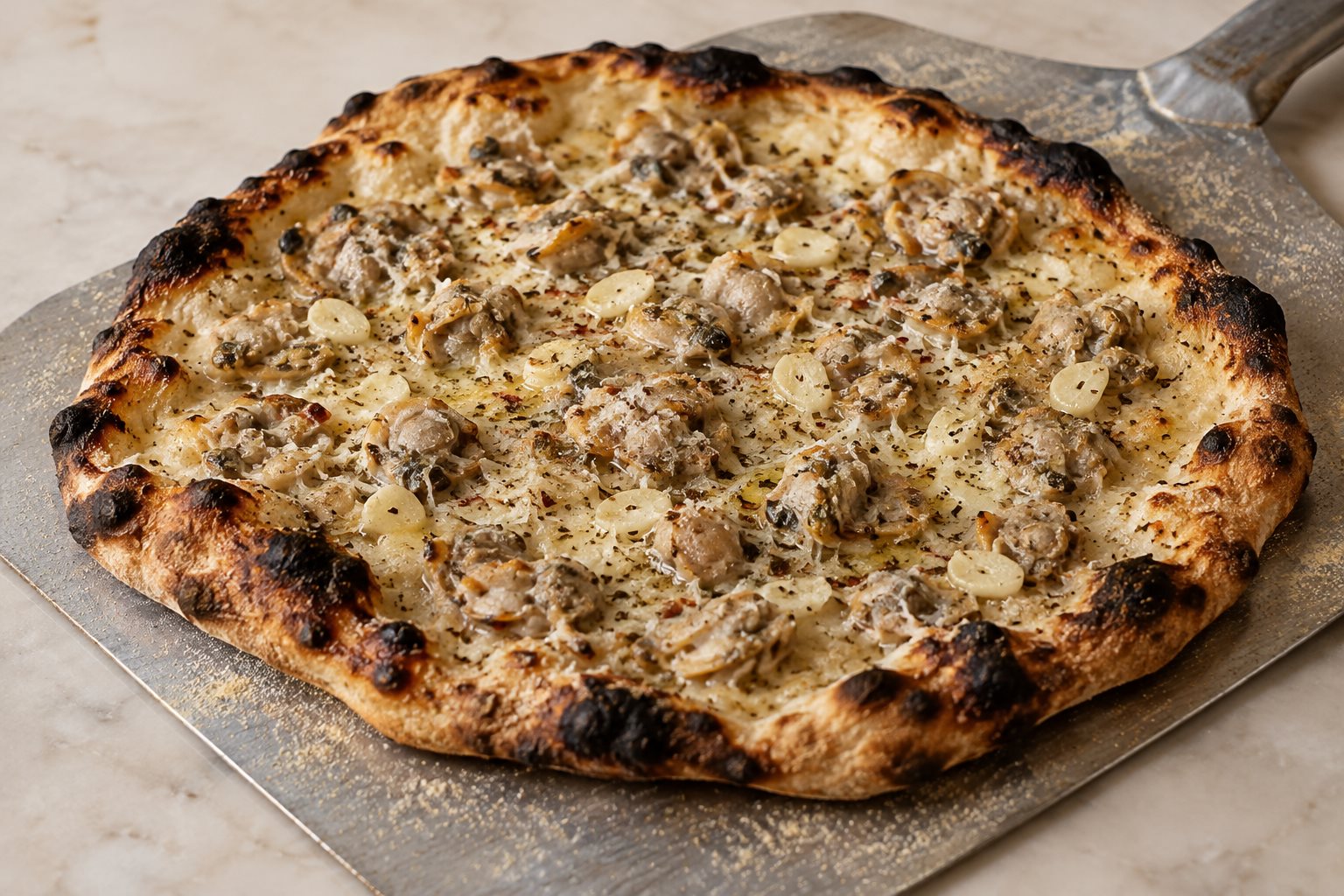
A charred, irregular oval pizza on a metal peel, scattered with shucked clam meat, sliced garlic and oregano, with no tomato sauce and dark blistered edges
The char is not a mistake. Look for black blisters on the rim and a floor that has gone the colour of a chestnut; anything paler than that was baked in too cool an oven. AI-generated illustration.

Every argument about this pie is really an argument about one word, and the word is dated: a Connecticut advertisement of December 1937 prints apizza and then explains it, in the same breath, as an Italian tomato pie.

The document that settles the vocabulary is an advertisement in the Branford Review and East Haven News of 23 December 1937. It reads, in full: "APIZZA. Come in and order one of our delicious tempting and tasty ITALIAN TOMATO PIES. 25c and 50c. RUSSO'S PIZZERIA, 668 Main St. East Haven." That is the whole shape of the thing in six lines. The word apizza is the headline, which means it is the word a New Haven-area reader would stop on; the gloss underneath it, "Italian tomato pies", is there because the editor could not assume the rest of the readership knew. Two sizes, a quarter and a half dollar. And the establishment calls itself a pizzeria while selling apizza, which is how the two spellings have lived side by side ever since. The same paper carries the other half of the story on 16 February 1939, and it is not an advertisement at all — it is a women's bowling league report. The team broke its record at the Elks alleys in New Haven, and "to celebrate this gala occasion, the girjs decided they would try Pepe's famous apizza in Woostcr Street." The OCR is rough; the page is not. That is a dated, third-party, non-commercial printing that puts Pepe, apizza and Wooster Street in one sentence in 1939, and calls the pie famous already. The shop's own founding date of 1925 is not testable against anything I could open: no New Haven daily is digitised far enough back in the archives that answer a script, and the word apizza does not appear anywhere in this collection before that December 1937 advertisement.

The clam is a federal document. Section V of The Fisheries and Fishery Industries of the United States, printed by the Government Printing Office in 1887, carries the clam fisheries chapters, and they were written by Ernest Ingersoll, listed on the contributors' page as of New Haven, Connecticut. On the Connecticut coast he reports about 25,000 bushels of quahaugs sent to market every year and about as many again eaten at home, dug by men he says are "locally known as proggers" who help the oystermen in winter and go clamming in summer; the hard clams, he adds, are found over a wider area than formerly "but in far less quantity". He also explains the word this recipe depends on. Little Neck is a bay on the north shore of Long Island, and the clams taken there "are most esteemed when about the size of a quarter-dollar, and are usually eaten raw" — but small quahaugs from anywhere else, he writes, "pass as Little Necks, however, by the market-men". By 1880 the place name had already become a size grade, which is exactly what it still is. Connecticut's own law has never caught up: chapter 491 of the General Statutes fixes a minimum length of one and a half inches for long clams and a recreational limit of half a bushel a day, and the hard clam turns up in the whole chapter only inside a note on legislative history. One more thing is worth saying plainly, because it is a verified absence rather than a guess: the phrases "white clam pizza" and "clam pizza" return zero hits in the Georgia Historic Newspapers corpus, which indexes reprints from all over the country, and "clam apizza" returns zero in the New Haven-area collection searched here. Whoever first put clams on this dough did it without a newspaper noticing.

Why this version works

No tomato, and therefore no water. A tomato pie protects itself: the sauce boils, steams, and the crust underneath finishes soft. Take the sauce away and the only liquid on the dough is the clam liquor, which is a few teaspoons and evaporates in the first minute. That is why a white pie can be baked darker and thinner than a red one without going soggy, and why the char reads as flavour rather than as damage.

Grated hard cheese, not melting cheese. Mozzarella throws moisture and covers everything in a sheet. A dry grating cheese browns in spots, seasons the oil, and leaves the clams visible and separate. The New Haven pie is defined as much by what it does not have on it as by what it does, and a plain white pie in that city has always meant no mozzarella unless you ask.

Clams shucked raw, opened over the dough. Steaming the clams open first cooks them once and the oven cooks them twice, which is how they turn to erasers. Shuck them raw, let the liquor fall onto the crust, and they get roughly ninety seconds of real heat. The 1887 survey is unsentimental about why the small ones: littlenecks are graded small, eaten raw, and tender at that size in a way a chowder quahaug never is.

The hottest floor you own, and no more than that. A coal oven runs far above anything domestic and bakes this pie in about four minutes. You cannot have that. What you can have is a steel or stone preheated for a full hour at the top of the range, which gets you a dark floor in eight to ten minutes. The compromise is deliberate: a longer bake at a lower heat dries the clams, so keep the pie thin and the topping sparse to shorten the time it needs.
Ingredient notes

Clams: two dozen littlenecks, the smallest hard clams your fish counter sells, and they must be shucked raw. Keep every drop of the liquor in a bowl and let the grit settle; pour off the clear part and leave the last spoonful behind. If shucking raw defeats you, put them in the freezer for fifteen minutes first — the muscle relaxes and the knife goes in.

Cheese: pecorino romano, grated fine, about half a cup. Parmigiano is milder and perfectly good; what does not belong is anything that melts into a blanket. Use a light hand — the clam liquor and the cheese are both salt, and together they can bury the shellfish.

Flour and time: bread flour and a cold overnight rise. The dough wants strength to be stretched thin without tearing and it wants the flavour that only a long slow fermentation gives, because there is no sauce here to hide behind. A same-day dough will work and will taste like less.

Oregano and oil: dried oregano, not fresh, crumbled between the palms as it goes on, and a good olive oil both under the toppings and over the pie as it comes out. This is a four-flavour dish and there is nowhere for a stale herb or a tired oil to hide.

Step by step

  1. Mix the dough and leave it alone. Stir the flour, yeast and salt together. Add the water and the tablespoon of oil and mix to a shaggy mass. Knead 6 to 8 minutes until it is smooth and elastic, then oil a bowl, turn the dough in it, cover, and refrigerate 24 to 48 hours. Two hours before baking, divide it into two balls, set them on a floured tray, cover, and let them come to room temperature.
  2. Heat the oven as hot as it will go. Put a baking steel or stone on the upper-middle rack and heat the oven to its maximum, 550°F if it reaches that, for a full hour. Do not shortcut this. The stored heat in the steel is the whole bake.
  3. Shuck the clams. Open the clams raw over a bowl, freeing the meat from both shells and catching the liquor. Let the liquor stand a few minutes, then pour the clear part into a small dish and discard the gritty last of it. Chop any clams larger than a bottle cap in half; leave the rest whole.
  4. Stretch, do not roll. Flour the peel with semolina. Press one dough ball flat from the middle outward, leaving the last half inch thick, then stretch it over your knuckles to a thin oval about 14 inches long. Thin enough to see light through the middle is right. Slide it onto the peel and shake once to be sure it moves.
  5. Dress it fast. Brush the surface with 1 tablespoon of the olive oil. Scatter the garlic, then the clams, then a spoonful of the reserved liquor, then the oregano and the pecorino. Work quickly — a dressed dough that sits on the peel for two minutes will weld itself to it.
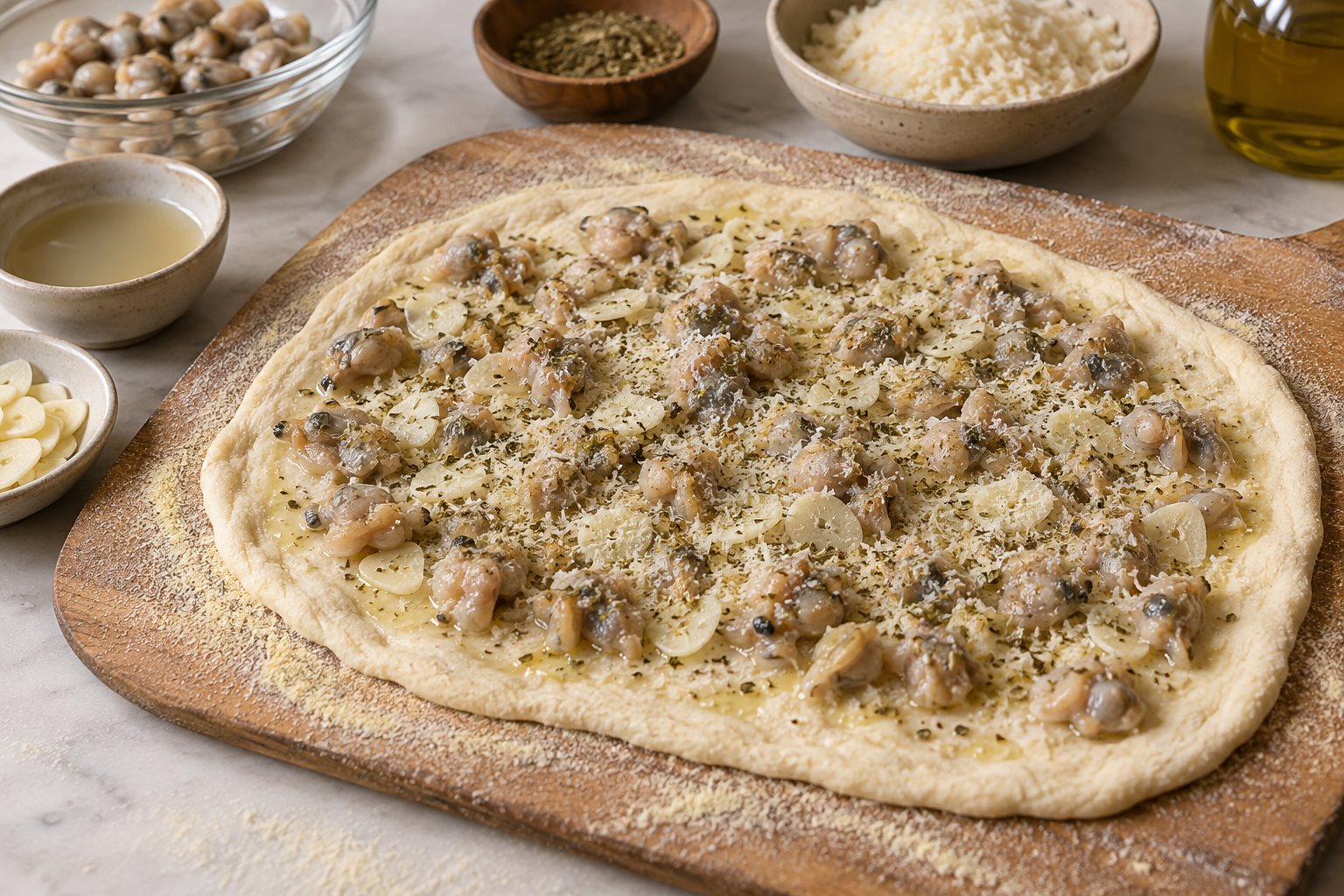
    Raw shucked clam meat, thin garlic slices, oregano and grated pecorino spread over an unbaked oval pizza.
    Dress the stretched dough quickly with shucked clams, garlic, oregano and pecorino. AI-generated illustration.
  6. Bake dark. Slide the pie onto the steel and bake 8 to 10 minutes, until the rim is blistered black in places and the underside is uniformly brown. Finish with the remaining oil and, if you want it, the crushed red pepper. Cut it into irregular pieces with shears and eat it standing up while you stretch the second one.
If the pie sticks to the peel halfway through the launch, do not pull it back — push the peel all the way in, let the front half touch the steel and set for five seconds, then jerk the peel out from under the rest. It comes out misshapen and it bakes fine. If the clams have gone rubbery and the crust is still pale, the oven was not hot enough and no amount of extra time will fix that pie: bake the second one with the toppings halved and the pie a minute shorter, and scatter the clams on in the last three minutes instead of at the start.

Storage and make-ahead

Cold, the next day, straight from the refrigerator is the traditional treatment and it is genuinely good — the crust firms up and the clams read as a salad. If you want it hot, use a dry skillet over medium heat with a lid for 3 minutes rather than an oven, which dries the shellfish out completely.

The dough keeps better than the pie. It will sit in the refrigerator for up to three days, improving for the first two, and it freezes in balls for a month. Clams do not keep once shucked: open them within an hour of baking and not before.

What to serve with it

Nothing rich, because the pie is already salt and oil. A sharp escarole salad with lemon and a lot of black pepper is the right foil, and so is a plate of raw littlenecks alongside if you bought extra. To drink, something cold, dry and unambitious — a pilsner, or a white with enough acid to cut through the pecorino.

A charred, irregular oval pizza on a metal peel, scattered with shucked clam meat, sliced garlic and oregano, with no tomato sauce and dark blistered edges

From the recipe box / Connecticut

New Haven White Clam Apizza

A thin, blistered, coal-dark crust with no tomato on it at all: littleneck clams shucked raw over the dough, their liquor, garlic, oregano, grated cheese and olive oil.

Prep
40 min
Cook
10 min
Total
24 hr 50 min
Serves
4
Calories
605 per serving

Ingredients

Scale

Instructions

  1. Mix the flour, yeast, salt, water and 1 tablespoon of the oil, knead 6–8 minutes, and refrigerate 24–48 hours. Divide into two balls and warm 2 hours before baking.
  2. Heat a baking steel or stone on the upper-middle rack at the oven's maximum, up to 550°F, for a full hour.
  3. Shuck the clams raw over a bowl, settle and decant the liquor, and halve any clams larger than a bottle cap.
  4. Stretch one ball by hand to a thin 14-inch oval on a semolina-floured peel, leaving the rim thicker.
  5. Brush with 1 tablespoon oil, then scatter on the garlic, clams, a spoonful of liquor, the oregano and the pecorino.
  6. Bake 8–10 minutes until the rim blisters black in places, finish with the remaining oil and the red pepper, and cut into irregular pieces.

Nutrition

Fat18 g (5 g saturated)
Sodium1480 mg
Protein25 g
ServingA quarter of one 14-inch pie
Calories605
Cholesterol30 mg
Carbohydrates82 g (2 g sugar, 3 g fiber)

Nutrition is an estimate calculated from the listed ingredients and is provided as a courtesy, not as dietary advice.

Questions readers ask

Where is the mozzarella?

Off, unless you ask for it. A plain white apizza in New Haven means grated hard cheese, oil, garlic and oregano; mozzarella is an extra you order onto it. Both versions exist and neither is wrong, but the pie described here is the one without, because mozzarella's moisture works directly against the dry, dark crust that the absence of tomato makes possible.

Can I use canned or frozen clams?

You can make a pleasant pie with them and it will not be this one. The whole argument for the dish is a raw clam given about ninety seconds of ferocious heat, which is only possible if it was never cooked before it went on. If fresh littlenecks are genuinely unavailable, drain canned whole baby clams thoroughly, pat them dry, and add them for the last three minutes only.

Is it really spelled apizza, and how is it said?

The spelling is documented and local: an East Haven advertisement of 23 December 1937 puts APIZZA in capitals as the headline of a pizzeria's notice and then explains it to the reader as an Italian tomato pie. The pronunciation usually given in New Haven is roughly ah-BEETS, which is a southern Italian shape of the word; that part is oral tradition rather than something any of the documents here writes down, so take the spelling as evidence and the sound as local practice.

Was this invented at a particular shop in a particular year?

Nothing I could open proves it. The Branford Review of 16 February 1939 calls Pepe's apizza on Wooster Street famous, which is real dated evidence for the shop and the street, but it says nothing about clams; and the phrases "clam pizza" and "white clam pizza" appear zero times in the large Georgia newspaper corpus that reprints from across the country. The clam pie is plainly a New Haven dish. Its birthday is not on any record reachable from here, and this article will not invent one.