American cooking Recipes & regional stories

Skillet & Sage

A culinary journey through the fifty states

The regional table / Louisiana

Muffuletta
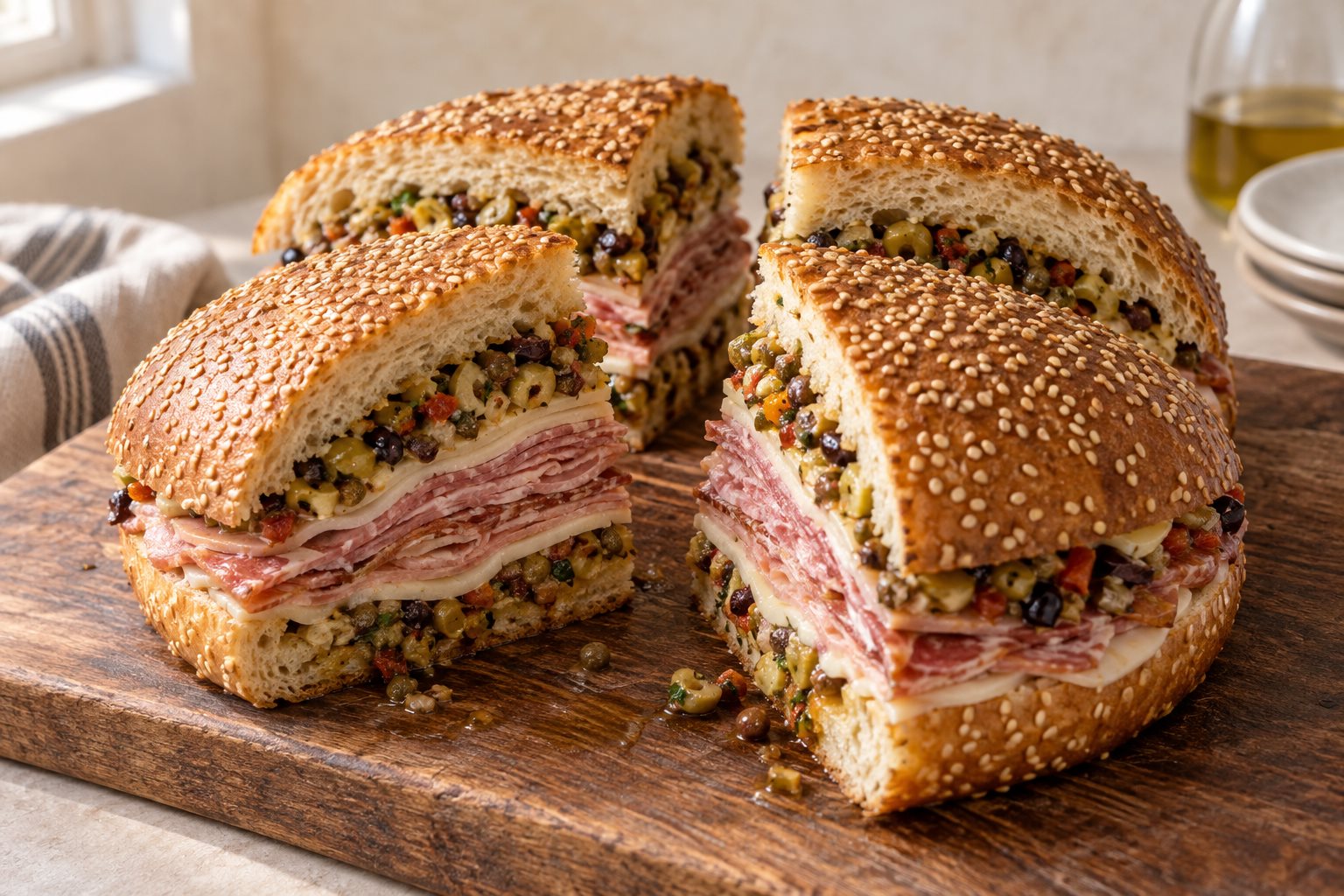
A round sesame-seeded loaf cut into four quarters on a board, each quarter showing layers of provolone, salami, mortadella and capicola under a thick line of chopped olive salad
The crumb at the cut edge should be stained olive-green and slightly translucent where the oil went in. Pale bread means it was not pressed long enough. AI-generated illustration.

Nothing here is cooked. The work is a day of waiting for the olive salad and two hours of weight on the loaf, and both of them are doing something you can taste.

The earliest dated appearance of the word that could be reached for this article is not from 1906 and not from a New Orleans paper. It is a United Press International column by Royal Brightbill, headed New Orleans muffuletta home, printed in the Griffin Daily News of Griffin, Georgia on 29 July 1976. It gives the sandwich in a single sentence — slices of provolone cheese, Genoa salami and Italian ham topped with a freshly made, well-seasoned olive salad and tucked between slices of the special muffuletta loaf, a 10-inch crusty disc sprinkled with sesame seeds — and prices it at about $2.40 for a sandwich that feeds two adults. Five spellings were searched to find it: muffuletta, muffaletta, muffeletta, muffoletta and mufaletta. Louisiana has no newspaper archive that answers a script at all, so an earlier printing almost certainly exists in New Orleans and could not be opened from here; what follows is dated to what was actually read.

That column is also the reason the famous origin claim is not repeated here. Frank Tusa, co-owner of Central Grocery on Decatur Street opposite the French Market, is quoted in it, and the reporter notes the sign out front identifying the shop as the home of the original muffuletta. But the column says in its own voice that no one is quite sure who created the sandwich, although it is generally agreed it came into being about the turn of the century. No year and no inventor — from the shop that claims it, in print, in 1976. What is documented, and federally, is why there was a Sicilian grocery opposite that market to begin with. The Immigration Commission printed its Reports in 1911, and Part 24 of Immigrants in Industries, Recent Immigrants in Agriculture, gives a whole chapter to Kenner, Louisiana, ten miles west of the city: 150 Italian families, all of them natives of Sicily, on farms of two to ten acres. Some of the Italians, the report says, drive into New Orleans during the night with loads of produce and take their stands in the Old French Market ready for the morning trade. The same volume calls Sicilians among the least desirable of all South European immigrants now coming to the United States, and then concedes in the next clause that their success in Louisiana warrants a more careful consideration. That is the neighborhood this sandwich comes out of, and that is what the federal record thought of the people who built it.

Why this version works

The olive salad is the dish. Everything else is sliced at a counter by somebody else. The salad is the only thing you make, it goes on both cut faces rather than in a layer in the middle, and its oil is what turns the crumb from bread into the wet, savory thing that holds the sandwich together. Under-dress it and you have a cold cut sandwich on a big roll.

What the brine actually did. USDA Farmers' Bulletin No. 1438, Making Fermented Pickles, 1924, states the mechanism plainly: vegetables placed in brine give up their juices and soluble material by osmosis, the sugar drawn out feeds lactic-acid bacteria, and the acid brine acts on the tissues to bring about the changes in color, taste and texture that mark the pickled state. It takes six weeks to two months for cucumbers. Its instruction for mixed pickles — onions, cauliflower, green peppers, tomatoes and beans — is one line long and it is the giardiniera rule: all vegetables should first be cured in brine. Cruess adds the olive half, where fermentation in a Seville cask runs one month in warm weather and three or longer in cool, and the flesh cures to the pit and turns sour. You are not fermenting anything on your counter. You are giving already-sour, already-salty things a day to trade oil and juice until the parsley tastes of olive and the olive tastes of fennel.

It wants curing, not freshness. The 1976 column calls the salad freshly made, and that is true of the chopping and false of the contents. Every solid in the jar arrived already cured. W. V. Cruess, writing Circular 278 for the University of California College of Agriculture in September 1924 after a trip through the olive districts of southern Europe, describes the pickle that is this salad's direct ancestor — olives crushed and sold in a vinegar brine flavored with garlic, peppers and spices — and records finding it common in Palermo and Messina in Sicily. He notes that such olives are dressed with sliced sweet peppers, garlic, fennel, whole pepper seed, whole mustard seed and bay leaves, and then stand several days before sale. Days, before the salad is sold, never mind eaten.

Pressing is mechanical, not decorative. Weight does three things at once: it drives the dressing out of the salad and into the crumb, it closes the air gaps between four slippery layers of cured meat so the stack cuts instead of sliding, and it takes an inch off the height of a sandwich nobody could otherwise get their mouth around. Two hours under a skillet does noticeably more than twenty minutes, and it is the reason this is a make-ahead sandwich rather than a fast one.
Ingredient notes

Olives: a mix, and both halves brine-cured rather than the canned black kind. Green Castelvetrano or manzanilla for sweetness and snap, plus something dark and sour — kalamata, gaeta, or any oil-cured olive from the deli case. Buy them whole and pit them yourself with the flat of a knife; pitted olives sit in weak brine and have given up most of what Cruess spent a circular describing.

The loaf: a round, seeded, soft-crumbed loaf about 10 inches across — the column's crusty disc sprinkled with sesame seeds. A sesame semolina round from an Italian bakery is the closest thing most places have. Failing that, use a round focaccia and skip the hollowing step, or a 10-inch boule and hollow it more aggressively. What you cannot use is a crusty sourdough round: the crust fights the press and the crumb will not take up oil.

The meats: the 1976 column names three — provolone, Genoa salami and Italian ham. Mortadella and capicola are what most New Orleans counters now read as the Italian ham half of that line, and four thin layers cut better than three thick ones. Have everything sliced as thin as the counter will go: thickness is what makes a quarter of this sandwich pull apart when you bite it.

Giardiniera: the jarred Italian pickled vegetable mix — cauliflower, carrot, celery, sweet and hot peppers — drained hard and chopped to the size of the olives. Drain it over a bowl and keep the brine; a spoonful of it goes back into the salad at the end if the mix tastes flat. Do not substitute fresh vegetables. Raw cauliflower in this salad stays raw, squeaks, and tastes of nothing by the second day.

Step by step

  1. Make the olive salad a day ahead. Chop the green and black olives, the drained giardiniera and the pickled peppers to a rough quarter-inch — a knife, not a processor, which turns the whole thing to paste. Combine in a bowl with the capers, garlic, parsley, oregano, crushed fennel seed, red pepper flakes and black pepper. Stir in the vinegar, then the olive oil.
  2. Let it sit. Cover and refrigerate at least 12 hours and up to 5 days. It should end up loose enough that oil rises above the solids when you stop stirring; add oil if it does not. Taste it cold on the second day — it will be rounder and saltier than it was, and if it tastes thin, a spoonful of the giardiniera brine fixes it. Bring it to room temperature before it goes near bread.
  3. Hollow the loaf. Split the loaf horizontally with a long serrated knife. Pull out a thin layer of crumb from the bottom half only, leaving a shell about three quarters of an inch thick. That hollow is where the salad sits; without it the sandwich is too tall and the salad slides out the side.
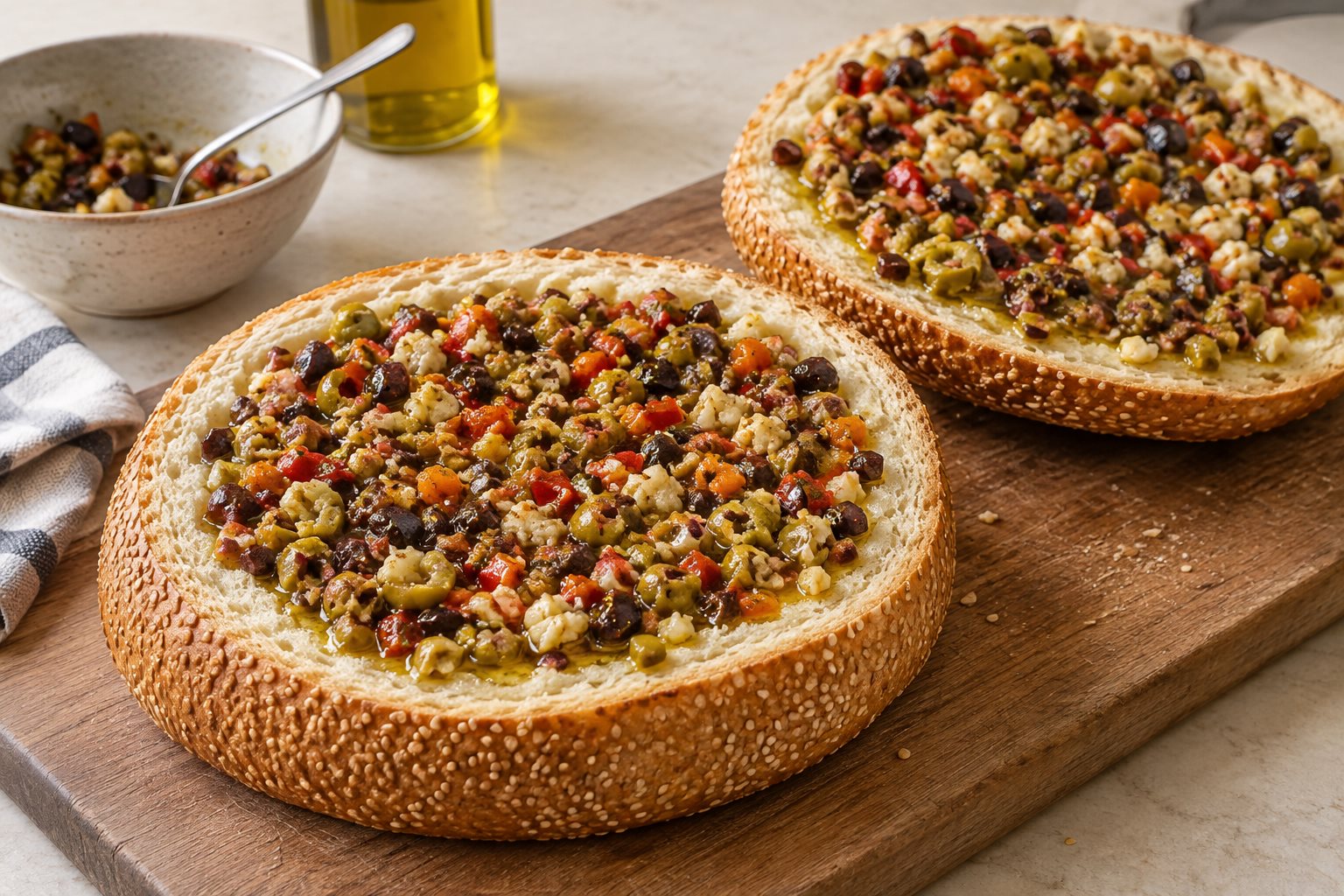
  4. Dress both faces. Spoon a little over half the olive salad into the bottom hollow with its oil and press it level. Spread the rest on the cut face of the top half, oil and all. Both halves get dressed, so the oil comes at the meat from above and below.
    Olive salad spread over both cut faces of a round sesame loaf
    Dress both cut faces with olive salad and its oil before layering the meat and cheese. AI-generated illustration.
  5. Layer. Onto the bottom half lay half the provolone, then the salami, the mortadella and the capicola, then the rest of the provolone. Cheese on both the top and the bottom of the stack keeps the meat from sliding on the wet bread. Set the top half on and press it down with your palms.
  6. Press two hours. Wrap the whole loaf tightly in plastic wrap, set it on a board or plate, and put a heavy skillet on top — a cast iron pan, or a plate with two cans on it. Leave it at cool room temperature 2 hours, or refrigerate up to 8 hours and let it come back to room temperature before serving.
  7. Cut in quarters. Unwrap, cut across into quarters with a serrated knife using a sawing motion and no downward pressure. Serve at room temperature, not chilled and not warm.
A soggy bottom crust means the salad went on more than a few hours ahead or the loaf was too soft to start with; the sandwich still eats well, but next time dress the top half more heavily than the bottom and cut the press to an hour. The opposite problem is commoner and easier: a dry sandwich, where the quarters show pale bread at the cut edge. That is under-dressed salad, not under-pressing, and there is no fixing it from outside — lift the top half off, spoon on another half cup of salad with its oil, and press it again for thirty minutes. If the olive salad itself tastes harsh and disjointed, it has not sat long enough. Put it back in the fridge and make the sandwich tomorrow; there is no shortcut that does what a day does.

Storage and make-ahead

The olive salad keeps 2 weeks refrigerated in a jar with the oil covering the solids, and it is better at a week than at a day. If the surface dries out, top it with oil rather than stirring air into it.

A built sandwich keeps 24 hours wrapped in the fridge and is at its best somewhere around hour six. Past a day the bottom crust goes to paste. Do not freeze it — the olive salad separates, and the bread thaws wet.

What to serve with it

Something cold and plain, because the sandwich carries salt, fat and vinegar all at once. An amber lager or a dry Sicilian white; unsweetened iced tea if it is the middle of the day.

No side is needed and most fight it. If you want one, keep it raw and sharp — fennel and celery in lemon, or just the extra olive salad in a bowl with bread.

A round sesame-seeded loaf cut into four quarters on a board, each quarter showing layers of provolone, salami, mortadella and capicola under a thick line of chopped olive salad

From the recipe box / Louisiana

Muffuletta

A round sesame loaf split and packed with provolone, Genoa salami, mortadella and capicola, under an olive salad that is made the day before and pressed into the bread for two hours.

Prep
24 hr 30 min
Cook
2 hr
Total
26 hr 30 min
Serves
4
Calories
1005 per serving

Ingredients

Scale

Instructions

  1. A day ahead, chop the olives, giardiniera and pickled peppers to a rough quarter-inch and combine with the capers, garlic, parsley, oregano, fennel seed, red pepper and black pepper. Stir in the vinegar, then the olive oil.
  2. Cover and refrigerate at least 12 hours and up to 5 days, then bring to room temperature.
  3. Split the loaf horizontally and pull a thin layer of crumb out of the bottom half, leaving a shell about 3/4 inch thick.
  4. Spoon a little over half the olive salad and its oil into the hollow and spread the rest on the cut face of the top half.
  5. Layer half the provolone, then the salami, mortadella and capicola, then the remaining provolone, and set the top half on.
  6. Wrap tightly in plastic and press under a heavy skillet 2 hours at cool room temperature, or up to 8 hours refrigerated.
  7. Unwrap and cut into quarters with a serrated knife, sawing rather than pressing. Serve at room temperature.

Nutrition

Fat66 g (22 g saturated)
Sodium2900 mg
Protein43 g
Serving1 quarter of a 10-inch loaf
Calories1005
Cholesterol130 mg
Carbohydrates59 g (4 g sugar, 5 g fiber)

Nutrition is an estimate calculated from the listed ingredients and is provided as a courtesy, not as dietary advice.

Questions readers ask

Should a muffuletta be served warm?

Not if you are following the record. The 1976 column describes the sandwich as it left the grocery counter, with no heating step anywhere in it, and the olive salad's oil separates and runs when warmed. Plenty of New Orleans places do toast one now and it is a good sandwich, but it is a different one: the cheese melts into the meat and the salad loses its bite.

Can I make the olive salad the same day?

You can eat it the same day and it will taste like chopped olives in oil. The change is not fermentation — everything in the jar was cured before you bought it — it is a slow exchange of oil and brine between the solids, and it takes hours, not minutes. Twelve is the floor, a full day is better, and a week-old jar is the best version of it. This is the one part of the recipe that cannot be hurried.

What can I use instead of a muffuletta loaf?

A round focaccia is the best ordinary substitute — soft, seeded or not, already the right shape, and it does not need hollowing. A 10-inch boule works if you take more crumb out of both halves. Avoid anything with a hard, shattering crust: it resists the press, so the layers never compact, and the crumb underneath stays dry while the salad sits on top of it.

Was the muffuletta invented at Central Grocery in 1906?

Nothing readable supports the year. The Central Grocery sign claims the original muffuletta, and the 1976 UPI column that quotes the shop's co-owner says in the same breath that no one is quite sure who created the sandwich, only that it is generally agreed to date from about the turn of the century. Louisiana's own archives — the state digital library, LSU and Tulane — refuse automated requests entirely, so the New Orleans papers that would settle it could not be opened. Treat 1906 as a claim with a shop attached, not a date with a document under it.