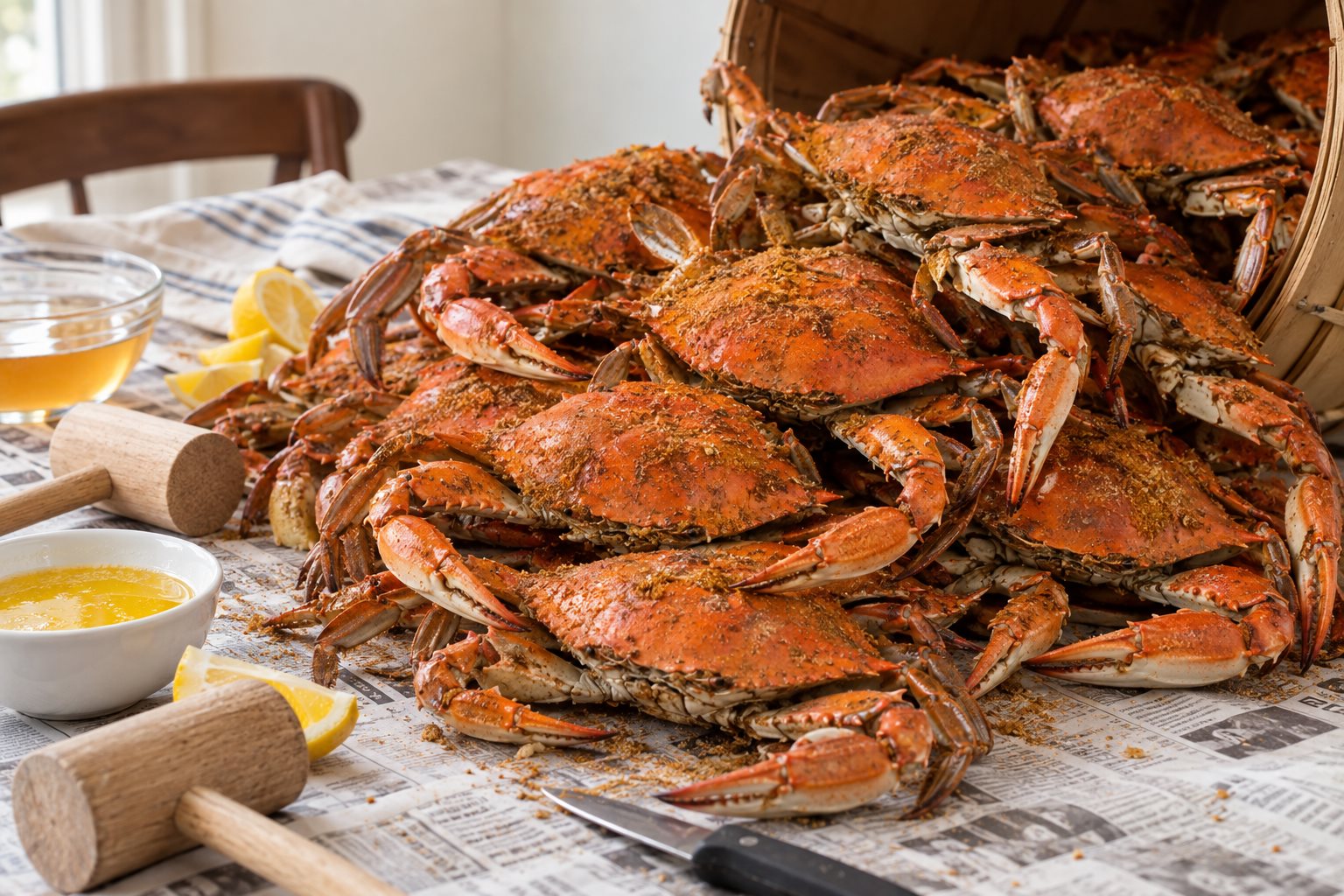
No plates, no serving dish. The crabs go straight from the pot onto the paper, and the paper goes into the bin at the end with the shells inside it. AI-generated illustration.
The whole technique is one sentence in a federal fisheries report, and it has not changed in a hundred and twenty years.
The Crab Industry of Maryland, written as an appendix to the Report of the Commissioner of Fisheries for the year ending 30 June 1904 and transcribed at eshore.iath.virginia.edu, walks through the Chesapeake packing houses and describes in passing the only piece of equipment this dish needs. The crabs, it says, are dumped into a large box, through which steam is forced from the bottom. They are steamed from twenty to forty minutes, the time varying at different factories, according to the number cooked. That is the recipe. The crabs never touch the water, and the twenty-minute spread is not vagueness — the report is naming the variable, which is how many crabs are in the box at once.
What the report has no word for is seasoning. It has a season: the Crisfield hard-crab fishery ran from early in April until the latter part of November, with the catch heaviest between 1 June and 1 September, and Maryland still opens on 1 April and closes on 15 December. It has the names: a big male is a Jimmy, and a mating pair lifted together off a trot line is a doubler. It has no spice at all, and neither does the Federal Writers' Project guide to Maryland of 1940, which disposes of the dish in one clause — hard-shell crabs are steamed, made into crab cakes or soup, or deviled. The seasoning turned up while that guide was at the printer. Baltimore Heritage's account of the Baltimore Spice Company has Gustav Brunn reaching Baltimore in 1939, released from Buchenwald after Kristallnacht on ten thousand marks paid to a lawyer, and opening a shop on the second floor of 26 Market Place, directly across from the wholesale fish market. Crab steamers came in for spices; he blended one for them around 1940 and named it after the Old Bay steamship line. McCormick bought the rights in 1990, and it has been their brand ever since.
Why this version works
They go in alive. Crab spoils fast in warm weather, which is why the 1904 crabbers worked their trot lines early and late and took few crabs between ten in the morning and two in the afternoon. A crab that dies before it is cooked begins breaking down its own meat immediately, and no amount of steam or seasoning fixes it. Sluggish is fine in a cold basket; motionless is not.
The time follows the load. The federal report gives twenty to forty minutes and says outright that the figure moves with the number cooked. A packing-house box held bushels; a home stockpot holds two dozen, which puts you at the short end — twenty-two to twenty-five minutes from the moment steam is driving out from under the lid, not from the moment the burner goes on.
The crabs sit above the liquid. Steam forced up through a box is what the 1904 report describes, and it is the difference between a seasoned crab and a washed one. Half an inch of liquid under a rack makes all the steam two dozen crabs can use in twenty-five minutes; anything deeper boils the bottom layer, rinses the seasoning off it and leaves the meat slack with water.
Seasoning goes between the layers, not on top. None of it gets into the meat. It sticks to the shell, comes off on your fingers when you break the crab open, and travels from your fingers to the meat — which is the entire mechanism. A crab seasoned only on the top of the pile is a plain crab, so every layer gets its own handful as it goes in.
Ingredient notes
Crabs: two dozen live hard crabs feed four people as a meal. Buy them the day you cook them, from a tank or an iced basket, and pick each one up: the ones that feel heavy for their width are the ones that have grown into their shells. Any crab that does not move goes back.
Old Bay: a registered brand, owned by McCormick, and the formula is theirs — nothing here reproduces it. Half a cup across two dozen crabs sounds enormous and is not, because most of it stays on the shells. If you cannot buy it, mix two parts celery salt to two parts sweet paprika, one part coarse black pepper, one part dry mustard and half a part cayenne. That is a plain seafood seasoning that does the same job in the same place; it is not the blend and does not taste like it.
The liquid: a cup each of water and cider vinegar in the bottom of the pot, under the rack, and no more. Beer instead of the water is common on the Eastern Shore and changes very little, since none of it is a broth — it is there to make steam and to keep the pot from scorching dry.
What you are allowed to keep: Maryland puts it in the regulation rather than in folklore. Under COMAR 08.02.03.14, from April 1 through July 14 you may not catch or possess a hard crab measuring less than 5 inches across the shell, and after July 14 the figure is 5 1/4 inches, measured from tip to tip of the spike. The minimum, the same section says, does not apply to mature female crabs, identified by the apron — but recreational crabbers may not keep those at all, nor an egg-bearing sponge crab. Males are jimmies and mature females sooks, and on a recreational licence your basket is jimmies.
Step by step
Set the pot up first. Put a rack or a steamer basket in a 16-quart stockpot so it stands at least 2 inches clear of the bottom. Pour in the water and vinegar, cover, and bring it to a hard boil before a single crab goes near it. Mix the Old Bay and the salt together in a bowl.
Cull the basket. Measure across the shell from spike tip to spike tip and set aside anything under 5 inches, any crab carrying an orange or brown sponge under the apron, and any crab that is not moving. Keep the rest cold and covered until the pot is boiling.
Layer and season. With tongs, lay a single layer of crabs on the rack, back down, and throw a small handful of the seasoning mix over them. Repeat until all two dozen are in, seasoning every layer as it goes. Do not stir and do not press them down.
Steam. Clamp the lid on and keep the heat high. Start timing when steam is driving steadily out from under the lid, and give them 22 to 25 minutes.
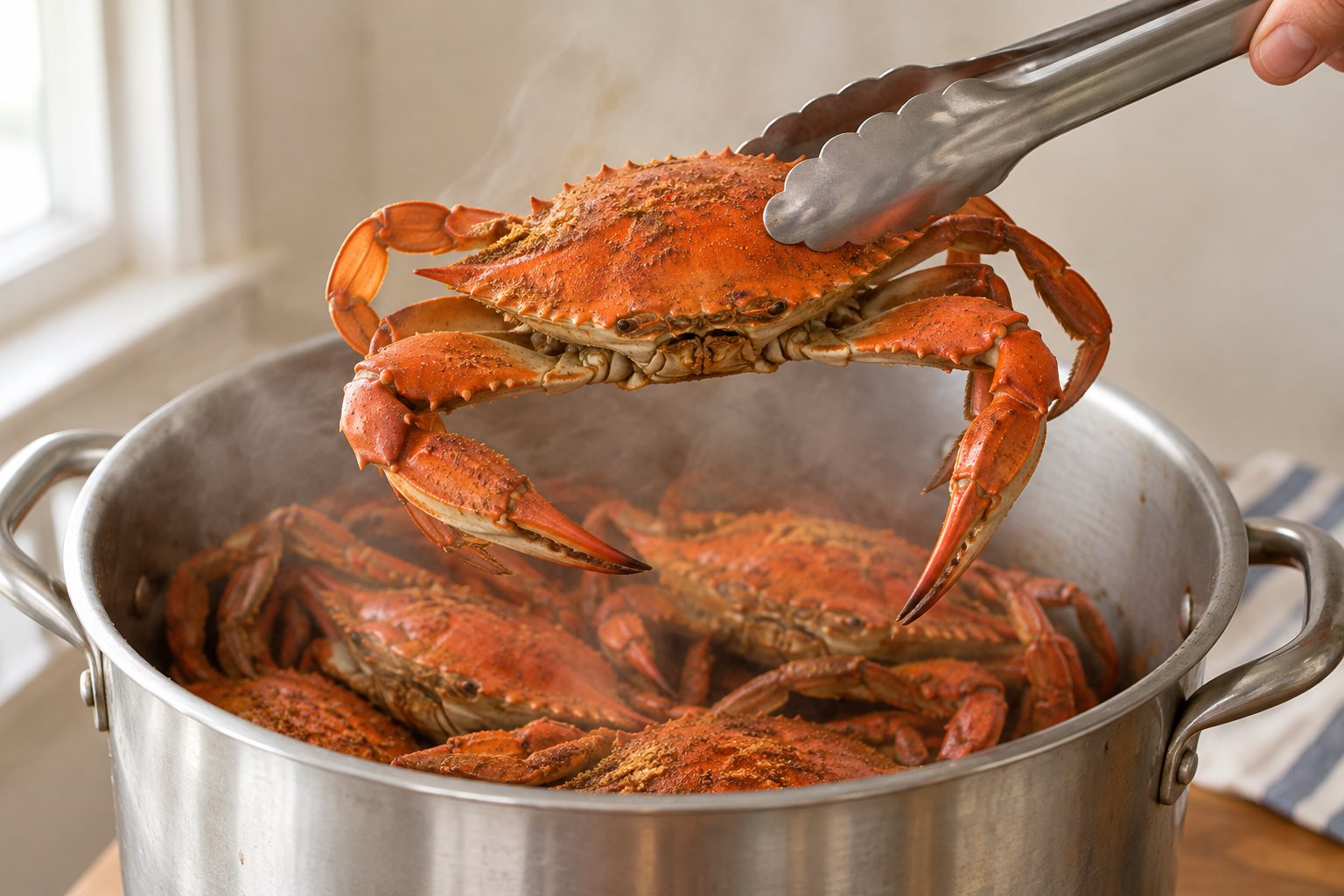
Check one. Lift a crab from the middle of the pile. It should be orange-red all over, down the legs and across the apron, with no green or blue left anywhere, and a walking leg should pull away cleanly. If any part is still dull, put the lid back for 5 minutes.
Check a crab from the middle of the pile: the shell and legs should be orange-red all over. AI-generated illustration.
Tip them out. Cover the table in four or five layers of newspaper. Pour the crabs into a heap in the middle, put out mallets, a paring knife each, melted butter and a bowl of vinegar, and let them cool 5 minutes before anyone starts. No plates.
If a crab comes out dull green along the back, the pot was not steaming hard when it was loaded — lid back on, five more minutes, and next time wait for a full boil before the first layer goes in. What cannot be rescued is a light crab. One that shed its shell recently has not yet grown into the new one, and it will steam up handsome and come apart nearly empty. That is settled at the dock by heft, not in the kitchen, and the only cure is to hand the batch a mallet and open a second dozen.
Storage and make-ahead
Steamed crabs keep 2 days refrigerated, but pick the meat the same night and keep that covered in the fridge instead. The 1904 report had already found the direction of travel: picked meat went under ice at once, and it holds far better that way than a whole cooked crab does.
Live crabs wait badly. Hold them in a basket or a cooler under ice with the drain open, covered with damp newspaper or burlap, never in standing water — fresh water drowns them. Cook them the day they come home.
What to serve with it
Corn on the cob, sliced tomatoes with salt, and something cold to drink. Nothing on the table should need a fork, because everybody's hands are covered in seasoning for the next two hours. Put the cider vinegar out beside the melted butter and let people choose between them.
From the recipe box / Maryland
Maryland Steamed Blue Crabs with Old Bay
Two dozen live crabs stacked above a half inch of vinegar and water, seasoned between every layer, steamed twenty-five minutes and tipped out onto newspaper.
Prep
15 min
Cook
25 min
Total
40 min
Serves
4
Calories
310 per serving
Ingredients
Scale
Instructions
Set a rack in a 16-quart stockpot, add the water and 1 cup vinegar, cover and bring to a hard boil. Mix the Old Bay and salt in a bowl.
Cull the basket: nothing under 5 inches across the shell, no sponge crabs, nothing motionless.
Lay the crabs in one layer at a time, back down, seasoning each layer with a handful of the mix.
Cover and steam 22–25 minutes, timing from when steam drives out from under the lid.
Check a crab from the middle: orange-red all over and a leg that pulls clean. Give it 5 more minutes if not.
Tip the crabs onto a newspaper-covered table with mallets, knives, melted butter, the remaining vinegar and the lemon. Rest 5 minutes before picking.
Nutrition
Fat
24 g (14 g saturated)
Sodium
980 mg
Protein
22 g
Serving
6 crabs with butter
Calories
310
Cholesterol
150 mg
Carbohydrates
1 g (0 g sugar, 0 g fiber)
Nutrition is an estimate calculated from the listed ingredients and is provided as
a courtesy, not as dietary advice.
Questions readers ask
Can I boil them instead?
You can, and plenty of the country does, but it is not this dish. Boiling puts the crab in the seasoned water rather than the seasoning on the crab, and it waterlogs the meat. The Chesapeake packing houses steamed even in 1904, while the same report has soft crabs boiled before canning — the two methods sat side by side in one building and were never confused.
Can I cook female crabs?
Not on a recreational licence in Maryland — you may not possess an egg-bearing sponge crab or any female hard or peeler crab. Mature females sold by a licensed dealer are a commercial catch and perfectly legal to buy and steam; they run smaller than jimmies, so buy a few more of them.
How many crabs is a person?
Six with corn and tomatoes is dinner; a dozen is a feast, and a feast runs three hours. Maryland's recreational limit is a bushel a person a day, or 6 dozen when you are using something other than a bushel basket, which tells you what the state considers a plausible afternoon.
What if the crabs are frozen?
Then steam them straight from frozen and add about 5 minutes, but expect less. Freezing ruptures the meat and it comes out of the shell in wet shreds rather than in pieces. This is a recipe about buying live crabs in season, and out of season the honest answer is to make crab cakes with picked meat instead.