American cooking Recipes & regional stories

Skillet & Sage

A culinary journey through the fifty states

The regional table / Maryland

Maryland Crab Soup, Red and Built on the Shells
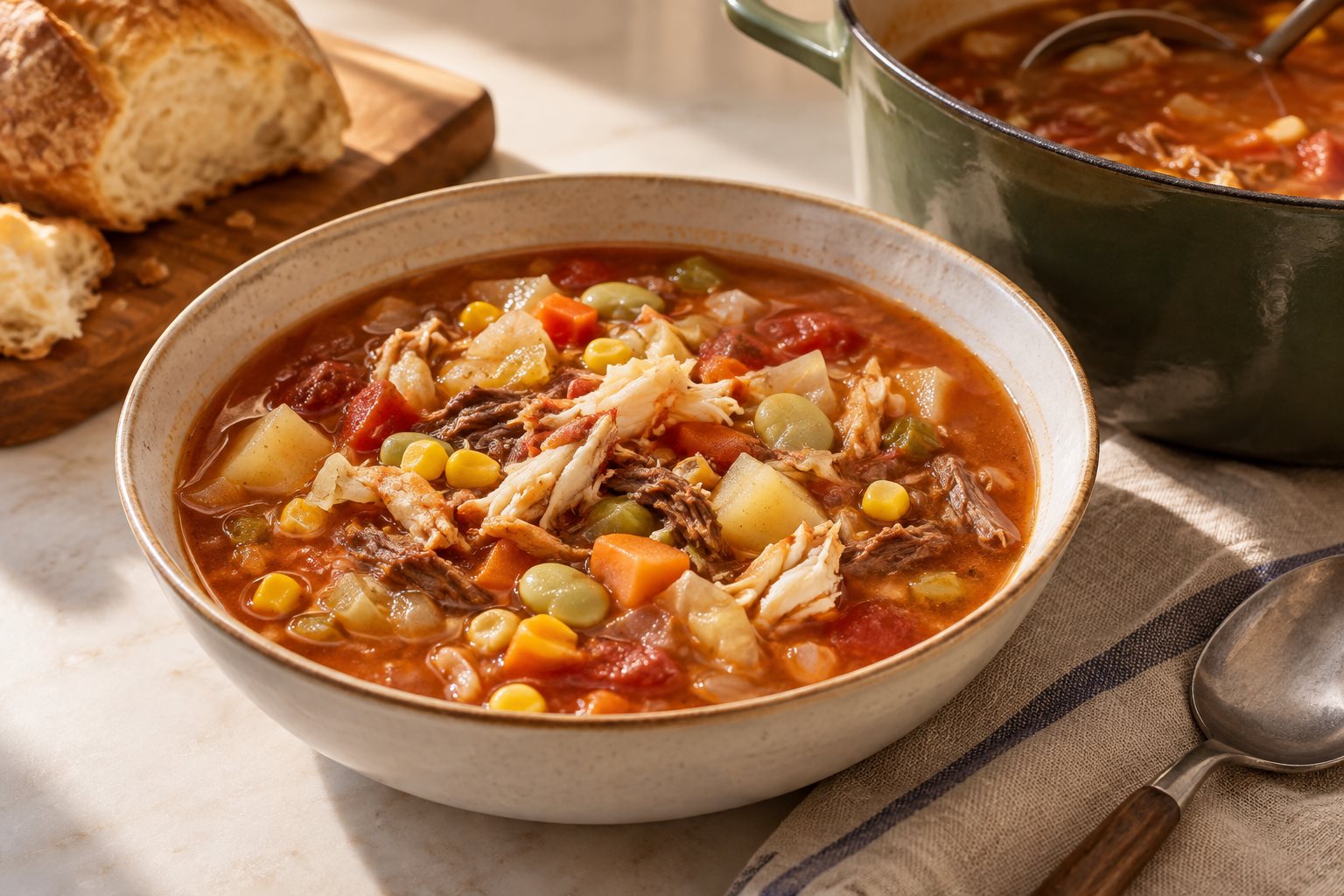
A bowl of thin red tomato crab soup with picked crab meat, corn, lima beans, cabbage, diced potato and shredded beef
The broth should be thin enough to run off the back of a spoon. Everything holding the soup up is sitting in it, not dissolved into it. AI-generated illustration.

Two soups in Maryland answer to the name crab soup, and the older books call only one of them that.

Mrs. B. C. Howard's Fifty Years in a Maryland Kitchen, printed in Baltimore and readable on Internet Archive in the Lippincott edition of 1881 and again in the fifth revised edition of 1913, carries four soups under the heading Crab Soup, and not one of them is this one. Three are milk. The fourth is red, and begins by frying three broken-up crabs with two slices of middling, but it is thickened with a table-spoonful of butter rolled in one of flour and finished with a tea-cup of new milk or cream. The rest of Maryland print agrees. The Queen of the Kitchen, a collection of old Maryland family receipts published in 1874, opens its Crab Soup by boiling a quart of milk. Mrs. Charles H. Gibson's Maryland and Virginia Cook Book of 1894 prints two, both of them cream. The Church Cook Book, published in Baltimore in 1908 for the benefit of church work and charity, prints one: the meat of six hard crabs, one quart fresh milk, butter and flour worked smooth together, boil fifteen minutes. Go looking for the red soup under its own name in a nineteenth-century Maryland book and it is not there.

It is in those books under a different name, and that is where the beef comes from. Howard's Okra Soup with Crabs opens with the line this whole recipe rests on: take a quarter of a peck of okra and boil in beef soup, two pounds of beef to three gallons of water, a ham bone added is a great improvement — then a quarter of a peck of tomatoes and one dozen hard crabs boiled and picked. A few lines above it, her Okra Soup puts in six boiled hard crabs, a little broken up, shells and all, but not picked. The vegetables are assembled a few pages later in her Shin Vegetable Soup: half a shin, two or three slices of bacon, a quart of tomatoes, okra, three or four potatoes, some lima beans, corn, in fact any vegetables that are procurable. Her plain Beef Soup boils two pounds of beef three hours and then takes a small head of cabbage cut in quarters, turnips, okra, tomatoes, carrots. So the beef stock under a Maryland crab soup is not a shortcut somebody took in a hurry. The beef soup was there first, the crab was put into it, and what changed later was only the name on the pot.

Why this version works

Nothing thickens it. Every milk crab soup in these books is thickened with butter rubbed into flour. This one is not thickened at all. What little body it has comes from potato starch and from three hours of reduction, and a roux would only coat the vegetables and dull the Old Bay.

Beef under crab, on the record. People taste this soup and assume a seafood house cheated with a beef cube. The 1881 Baltimore text says the opposite: the okra soup that carries crabs is boiled in beef soup, two pounds of beef to three gallons of water. Beef gives a long, savoury body that crab shells cannot make on their own, and crab on top of it reads as crab rather than as fish stock.

The shells are half the flavour. Howard's White Crab Soup is six crabs to a gallon of water, legs and fins cracked and put in with the fat from the backs, boiled an hour and a half before any picked meat goes near it. Bodies and claws simmered in the broth for half an hour and then thrown away is what separates this from a vegetable soup with crab in it.

The crab meat goes in last and barely cooks. The meat was steamed at the packing house and is cold and cooked when you buy it. Five minutes in hot broth off the heat warms it through; ten minutes of boiling shreds it into the soup and you lose every piece you can see.
Ingredient notes

Beef: two pounds of cross-cut shank on the bone. It is the cheapest beef in the case and the right one — connective tissue and marrow are what make the broth, and the meat that falls off it at the end goes back into the soup. A shin, which is what Howard calls for, is the same thing under an older name.

Crabs: six whole steamed hard crabs for the pot and half a pound of picked meat for the bowl. The steamed crabs are there to be broken up and boiled; buy the cheapest ones or use whatever is left from a crab feast the night before. Claw meat is the right grade for the picked half — it has more flavour than lump and nobody needs whole lumps in a soup.

Old Bay: a brand, owned by McCormick, and nothing here reproduces its formula. Two tablespoons for four quarts of soup. If you cannot buy it, use any celery-salt-led seafood seasoning, or mix two parts celery salt with two parts paprika and one part each of dry mustard and coarse black pepper — it seasons the same place in the soup and it does not taste the same.

The vegetables: corn, lima beans, cabbage, potato and tomato, and the proportions are yours. Frozen limas and frozen corn are fine and in February they are better than the alternative. Cut the potato small, half an inch, so it gives up a little starch; leave the cabbage in wide shreds so it stays recognisable.

Step by step

  1. Start the beef. Put the shank, water, bay leaves and the onion halves in a large pot, bring it to a boil, and skim the grey foam off carefully for the first ten minutes. Drop to a bare simmer and leave it 2 1/2 hours, uncovered, skimming now and then.
  2. Break the crabs down. Pull the top shell off each steamed crab, scrape out the gills, snap each body in half and crack the claws with the back of a knife. Keep the picked meat covered in the fridge and do not let it near the pot yet.
  3. Give the broth the shells. Add the crab bodies and cracked claws to the simmering pot for the last 30 minutes. Then strain the whole thing through a colander into a clean pot. Pick the beef off the bone and shred it; throw out the shells, the bones and the bay.
  4. Build the soup. You want about 2 1/2 quarts of broth — top it up with water if it has reduced further. Add the tomatoes and their juice, crushing them in your hand as they go, then the diced onion, celery, carrot, potato, lima beans and Old Bay. Simmer 25 minutes, until the potato is tender.
  5. Cabbage and corn late. Stir in the cabbage and the corn and simmer 10 minutes more. Taste for salt now rather than earlier: the seasoning is mostly salt and the crab meat brings its own.
  6. Crab last. Return the shredded beef, take the pot off the heat, fold in the picked crab meat and the vinegar, and leave it covered 5 minutes before ladling. It is better an hour later and better again the next day.
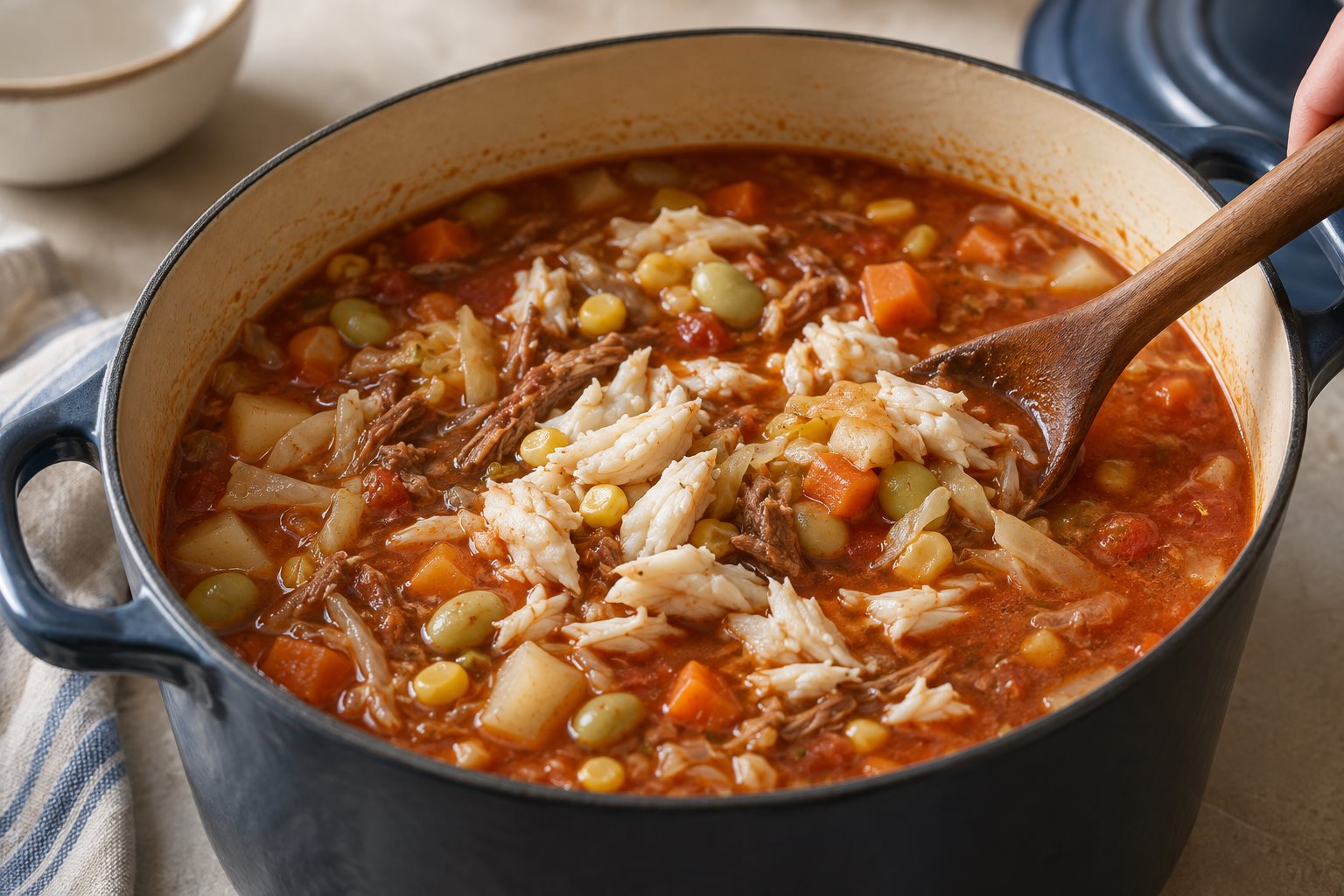
    Picked crab meat folded into red vegetable soup off the heat
    Add the picked crab off the heat and let it warm through in the finished soup. AI-generated illustration.
If it tastes thin and flat rather than savoury, the beef did not go long enough or was boiled hard instead of simmered — put the strained broth back on and reduce it by a quarter before the vegetables go in, and skim it while it goes. If it has gone the other way and the broth is cloudy and muddy, that is a rolling boil emulsifying the beef fat, and the cure is the fridge: cool it overnight, lift the cap of fat off the top in the morning, and reheat it gently. If the crab meat has vanished into shreds, it was in too long and boiling; nothing recovers the pieces, so hold back a handful of meat next time and drop it into each bowl cold.

Storage and make-ahead

Refrigerated, the soup keeps 3 days and improves on the second. Reheat it gently and stop at a bare steam — a second hard boil finishes off whatever crab meat survived the first.

It freezes well for 3 months if you freeze it before the crab goes in. The potato softens a little and the cabbage goes limp; the broth, the corn and the limas come through untouched. Add fresh picked meat when you reheat it.

What to serve with it

Saltines and a bottle of hot sauce on the table, and nothing else that needs cooking. If it is a meal rather than a first course, serve it with a hunk of bread and a half-dozen steamed crabs alongside, which is where the shells for the next pot come from.

A bowl of thin red tomato crab soup with picked crab meat, corn, lima beans, cabbage, diced potato and shredded beef

From the recipe box / Maryland

Maryland Crab Soup, Red and Built on the Shells

A beef broth run through crab shells, loaded with corn, lima beans, cabbage, potato and tomato, and given its crab meat in the last five minutes.

Prep
30 min
Cook
3 hr 15 min
Total
3 hr 45 min
Serves
8
Calories
300 per serving

Ingredients

Scale

Instructions

  1. Simmer the shank, water, bay leaves and halved onion 2 1/2 hours, skimming, starting with a careful skim in the first 10 minutes.
  2. Clean the steamed crabs, snap the bodies in half and crack the claws. Keep the picked meat cold and separate.
  3. Add the crab bodies and claws for the last 30 minutes, then strain. Shred the beef off the bone and discard the shells and bones.
  4. Return about 2 1/2 quarts of broth to the pot with the tomatoes, diced onion, celery, carrot, potato, lima beans and Old Bay, and simmer 25 minutes.
  5. Add the cabbage and corn, simmer 10 minutes more, and season with the salt.
  6. Off the heat, stir in the beef, the picked crab meat and the vinegar, and rest 5 minutes before serving.

Nutrition

Fat6 g (2 g saturated)
Sodium960 mg
Protein26 g
Servingabout 2 cups
Calories300
Cholesterol70 mg
Carbohydrates34 g (7 g sugar, 6 g fiber)

Nutrition is an estimate calculated from the listed ingredients and is provided as a courtesy, not as dietary advice.

Questions readers ask

Is this the same as cream of crab?

No, and Maryland has never treated them as the same soup. The nineteenth-century books print the cream one under the name crab soup and this one under okra soup; the split has outlived the books. A grocery advertisement carried in a Georgia paper in January 2025 lists the two side by side in the same line of type, cream of crab or Maryland crab soup, as different things you buy in different cans.

Can I make it with the leftovers from a crab feast?

That is what it is for. Cold picked-over crabs, shells and all, are exactly what goes in the broth. Rinse the heaviest seasoning off the shells first and hold back on the Old Bay until you taste the strained broth, or the soup will land somewhere past salty.

Can I skip the whole crabs and use picked meat only?

You can, and the soup will be good and noticeably flatter, because the shells are doing half the work. If you have no whole crabs, simmer the broth 30 minutes longer to make up some of the depth, and add the meat in two goes — half with the vegetables, half off the heat.

Can I use stock from a carton instead of making the beef broth?

Yes. Use four quarts of beef stock, skip the first step and simmer the crab bodies and claws in it for 30 minutes before straining. You lose the shredded beef and a good deal of body, and the cooking time drops from most of an afternoon to about an hour.