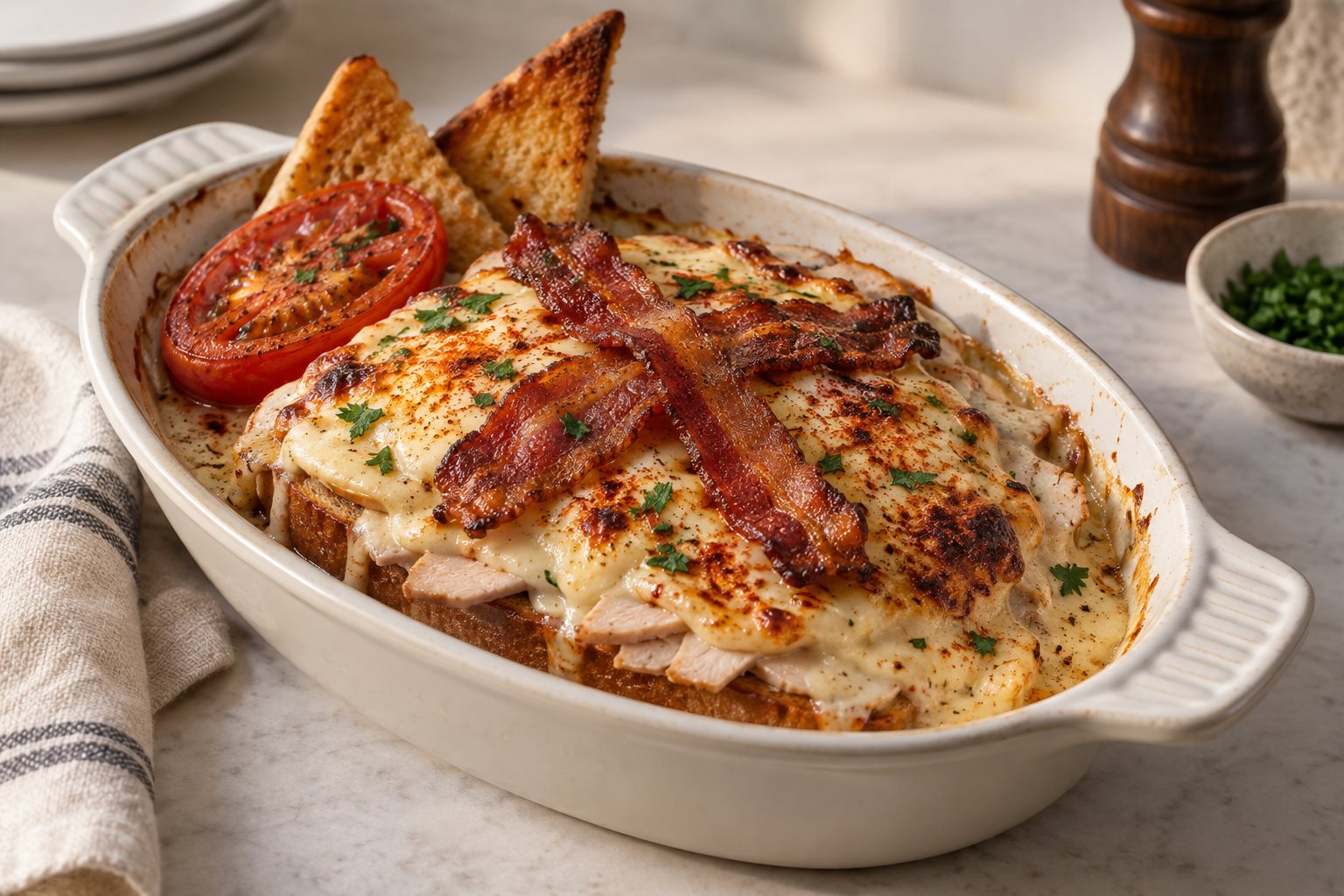
It is a sandwich you eat with a fork, and everything that can go wrong with it goes wrong in the last two minutes under the broiler.
Start with what is actually on paper. The Brown Hotel Building and Theater went on the National Register of Historic Places in 1978, and the nomination form filed for it is a real document you can pull down and read. It says the hotel was built by James Graham Brown, designed by Preston J. Bradshaw of St. Louis, and opened on 25 October 1923 with the Paul Whiteman Orchestra and Barney Rapp directing, with David Lloyd George the first name on the register; it says the lobby was Colonial, the Grill Room Elizabethan and the dining room French. It runs through the architecture, the money and the man for several pages and never once mentions the sandwich that carries the hotel's name. That absence is the honest place to start: the building is documented, the dish is not.
The claim is the hotel's own, and it is worth stating as a claim. The Brown Hotel says that in the 1920s its dinner dance drew over 1,200 guests an evening, that ham and eggs bored them, and that Chef Fred Schmidt set out to make "something more glamorous than traditional ham and eggs" — open-faced turkey under a Mornay, with bacon. No contemporary paper I could reach names the chef or fixes the year, and Kentucky's own newspaper program has been folded into a catalogue search that no longer answers a script, so I am not going to pretend to a citation I do not have. What I can show is the dish travelling: on 8 December 1976 the Lake City Reporter, a Florida paper, printed a "Kentucky Hot-Brown Sandwich" from a Mrs. Mildred Reaume — a flour-thickened milk sauce with processed cheese and two beaten eggs stirred in, toast cut diagonally, sliced turkey or chicken, broiled "till sauce begins to bubble," served with asparagus on the side and no tomato anywhere in it. The quantities below are this site's own, worked out for this page.
Why this version works
Broiler, not oven. The sauce has to brown before the turkey overcooks and the toast surrenders. That is a top-heat job: four inches under a hot element for three or four minutes. A 425°F oven takes fifteen minutes to put any colour on the top, and by then the whole dish has gone soft and the turkey is dry.
The bread has to be dry. Every sad Hot Brown is a wet one, and the bread is where the water comes from. Toast it hard, to the colour of a good crust rather than of breakfast, and let it cool on a rack so the steam leaves. Soft bread under a cup of sauce is bread pudding in about ninety seconds.
A Mornay, not a cheese sauce. A Mornay is a béchamel finished off the heat with a hard grating cheese, and that order is what keeps it smooth. Cheese boiled into milk breaks into oil and strings within a minute; cheese stirred into a sauce pulled off the flame melts into it and stays. The 1976 Florida version reaches the same place by another road, thickening with flour and then binding with beaten eggs, which is a custard trick and works — but it will scramble if it boils.
Bacon and tomato afterwards, not under. Bacon under the sauce steams limp and tomato under the sauce leaks. Cook them separately, lay them on at the end, and both stay what they are. The hotel's own version puts the tomato beside the turkey and the bacon crossed on top, which is the same logic.
Ingredient notes
Bread: Texas toast or any thick white loaf cut about three quarters of an inch. Thin sandwich bread cannot carry the weight. Trim the crusts if you want the hotel's look; keep them if you want the corners to stay rigid.
Cheese: Pecorino Romano or Parmesan, grated fine. The hotel uses Pecorino Romano and finishes with Parmesan, and a hard, salty, low-moisture cheese is what a Mornay wants. Cheddar makes a good sauce but a different dish — oilier, softer, and it browns to a skin rather than a blistered crust.
Tomato: Roma, halved lengthwise, cut side up. A watery slicing tomato will thin the sauce it sits in. Out of season, leave it off rather than putting a pale one on — the dish loses nothing it had.
Turkey: roasted breast, sliced about a quarter inch thick, warm or at room temperature. This is the dish leftover Thanksgiving turkey was invented for. Deli turkey works and tastes like deli turkey: wetter, saltier, and it slumps under heat.
Step by step
Toast hard. Heat the broiler with a rack four inches below the element. Toast the bread until it is deep gold and rigid all the way through, then cool it on a rack. Cut one slice per serving in half on the diagonal for the points, and leave the other whole.
Cook the bacon and the tomatoes. Fry the bacon until properly crisp and drain it. Put the tomato halves cut side up under the broiler for 4 to 5 minutes, until the edges char slightly, and set them aside.
Make the béchamel. Melt the butter in a heavy saucepan over medium heat, whisk in the flour and cook 2 minutes without colouring it. Whisk in the milk and cream in three additions, bring to a bare simmer and cook 5 minutes, whisking, until it coats a spoon heavily.
Finish it as a Mornay. Take the pan off the heat. Whisk in the grated Pecorino a handful at a time until smooth, then the nutmeg, salt and pepper. It should be thick enough to sit on toast without running off it. Do not put it back on the flame.
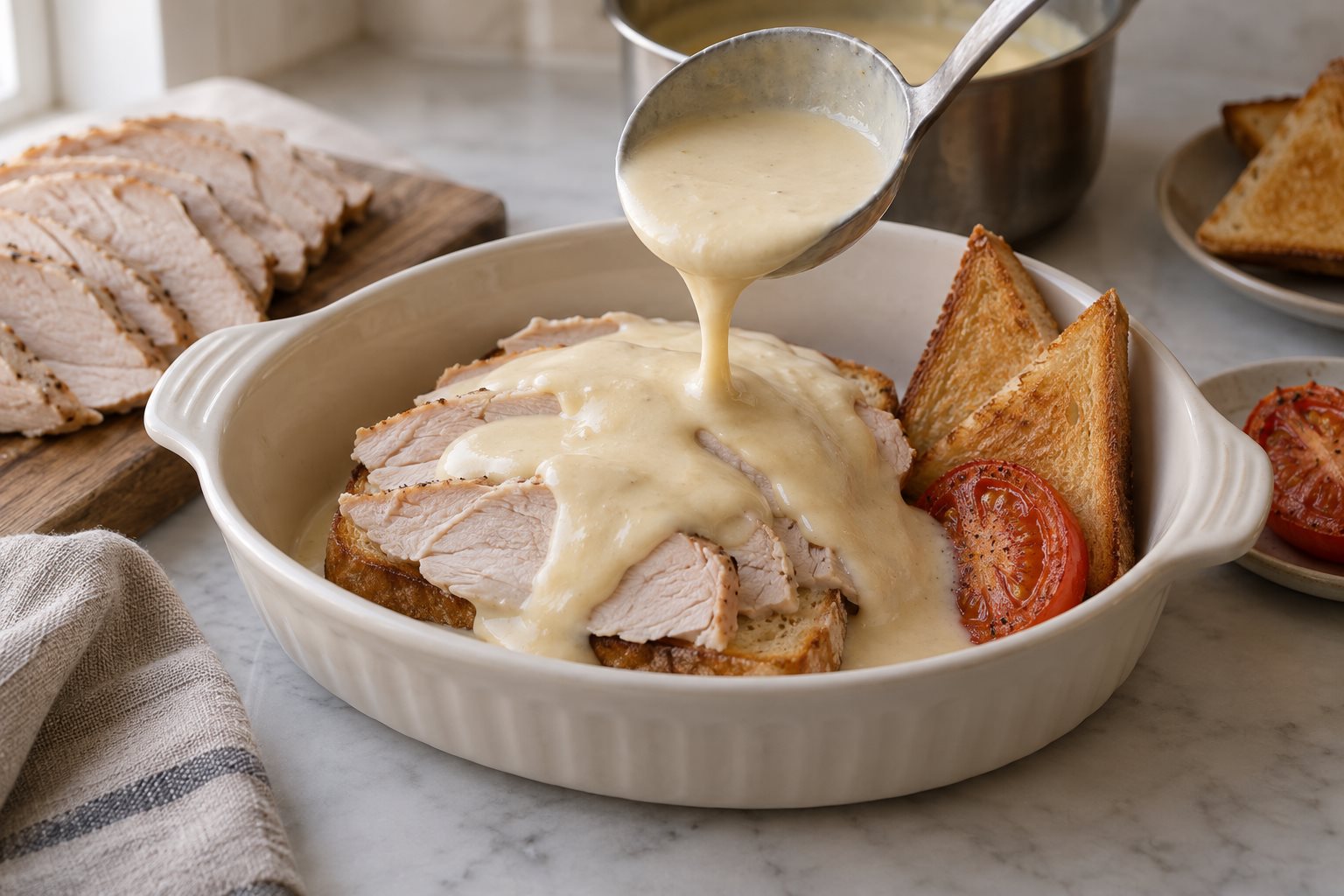
Build. Set a whole slice of toast in each oven-safe dish, lay the turkey over it in overlapping slices, tuck a tomato half and the two toast points against the side, and ladle the sauce over the turkey so it pools but does not flood the dish.
Ladle the thick Mornay over turkey on toast, keeping the toast points and tomato at the side. AI-generated illustration.
Broil. Scatter the Parmesan over the top and broil 3 to 4 minutes, watching it the whole time, until the surface bubbles and takes dark blistered patches.
Finish and serve at once. Cross two bacon strips on each, dust with paprika, scatter the parsley and take it to the table immediately. This dish has a five-minute life.
If the sauce breaks into grease and grain, it got too hot after the cheese went in. Take it off the heat, add two tablespoons of cold cream and whisk hard from the centre outwards; that pulls most of them back. If it is past that, whisk a fresh tablespoon of flour into a tablespoon of melted butter in a clean pan, add the broken sauce a ladle at a time, and bring it just to a simmer before the cheese goes back in off the flame. And if the toast has already gone soft under a sauce you are still fixing, start the toast again — you cannot dry it out once it is wet.
Storage and make-ahead
This does not keep, and nothing about it improves overnight. Sauce on toast is soup by morning. If you are cooking ahead, cook the components: the turkey, the bacon and the toast all hold, and the sauce can sit covered in the fridge for 2 days.
Reheat the sauce gently in a saucepan with a splash of milk, stirring, and stop before it simmers — a reheated Mornay taken to the boil will separate exactly the way a fresh one does. Then toast fresh bread and build as usual.
What to serve with it
It needs sharpness and nothing heavy. A plain salad of bitter leaves with a hard lemon dressing, or pickled green tomatoes, or the asparagus the 1976 Florida version served alongside. To drink, something with acid and bubbles; this is the rare Kentucky dish that bourbon does not help.
From the recipe box / Kentucky
The Louisville Hot Brown
Roast turkey on hard-toasted bread under a Mornay sauce, run under the broiler until the top blisters, finished with bacon and a roasted tomato half.
Prep
15 min
Cook
25 min
Total
40 min
Serves
4
Calories
862 per serving
Ingredients
Scale
Instructions
Heat the broiler with a rack 4 inches below it. Toast the bread hard, cool it on a rack, and cut four slices into diagonal points.
Fry the bacon crisp and drain it; broil the tomato halves cut side up 4–5 minutes and set aside.
Melt the butter, whisk in the flour and cook 2 minutes, then whisk in the milk and cream and simmer 5 minutes until thick.
Off the heat, whisk in the Pecorino a handful at a time, then the nutmeg, salt and pepper.
Set a whole slice of toast in each oven-safe dish, lay the turkey over it, tuck in a tomato half and two toast points, and ladle over the sauce.
Scatter the Parmesan and broil 3–4 minutes, until bubbling and blistered dark in patches.
Cross two bacon strips on each, dust with paprika, scatter parsley and serve immediately.
Nutrition
Fat
46 g (23 g saturated)
Sodium
1720 mg
Protein
55 g
Serving
1 assembled dish
Calories
862
Cholesterol
178 mg
Carbohydrates
41 g (8 g sugar, 3 g fiber)
Nutrition is an estimate calculated from the listed ingredients and is provided as
a courtesy, not as dietary advice.
Questions readers ask
Can I use cheddar instead?
You can, and plenty of home versions do — the 1976 newspaper recipe uses a half pound of processed cheese. Expect a softer, oilier sauce that browns to a skin rather than blistering, and salt it more carefully, because cheddar brings less salt than Pecorino does.
Can I make the sauce ahead?
Yes, up to 2 days. Cool it with a sheet of plastic on the surface, then reheat gently with a splash of milk, stirring, and stop short of a simmer. A Mornay that boils after the cheese is in will break whether it is five minutes old or two days.
Do I need individual dishes?
No, but they work better. One large gratin dish will feed four and taste the same, and the only thing you lose is the crisp edge that forms where sauce meets hot metal. What you cannot do is build it on a plate — this goes under a broiler, so everything it touches has to take direct heat.
Is there supposed to be tomato in it?
It depends whose version you follow, and both are on record. The Brown Hotel's own published method puts roasted Roma halves beside the turkey. The Kentucky Hot-Brown printed in the Lake City Reporter on 8 December 1976 has no tomato at all and asparagus on the side instead. Neither is wrong; the tomato adds acid the dish otherwise lacks, which is why it is here.