American cooking Recipes & regional stories

Skillet & Sage

A culinary journey through the fifty states

The regional table / Alabama

Lane Cake with Raisin and Whiskey Filling
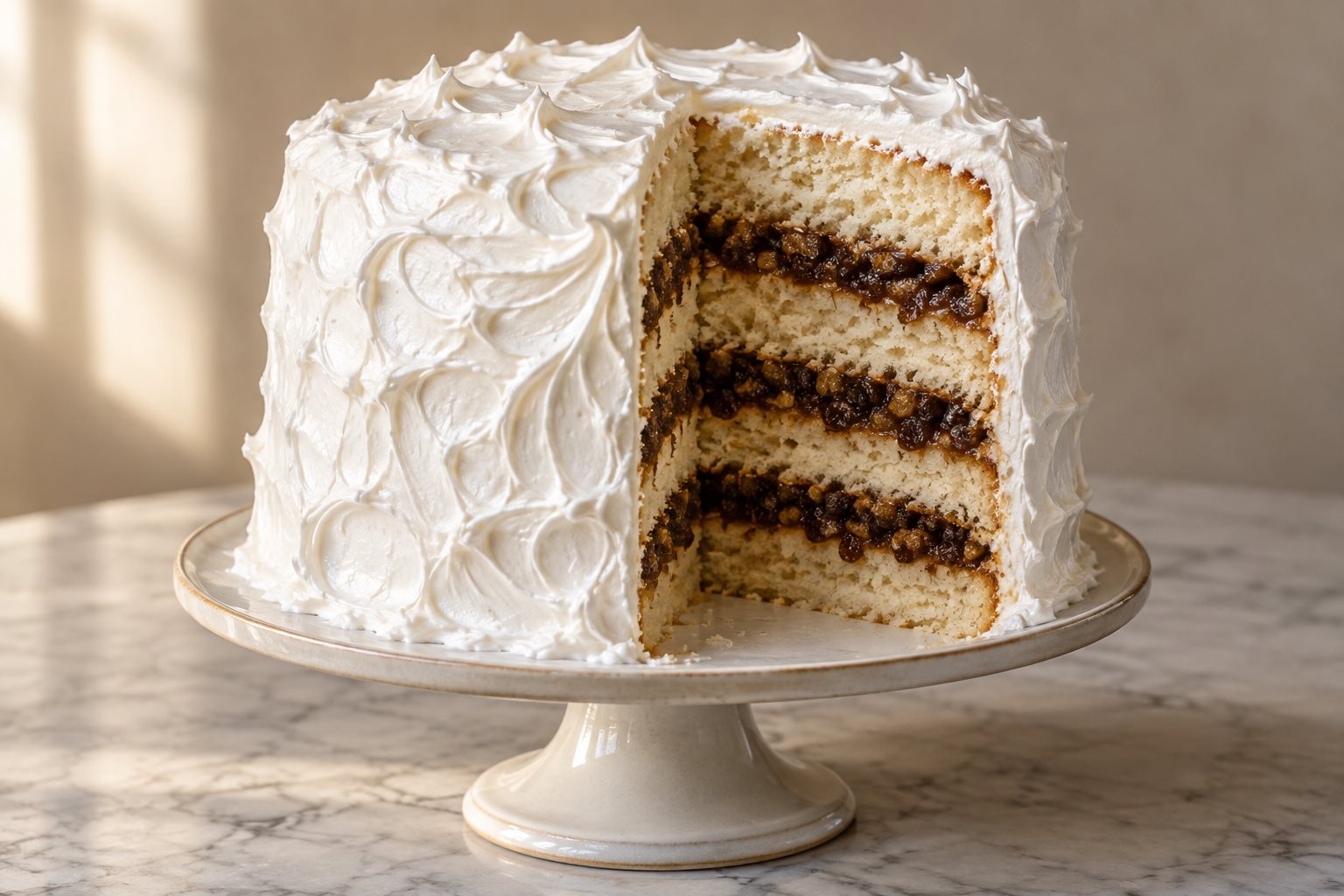
A tall four-layer white cake cut to show three dark stripes of raisin filling between pale layers, under a soft white boiled icing, on a footed stand
Four layers means three stripes of filling. The stripes should be as thick as the cake is pale. AI-generated illustration.

The cake is in print under its own name, in its author's own book, and the book settles every argument about it in nine lines.

Almost nothing on this site has a named author and a named book behind it. This does. The wrapper reads, in black letter, Some Good Things to Eat — Price, 50 Cts. — Mrs. Emma Rylander Lane, Clayton, Alabama — Copyrighted 1898. Inside, the title page gives the book its working name: My Best Cakes, Salads, Croquettes, Etc., With a Few Choice Miscellaneous Recipes Kindly Contributed by My Friends, printed at Macon, Georgia, by the press of the J. W. Burke Company in 1898. She dedicates it to her mother, who gave her the love of the culinary art, and to her husband, whose discriminating and appreciative appetite had been her inspiration for nearly seventeen years. The preface says the fifty-cent price puts it within easy reach of Southern housekeepers, that every recipe has been carefully tested, and that the dishes will be found suited to Southern tastes, Southern cooks and Southern markets. The copy read here is the Auburn University Libraries scan of the Patrick Cather collection of Alabama cookbooks, and on page 40, after a note on egg-yolk fillings, the heading is set in small capitals: LANE CAKE. The filling runs over onto page 41 and ends in her own voice — it is much better made a day or two before using, it is her prize cake, and it was named, she writes, not from her own conceit but through the courtesy of Mrs. Janie McDowell Pruett, of Eufaula, Alabama. Eufaula and Clayton sit in the same Barbour County, twenty-odd miles apart. So the woman did not name the cake after herself; the next town over did it for her.

What the page prints is a white butter cake — eight whites, a cup of butter, a cup of sweet milk, two cups of sugar, three and a quarter cups of sifted flour, two teaspoons of baking powder, a tablespoon of vanilla, baked in four layers in medium-sized pie tins on ungreased brown paper — and a filling of eight yolks, a large cup of sugar and half a cup of butter cooked on top of the stove until quite thick, stirring all the time, with a cup of seeded and finely clipped raisins, one wine-glass of good whiskey or brandy and a teaspoon of vanilla stirred in while it is still hot. That is the whole of it. There is no coconut and there are no pecans: the word pecan does not appear anywhere in the book, and cocoanut appears three times, in a fruit salad and two custards, never within thirty pages of this cake. She does not say bourbon either — the word is not in the book. The frosting is not named in the recipe, which ends only "Spread thickly between the layers and ice", but her icing chapter opens with Plain Boiled Icing, boiled sugar poured onto a whipped white and beaten until cool, and tells you to double the quantity for a medium-size cake; so the soft white boiled icing is the house default and is as old as the recipe, while the coconut and the nuts are somebody's later improvement and cannot be dated from anything that opened here. Dating the name is easier than dating the drift. Georgia Historic Newspapers, searched by exact phrase and sorted by date, gives the earliest genuine printing as 30 June 1910 in the Americus Times-Recorder, a banquet menu for the visiting press association — Pound Cake. Lane Cake. Coffee. — reprinted in the Hamilton Journal of 29 July when the dinner had been eaten; two apparently earlier hits are both false, an 1884 report where the OCR turned "take" into "cake" behind General Lane, and an 1894 Savannah price list selling Lane Cake Soap at three cents. Americus was her town: the same paper carried her small advertisement on 20 and 27 January 1901, wanting to do fancy cooking of all kinds, special attention given to receptions, orders taken at B. H. Mayo's store, the Woman's Exchange and 711 Lee street, Mrs. Emma Rylander Lane. Three years later, on 26 April 1904, it printed her death — pneumonia, suddenly, at Cananea in Mexico, the wife of Davis T. Lane and the daughter of the late Maj. Emory Rylander — and on 5 May her funeral was held straight from the railway depot as the body came off the train. Her preface had promised a second volume. Nebraska's newspaper archive, which is open and deep, contains the phrase exactly once, in 1961: this cake never left the South. It is also the cake a neighbour bakes in Harper Lee's To Kill a Mockingbird, loaded with enough liquor to make a child tipsy, which is the only reason most people outside Alabama have heard of it.

Why this version works

It is better a day or two old. Her line, not a modern embellishment. A cooked yolk filling is dense and wet and the layers next to it are dry and porous; given a night under a cover, the whiskey and the raisin moisture move outward into the crumb and the cake becomes one thing instead of three. Eaten the hour it is iced, it tastes like a good white cake with something sticky in the middle.

Eight whites up, eight yolks down. The cake takes the whites and the filling takes the yolks, and the count is the same on both sides. That is not a coincidence in a book that tells you, two pages earlier, that this sort of filling can be made any time there is an accumulation of egg yolks and will keep for weeks. Nothing is left over and nothing is thrown away, which is why the architecture survived in farm kitchens for a century.

Four thin layers, not two fat ones. She says four, in medium-sized pie tins, and her baking note says all layer cakes should be baked rapidly. Four layers give three seams of filling instead of one, so every forkful gets raisins and whiskey rather than an inch of plain white cake with a stripe somewhere in it. Thin layers also bake through before the crumb dries.

The filling is a curd, not a frosting. Yolks, sugar and butter cooked on direct heat until quite thick is a custard taken past the point where a custard would stop. It sets to a sliceable paste when cold, which is what holds four thin layers in a stack. Her warning is the part to obey: stir all the time, or it will be sure to burn. There is no flour and no cornstarch in it to protect you.
Ingredient notes

Flour: Her own table of weights and measures makes the conversion for you: one ordinary tea cup holds half a pint, and four cups of sifted flour, slightly heaped, weigh a pound. Three and a quarter cups is therefore about 13 ounces, which is what a modern sifted cup gives you too. Sift first, then measure — she sifts flour and baking powder together three times and says the lightness of many cakes depends largely on it.

Raisins: Seeded and finely clipped, in her words. Seeding was hand work in 1898; buy seedless and do the clipping, with scissors or a knife, until the pieces are the size of a lentil. Whole raisins tear the layers apart when the cake is cut. No coconut and no pecans go in — neither is anywhere near this recipe in her book, and adding them makes a good cake that is not this one.

Whiskey or brandy: Her exact phrase is one wine-glass of good whiskey or brandy, so either is correct and neither is more authentic. Bourbon is the usual modern choice and she never names it. The one quantity that has to be settled at the stove is the wine-glass itself: her table sets a tea cup at half a pint and two level tablespoons of liquid at an ounce, but never defines a wine-glass. A quarter cup is what this filling carries without going thin.

Butter, eggs and salt: Unsalted butter, two sticks in the cake and one in the filling, soft enough to cream but not oily — she forbids putting your hands in it, on the grounds that the heat makes the batter oily and heavy. Eight large eggs cover both halves of the recipe. There is no salt in her cake at all; the half teaspoon below is the only thing in this recipe that is not hers.

Step by step

  1. Make the filling first, the day before. Whisk the yolks, 1 cup sugar and the salt smooth in a heavy saucepan, add the ½ cup butter in pieces, and cook over medium-low heat, stirring constantly and getting into the corners, 8 to 12 minutes — it will thin as the butter melts, then thicken suddenly to the consistency of lemon curd at around 170°F. Off the heat and while still hot, stir in the chopped raisins, the whiskey and 1 teaspoon vanilla. Cool, cover, and refrigerate overnight.
  2. Prepare four tins. Heat the oven to 350°F. Butter four 8-inch round tins and line each bottom with a disc of parchment — her ungreased brown paper, which is the one piece of her equipment you can buy unchanged. Sift the flour, baking powder and salt together three times.
  3. Cream, then alternate. Beat the butter and 2 cups sugar until pale and light, 4 to 5 minutes. Add the flour and the milk alternately, a little at a time, beginning and ending with flour, beating only until each addition disappears.
  4. Whip the whites last and use them at once. Beat the 8 whites to a stiff but not dry froth and fold them in with the tablespoon of vanilla immediately. Her rule is blunt: whites must go into the batter the moment the whip is out, and letting them stand even a minute makes the cake coarse-grained and tough.
  5. Bake all four together. Divide the batter between the tins — about 12 ounces each — level it, and get them into the oven straight away. Bake 16 to 19 minutes. Her doneness test still works better than a timer: the layer pulls from the side of the tin and wrinkles at the edge, and pressed gently near the middle it springs back leaving only a slight print. Cool 10 minutes in the tins, then turn out, peel the paper and cool completely.
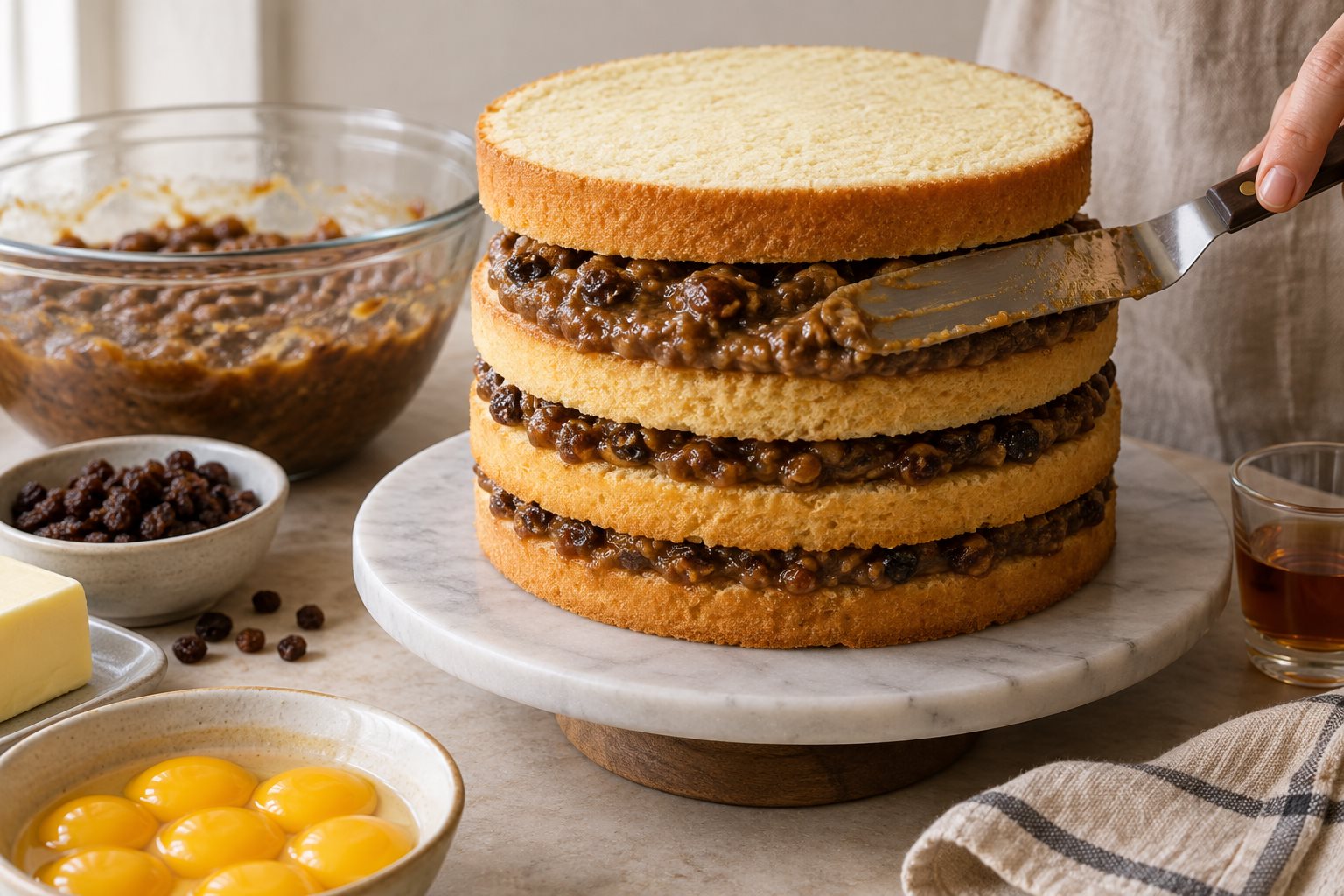
  6. Fill and stack. Beat the cold filling smooth. Spread a third of it thickly over the first layer, right to the edge, and repeat twice, leaving the top layer bare. Press the stack gently square.
    Four pale cake layers with dark raisin custard between them, an offset spatula smoothing the filling and the top still bare before icing.
    Spread the cooled raisin filling to the edges, then stack the four layers before icing. AI-generated illustration.
  7. Boil the icing and use it hot. Whip the 2 whites stiff. Dissolve 2 cups sugar in ½ cup boiling water over a hot fire, stirring back and forth rather than round and round so it does not grain, then boil without stirring until a spoonful poured back runs off in a fine thread, about 240°F. Pour it slowly onto the whites, beating, and keep beating until cool and thick enough to hold a peak. Swirl over the top and sides. Leave the cake under a dome a day before cutting.
If the filling scrambles — grainy, with flecks of set yolk — it went over too hot or stopped being stirred. Push it through a sieve while hot; it will come back to smooth and lose only a little body, which the overnight chill returns. If it never thickens after fifteen minutes, the heat is too low: raise it a little and keep the spoon moving, and stop the moment it coats the back of the spoon in a layer you can draw a clean line through. For the icing she gives her own fix and it is still the right one: if it runs, beat in a pinch of tartaric acid, which today means an eighth of a teaspoon of cream of tartar. Icing that sets grainy was stirred round and round, or had sugar crystals on the pan wall — wash the sides down with a wet brush next time.

Storage and make-ahead

The whole cake keeps 4 days under a dome at room temperature and is at its best on days two and three, which is her point about making it ahead. Refrigeration dries the layers and stiffens the filling; if the kitchen is hot enough to worry about, keep it cold and let the slices stand half an hour before eating.

The filling alone keeps 2 weeks in a sealed jar in the fridge — the book says this sort of cooked yolk filling will keep for weeks, hot weather or cold. Iced cake does not freeze well because boiled icing weeps, but unfilled layers freeze 2 months double-wrapped.

What to serve with it

Nothing sweet beside it; the cake is carrying five cups of sugar between batter, filling and icing. Strong black coffee is the traditional partner and the one the old Georgia menus print, with Lane cake following chicken salad and beaten biscuits. A small glass of the same whiskey that went into the filling does no harm either.

A tall four-layer white cake cut to show three dark stripes of raisin filling between pale layers, under a soft white boiled icing, on a footed stand

From the recipe box / Alabama

Lane Cake with Raisin and Whiskey Filling

Four thin white layers split by a cooked filling of eight egg yolks, sugar, butter, clipped raisins and a wine-glass of whiskey, iced in boiled white icing — printed under this name, by the woman whose name it is, in Clayton, Alabama, in 1898.

Prep
45 min
Cook
1 hr
Total
2 hr 15 min, plus overnight
Serves
16
Calories
565 per serving

Ingredients

Scale

Instructions

  1. A day ahead, cook the 8 yolks, 1 cup sugar, a pinch of the salt and the ½ cup butter over medium-low heat, stirring constantly, 8–12 minutes to about 170°F, until it thickens like lemon curd.
  2. Off the heat and still hot, stir in the raisins, the whiskey and 1 teaspoon vanilla. Cool, cover and refrigerate overnight.
  3. Heat the oven to 350°F. Butter four 8-inch tins and line each bottom with parchment. Sift the flour, baking powder and remaining salt together three times.
  4. Cream the 1 cup butter with 2 cups sugar 4–5 minutes until pale, then add flour and milk alternately, beginning and ending with flour.
  5. Whip 8 egg whites stiff, fold them in at once with 1 tablespoon vanilla, divide between the tins and bake immediately, 16–19 minutes, until the layers wrinkle at the edge and spring back. Cool 10 minutes, turn out, peel the paper, cool completely.
  6. Stack the four layers with the cold filling spread thickly between them, leaving the top bare.
  7. Boil 2 cups sugar with ½ cup water to 240°F, pour it slowly onto 2 stiff egg whites while beating, beat until cool, and ice the top and sides. Keep the cake a day before cutting.

Nutrition

Fat20 g (10 g saturated)
Sodium180 mg
Protein6 g
Servingone sixteenth of a four-layer 8-inch cake
Calories565
Cholesterol140 mg
Carbohydrates88 g (70 g sugar, 1 g fiber)

Nutrition is an estimate calculated from the listed ingredients and is provided as a courtesy, not as dietary advice.

Questions readers ask

Can I leave the whiskey out?

You can, and the cake will still stack, but understand what goes with it. The quarter cup is also a quarter cup of liquid in a filling that is otherwise fat, sugar and yolk, so replace it with orange juice or strong black tea rather than nothing, and add a teaspoon more vanilla. The keeping quality drops: an alcohol-free filling is a three-day filling, not a two-week one.

Why boiled icing rather than buttercream?

Because that is what the book ices with. Its icing chapter leads with Plain Boiled Icing — a cup of sugar dissolved in four tablespoons of boiling water, boiled to the thread, poured onto a whipped white and beaten until cool — and instructs you to double the quantity for a medium-size cake, which is exactly the quantity used here. It is also the right texture: a soft marshmallowy shell over a dense filling, where buttercream would put fat on top of fat.

Did Emma Lane name the cake after herself?

No, and she says so in print, which is rare enough to be worth quoting. The recipe ends: my prize cake, and named not from my own conceit, but through the courtesy of Mrs. Janie McDowell Pruett, of Eufaula, Ala. She calls it a prize cake but names no fair and no competition, and the words fair and premium appear nowhere in the book — so the county-fair story that usually accompanies this cake has no support in the only document that matters.

Should there be coconut and pecans in the filling?

Not in the original, and the book is unambiguous. The filling on page 41 is yolks, sugar, butter, raisins, whiskey or brandy and vanilla. Pecan does not occur once in the whole of Some Good Things to Eat, and cocoanut occurs three times, all of them in a fruit salad and two custards far from the cake chapter. The coconut-and-pecan version is real and widely loved, but it is a later addition by somebody else, and nothing that could be opened for this article dates it.