American cooking Recipes & regional stories

Skillet & Sage

A culinary journey through the fifty states

The regional table / Missouri

Kansas City Burnt Ends
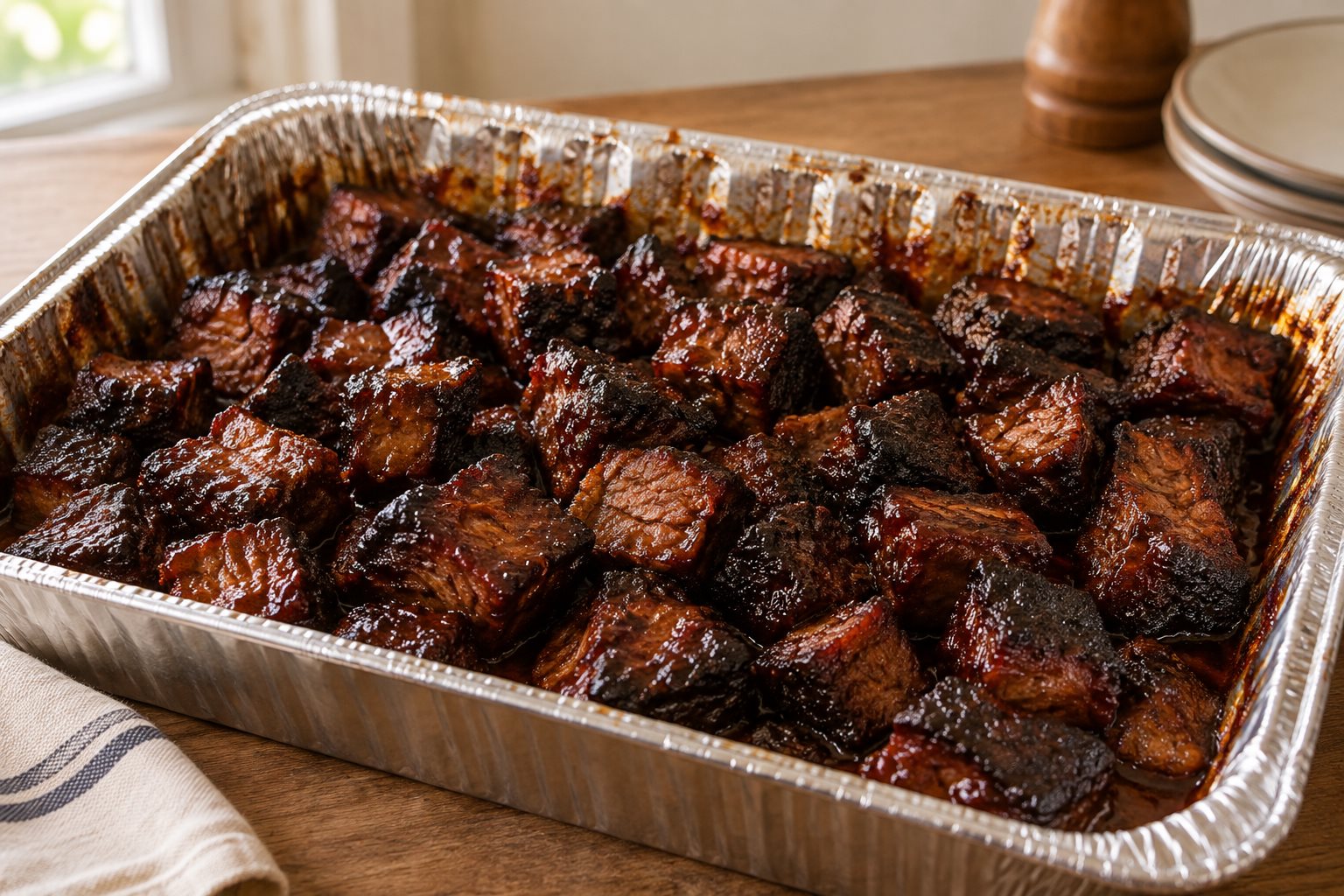
A foil pan of dark cubed beef glazed with sauce, the corners of each cube blackened and crisp
One muscle, cut into cubes and cooked again. What you are looking at is six crusted faces where there used to be one. AI-generated illustration.

A whole brisket has one muscle that can stand a second cook, and burnt ends are what happens when somebody makes it stand one.

Somebody else has already written the brisket article on this site, so this one leaves the fire alone and stays with the cut. The federal specification is precise about it. USDA's Institutional Meat Purchase Specifications, Fresh Beef Series 100, effective November 2014, defines Item No. 118, beef brisket, as the anterior end of the sternum bones plus two muscles, the M. pectoralis profundi and the M. pectoralis superficialis, which it calls the web muscle. Split them and you get two saleable items: Item No. 120A, Beef Brisket, Flat Cut, Boneless, which "shall consist only of the M. pectoralis profundi," and Item No. 120B, Beef Brisket, Point Cut, Boneless, which "shall consist only of the M. pectoralis superficialis (web muscle)." Burnt ends are 120B and nothing else. USDA's own nutrient tables say why that matters: a hundred grams of brisket point half, lean and fat, trimmed of surface fat and cooked, carries 28.5 grams of fat and 358 calories, against 8.01 grams and 213 calories for the flat half handled the same way. Same animal, same trim, three and a half times the fat.

For the people, the record in Missouri is thinner than the steer that sent me here suggested. The Southern Foodways Alliance carried the Texas brisket and Memphis ribs articles on this site because it has oral history projects in those places; it has none in Kansas City, and its Southern BBQ Trail stops at the Arkansas and Tennessee lines. What the SFA does have is a Gravy podcast episode of 17 August 2022, "Henry Perry, Kansas City's Barbecue King," reported by Mackenzie Martin of KCUR, which says Perry "was born in Shelby County, Tennessee, and started learning how to barbecue when he was just seven," was cooking professionally on a Mississippi River steamboat by fifteen, sold from a stand and later from 18th and Vine, and died in 1940, by which time close to a hundred barbecue restaurants were working in the area; among those who came out of his kitchens were Arthur Pinkard, who cooked for the first Gates, and the brothers Arthur and Charlie Bryant. The Missouri Historical Review says the same thing in its own voice: reviewing Andrea Broomfield's Iconic Restaurants of Kansas City in January 2023, it notes that "Henry Perry's barbecue stand launched several careers, including that of Arthur Bryant, in what would become Kansas City's signature contribution to American fare." This is Black pitmasters' work and the city is built on it. The dish is younger than the public domain and no old book holds it, so the quantities below are this site's own, worked out for this page.

Why this version works

Sugar goes on last. Kansas City sauce is tomato and molasses and it will be carbon if it meets the fire at hour one. Hold it back for the second cook, when the meat is already tender and only an hour and a half of heat remains, and the sugar has just enough time to set into a lacquer without burning.

Cubing is the whole trick. Federal law describes what barbecue is supposed to look like. 9 CFR 319.80 says barbecued meats must be cooked by dry heat from burning hardwood "for a sufficient period to assume the usual characteristics of a barbecued article, which include the formation of a brown crust on the surface and the rendering of surface fat." A whole point has one such surface. Cut into inch cubes it has six per cube, and the second cook builds crust on all of them.

The fat is the budget for the second cook. An hour and a half more heat would ruin a flat, which is nearly lean by the time it is tender. The point has 28.5 grams of fat per hundred to spend and keeps eating well while its edges candy. That, and not any secret, is why burnt ends come off the point and not the other end of the brisket.

The point is a single muscle, so buy it as one. Because Item No. 120B exists, a butcher can sell you the point on its own, and a 4 to 5 pound point cooks in two-thirds the time of a 14 pound packer with no flat going dry alongside it. If the counter only has whole packers, the seam of fat between the two muscles is your cutting line: slide a knife along it with the brisket fat side up and the point lifts off as one wedge.
Ingredient notes

Rub: Half salt and coarse black pepper, half paprika with brown sugar, garlic and onion powder — this is Kansas City rather than Central Texas, and the sweetness belongs. Make a double batch; a third of it goes on raw, a third over the cubes, and the rest keeps.

Sauce: A cup and a half of thick tomato-and-molasses sauce, thinned with a quarter cup of beef stock so it coats rather than clumps. The commercial versions of this dish are honest about what they are for. Famous Dave's of America told the SEC in its annual report filed 15 March 2013 that its new burnt ends "will allow us to use all of the parts of the brisket; it will improve yield, and thus the margin contribution for this product."

Fuel and pan: Oak or hickory for the first cook and a disposable half-size foil pan for the second. The second cook is dry heat in a pan and does not need smoke: a 275°F oven does it as well as a pit, which is the practical way to make burnt ends the day after you cooked a brisket.

Brisket point: Four to five pounds, Item No. 120B if the label carries item numbers, otherwise ask for the point, the deckle point or the second cut. Choice grade or better. Leave a quarter inch of the fat cap on: the specification calls for trimming practically free of fat, and packers take it further than a pit wants.

Step by step

  1. Separate the point. If you bought a whole packer, set it fat side up and follow the seam of fat between the two muscles with a long knife, pulling the point back with your free hand as it releases. Trim the cap to a quarter inch. A bought point needs only the trim.
  2. Season and let it sit. Mix the rub. Coat the point on every face with about half of it and leave it uncovered on a rack in the fridge for 4 hours or overnight. Salt needs the time; the sugar and paprika do not mind it.
  3. First cook, to tender. Cook at 250 to 275°F over oak or hickory until a probe slides into the thickest part with no resistance — 195 to 203°F, usually 7 to 8 hours for a 5 pound point. Wrap in butcher paper at about 165°F if the bark is where you want it. The fire craft here is ordinary brisket cooking and another writer has already laid it out.
  4. Rest, then chill if you can. Rest 45 minutes minimum before cutting. A point chilled overnight cubes far more neatly than a hot one, and the day-after route costs nothing in eating quality.
  5. Cube. Cut the point into 1-inch cubes across the grain. Expect some cubes to be nearly all bark and some nearly all interior; that variety is the dish, so do not sort them.
  6. Dress the cubes. Tip them into a foil pan, scatter over a third of the remaining rub, pour on the sauce loosened with the stock, and turn gently until every cube is coated. One layer deep, or as close as the pan allows.
  7. Second cook, uncovered. Back into 275°F heat, uncovered, for 60 to 90 minutes, stirring twice. They are done when the sauce has tightened to a glaze that clings when a cube is lifted and the corners have gone dark and firm. Let them settle 10 minutes before serving.
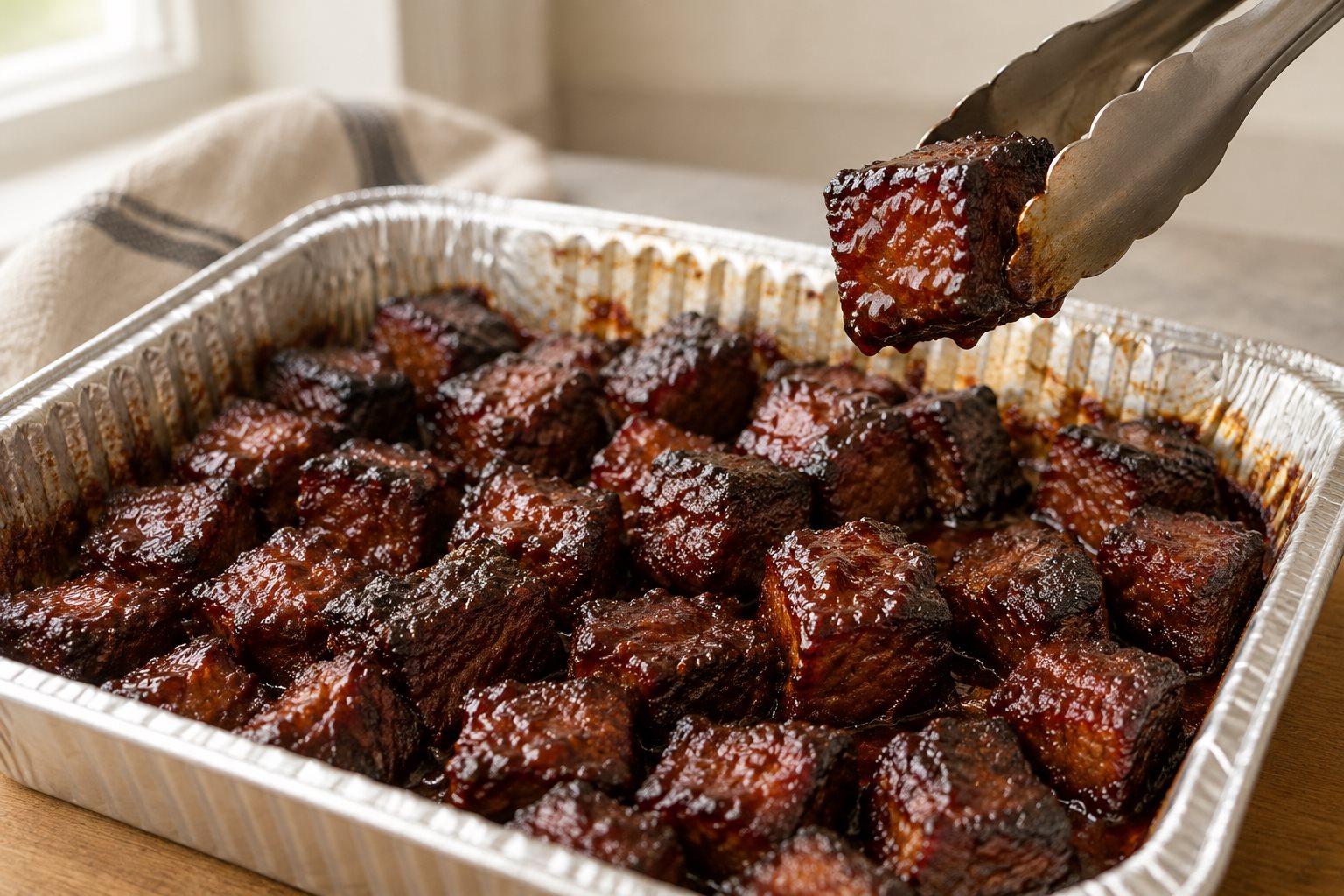
    Tongs lifting a glazed brisket cube with dark corners above a foil pan
    The second cook is done when the glaze clings and the corners are dark and firm. AI-generated illustration.
If the cubes came out tough, the first cook stopped short: the point was at temperature but not probe-tender. Put them back in the pan with a splash of stock, cover with foil this time, and give them 45 minutes more at 275°F, then uncover for the last 15 to dry the glaze again. If they went the other way and collapsed into shreds when you stirred, the point was overcooked before cubing; stop stirring, serve them as chopped brisket on a bun, and pull the next point at the first sign the probe goes in like butter. Sauce that turned bitter and black means the second cook ran hot — drop to 250°F and stir more often.

Storage and make-ahead

Burnt ends keep 4 days refrigerated and reheat better than almost any other barbecue, because the glaze protects them. Cover with foil, add a spoonful of stock, and warm at 300°F for 20 minutes, then uncover for 5.

They freeze for 3 months in their own sauce, which is worth knowing: the yield from one point feeds eight, and half of it in the freezer is the best reason to cook a brisket you do not need all of.

What to serve with it

White bread, pickles and raw onion, and beans cooked with a few burnt ends stirred through them — that last is the standard Kansas City move and the best use of the odd cubes. Something sour on the plate matters more here than with any other barbecue, because the sauce is sweet and the meat is rich; dill pickle chips do more work than coleslaw.

A foil pan of dark cubed beef glazed with sauce, the corners of each cube blackened and crisp

From the recipe box / Missouri

Kansas City Burnt Ends

The point of a brisket cooked once for tenderness, cut into inch cubes, tossed with rub and sauce and cooked a second time until every face has its own crust.

Prep
30 min
Cook
9 hr
Total
10 hr
Serves
8
Calories
650 per serving

Ingredients

Scale

Instructions

  1. Separate the point from the flat along the fat seam if you bought a whole packer, and trim the cap to 1/4 inch.
  2. Mix the salt, pepper, paprika, brown sugar, garlic powder, onion powder and cayenne. Coat the point with half of it and rest uncovered in the fridge 4 hours or overnight.
  3. Cook at 250–275°F over oak or hickory to 195–203°F and probe-tender, 7 to 8 hours, wrapping in butcher paper once the bark has set.
  4. Rest at least 45 minutes, or chill overnight for easier cutting.
  5. Cut into 1-inch cubes across the grain and tip them into a foil pan.
  6. Scatter over a third of the remaining rub, add the sauce loosened with the stock, and turn to coat.
  7. Cook uncovered at 275°F for 60 to 90 minutes, stirring twice, until the glaze clings and the corners darken. Settle 10 minutes before serving.

Nutrition

Fat46 g (18 g saturated)
Sodium1150 mg
Protein40 g
ServingAbout 6 oz of cubes with glaze
Calories650
Cholesterol150 mg
Carbohydrates18 g (16 g sugar, 1 g fiber)

Nutrition is an estimate calculated from the listed ingredients and is provided as a courtesy, not as dietary advice.

Questions readers ask

Do I need a smoker?

For the first cook, yes, or a kettle set up for indirect heat — that stage is what puts smoke and bark on the meat. The second cook is just dry heat and a 275°F oven handles it, which is why burnt ends are the natural thing to do with yesterday's leftover point.

Were burnt ends really given away?

That is the story everybody tells and I could not document it. It appears in print as a claim — a Georgia paper in August 2020 calls Kansas City "the birthplace of burnt ends, the fatty, meaty top section of the brisket other places used to discard" — but nothing I could reach shows it happening. Worth knowing: in the open newspaper archives the phrase "burnt ends" means burnt tobacco leaves, spent matches and the burnt ends of a cake right through the 1930s, and only turns up meaning meat in this century.

Can I make burnt ends from the flat?

You can cube a flat and sauce it, and people sell it, but it is a different dish. The flat is the M. pectoralis profundi and carries about a quarter of the point's fat, so ninety minutes of extra dry heat leaves you with sauced jerky. If the flat is all you have, cut the second cook to 30 minutes and cover the pan.

How much does a 5 pound point yield?

About 3 pounds of cubes. The federal barbecue standard at 9 CFR 319.80 caps cooked barbecued meat at 70 percent of its fresh weight, and a point rendered properly loses a little more than that. Eight servings is honest; six is generous.