The regional table / Minnesota
Jucy Lucy, or Juicy Lucy
Two bars on the same street claim it, they do not spell it the same way, and the evidence does not settle which came first.
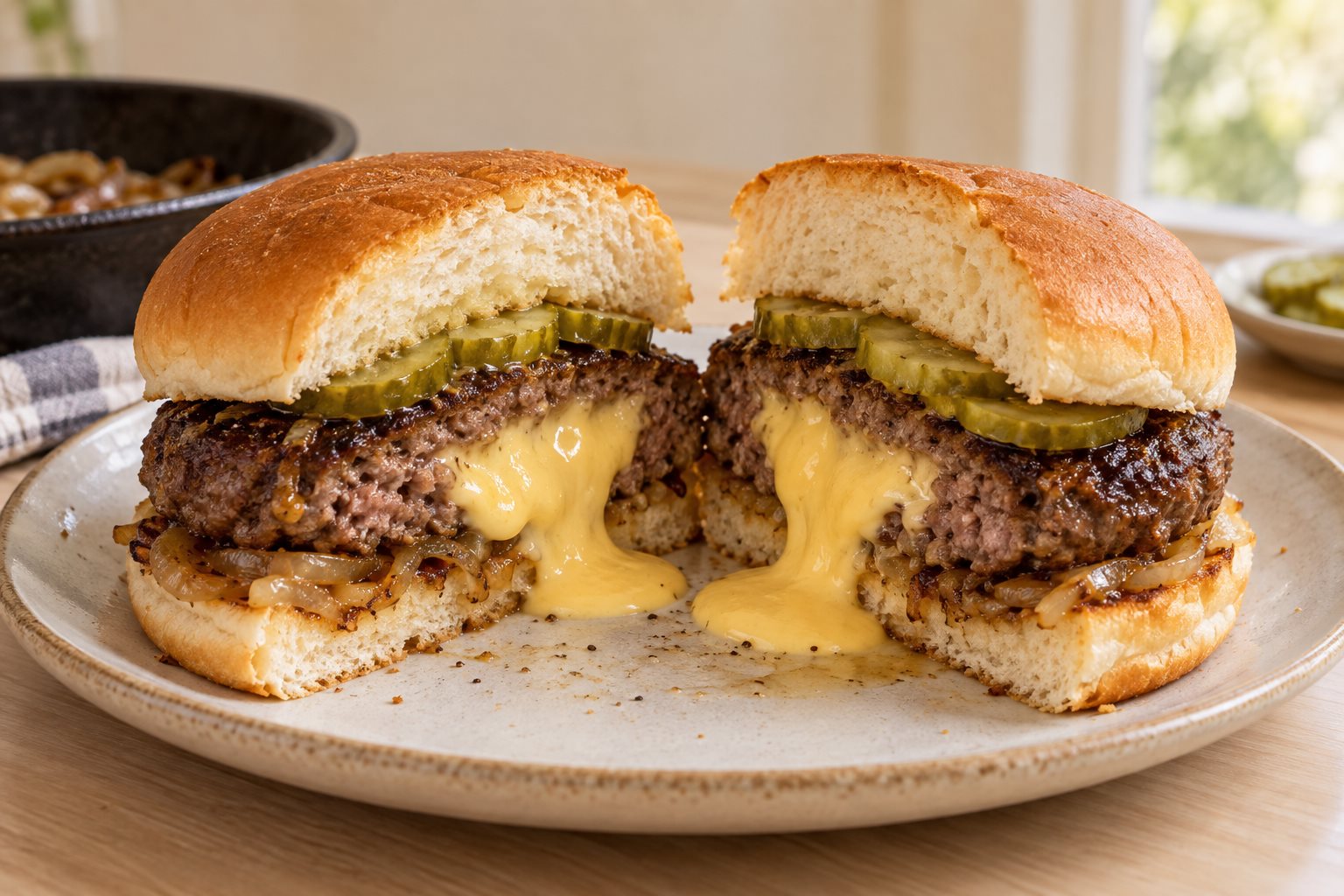
Matt's Bar & Grill is at 3500 Cedar Avenue South in Minneapolis, and its own account is blunt: it heads itself "HOME OF THE ORIGINAL JUCY LUCY!", says the place "began in 1954 as a neighborhood burger eatery", and credits the sandwich to a customer rather than a cook — the founder, Matt Bristol, "explains how the 'Jucy Lucy' was created when a local customer asked for two hamburger patties with a slice of cheese in the middle", and on biting into it the man "exclaimed 'that's one juicy Lucy', and a legend was born". The missing letter is explained as an accident that stuck: "Customer demand grew so quickly, we forgot to add the 'i'." The bar then turns the spelling into the claim itself, warning readers that "if it's spelled correctly, you just might be eating a shameless ripoff!" The house motto, printed with the rest of it, is "Fear the Cheese!"
Twenty-three blocks south, at 5800 Cedar Avenue South, the 5-8 Club spells it with the letter and registers the phrase: its page is headed "Home of the Juicy Lucy®" and dates the business, not the burger, to "In 1928, at the height of Prohibition, the 5-8 Club originally opened in Minneapolis as a speakeasy", when it "was known as the 58th Street Club, located out in the country". Read carefully, the 5-8 Club's own text names no inventor and no year of invention at all: it calls the burger "Minneapolis' contribution to American food culture" and makes a quality claim instead, a burger "stuffed with American cheese that rivals imitate, but no one duplicates". So the record is two houses, one street, two spellings, one claim of invention and one claim of custody, and nothing outside the houses to break the tie. There is no litigation: a search of the federal and state opinion database returns nothing for either spelling. The Minnesota Historical Society's newspaper hub, which would hold the Minneapolis dailies, refused automated requests on 22 September 2026, so no dated press evidence could be read for this page and none is invented here. This site had to choose one spelling for a web address and chose the shorter; that is a filing decision and not a verdict. The dish is younger than any public-domain cookbook and the quantities below were worked out for this page.
Why this version works
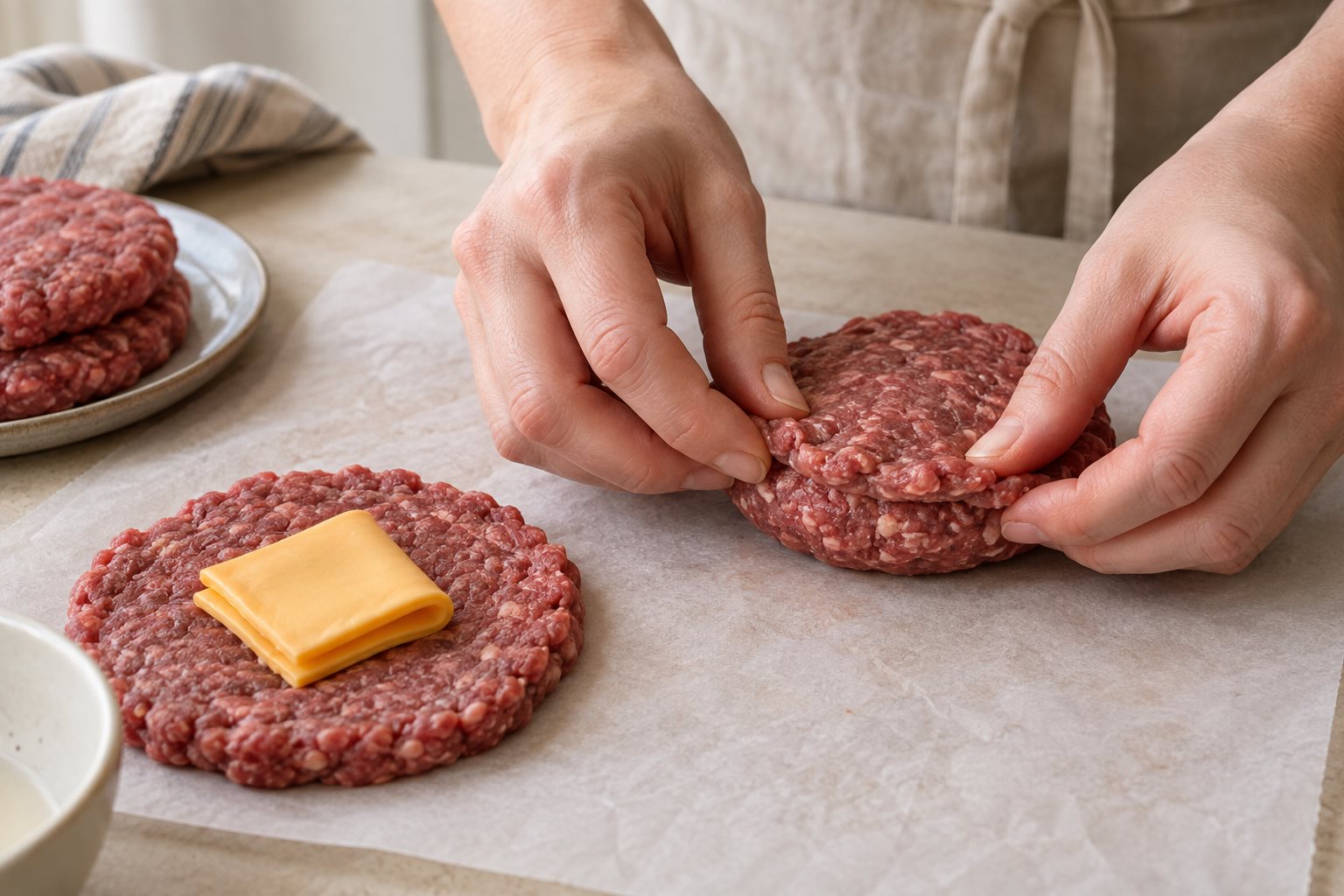
A wide, thin, cold seam. Two patties of four ounces each, pressed to five inches across, give a one-inch border of bare meat all the way round the cheese. Press that border together, then roll the edge between your fingers so the two discs become one. A stuffed patty fails at the rim, never in the middle.
High heat on the first side, then patience. A cheese-filled patty needs long enough for the middle to go liquid, which is well past the point where an ordinary burger is done. Hard contact on a dry, very hot pan builds the crust fast so the inside can have the time it needs without the outside going grey. Then it has to rest, or the first bite is molten cheese at oven temperature straight onto the roof of the mouth — which is what the sign at Matt's is actually warning about.
Eighty-twenty chuck and nothing added to it. 9 CFR 319.15(b) says hamburger "shall not contain more than 30 percent fat, and shall not contain added water, phosphates, binders, or extenders". Take the regulation as a recipe instruction. Egg, breadcrumb or milk in the mix makes a meatloaf that cannot seal to itself, and the seam is the only thing standing between you and a griddle full of cheese. Salt the outside of the formed patty, not the inside of the meat, for the same reason: salt dissolves muscle protein into a sticky paste that traps steam and bursts.
Process American cheese, and the reason is in the federal standard. 21 CFR 133.169 defines pasteurized process cheese as cheese comminuted and mixed with heat and an emulsifying agent "into a homogeneous plastic mass". The agents are named in paragraph (c) — sodium citrate, the phosphates, the tartrates — "in such quantity that the weight of the solids of such emulsifying agent is not more than 3 percent of the weight of the pasteurized process cheese." Those three percent are the whole trick: they stop the fat and the protein separating when the cheese goes past its melting point. Cheddar has no such salts, and inside a patty at 190°F it splits into oil and squeaky curd.