American cooking Recipes & regional stories

Skillet & Sage

A culinary journey through the fifty states

The regional table / Massachusetts

Ipswich Fried Clams
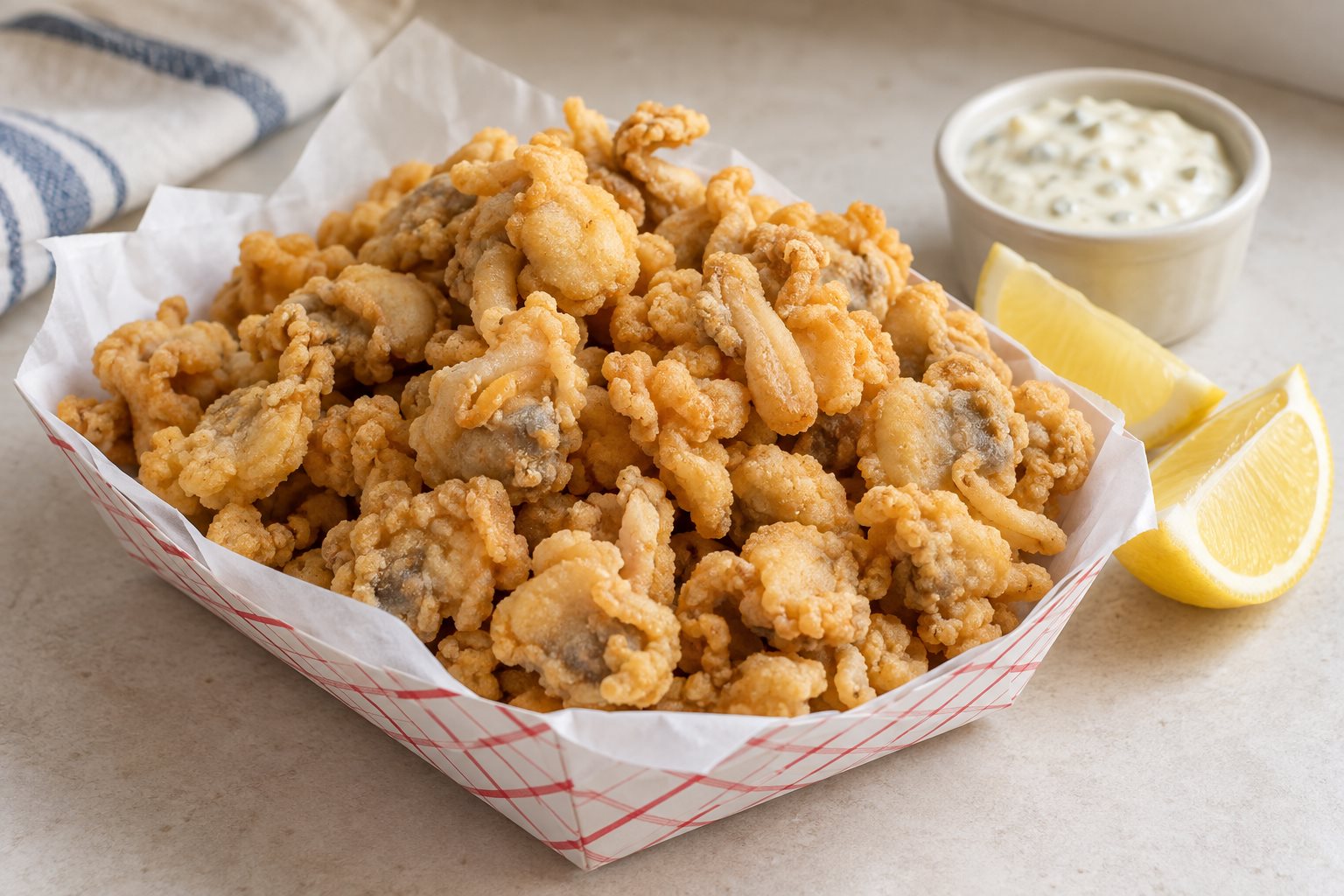
A paper tray heaped with whole fried clams, pale gold and irregular, bellies and necks plainly visible, lemon wedges and a cup of tartar sauce beside it
Pale gold, not brown. The round bulges are the bellies, and they are the entire reason to fry a soft-shell clam. AI-generated illustration.

A clam strip is a surf clam with the belly cut away. This is the other thing entirely: the whole animal, neck and belly together, in a coat thin enough to see the clam through.

The document is Section II of The Fisheries and Fishery Industries of the United States, George Brown Goode, Government Printing Office, 1887 — the geographical review of the fisheries for the year 1880, with the Massachusetts entries written by William A. Wilcox of Boston. His Ipswich page, 136, describes the flats the dish is named for: they run from Rowley on the north to Essex on the south, ten miles long by half a mile wide, and in 1880 they were worked for bait. Seventy-five men dug from March to June of 1879 and fifty more from November to March. Clams went at a dollar a barrel in the shell, or by the water-bucketful at fifty cents for the cod boats, and five hundred barrels were salted down for bait that season against the several thousand barrels of earlier years. A close season had just been declared, no digging from 15 May to 15 October, permits issued by the selectmen to residents only, a dollar a bushel in fines for anyone caught and his tools confiscated. Then Wilcox adds the sentence this recipe hangs on: "It must be added, however, that a demand for clams formerly not in existence has lately sprung up; this is to supply clams as food in Boston and other neighboring cities." Forty barrels a week in the shell went to Salem through the summer of 1879, and sixty barrels plus two hundred and eighty gallons of shucked meat weekly to Boston that winter. The eating clam was the new thing on these flats, and it was new in 1880.

Essex, the next town south, carries a famous origin claim: that the fried clam was invented at a roadside stand there in 1916. It is the claim of the house that makes it, and no document opened for this article supports it. What the printed record does hold is older. Mrs D. A. Lincoln of the Boston Cooking School, copyright 1883, gives a fritter batter on page 107 of Mrs Lincoln's Boston Cook Book and then writes, under Clam Fritters: "Clams in the shell should be steamed and dressed. Drain, and dip each whole clam into the batter." That is a whole clam, fried in deep fat, in a Boston cookbook thirty-three years early. By then it was restaurant food too. A Brooklyn Eagle squib reprinted in the Georgia papers in June 1881 sets two young women down "to a dish of fried clams in a Fulton-street restaurant", and a Thomasville paper of March 1880 has a man eating fried clams in a saloon on the corner. The loudest silence is Fannie Farmer: the 1896 Boston Cooking-School Cook Book, full of clam bouillon, clam chowder, clam consomme and a Clam and Chicken Frappe, has no fried clam in it at all, only Clam Fritters of chopped meat dropped by the spoonful. So the quantities below are worked out for this page. What the documents settle is the clam, the flats and the century; the corn flour is mine.

Why this version works

The belly is the whole point. Fish and Wildlife Service Circular 110, The Soft-Shell Clam Industry of Maine, 1961, defines it without sentiment: between the gills lies the visceral mass, "the so-called belly or stomach", holding the digestive and reproductive organs. That is where a clam tastes of the sea rather than of protein. Cut it off and you have removed the flavour and kept the chew.

Evaporated milk does the sticking. It is thicker than fresh milk and its lactose has already taken some heat, so it clings where milk runs off and it colours in a minute of frying instead of three. Three minutes at frying heat is a dead clam. Buttermilk works and tastes sharper; water does not work at all.

Short fry, small batches, hot fat. Sixty to ninety seconds at 350°F and out. Clams are mostly water: a dozen of them dropped at once take the fat down thirty degrees, and everything after that is absorption rather than frying. Fry four ounces at a time and let the fat come back up between batches.

Corn flour, not cornmeal and not batter. Finely milled corn flour goes on as a coat, not a jacket. Cornmeal is gritty and falls off in the fat; a poured batter seals the clam into a doughnut and steams the belly until it bursts. The coat should be thin enough that you can still see the shape of the neck through it.
Ingredient notes

Fat: peanut oil for its smoke point, or lard, which is what the old frying kettles held. Two quarts in a six-quart pot gives three inches of fat and four inches of clearance, and you want both.

Clams: soft-shell clams, Mya arenaria, sold as steamers or as frying clams. Circular 110 records a marked price premium on clams under three inches across, and that is the frying size; the large ones went to the canners. Two pints of shucked meat feeds four. Buy them shucked if the fish market shucks them, and buy them the day you fry.

Corn flour: the finely milled kind, sometimes sold as fish fry or as corn fines — not cornmeal, not masa harina, not cornstarch. The half cup of wheat flour with it keeps the coat from going sandy.

Evaporated milk: one can, unsweetened, chilled. Sweetened condensed milk is a different product and will burn black before the clam is warm.

Step by step

  1. Rinse the sand out. Soft-shell clams live buried and their bellies hold grit. Tip the shucked meats into a bowl of cold water with the tablespoon of salt, swirl them with your hand for ten seconds, and lift them out into a colander. Repeat with fresh water until the water runs clear, usually three changes. Do not soak them; they go slack.
  2. Dress the necks. Each clam has a dark sheath over the siphon. Pinch the end and pull it off, the way you would peel a finger of a glove. It is edible but it is tough and it curls in the fat. Lincoln calls this dressing the clam and it is ten minutes of work for two pints.
  3. Into the milk. Pour the evaporated milk over the drained clams and leave them 10 minutes at the sink while the fat heats. No longer — the coat thins out if they sit.
  4. Heat the fat. Bring the oil to 350°F in a heavy 6-quart pot and set a rack over a sheet pan next to it. Keep a thermometer clipped on; this recipe is run entirely by that number.
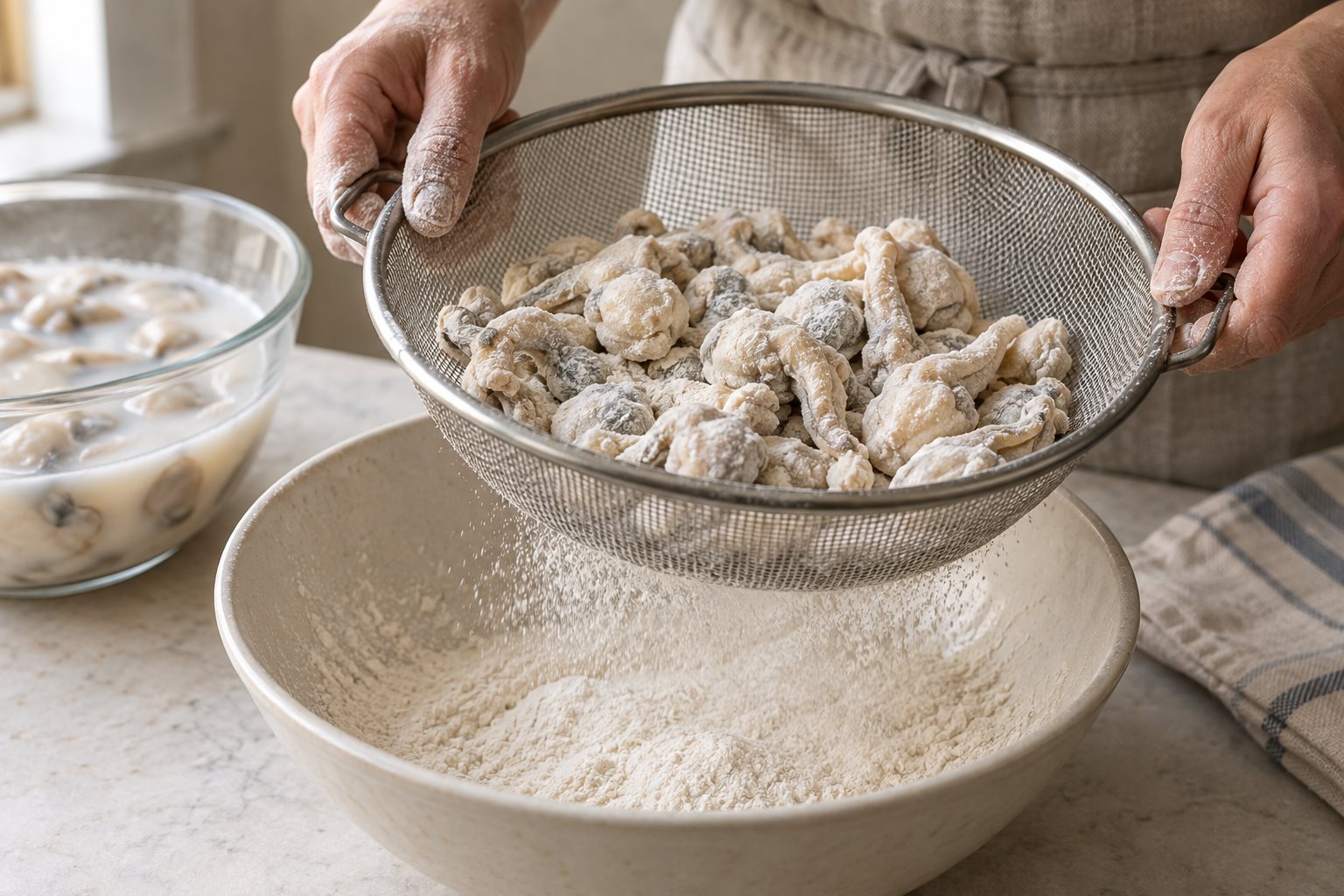
  5. Dredge and shake. Mix the corn flour, the wheat flour, the salt and the pepper in a wide bowl. Lift a handful of clams out of the milk, let them drip a moment, drop them into the flour and toss with your fingers until each one is coated. Turn them into a coarse sieve and shake hard — the loose flour is what burns and clouds the fat.
    Flour-coated whole clams in a sieve with loose flour falling into a bowl
    Shake off loose flour in a sieve before frying; a thin coat keeps the clams light. AI-generated illustration.
  6. Fry in small batches. Lower a handful into the fat, about four ounces, and fry 60 to 90 seconds, until the coat is pale gold and the clams float and sound crisp against the spider. Lift them to the rack and salt them at once. Let the fat come back to 350°F before the next batch, and skim the crumbs between batches. Serve immediately, with lemon.
Greasy, heavy clams with a soft coat mean the fat was under 325°F when they went in, and the usual cause is a crowded pot rather than a cold burner. Nothing recovers a soggy batch, but the next one will be right if you halve the handful and wait for the thermometer. A burst belly is the opposite fault: too long in the fat. Pull them at ninety seconds even if they look paler than you expected, because the coat keeps colouring for half a minute on the rack.

Storage and make-ahead

These do not keep and there is no honest way to say otherwise. A fried clam is at its best inside two minutes and finished inside ten; refrigerated and reheated it is a rubber band in a crust. Fry only what the table will eat standing up.

The raw clams are the part to handle carefully. Keep shucked meats covered in the coldest part of the fridge and fry them within a day, and keep live clams in the shell under a damp cloth, never sealed in a bag or sitting in fresh water.

What to serve with it

Tartar sauce and lemon, and a pile of something starchy that fries at the same temperature — onion rings or thick chips. Cut the fat with slaw dressed in cider vinegar rather than mayonnaise, and drink lager or cold cider. A tray of fried clams wants nothing built or plated; it wants paper and a lot of napkins.

A paper tray heaped with whole fried clams, pale gold and irregular, bellies and necks plainly visible, lemon wedges and a cup of tartar sauce beside it

From the recipe box / Massachusetts

Ipswich Fried Clams

Whole soft-shell clams, belly and neck together, through evaporated milk and corn flour and ninety seconds of hot fat.

Prep
30 min
Cook
20 min
Total
50 min
Serves
4
Calories
665 per serving

Ingredients

Scale

Instructions

  1. Swirl the shucked clams in cold salted water, lift them out, and repeat with fresh water until it runs clear — about three changes.
  2. Pull the dark sheath off each siphon and discard it.
  3. Pour the evaporated milk over the drained clams and leave them 10 minutes.
  4. Heat 2 quarts of oil to 350°F in a heavy 6-quart pot and set a rack over a sheet pan alongside.
  5. Toss a handful of drained clams at a time in the corn flour, wheat flour, salt and pepper, then shake off every loose crumb in a sieve.
  6. Fry 4 ounces at a time for 60–90 seconds, until pale gold, lift to the rack, salt at once, and bring the fat back to 350°F before the next batch. Serve with lemon.

Nutrition

Fat42 g (8 g saturated)
Sodium940 mg
Protein32 g
ServingAbout 8 oz fried clams
Calories665
Cholesterol80 mg
Carbohydrates36 g (3 g sugar, 2 g fiber)

Nutrition is an estimate calculated from the listed ingredients and is provided as a courtesy, not as dietary advice.

Questions readers ask

Do I have to eat the belly?

You do not, and clam shacks on the North Shore will sell you the necks alone for more money. But the belly is the visceral mass, it is where the clam tastes of the flat it came out of, and a clam fried without it is a piece of fried gristle with a good crust. Eat one whole before you decide.

Are clams from these flats safe to eat?

They are regulated rather than trusted, which is better. Henry Lind's history of the Massachusetts shellfish officer service in Marine Fisheries Review 71(3), 2009, dates the system to 1972, when blooms of a red tide organism producing paralytic shellfish poison spread across wide areas after a late-season hurricane and the bays were closed. Weekly sampling of the beds has run ever since, with the local constable posting and patrolling any closed flat daily, and Lind records that there have been no reported instances of PSP illness in the state. Ipswich and Essex sit in the state's Area 1, twelve towns whose principal species is the softshell clam.

Can I use cornmeal instead of corn flour?

No. Cornmeal is ground too coarse to stick to a wet clam, so most of it ends up on the bottom of the pot, burning and flavouring the next batch. If corn flour is unavailable, run cornmeal through a spice grinder and sift it, or use all wheat flour and accept a softer coat.

What is the difference between this and a clam strip?

Species, and an amputation. A strip is cut from the foot of a surf clam, Spisula solidissima, a big offshore hard clam with no belly worth frying. Circular 110 records the switch plainly: after the Maine flats thinned, surf clams "were processed for frying and soon became an important competitor of soft-shell clams for the fried-clam market". The strip is uniform, cheap and chewy. The whole soft-shell clam is none of those things.