The regional table / Connecticut
Hartford Election Cake
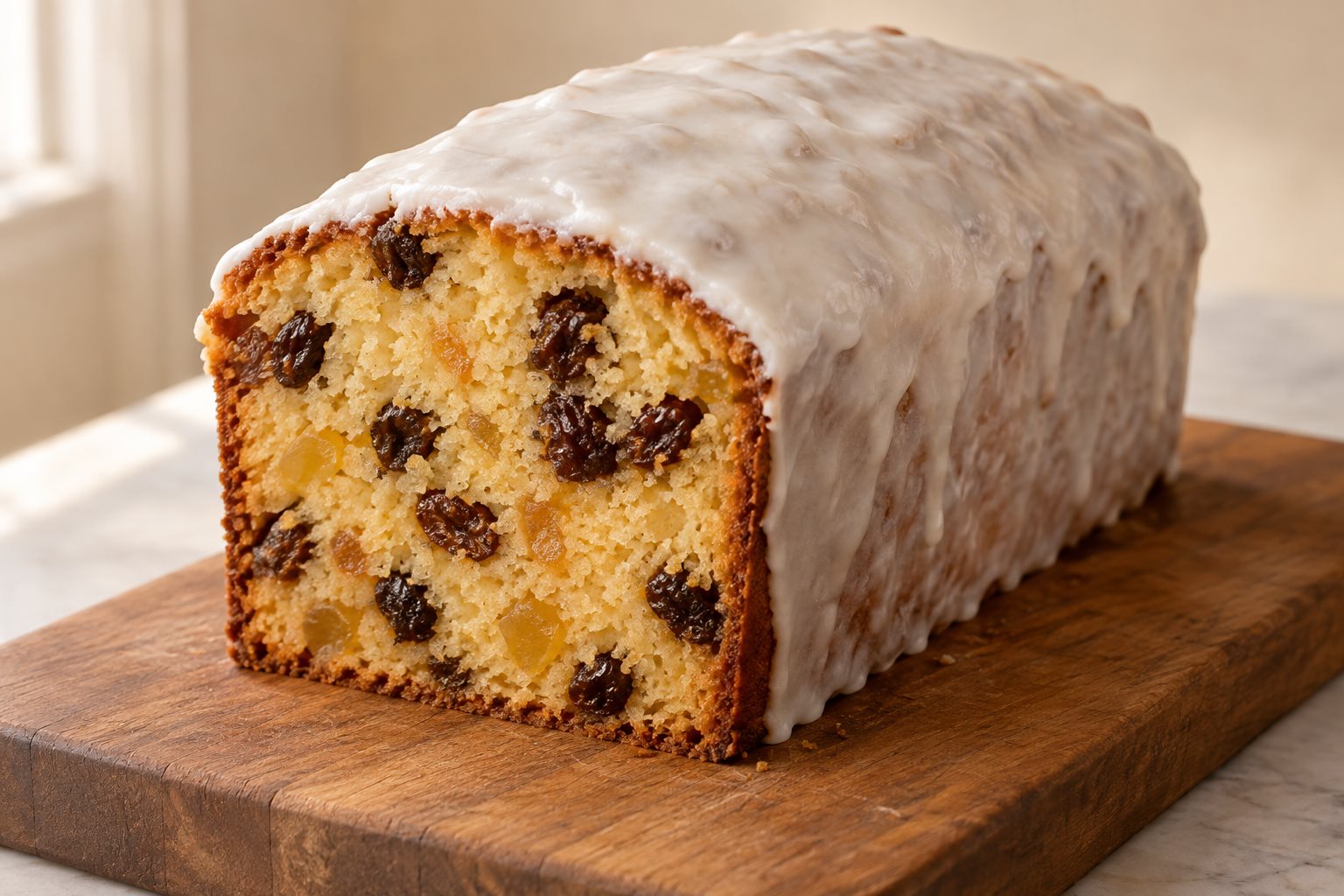
Eleven of these were printed in one Hartford book in 1889, each under the name of the woman who made it, and the smallest of them starts with two quarts of flour.
The scale is the story, and it is documented from both ends. Start at the top: Hartford Election Cake and Other Receipts, collected by Ellen Terry Johnson, printed by the Fowler & Miller Co. of 341 Main Street, Hartford, in June 1889. It prints eleven election cakes in a row, numbered 1 to 11, each credited by name — Mrs. Sheldon, Miss Rebecca Butler, Mrs. Lewis Weld, Mrs. Nathaniel Terry, Mrs. Henry Hudson, Miss C. M. Ely, Mrs. Charles H. Brainard, Miss Mary Ann Olcott, Miss Gleason, and one from Windsor. Mrs. Sheldon's uses eight pounds of flour, four and a quarter pounds of butter, four and a quarter pounds of sugar, four pounds of raisins, a pound of citron and a quart of home-made yeast, and makes ten medium-sized loaves. Mrs. Nathaniel Terry's takes twelve quarts of flour and makes twelve. Mrs. Henry Hudson's measures its flour by the peck. Mrs. Brainard's, the book notes drily, "makes fourteen loaves, and is usually divided". Ahead of them all stands a receipt for Hartford Election Cake Yeast — three pints of water, eight potatoes, a handful of hops, brown sugar, a coffee cup of distiller's yeast, twenty-four hours to rise — and then a short paragraph settling an argument that was evidently live in 1889: "It has been claimed that the compressed yeast of modern use, is worthless for making election cake. This is incorrect, for although it is undoubtedly less successful, as a rule, still excellent loaf cake has been made of it. It requires a cake and a half of Fleischman's yeast to raise seven loaves of cake." That sentence is the licence for the packet of dried yeast in the list below.
Now the other end, and a correction worth making plainly. Amelia Simmons's American Cookery, Hartford, printed by Hudson & Goodwin in 1796 — the first cookery book written by an American, advertised in the Connecticut Journal of 8 June 1796 as just published and sold by Isaac Beers at two shillings threepence — contains no election cake at all. The word election does not occur in it. What it contains instead is the architecture, under another name: Loaf Cakes, No. 1, which rubs six pounds of sugar, two pounds of lard and three of butter into twelve pounds of flour, adds eighteen eggs, a quart of milk, two ounces of cinnamon, two small nutmegs, a teacup of coriander seed, a pint of brandy, half a pint of wine, six pounds of stoned raisins and a pint of emptins — home-made yeast — and tells you to "rub your shortning and sugar half an hour, it will render the cake much whiter and lighter", then frosts it with six whipped whites and three pounds of sifted loaf sugar "put on thick, as it comes hot from the oven". Her errata page goes further in the same direction: "Page 35. Another plain cake, No. 5; for 9 pounds of flour, read 18 pounds." The edition usually credited with the first printed Election Cake is the undated Albany one from the Websters' printing office; Waldo Lincoln's standard bibliography of American cookery books dates it only to about 1800 and remarks that it "is actually the third edition", and no scan of it could be opened from here, so this article does not lean on it. Between the two ends sits Lydia Maria Child, The American Frugal Housewife of 1832, who already calls the thing antique: "Old-fashioned election cake is made of four pounds of flour; three quarters of a pound of butter; four eggs; one pound of sugar; one pound of currants, or raisins if you choose; half a pint of good yeast." And the occasion itself survives in the Connecticut press, sourly. The Stonington Mirror of 14 May 1874, reporting inauguration day in New Haven, says it "failed to awaken any enthusiasm in our citizens. Election cake had very meager sales and was said to have been slack baked." By 1896 Fannie Farmer had shrunk it to a single bread pan built on one cup of bread dough, one egg and eight chopped figs, and by 9 June 1932 a syndicated newspaper menu for political-party dinners was serving "Election Cake and Favorite Son-dae" as a pun. The recipe below is Miss C. M. Ely's No. 6 — two quarts of flour, the smallest of the eleven — divided by four, so that it makes one loaf.
Why this version works
The fruit goes in last and floured. Mrs. Brainard's receipt says to stir in the fruit "very lightly", "well dredged with flour, which must be taken from that measured for the cake" — so the coating is not extra flour but borrowed flour, which is the correct way to do it and the reason the amounts here are taken out of the main measure. Dredged fruit hangs in the crumb; undredged fruit sinks and makes a wet seam at the bottom.
Half an hour of creaming, and Simmons says why. The 1796 instruction is explicit about the reason: rub the shortening and sugar half an hour and "it will render the cake much whiter and lighter". With no chemical leavening in the original, the air you beat into the butter is the only lift the cake gets beyond the yeast. A stand mixer does in five minutes what a Hartford kitchen did in thirty, but the five minutes are not optional.
Slack baking is the failure the record itself names. The 1874 Connecticut complaint was not that the cake was stale but that it was "slack baked" — pulled from a cooling oven before the middle set. A loaf this heavy with sugar and fruit browns long before it is cooked, which is exactly the trap. Cover it with foil once it is coloured and keep baking; the only honest test is a skewer and a thermometer, not the top.
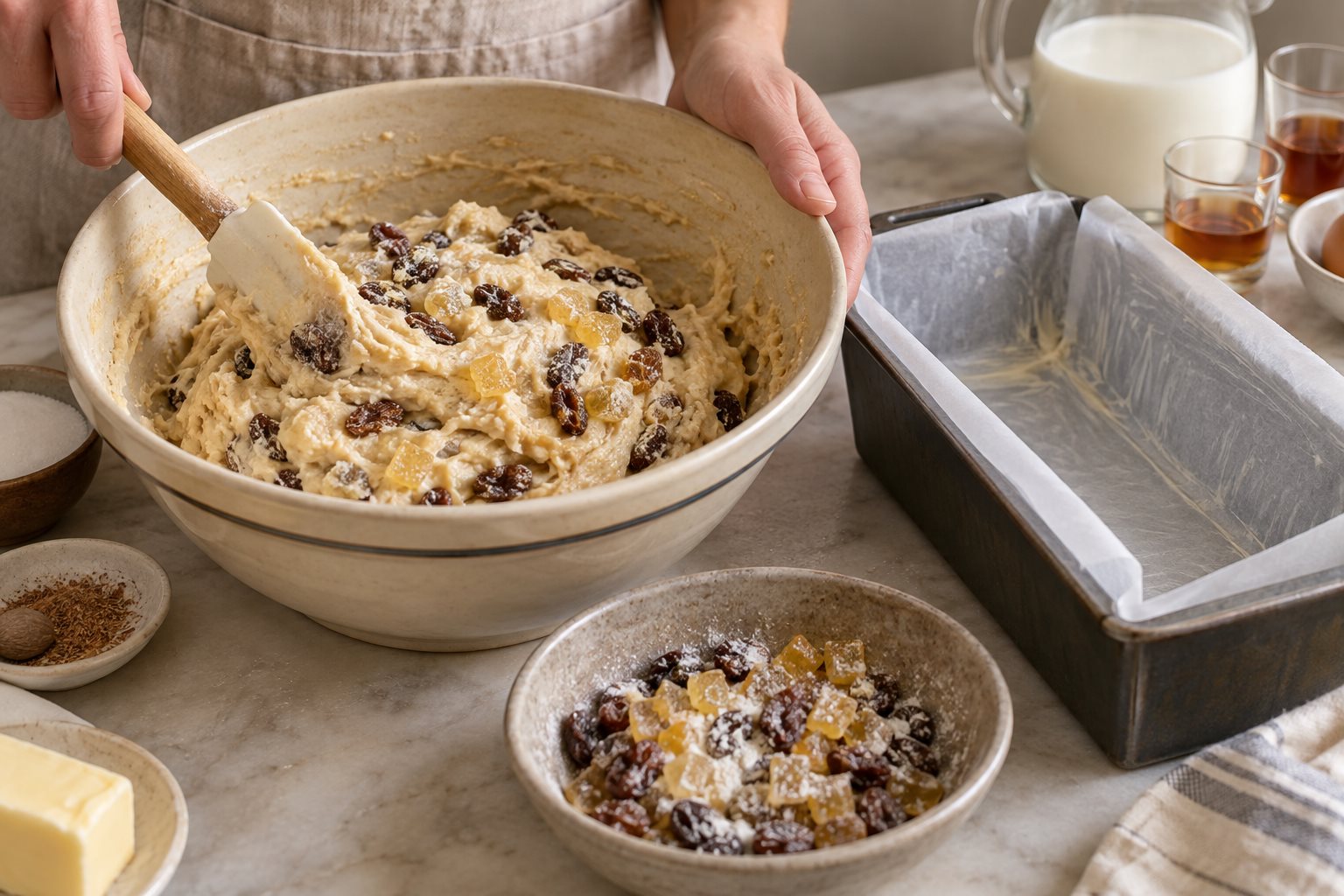
It is bread, and it is mixed in two stages because of that. Every one of the eleven Hartford receipts builds a sponge first — part of the flour, part of the shortening, the milk and all the yeast — and only enriches it hours later. That order is not decoration. Sugar and fat in quantity slow yeast to a crawl, so the leavening has to establish itself in a lean batter before the four and a quarter pounds of butter arrive. Reverse the order and you get a dense, greasy brick.