The regional table / Missouri
St. Louis Gooey Butter Cake
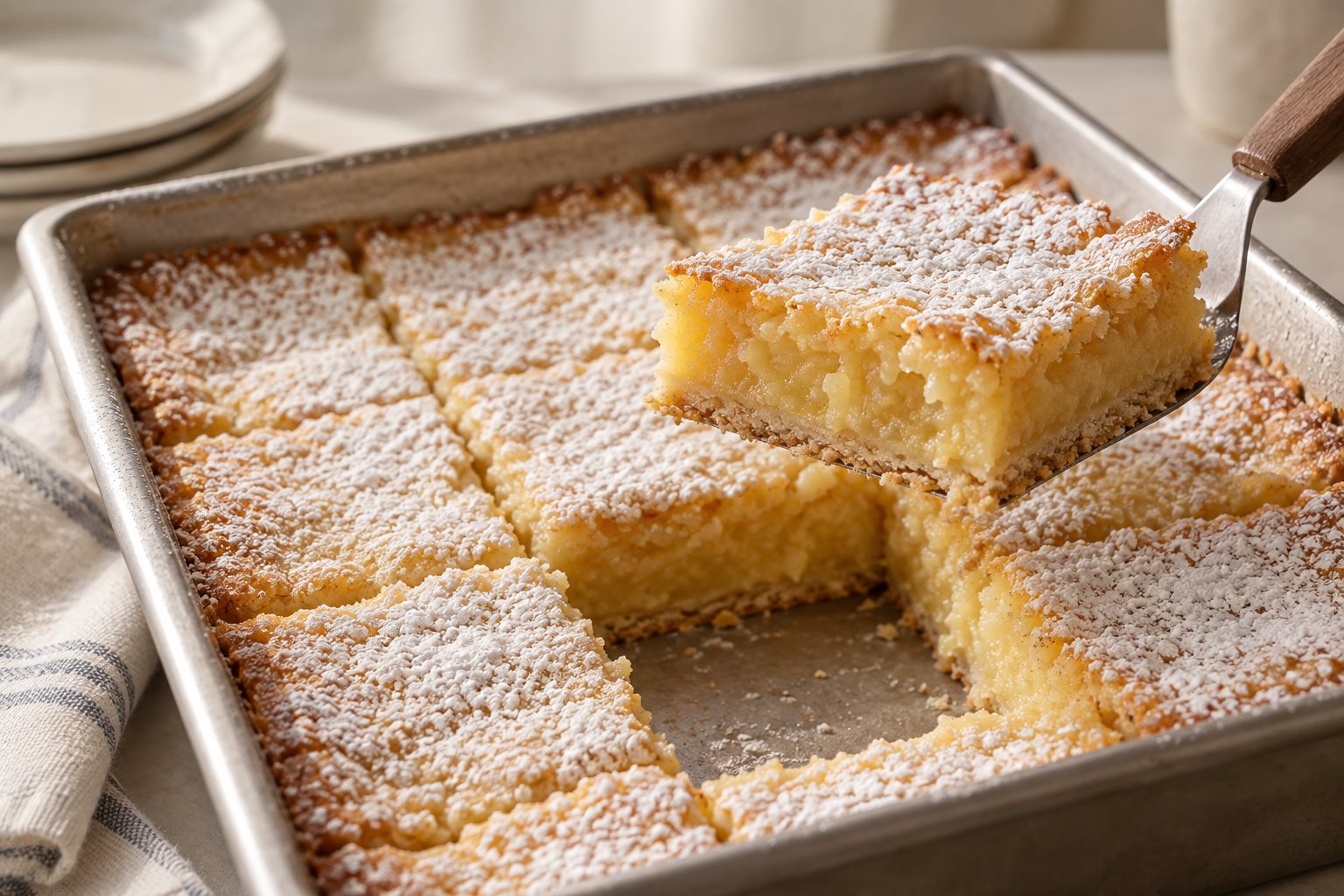
If the middle of your cake looks done, you have baked something else.
The oldest hard record of this cake I could find is a lawsuit. Dickson v. National Supermarkets, Inc., 728 S.W.2d 736, decided by the Missouri Court of Appeals on 5 May 1987, opens: "Personal injury-products liability action for injuries received by respondents (plaintiffs) as a result of ingesting 'gooey butter cake' purchased from appellant (National)." The court put the name in quotation marks, which tells you something about how local it still was, and the cake in that case came from a grocery bakery rather than a restaurant, which tells you where it lived. Beyond that the archives are quiet in a way worth reporting: the phrase does not appear anywhere in the State Historical Society of Missouri's digital collections, across all twenty-nine of them, including the complete run of the Missouri Historical Review, and it does not appear anywhere in Nebraska's newspaper archive either. This is a twentieth-century bakery cake with no old book behind it, and the quantities below are this site's own, worked out for this page.
There are two cakes wearing this name and the record is one-sided about which one got into print. Every published recipe I could reach is the cream cheese one, and it is a cake-mix dessert: the Houston Home Journal of 1 July 1992 prints it as a box of yellow cake mix, a stick of melted butter and an egg pressed into a 9 by 13 pan, topped with eight ounces of cream cheese, a box of powdered sugar and two eggs, baked at 350°F for 30 minutes. Paula Deen's pumpkin version of the same construction ran in Georgia papers in 2005, 2007 and 2008, a red velvet one in 2018, and a bare cake-mix version was still running in June 2025. The other cake — the one St. Louis bakeries sell, a thin yeast-raised base under a topping loosened with corn syrup — is the older shape and the one this recipe follows, but I could not put my hands on a documented formula for it in any open archive, and I am not going to invent a bakery to hang it on. What the German bakery context does support is the surroundings: the State Historical Society's German Experience in St. Louis collection holds a portrait of James Grunzinger, owner of Grunzinger's Bakeries, born in St. Louis and filed under German Americans, and its Folklore and Folklife collection holds a Missouri German community recipe book, Senior citizens present—authentic German recipes, old time remedies, historical sketches of Freistatt (Freistatt, Mo.: Hal Schimke Litho, 1981), full of Kuchen — Brauner Kaffeekuchen, Rahm Kuchen, Pflaumen Kuchen, a Zwetschenkuchen copied out of Die Rundschau of Mittwoch, den 16 Juli 1919, and Blitzkuchen baked fifty and sixty to a wedding. There is no gooey butter cake in it.
Why this version works
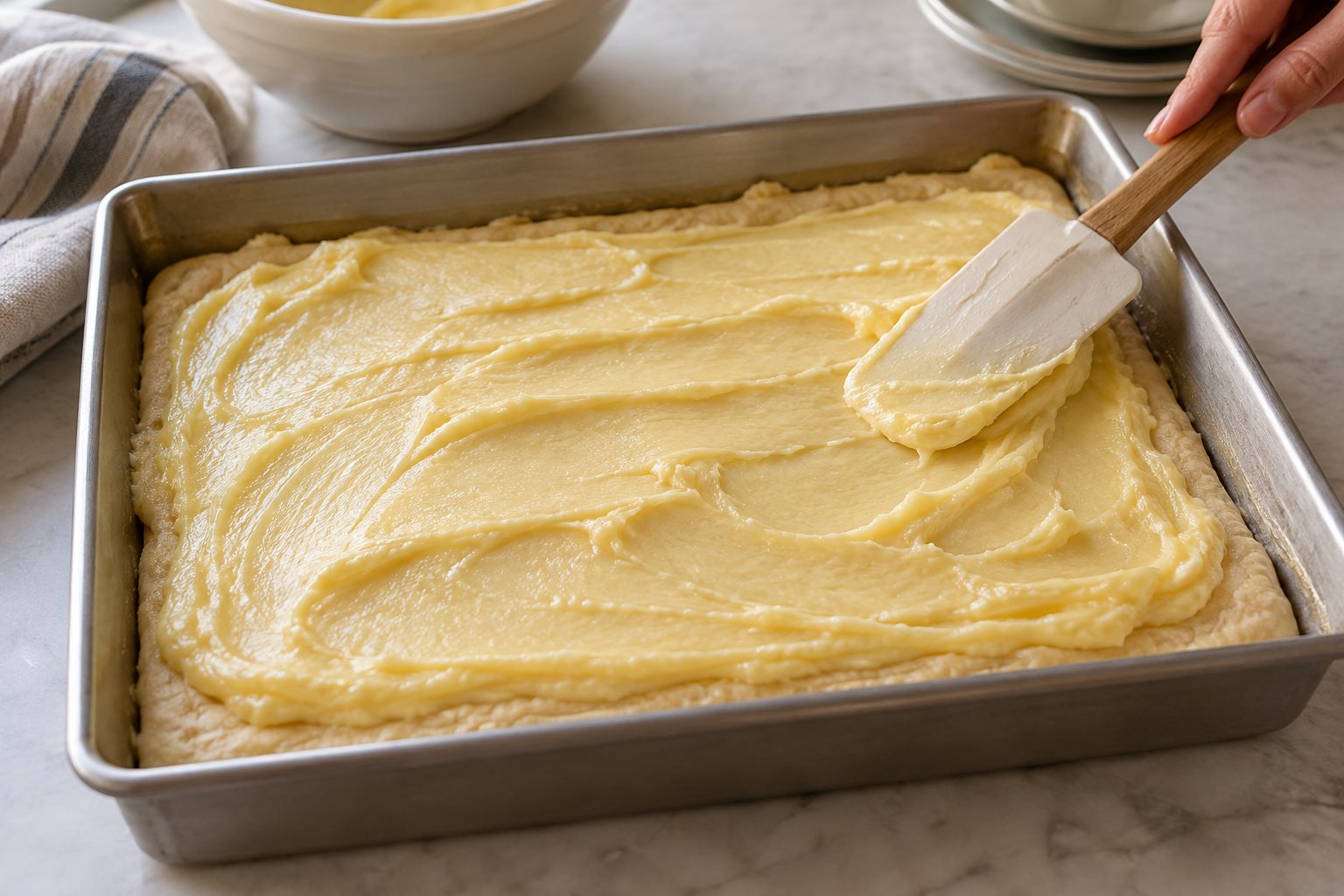
The base is bread, not cake. A yeast dough pressed thin gives you a quarter inch of soft, barely sweet crumb that holds the topping up and tastes of butter and milk rather than sugar. Build the base from a cake mix and you get sweet under sweet, which is the single biggest difference between the bakery cake and the potluck one.
Corn syrup keeps the middle liquid. Granulated sugar cooked with butter and eggs and then cooled will firm up and go slightly grainy. A third of a cup of light corn syrup in the topping interferes with that: the goo stays glossy and spoonable at room temperature a day later instead of setting into a fudge layer. It is the only ingredient in this cake doing a job you cannot see.
Underbaking is the recipe, not a risk. The cake is done when the outer two inches have set and puffed and the middle four still shudder when you knock the pan. A skewer will come out wet and should. Carryover heat in a heavy pan finishes the middle as it cools; bake until a skewer is clean and you have a butter sponge with no gooey in it.
It must cool completely before it is cut. Warm, the topping is soup and runs off the base. At room temperature it sets to the texture it will keep. Two hours in the pan, undisturbed, then powdered sugar and a knife — and the powdered sugar goes on only at the end, because on a warm cake it dissolves and disappears.