The regional table / Arkansas
Fried Peach Hand Pies
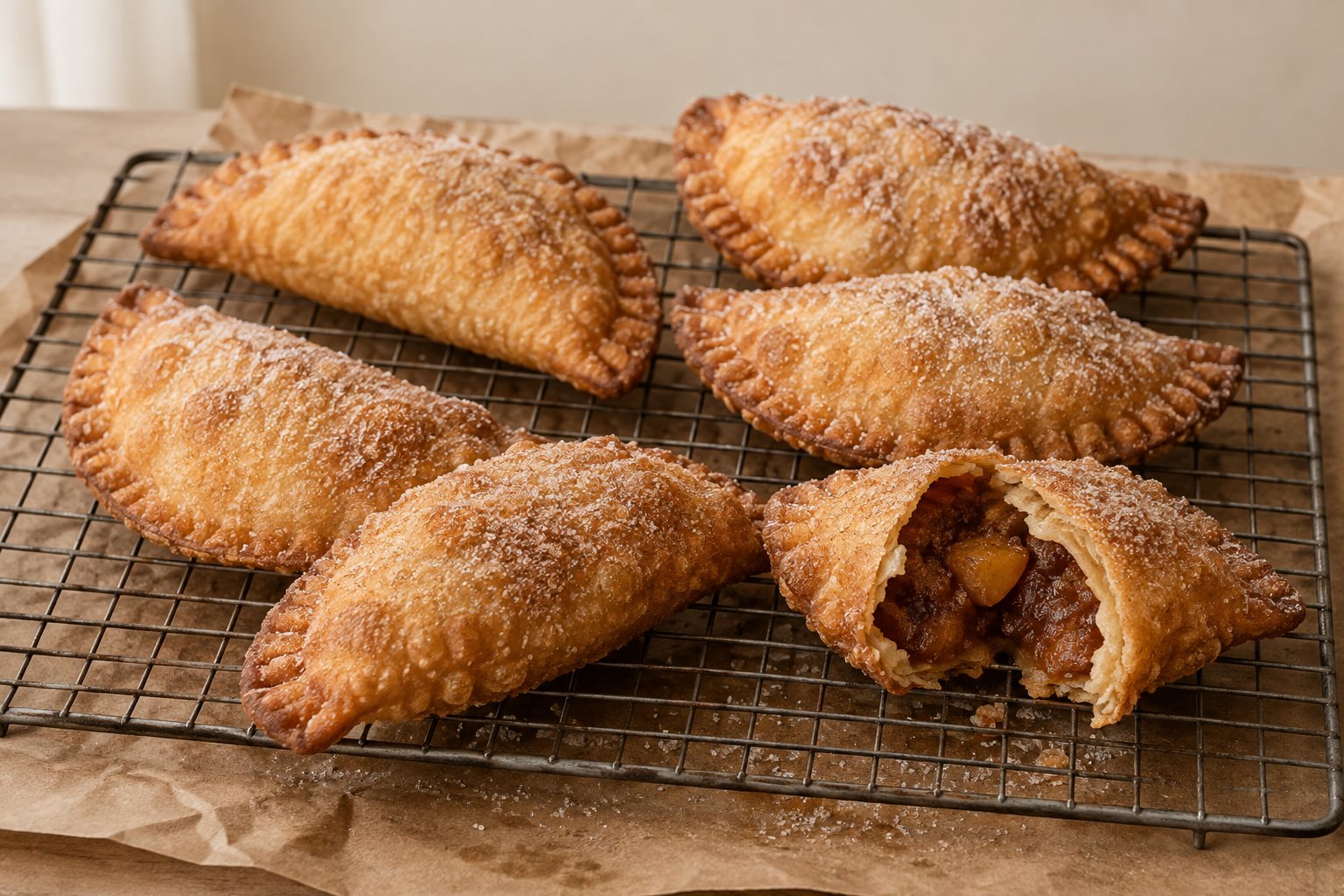
The fruit is dried, and that is not a substitution for anything. A fried pie is a dried-fruit pie, and every decision in it follows from the fact that the filling has to be stiff enough not to blow the seam open in hot fat.
Dried peaches are their own commodity, and the federal government still keeps them that way: 7 CFR 5.4, the list of goods for which parity prices are calculated, names "freestone peaches for processing (except dried)" and then names "dried peaches" separately, a line further down. The literature behind that distinction is enormous and open. Farmers' Bulletin 984, Farm and Home Drying of Fruits and Vegetables, written by Joseph S. Caldwell and revised in 1919, gives the whole operation: what a peach for drying should be ("gathered when ripe but before it begins to soften"), how it is halved and laid "in a single layer, with the stone cavity uppermost, upon the trays", and what the sulphur box is — for a small drier, a packing box or a canvas-covered frame inverted over a stack of trays raised on two blocks of wood, with sulphur burning in a heavy metal vessel, "such as an old saucepan", underneath. The bulletin takes the trouble to correct the folklore about it: "While sulphuring is sometimes called bleaching, the use of this term is misleading, since sulphur fumes do not bleach or whiten the fruit, but merely prevent darkening after the treatment." It gives the fruit's own signal for when the treatment is finished — "The sulphuring is completed when juice begins to collect in the stone cavity" — and warns that this juice is rich in sugar and must not be lost by tipping the trays. It notes that an Elberta, being soft and full of water, needs a little over half the sulphuring time of a firm, dry-fleshed variety. Dried fruit is not stored the moment it leaves the drier, either: it is piled loosely on a clean floor while still warm and stirred at daily intervals "for ten days or two weeks" until the wet pieces and the dry pieces come into equilibrium, which the bulletin calls conditioning. The companion volume, Farmers' Bulletin 841 of 1917, adds the reason the whole cupboard could be lost anyway — the Indian-meal moth and the fig moth lay their eggs on the fruit while it is still on the racks, "generally at dusk or after dark, as they are not fond of daylight". And the yield table is the fact that explains why anybody bothered: a hundred pounds of fresh peaches come off the trays as thirteen to sixteen pounds of dried ones. That is a bushel reduced to something a household can keep on a shelf all winter and a rider can put in a saddlebag.
The form is old and the name never settled, which is the interesting part. Mrs. Porter's New Southern Cookery Book of 1871 does not print a fruit turnover at all, but it assumes you know one: its recipe for beef patties says to roll plain paste thin and "cut it in shape like an apple-puff; fill it with the mince, pinch the edges, and fry them a nice brown". The Dixie Cook-Book of 1883 folds its puff paste "like an old-fashioned turn-over" — already old-fashioned, in 1883. Housekeeping in Old Virginia, 1879, prints two recipes headed Turnovers and both of them are yeast breakfast rolls with no fruit in them whatever. The Blue Grass Cook Book of 1904 gives the entire method inside a savoury recipe, with pastry cut out with a biscuit cutter, rolled thinner, a large spoonful set in the middle, and the whole thing turned over "like a turn-over pie" and fried. So the shape was common property, used to explain other dishes, while the fruit version itself went unwritten; in the six public-domain cookbooks read for this piece it appears as a reference and never as a recipe. The newspapers carry the names before the cookbooks do: "half moon pies" in a country-wedding sketch in the Omaha Daily Bee of 18 July 1884, next to tater custards, and a grandmother who could make fishballs and "fried pies to the queen's taste" in the Beatrice Daily Express of 23 August 1895. None of this is Arkansas, and no honest account can make it so. The form belongs to the whole upland South — the Ozarks, the Cumberland Plateau, the southern Appalachians — and Arkansas's own record of it is shut: the state has no open newspaper archive, the nationwide community-newspaper network holds a single Arkansas title, and the Arkansas church and community cookbooks that ought to hold this recipe are not among the ones that have been digitised and opened. What is open, and close by, is an oral history. On 18 July 1992, at La Forge in New Madrid County, Missouri, Marshall Dial asked Shirley LaPlant whether people dried fruit in her childhood. She said some did and some did not, that she could not remember the method, and then remembered it anyway: "Mother and them were putting them in the oven and turn it on real low and that's the way they dried it." Dial prompted her — "Dried peaches, dried apples" — and then, "And then in the winter." That is the dish's season. The quantities below were worked out for this page.
Why this version works
A wet filling is a burst pie. Water boils at 212°F and the frying fat sits at 350 to 360°F, so any free liquid left in the filling flashes to steam within seconds of the pie going in, and the only way out is the seam. This is the whole argument for dried fruit. A paste cooked down until a spoon drawn through the pan leaves a track that does not close has almost no free water left in it, and it goes into the fat as a solid rather than as a sauce waiting to become gas.
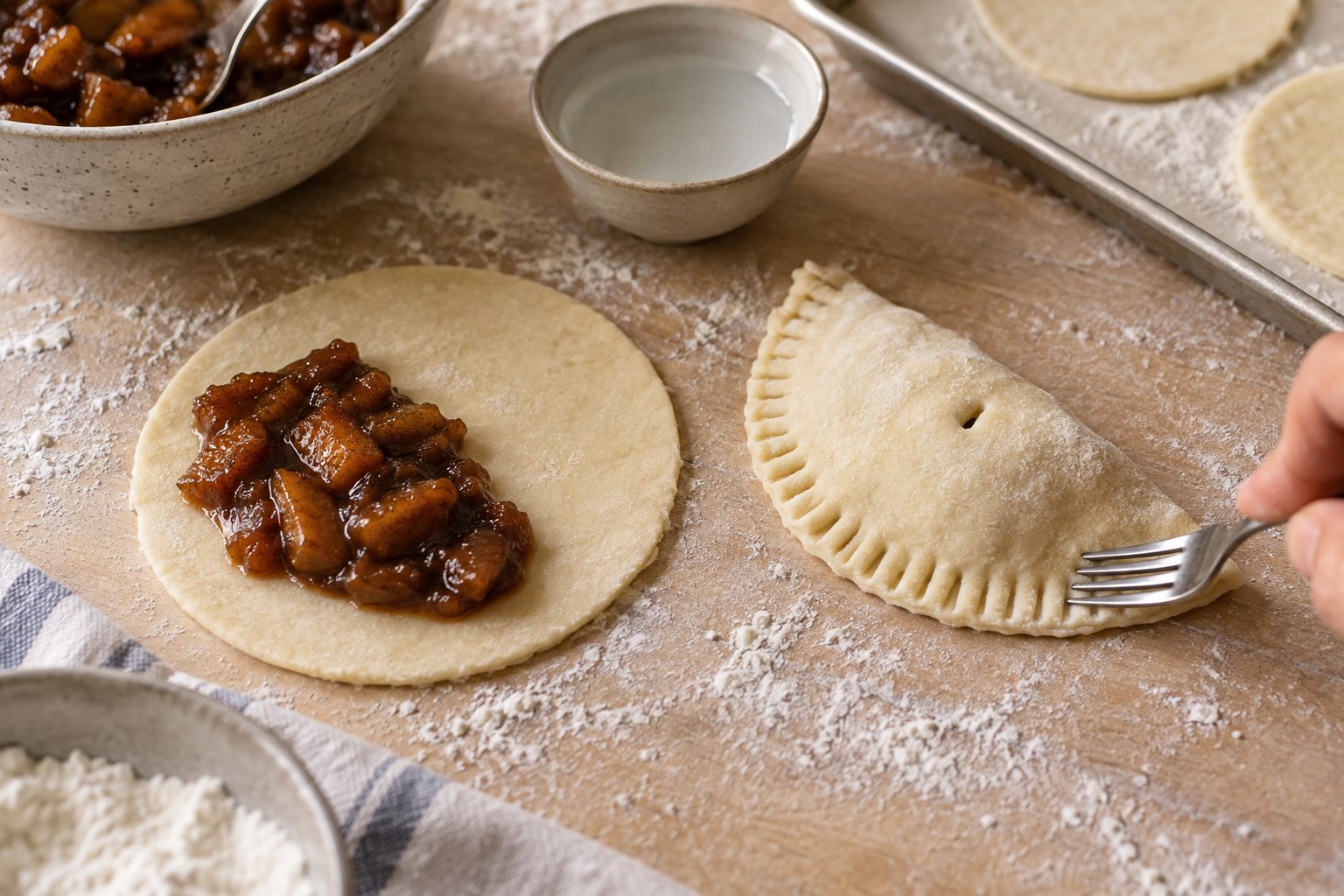
A dry seam seals and a wet one steams open. Filling smeared onto the half inch of pastry you are about to press together is grease and sugar between two surfaces that need to stick. Keep the border clean, brush it with water or egg, fold once and press with the pad of your thumb before you ever touch a fork. One fold means one seam, which is the other reason this shape survives frying while a two-crust miniature pie does not.
Rehydrate the fruit, then take the water back off. Farmers' Bulletin 841 states the rule for cooking anything dried: "the water which has been dried out of the fruits or vegetables must be restored to them before cooking and that this process requires time." The Dixie Cook-Book of 1883 gives the household version — dried fruits "require less boiling, if clean soft water is poured over them and allowed to stand over night", then boiled tender in that same water and sweetened five minutes before it comes off the stove. The soak is not there to make the filling wet; it is there to soften every piece evenly so the fruit breaks down without scorching. Most of that water then goes back up the chimney during the stew.
Fat at 350 to 360°F, and fewer pies in the pan than you think. A hand pie is almost all crust and the filling is already cooked, so the only job in the fat is to set and brown the pastry, which takes about three minutes a side. Too cool and the pastry drinks fat before it sets; too hot and the outside colours while the fold stays raw. Three or four pies at a time in a wide skillet keeps the temperature from falling off a cliff when they go in.