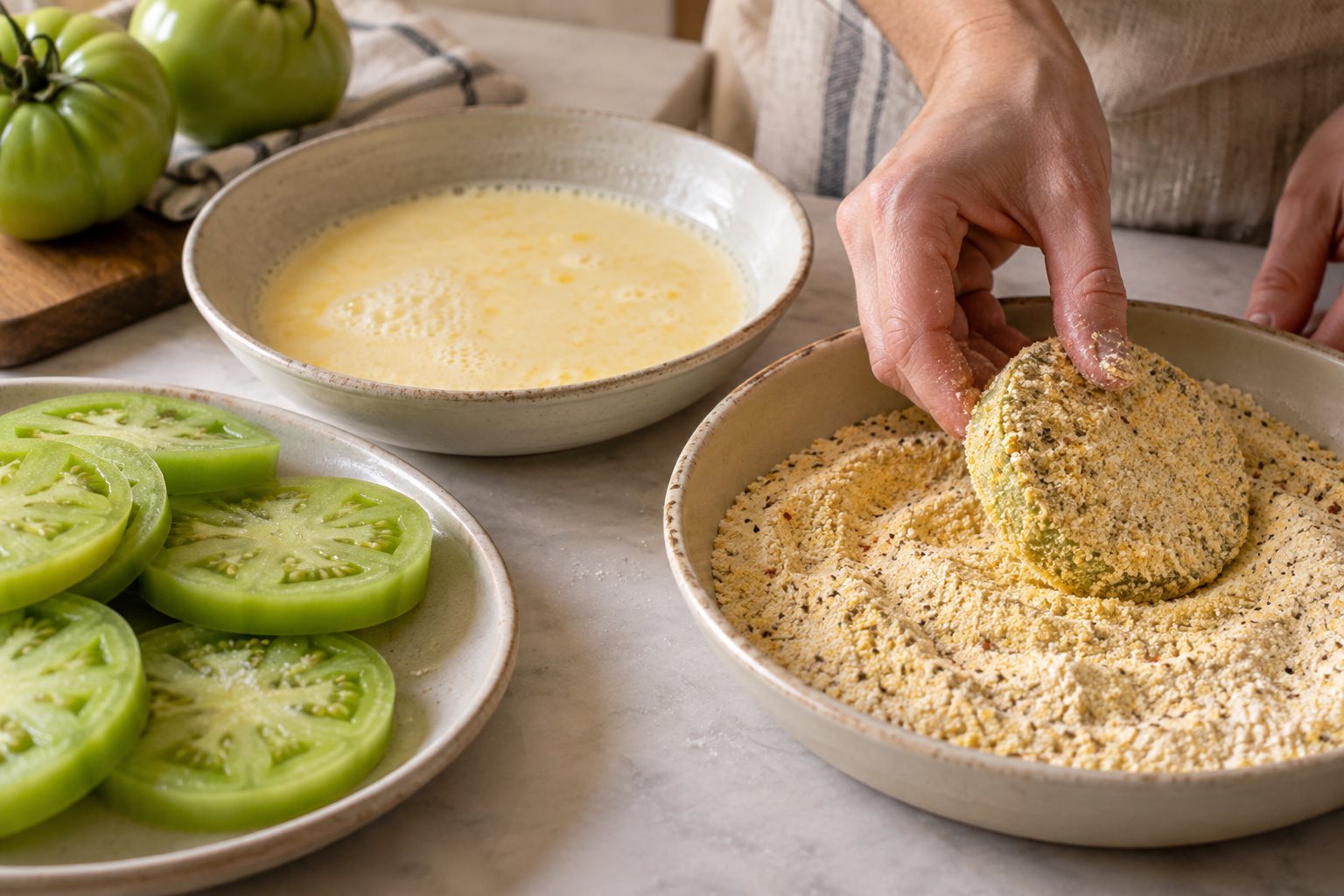
The regional table / Alabama
Fried Green Tomatoes
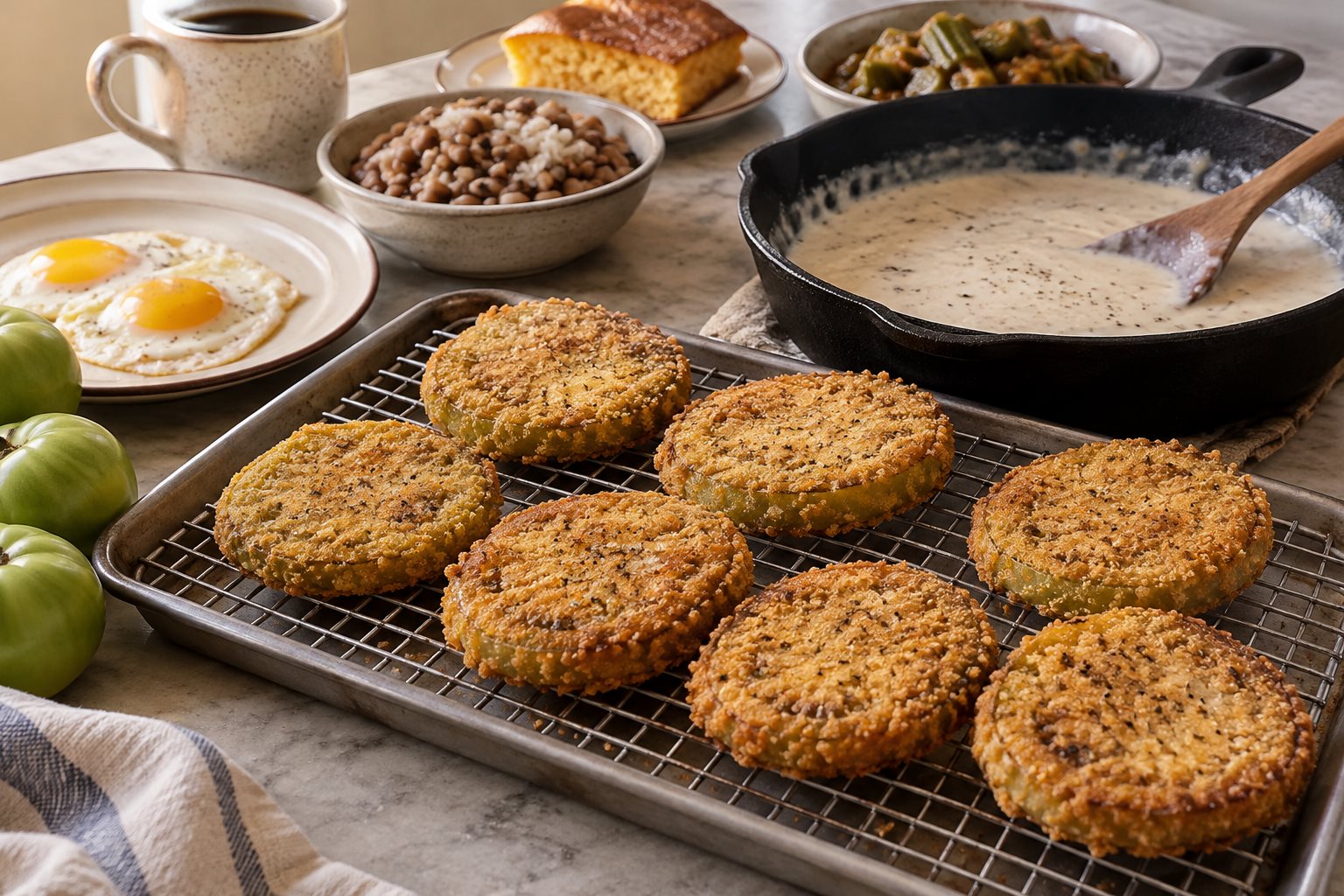
Salt the slices and leave them alone for twenty minutes. Every failure this dish has — sliding crust, soggy middle, grey gravy — starts with skipping that.
The dish comes with a history that does not survive being checked. The claim usually made is that it is old and Southern; the counter-claim, made just as often, is that green tomatoes fried in cornmeal show up in Northern and Midwestern kitchens first and that the Southern association is largely an invention of the years after Fannie Flagg's 1987 novel. Neither holds. Georgia Historic Newspapers, searched by exact phrase and sorted by date, returns the Atlanta Constitution of 23 September 1884, in the readers' recipe exchange that ran under the heading Woman's Kingdom: "Fried Green Tomatoes.—This is said to be a nice breakfast dish. Take large green tomatoes and cut in slices half inch thick. Have plenty of butter in your skillet. Lay your slices in, pepper, salt and sprinkle thick with sugar. Fry a nice brown." No cornmeal, no egg, no crumbs — butter and sugar, and an editorial hedge that tells you the Atlanta readership had not all met it yet. The same phrase search of Nebraska's archive at nebnewspapers.unl.edu turns up nothing before the Omaha Daily Bee of 4 October 1903, nineteen years later, and that one is egg and fine bread crumbs. On the two archives that answer, the record runs the other way from the counter-claim.
What is true is that the dish was missing from the books for a long time, North and South alike. Housekeeping in Old Virginia of 1879 does not contain the phrase green tomato once in a hundred and ten mentions of tomatoes, and its "Fried Tomatoes" are canned ones. Mrs. Hill's New Cook-Book of 1898, written by Annabella Hill of LaGrange, Georgia, has none either. Neither does Buckeye Cookery of 1877 out of the Midwest, which sends green tomatoes only to the pickle crock and to a pie; nor Aunt Babette's Cook Book, Cincinnati 1893; nor the Boston Cooking-School Cook Book of 1900. It lived in the newspaper column before it lived in a cookbook. And it was filed under Southern cooking long before 1987: the Cairo Messenger of Cairo, Georgia, on 28 February 1908 reprinted a Good Housekeeping column headed plainly "SOUTHERN COOKING", running fried green tomatoes alongside baked cashaw, sweet potato pone, peas and rice with cow-peas, and stewed okra — slices of large green tomato, salted, dipped in corn meal, fried slowly in a little butter under a lid, and noted as "easier to fry than ripe toma[toes]" and "an excellent break[fast]" dish. The right-hand edge of that line is lost in the scan, which is why it is quoted here with the gap showing. What the novel changed was volume rather than affiliation: of the 1,771 pages Georgia returns for the phrase, thirty are dated before 1992 — though that archive runs to 2025 and is far denser in its recent decades, so the count measures the corpus as much as it measures the dish. The Alabama end of the story is Fannie Flagg herself, born Patricia Neal in Birmingham on 21 September 1944 and raised in Irondale, per the Encyclopedia of Alabama; the Irondale Cafe survives on a postcard in Troy University's Wade Hall collection, digitised by the state archives, printed "The Original Whistle Stop Cafe, Irondale Cafe, Home of Fried Green Tomatos".
Why this version works
Half the sugar, six times the starch. USDA Bulletin No. 859, Charles E. Sando, issued 7 September 1920 and still the clearest account of the chemistry, tagged blossoms and picked fruit at known ages rather than by size — "Maturity is dependent upon age, not upon size" — and analysed them through. Sugars rose from 25.66 per cent of dry weight in fruit fourteen days old to 48.32 per cent in ripe fruit; starch fell from 15.84 to 2.65 per cent over the same span, and Sando notes the sharpest drop comes "during the period of transition from green to red". Moisture rises through the whole period and crude fibre and pentosans fall. That is the frying pan in a table: the green slice is drier, stiffer and far less sugary, so it takes a long, even heat without the crust going dark before the middle is hot, while a ripe slice scorches on the outside and floods the pan on the inside.
Take them dead green, then salt them. Sando found acidity does not simply climb: it rises from the second week to the fifth and then falls gradually through the last three weeks, so the highest acid sits around the change of colour rather than at either end. The Country Gentleman column reprinted in the Sylvania Telephone of 9 June 1916 had already reached the same place from the other direction — "Select tomatoes that show no signs of turning even yellow, for during the turning process there is a disagreeable acid flavor." Fully green, then, not half-turned. The salting is the other half: twenty minutes under salt pulls free water out of the cut faces, and less water means the egg wash grips instead of sliding and the cornmeal fries instead of steaming. Sister Mary's Kitchen, syndicated into the Augusta Herald of 13 October 1924, put a weight on top to hurry it along.
The pectin has not been taken apart yet. Handbook 66 describes the cell wall as cellulose, hemicellulose and pectin, and ripening as the solubilisation and degradation of that pectin together with a net loss of the neutral sugars galactose and arabinose and a fall in the molecular weight of the hemicelluloses, worked by polygalacturonases and a run of glycosidases — no one enzyme being the culprit. Cooking then does its own share: pectic polymers degrade by beta-elimination, and that plus the loss of cell turgor is what thermal softening is. A ripe slice arrives in the pan with half that demolition already done and finishes the job in ninety seconds, which is why it slumps into the crust and tears. A green slice has only the cooking half to survive, and survives it.
A green tomato is a mature tomato, not a baby one. The federal grade standards are exact about this and it is the single thing most home cooks get wrong. Section 51.1865 of title 7 of the Code of Federal Regulations defines Mature as a tomato that "has reached the stage of development which will insure a proper completion of the ripening process, and that the contents of two or more seed cavities have developed a jelly-like consistency and the seeds are well developed". Section 51.1860 then classifies colour only for lots that are already mature, and its first class, Green, means "the surface of the tomato is completely green in color". So the trade's mature green is those two conditions together, and a truly immature tomato is not gradeable at all. USDA Agriculture Handbook 66 gives the same thing as a cutting test, after Kader and Morris: stage M-1 has white seeds that the knife cuts through and no gel in the locules, M-3 has gel in every locule with the seeds pushing aside from the blade and the interior still green. M-3 is what you want. Handbook 66 even concedes the use: "Immature tomatoes are available for certain regional dishes."