The regional table / Indiana
Fried Biscuits with Apple Butter
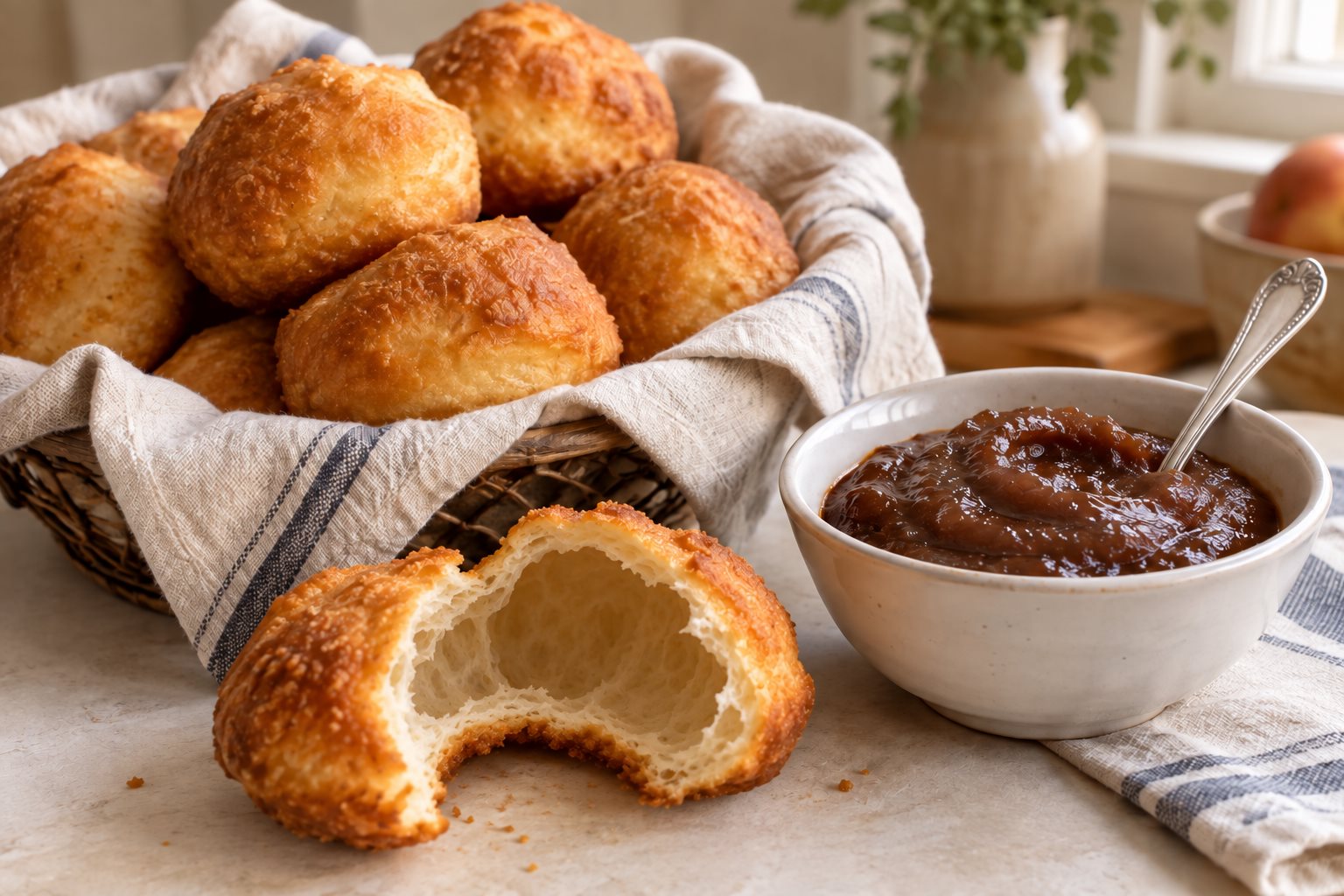
It is a bread roll cooked in fat instead of air, which changes everything about it except the dough, and it has to be eaten within about four minutes of coming out.
The name is precise, and the federal government is the one who made it so. The United States Department of Agriculture's Radio Service broadcast a Housekeepers' Chat on 2 January 1928 called "Out of the Frying Pan onto the Table", written with the Bureau of Home Economics, and it opens its question-and-answer section by settling the vocabulary: "Frying is cooking foods in deep fat. Sauteing is cooking foods in shallow fat. Doughnuts are fried. Chicken is sauteed." A fried biscuit is therefore fried in the strict sense — it floats, it never touches the bottom of the pan, and it is closer kin to a doughnut than to anything that comes out of an oven. The same broadcast notes, for anyone wondering whether all this fat ends up in the food, that fried foods are considered more desirable than sautéed ones "because fried foods absorb less fat, in the cooking process", and it gives the old method for saving the fat afterwards: melt it with slices of raw potato, heat gradually, and when it stops bubbling and the potato is brown, strain it through cheesecloth.
What is not documented is where Brown County got the idea. The yeast dough fried in deep fat is certainly old in Indiana — the Indianapolis Cook Book of 1883 prints "Raised Doughnuts" from a Mrs. Ends, a quart of sweet milk warmed with a quarter pound of butter and lard mixed, a cup of sugar, five eggs and a cup of yeast — but it calls the thing a doughnut, and the phrase fried biscuit appears nowhere in that book, nor in The Princeton Cook Book of 1909, nor in the Fort Wayne Lutheran Hospital cook book of 1927, all of which are full of soda biscuits and beaten biscuits and tea biscuits baked in an oven. The printed trail outside Indiana is no better: in Georgia Historic Newspapers, which carries syndicated columns from everywhere, the phrase surfaces first on 27 October 1916, when the Augusta Herald lists Fried Biscuits on the menu of a cookery lecture by Mrs. Kate Brew Vaughn at the Armory, and by 14 June 1967 it has been captured by the freezer case, advertised in the Griffin Daily News as a packer-label product in a can. Indiana's own newspaper portal at newspapers.library.in.gov answered 403 to every request on 22 September 2026, so no Brown County date is claimed here. The dish is a Brown County institution; the year it became one is not a thing this page can tell you.
Why this version works
350°F and nothing higher. Sweetened dough browns fast. At 375°F the outside is the colour of a walnut before the inside has finished steaming; at 325°F the biscuit sits in the fat long enough to drink it. Between 350 and 360°F, dropping about ten degrees each time a batch goes in, is the working range.
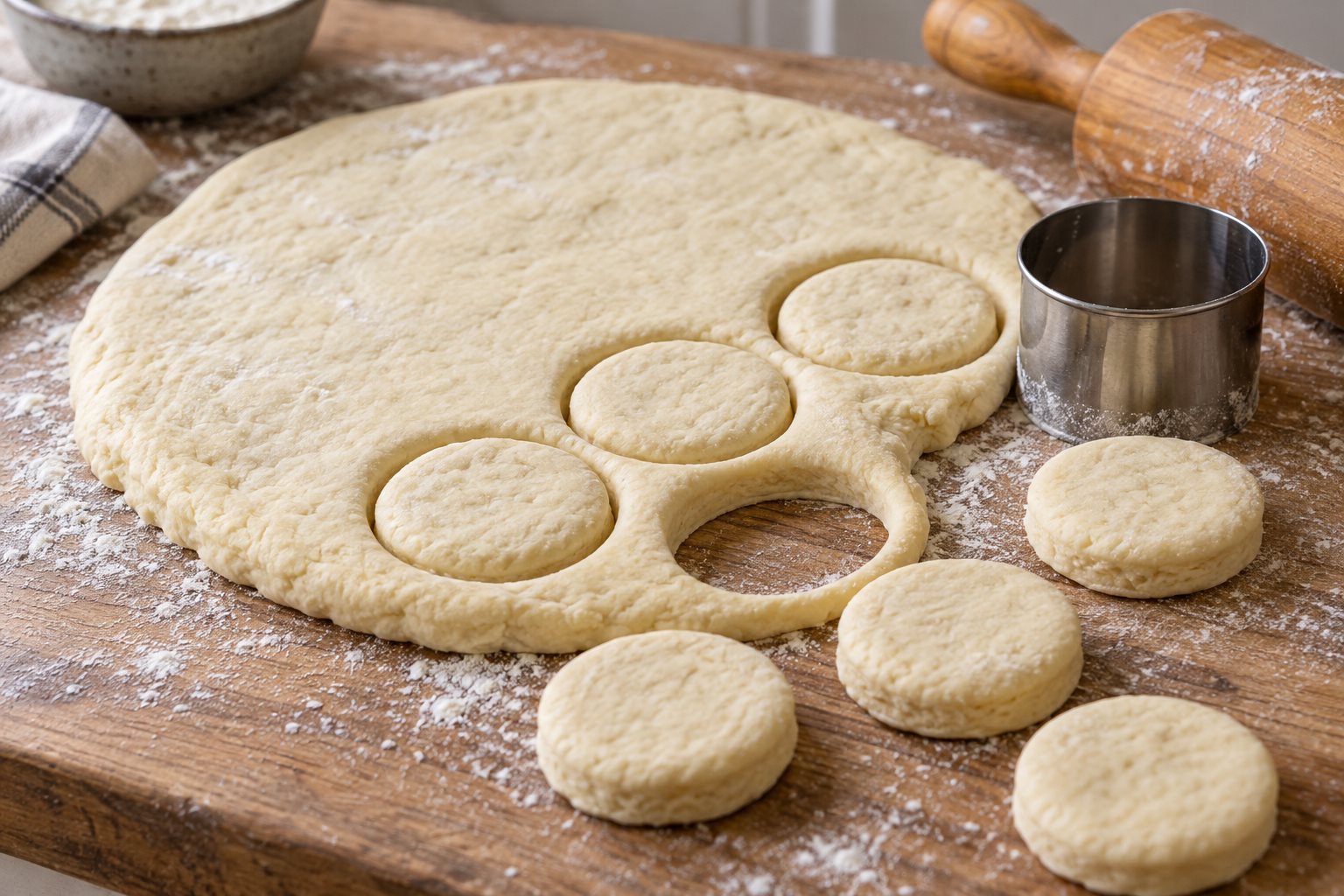
Rolled thin and cut small. Half an inch thick and two inches across is the size at which a biscuit cooks through in the ninety seconds its outside takes to colour. Bigger and thicker gives you a raw seam in the centre under a dark crust, which is the commonest way this goes wrong.
Apple butter cold, biscuit hot. The contrast is the dish. Apple butter is a fruit butter cooked down until the water is gone, and the federal grade standard in 7 CFR 52 puts its soluble solids at not less than 43 per cent and defines good consistency as a spoonful that "forms a moderately mounded mass" with practically no free liquor after two minutes on a flat surface. That thickness is what lets it sit inside a hot hollow biscuit instead of running straight out the bottom.
Yeast dough, not baking powder. A chemically leavened biscuit dropped in hot fat goes greasy and dense, because its gas is released all at once and it has no gluten structure to hold a shell. A yeast dough has already built its structure before it goes in; the fat simply sets the outside instantly and the trapped steam blows the middle open. That hollow is the whole texture.